
Smart Meter Market Share, Growth, Industry Analysis, 2026-2034
REPORT DETAILS
Smart Meter Market Size and Growth Outlook
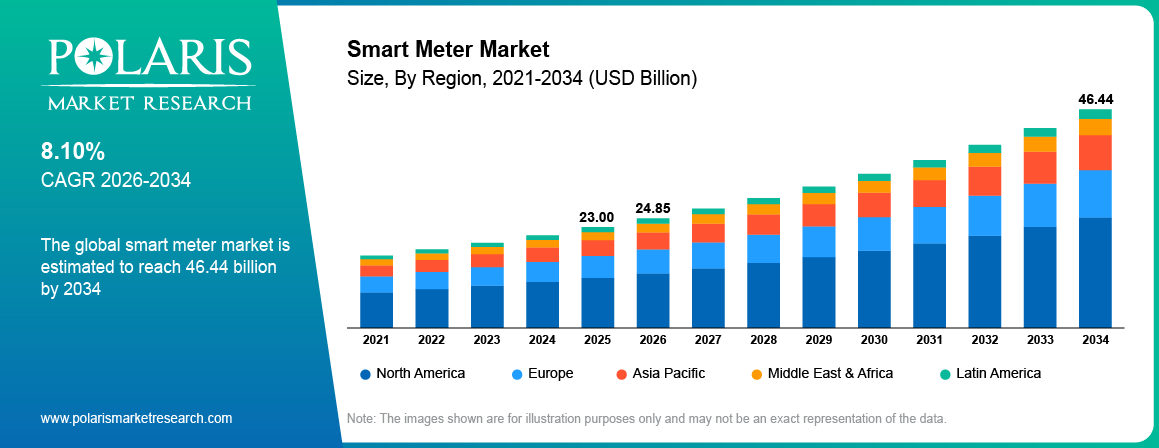
The global smart meter market was valued at USD 23.00 billion in 2025 and is forecast to grow at a CAGR of 8.10% from 2026 to 2034. Government initiatives for smart grids and energy conservation are driving adoption.
Market Statistics
Smart Meter Market Key Takeaways
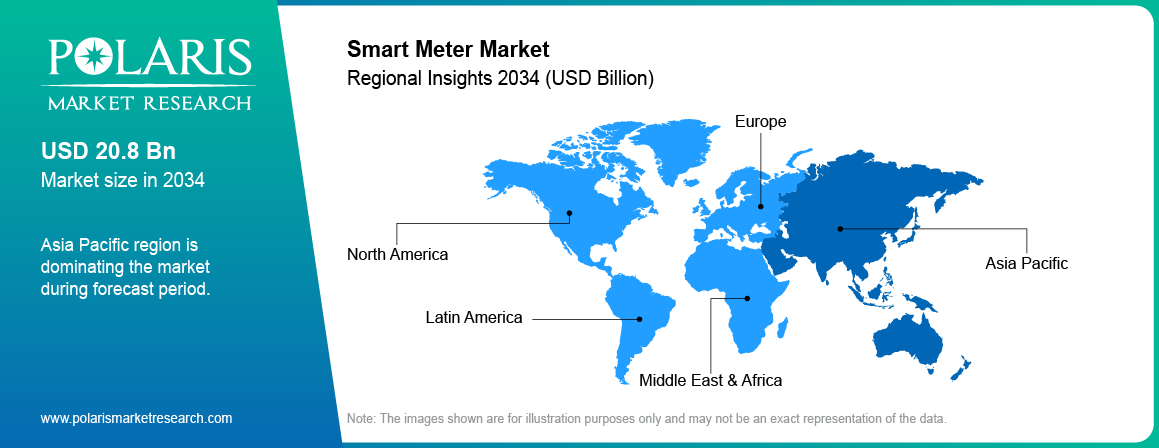
- Asia Pacific led the global market with a 40.0% share in 2025. This is owing to the widespread implementation of smart electric meters and smart gas meters in the region.
- North America is projected to witness significant growth at a 7.2% CAGR. Grid modernization and increased penetration of renewable energy contribute to the regional market growth.
- The advanced meter reading (AMR) segment led with a 68.0% share in 2025. This is because more utilities are recognizing its potential to enhance efficiency and elevate customer service.
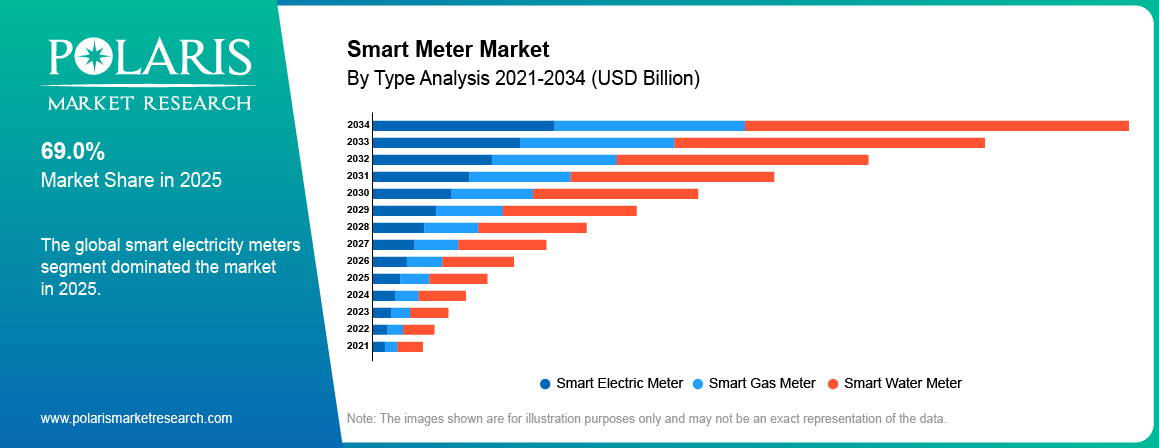
- Smart electricity meters held the largest market share of 69.0% in 2025. Smart electricity meters provide electricity suppliers real-time statistics on the energy consumption of consumers.
- The residential segment accounted for the largest market share of 68.0% in 2025. The government-mandated rollouts for households contribute to the segment’s leading market position.
Note: Figures and projections outlined in this report are the result of Polaris Market Research’s proprietary analytical processes, grounded in the latest available datasets and market observations.
What Is a Smart Meter and How Does It Work?
The global smart meter market has witnessed growth over the past few years, reshaping the landscape of the utility and energy sectors. Increasing consumer behavior towards more sustainable and efficient energy consumption models, the significance of smart meters has become rising significantly. These advanced devices, equipped with real-time data collection and communication capabilities, have emerged as a linchpin in the modernization of energy infrastructures worldwide.
One of the primary drivers propelling the smart meter market's expansion is the imperative need for enhanced energy management and conservation. Traditional metering systems, characterized by manual reading and periodic billing, could be more robust in their ability to provide timely insights into consumption patterns. In contrast, smart meters empower both utilities and consumers with granular, real-time data, facilitating informed decision-making and fostering a culture of energy consciousness. This transition from reactive to proactive energy management is pivotal in optimizing resource allocation, minimizing wastage, and mitigating the environmental footprint.
Furthermore, the integration of smart meters within the broader smart grid ecosystem amplifies their utility manifold. By facilitating bidirectional communication between utilities and end-users, these devices enable dynamic demand response mechanisms, grid monitoring, and fault detection. Such functionalities not only bolster grid reliability and resilience but also pave the way for the seamless integration of renewable energy sources. As the global energy mix undergoes a paradigm shift towards sustainable alternatives, the role of smart meters in balancing supply-demand dynamics and ensuring grid stability becomes increasingly indispensable.
The proliferation of smart meters is mainly due to digital transformation and technological innovation. As utilities worldwide struggle with aging infrastructures, evolving regulatory mandates, and escalating consumer expectations, the adoption of smart metering solutions emerges as a strategic imperative rather than a mere operational upgrade. Consequently, the market landscape is witnessing a surge in investments, partnerships, and acquisitions aimed at harnessing the full potential of smart metering technologies. For instance, In Jan 2023, Badger Meter, Inc. acquired Syrinix, Ltd., a UK-based intelligent water monitoring solutions provider, for £15 Billion, enhancing its smart water capabilities with high-frequency pressure monitoring and leak detection technologies.
Smart Meters vs Traditional Meters
| Factor | Smart Meter | Traditional Meter |
| Data Collection | Automated and immediate | Manual reading is necessary |
| Billing Efficiency | High efficiency | Error-prone |
| Monitoring | Immediate monitoring | Limited ability |
| Communication | Two-way communication system | One-way communication system |
| Efficiency | Efficient | Not as efficient |
| Energy Management | Facilitates energy management | Limited capability |
Source: Polaris Market Research Analysis
To Understand More About this Research: Download Sample Report
AI, Forecasting and Grid Analytics in the Smart Meter Market
- Artificial intelligence aids in analyzing energy consumption through smart meters in real-time.
- AI assists in energy management through forecasting energy consumption patterns and minimizing energy wastage.
- AI helps in enhancing the reliability of the electrical grid by detecting faults and abnormal usage of energy.
- Moreover, it helps to offer customized energy consumption information and demand management solutions.
Market Dynamics
Driver: Rising Government Support and Investments
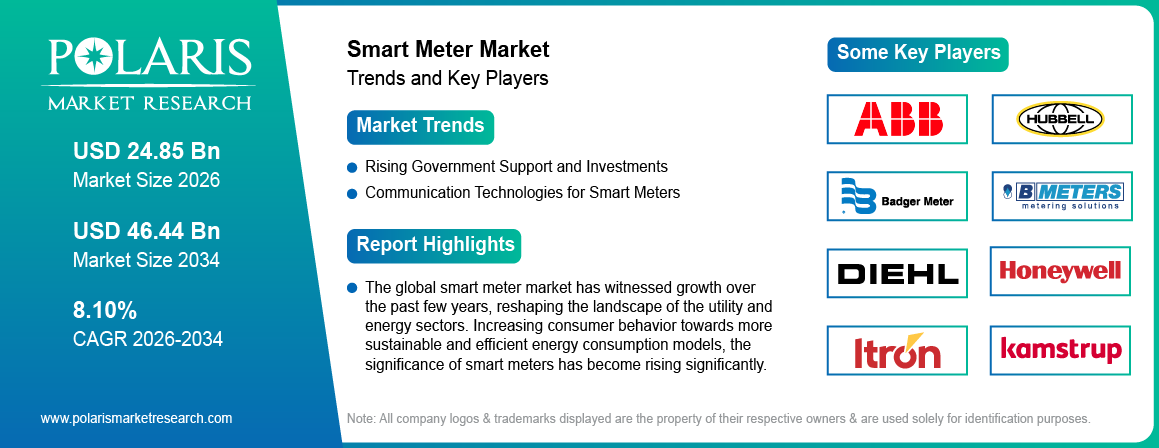
Rising government support and strategic investments in modernizing the energy infrastructure drive the market during the forecast period. To overcome climate change, energy efficiency, and the pressing need for sustainable solutions, the deployment of smart meters has emerged as a pivotal strategy for efficient energy management.
Governments, recognizing the transformative potential of smart meter technology, have increasingly taken proactive measures to accelerate its adoption. Policymakers and regulatory bodies have been essential in shaping the market landscape by introducing favourable policies, incentives, and frameworks that incentivize utilities and consumers alike. These initiatives often encompass a range of measures, from regulatory mandates requiring utilities to deploy smart meters to financial incentives designed to mitigate the initial capital costs associated with large-scale deployments.
For instance, The Energy Efficiency Services Limited (EESL), which the Indian government owns, has installed about 10 lakh smart meters across the country as part of the Smart Meter National Programme. The program aims to install 25 crore smart meters over the next few years. To ensure that there is an adequate supply of meters and to prevent monopolies, it has been proposed to establish a manufacturing base for smart electricity meters in the country. This development is expected to be a major driver of the program. Such government support not only catalyzes investments but also instills confidence among stakeholders, paving the way for broader acceptance and integration of smart meter solutions.
Furthermore, the influx of investments from both public and private sectors has been instrumental in fueling the growth of the smart meter market. Venture capital firms, institutional investors, and industry stakeholders have shown a keen interest in backing innovative smart meter technologies and solutions. These investments are often directed toward research and development, infrastructure development, and market expansion initiatives, thereby fostering technological advancements and driving down costs.
Driver: Communication Technologies for Smart Meters
Smart meters employ communication technologies like RF (radio frequency), PLC (power line communication), and cellular technologies to allow the transfer of real-time data on the amount of energy being consumed by the end user to the utility companies. RF communication technologies have gained immense popularity owing to the ability to share data wirelessly across long distances and even in smart grids. The effectiveness of power line communication technologies is derived from the ability to send data through power lines without employing other means of communication. The increasing popularity of cellular technologies like 4G and 5G among utility companies stems from the ability to exchange data efficiently over extensive areas.
Restraint: High Cost of Smart Meter Installation
The installation of smart meters involves considerable upfront expenditure, including equipment, deployment and integration with existing systems. For utilities operating under budget constraints, these costs can slow the pace of rollout or limit the scale of adoption. Higher initial investment may also extend the time needed to realize returns, making decision-making more cautious. Smaller utilities and emerging markets may find these cost barriers especially challenging. Addressing affordability remains an important consideration for sustained market growth.
Opportunity: Expansion of Smart Grids and Renewable Energy Integration
The continued development of smart grids and the integration of renewable energy sources are expected to open several new avenues for the market. Smart meters play a supporting role in these systems by enabling better visibility into energy use and supporting more responsive grid management. As utilities connect more renewable sources and modernize network operations, the need for advanced metering capabilities is likely to increase. Solution providers that offer compatible, scalable technologies can position themselves strongly in this evolving landscape. This convergence of grid modernization and clean energy adoption presents meaningful long-term potential for market participants.
For Specific Research Requirements, Request for a Customized Research Report
Report Segmentation
The market is primarily segmented based on type, technology, application, and region.
| By Type | By Technology | By Application | By Region |
|
|
|
|
Source: Polaris Market Research Analysis
To Understand the Scope of this Report: Request Customization
By Type Analysis
Smart Electricity Meters are Holding Largest Market Share in 2025 and Expected to Grow at High CAGR over the Forecast Period
Smart Electricity Meters held the largest share of 69.0% in 2025 and Expected to Grow at High CAGR over the Forecast Period. Smart electricity meters offer electricity suppliers real-time statistics on a consumer's energy consumption every hour or even more frequently, eliminating the necessity for manual readings by electric companies. These meters empower consumers by providing accurate, real-time data on their energy usage, granting them greater control over electricity consumption. Additionally, smart electricity meters afford consumers the flexibility to select the most suitable tariff plan based on their specific energy consumption patterns.
Moreover, the installation of smart meters has been mandated by the majority of governments, considering them integral to national energy policies aimed at enhancing efficiency and reducing carbon emissions. Several governments have initiated the deployment of smart meters as part of efforts to expedite their adoption.
For instance, In June 2021, the Government of India unveiled its initiative to replace traditional electric meters with smart meters by 2025. The initial phase of the project involves replacing existing electric meters in 500 AMRUT cities, industrial and commercial centers, and union territories. The subsequent phase will prioritize the implementation of smart metering devices in rural areas.
By Technology Analysis
The Advanced Metering Infrastructure (Ami) Segment Acquired Highest Market Share in 2025
The Advanced Metering Infrastructure (Ami) Segment Acquired Highest Market Share of 68.0% share in 2025. Automatic Meter Reading (AMR) is a technology employed to autonomously gather consumption, diagnostic, and status data from gas, electricity, or water metering devices. Subsequently, the AMR transmits this data to a centralized database for purposes such as billing, troubleshooting, and analysis. An automated meter reading device (AMR device) is an add-on that can be retrofitted onto an existing energy meter or water meter, transforming a conventional meter into a smart electricity meter or smart water meter by enabling the transmission of real-time data through a connected network.
The adoption of Automated Meter Reading (AMR) technology is growing at a CAGR of 6.9% during the forecast period as it is increasing as more utilities recognize its potential to enhance efficiency and elevate customer service. For businesses, AMR technology provides them with control over consumption and billing. Utilities, businesses, and homeowners are discovering the benefits of AMR systems in streamlining operations. The recent advancements in AMR technology and data communication further contribute to its appeal.
Regional Insights
Asia Pacific Region Held the Largest Share of the Global Market in 2025
The smart meter market in the Asia Pacific region accounted for 40.0% share in 2025 due to significant valuation and is poised to sustain its dominant position. This region is characterized by widespread implementations of smart electric meters, smart gas meters, and smart water meters, all aimed at fostering sustainable and efficient consumption of electricity, gas, and water respectively. The Asia Pacific region has witnessed a substantial increase in renewable energy production, leading to the establishment of new energy grids and the expansion of transmission and distribution networks. These advancements have propelled the installation of smart meters throughout the region. While natural gas and water meters currently hold a smaller presence compared to electricity meters, their market share is anticipated to grow with the rising adoption of IoT and mobile device management.
Key countries in the region, including China, Japan, and South Korea, have either implemented or are planning large-scale smart meter rollouts. Furthermore, the increasing uptake of renewable energy sources and the demand for more precise and real-time energy data are contributing to market expansion. However, challenges such as the need for more standardization and concerns about cybersecurity may impede market growth.
Source: Polaris Market Research Analysis
Smart Meter Market Competitive Landscape and Key Companies
The Smart Meter market is characterized by intense competition, with numerous manufacturers holding a significant portion of the market share. Key business strategies employed by market participants to sustain and expand their global presence include product launches, approvals, strategic acquisitions, and innovations.
Some of the major players operating in the global market include:
- ABB
- Hubbell
- Badger Meter
- BMETER
- Diehl
- Honeywell
- Itron, Jabil
- Kamstrup
- Landis+Gyr
- Secure Meters Ltd
- Sensus
- Siemens
- ZENNER
Smart Meter Market Recent Developments
- March 2026: Genus Power exceeded the installation of 26 million smart meters globally. The company said that the achievement underscores its position as a leader in end-to-end smart metering systems. (source: prnewswire.com)
- February 2026: Adani Energy Solutions Limited (AESL) announced the successful delivery of 1 crore electricity smart meters across discoms. According to AESL, the milestone underscores the company’s commitment to boost digital transformation in retail electricity distribution. (source: adani.com)
- March 2025: Honeywell unveiled the NXU Residential Smart Gas Meter to enhance safety for North American gas users with automation and remote control, using Forge Performance+ to deliver real-time utility insights. (Source: honeywell.com)
- March 2025: Itron and CHINT Global launched the first residential smart meter using the ACESM GCP standard, improving interoperability and easing multi-vendor integration to speed smart meter adoption and cut deployment costs. (Source: chint.com)
- February 2025: EDF India and Actis launched a $200 million JV to deploy advanced smart metering infrastructure, improving energy efficiency, reducing losses, and enhancing billing accuracy, supporting India's goal of 250 million smart meters by 2025. (Source: act.is)
Smart Meter Market Report Scope
| Report Attributes | Details |
| Market size value in 2025 | USD 23.00 Billion |
| Market size value in 2026 | USD 24.85 Billion |
| Revenue forecast in 2034 | USD 46.44 Billion |
| CAGR | 8.10% from 2026– 2034 |
| Base year | 2025 |
| Historical data | 2021 – 2024 |
| Forecast period | 2026 – 2034 |
| Quantitative units | Revenue in USD Billion and CAGR from 2026 to 2034 |
| Segments covered | By Type, By Technology, By Application, By Region |
| Regional scope | North America, Europe, Asia Pacific, Latin America, Middle East & Africa |
| Customization | Report customization as per your requirements with respect to countries, region, and segmentation. |
Source: Polaris Market Research Analysis
We provide our clients the option to personalize the Smart Meter Market report to suit their needs. By customizing the report, you can get data as per your format and definition. Also, the customization option allows you to gain a deeper dive into a specific segment, region, customer, or market competitor.
Browse Our Top Selling Reports
Multi-access Edge Computing Market Size, Share 2024 Research Report
Industrial Refrigeration Systems Market Size, Share 2024 Research Report
Tacrolimus Market Size, Share 2024 Research Report
U.S. Metaverse Market Size, Share 2024 Research Report
U.S. Data Center Cooling Market Size, Share 2024 Research Report
Smart Meter Market FAQs
The global Smart Meter market size is expected to reach USD 46.44 Billion by 2034.
Key players in the market are ABB, Hubbell, Badger Meter, BMETER, Diehl, Honeywell, Itron, Jabil
Asia Pacific led the global market with a 40.0% share in 2025.
The global smart meter market is expected to grow at a CAGR of 8.10% during the forecast period.
The smart meter market report covering key segments are type, technology, application, and region.
Smart meters are advanced devices equipped with real-time data collection and communication capabilities that measure electricity, gas, or water consumption, enabling proactive energy management and efficient utility billing.
Key trends include rising government mandates for smart grid modernization, growing Advanced Metering Infrastructure (AMI) adoption, IoT integration, renewable energy expansion, cybersecurity enhancements, and large-scale national smart meter deployment programs globally.
Download Sample Report of Smart Meter Market
Please fill out the form to request a customized copy of the research report.


