
STD Diagnostics Market Size, Share, Trends & Forecast, 2026-2034
REPORT DETAILS
STD Diagnostics Market Summary
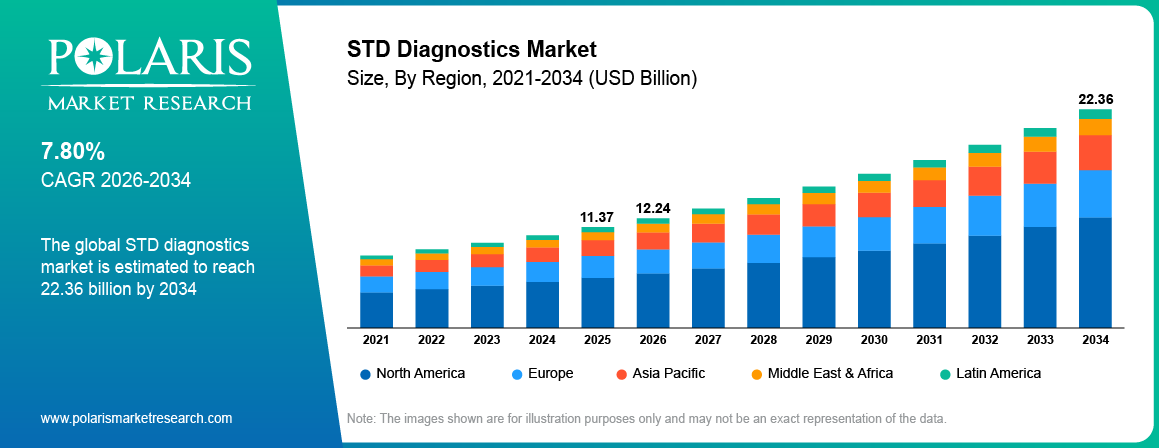
STD diagnostics market size was valued at USD 11.37 billion in 2025. The market is anticipated to grow from USD 12.24 billion in 2026 to USD 22.36 billion by 2034, exhibiting the CAGR of 7.80% during the forecast period.
Market Statistics
STD Diagnostics Market Key Takeaways
- North America dominated the global market with 41.6% share in 2025. Increasing prevalence of STD diseases boost the regional market growth.
- The Asia Pacific market is anticipated to record the highest CAGR of 7.9% during the forecast period. The regional market growth is driven by favorable government initiatives promoting the importance of early detection & diagnosis of STDs.
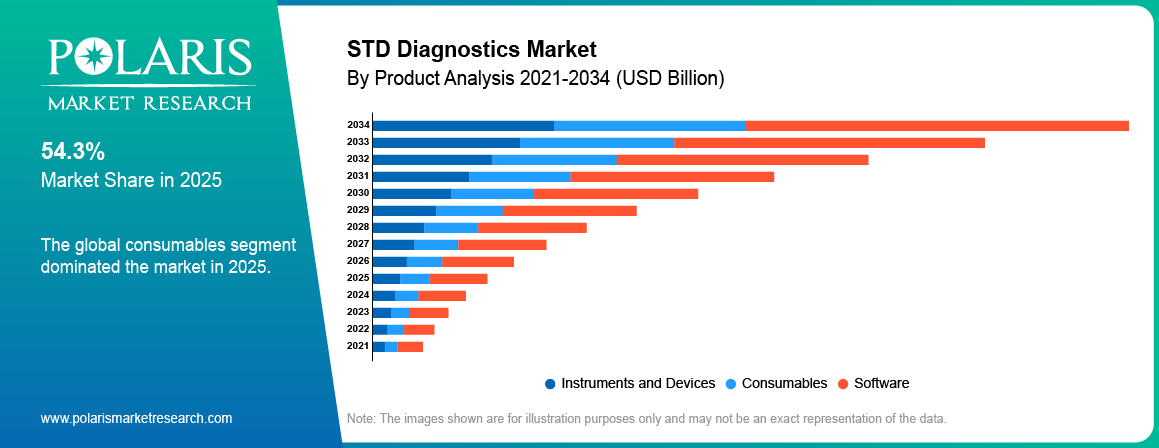
- The consumables segment held the largest share of 54.3% in 2025. This is attributed to its upsurging demand in STD diagnostics.
- The HIV testing segment led with 29.7% revenue share in 2025. Rising prevalence of HIV diseases worldwide propels the dominance.
- The molecular diagnostics segment is anticipated to record the highest CAGR of 7.6% during 2026–2034. It is fueled by its advantages such as cost-effectiveness, accuracy, and user-friendliness.
Note: Figures and projections outlined in this report are the result of Polaris Market Research’s proprietary analytical processes, grounded in the latest available datasets and market observations.
What Are STD/STI Diagnostic Tests? Definition, Test Types & Market Scope
Sexually transmitted diseases (STDs) diagnostics uses several diagnostic methods for disease detection. A few STD examples include chlamydia, gonorrhea, syphilis, HIV, HPV, herpes simplex virus, and many others. Through such methods, an early diagnosis is made, and treatment of these diseases begins. They help in disease management and preventing their spread. It helps improve public health outcomes.
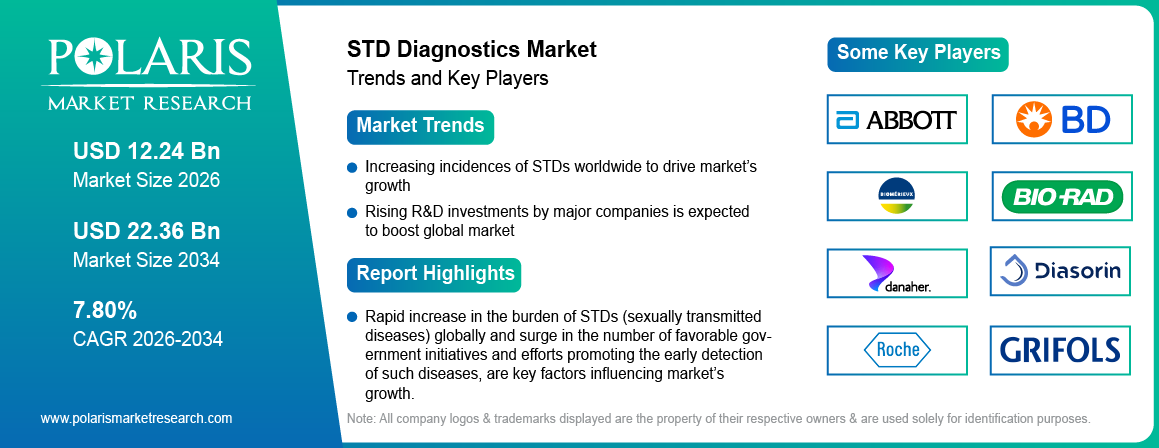
Rapid increase in the burden of STDs (sexually transmitted diseases) globally and surge in the number of favorable government initiatives and efforts promoting the early detection of such diseases, are key factors influencing market’s growth. Additionally, rising awareness among general public and healthcare professionals regarding the importance of early detection of STDs for effective treatment, also leading to greater need for efficient diagnostic tests.
- For instance, in July 2023, The World Health Organization, released its latest guidance to improve the diagnosis and treatment of sexually transmitted infections. As over 1 million new STIs (sexually transmitted infections) are acquired on daily basis, that creates a global challenge for the treatment or diagnosis of such infections.
As more number of innovated tools are increasingly need worldwide to fight against the STDs because there are no signs of slowing the number of STDs without long-term investment and new game-changing innovations in rapid diagnostics, vaccine development, prevention, and treatment. Thus, companies are heavily focusing on the development of new solutions for efficient care or diagnosis of STIs.
- For instance, in May 2022, Becton, Dickinson, and Company, announced the launch of its new automated and high-throughput infectious disease molecular diagnostic platform. The newly developed system includes a single test which detects three most prevalent non-viral sexually transmitted infection.
The STD Diagnostics Market report details key market dynamics to help industry players align their business strategies with current and future trends. It examines technological advances and breakthroughs in the industry and their impact on the market presence. Furthermore, a detailed regional analysis of the industry at the local, national, and global levels has been provided.
How Does STD/STI Diagnostic Testing Work? Samples, NAAT/PCR, Serology & Rapid Tests
- The patient sample is obtained from the blood, urine, swab, or tissue samples.
- The sample is then processed either for laboratory or rapid test analyses.
- Diagnosis is done using either molecular, serology, and culture, or antigen tests.
- Identification of pathogens involves finding the infectious organism or markers.
- Analyzed data is used to determine if the infection exists or not.
- If there is an infection, appropriate treatment and follow ups are prescribed.
Source: Polaris Market Research Analysis
To Understand More About this Research: Download Sample Report
Market Dynamics
Driver: Rising Global STI Burden and Screening Demand
The number of people suffering with several types of sexually transmitted diseases in increasing rapidly across the globe, which acts as a significant driver for the market. Also, growing awareness, changes in sexual behaviors, and higher screening are also the factors contribute to the diagnosis of STDs globally.
- For instance, according to the World Health Organization, every year more than 374 million new STI infections are acquired across the world. And, over 500 million aged 15049 years are projected to have genital infection with herpes simplex virus.
Opportunity: R&D Investment in Rapid, Molecular & Multiplex STI Diagnostics
Growing investments in R&D activities by key players in order to introduce novel & innovative products and bring advancements in diagnostic technologies like point-of-care testing, serological assays, and nucleic acid amplification tests, are further anticipated to create growth opportunities for the market.
- For instance, in June 2023, Linear Diagnostics, announced that they have obtained funding from the National Institute for Health and Care Research UK, for the development of 20-minute sexually transmitted disease test to effectively diagnose Chlamydia and gonorrhoea.
Restraint: High Molecular/Advanced Diagnostic Costs and Screening-Awareness Gaps
The high costs associated with innovated diagnostic devices for STDs and lack of awareness among general population about the importance of regular STD screening and available treatment options, are factors could hamper the global market growth.
Rapid STD/STI Testing vs Laboratory Testing: Time, Accuracy, Cost & Use Setting
| Feature | Rapid STD Testing | Laboratory Testing |
| Results Time | Minutes | Hours to days |
| Accuracy | High | Very high |
| Convenience | High | Moderate |
| Cost | Lower | Higher |
| Point-of-Care Use | Yes | Limited |
| Comprehensive Analysis | Limited | Extensive |
Source: Polaris Market Research Analysis
Source: Polaris Market Research Analysis
AI Impact on STD Diagnostics: Test Interpretation, Lab Automation & Outbreak Analytics
- Artificial intelligence (AI) is used to analyze complex diagnostic data. It improves the accuracy of STD detection.
- Machine learning algorithms help achieve fast analysis of tests conducted for molecules and immunoassays.
- AI allows early detection of sexually transmitted infections through prediction analytics.
- Clinical decision support using AI allows health practitioners to choose proper diagnostic pathways.
- The intelligent automation of the laboratory process is employed to avoid manual errors.
Role of STD/STI Diagnostics in Screening, Surveillance & Public Health Programs
STD diagnostic testing is an integral part of public health infrastructure both nationally and regionally. This is going far beyond clinical medicine to cover disease control on a population scale.
- Disease surveillance: infection tracking among demographics and geographic areas
- Outbreak surveillance: rapid infection outbreak monitoring
- Screening programs: disease detection programs run by the government or NGO's
- Contact tracing: people who may have been exposed to infections being tested
- Prevention programs: helping out vaccine campaigns and awareness programs
STD Diagnostics Market Segmentation Analysis
The market is primarily segmented based on product, application, technology, and region.
| By Product | By Application | By Technology | By Region |
|
|
|
|
Source: Polaris Market Research Analysis
STD Diagnostics Market by Product
Consumables Held 54.3% of the STD Diagnostics Market in 2025
The consumables segment accounted for notable share. Segment’s dominance is attributed to its increasing demand in STD diagnostics, as they are designed in such a way to provide reliable and accurate results and enable early detection of STDs. Moreover, as it is a type of multiplex test which can detect and even differentiate four common STDs at a single time, allowing health facilities to scale up their diagnostic capabilities.
The software segment is expected to grow at highest growth. This growth is due to their growing proliferation in healthcare settings because they allow for efficient management and integration of patient information while reducing manual errors and boosting efficiency.
STD Diagnostics Market by Infection/Test Type
The HIV testing segment led with 29.7% revenue share in 2025.
The HIV testing segment held the maximum revenue share. This dominance is attributable to rising prevalence of HIV diseases worldwide and growing number of government health campaigns or programs to raise awareness about the importance of HIV testing. For instance, as per our findings, more than 39 million people across the globe were living with HIV in 2022, and approx. 1.3 million people were newly affected with the disease in 2022. And, over 630,000 people died due to AIDS-related illness in the year.
Importance in Women's Health & Prenatal Screening
The screening for sexually transmitted diseases (STDs) is one of the main ways to ensure reproductive health of women. This check-up helps in the prevention of serious conditions like infertility, pelvic inflammatory disease, and cervical cancer. These conditions are caused by untreated infections, including HPV and chlamydia. The prenatal screening of STDs is an important element of prenatal care. It helps detect infections that can be passed to the baby during pregnancy or delivery. Thus, access to STD diagnostic procedures is one of the priorities of global public health programs.
STD Diagnostics Market by Technology
Molecular diagnostics segment is expected to witness highest growth
The molecular diagnostics segment is anticipated to record the highest CAGR of 7.6% during 2026–2034.Segment’s growth is attributed to rising use of high-throughput PCR technology for the detection of STDs due to its numerous advantages such as cost-effectiveness, accuracy, and user-friendliness. Also, the growing availability of at-home molecular testing kits for STDs allowing individuals to have tests in their homes, is further propelling segment’s growth.
The immunoassay segment led the market. This is due to its higher testing rates for STDs as compared to other technologies and growing proliferation for the regulatory approvals of new and more innovative immunoassay products for the diagnosis & care.
STD/STI Diagnostics Use Cases: Screening, Diagnosis, Prenatal Care & Blood Safety
| Application | Real-World Example |
| HIV Screening Programs | Routine HIV testing in hospitals, community clinics, and national screening initiatives. |
| Chlamydia Testing | NAAT-based screening for sexually active individuals and high-risk populations. |
| Gonorrhea Diagnosis | Molecular and culture testing to confirm Neisseria gonorrhoeae infection. |
| Syphilis Detection | Serological screening during routine health checkups and antenatal care. |
| HPV Screening | HPV DNA testing for cervical cancer screening programs. |
| Prenatal STI Testing | Screening pregnant women for HIV, syphilis, chlamydia, and hepatitis infections. |
| Blood Donor Screening | Testing donated blood for HIV, syphilis, and other transfusion-transmissible infections. |
Source: Polaris Market Research Analysis
Point-of-Care & At-Home STI Testing Market Trends
Point-of-care (POC) diagnostic systems are increasingly being adopted by healthcare professionals. POC diagnostic systems give the result in a single patient consultation, allowing for rapid counseling and treatment, thus reducing the need for follow-up consultations. The need for confidentiality and convenience drives the uptake of at-home testing kits for STDs. Digital health systems facilitate this by managing the logistics of specimen sampling and providing results.
- Rapid result reporting for better decision-making during clinical consultations
- Increased use of self-testing kits for chlamydia, gonorrhea, HIV, and syphilis
- Result reporting via digital means during telemedicine consultation
- Increased compliance from patients due to shorter waiting times and fewer visits
- De-centralized testing in pharmacies and other health facilities
Digital Health in STD/STI Diagnostics: Telehealth, Home Testing, Apps & EHR Integration
Digital transformation is changing the way STD testing is being conducted and interpreted. There has been an increasing use of connected technologies and AI-enabled devices that are improving the process of testing in terms of speed, accuracy, and accessibility.
- Telediagnostics through telemedicine consultation for remote diagnosis and treatment plan
- AI-enabled device to interpret the test result to eliminate errors made manually
- Mobile health apps to order tests and monitor results
- EHRs integration to streamline the workflow
- Predictive analytics to detect outbreaks and plan resources
- Patient monitoring after a test
Source: Polaris Market Research Analysis
STD Diagnostics Market by Region
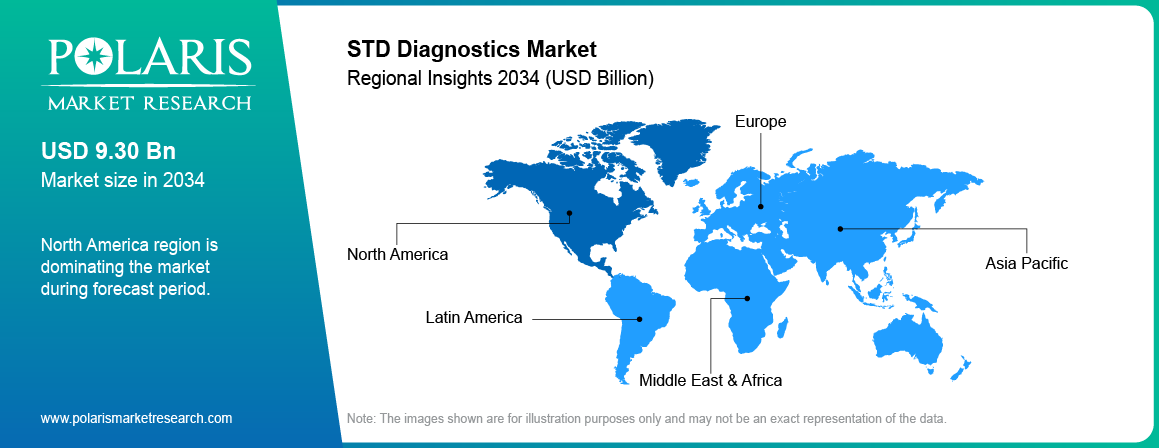
North America dominated the global market with 41.6% share in 2025
The North America region dominated the global market. Region’s dominance is accelerated by rising prevalence of STD diseases and presence of technologically advanced diagnostic solutions such as nucleic acid amplification tests and point-of-care testing in the region. In addition, increasing emphasis on the adoption of early detection measures to reduce the transmission rates of STDs and growing preference for rapid and convenient testing methods, further contributes to adoption of STD diagnostics. For instance, according to the Centers for Disease Control and Prevention, about 1 in every 5 people in the US have a STI, that means around 68 million people are suffering with some kind of STIs in the country.
The Asia Pacific market is anticipated to record the highest CAGR of 7.9% during the forecast period.
Region’s growth is accelerated by increasing number of STI cases, rapid growth in younger population who are more prone to such diseases, and robust presence of favorable government initiatives promoting the importance of early detection & diagnosis of STDs. For instance, according to our findings, over 6% of total adult population in India are affected with sexually transmitted infections.
Source: Polaris Market Research Analysis
STD Diagnostics Competitive Landscape & Leading Companies
Regulatory approvals and new product development to drive market competition
The STD diagnostics market is modertaly competitive in nature with the robust presence of global and regional players consolidating for their position. Companies are competing on various factors such as improving reliability and accuracy of their diagnostic tests, compliance with regulatory standards, offering cost-effective solutions, gaining approvals from health authorities, and adoption of innovative diagnostic technologies.
Leading STD/STI Diagnostics Companies
- Abbott Laboratories (US)
- Becton, Dickinson, and Company (US)
- bioMerieux SA (France)
- Bio-Rad Laboratories (US)
- Danaher Corporation (US)
- DiaSorin S.p.A. (Italy)
- F. Hoffmann-La Roche Ltd. (Switzerland)
- Grifols S.A. (Spain)
- Hologic Inc. (US)
- QIAGEN (Netherlands)
- Quidel Corporation (US)
- Roche Diagnostics (Switzerland)
- Siemens Healthcare (Germany)
- Thermo Fisher Scientific (US)
STD Diagnostics Market Developments: Home Tests, POC Molecular Assays & Partnerships
- June 2026: LotusDx established its research and development (R&D) laboratory at ONE BioHub, in Aberdeen, UK. With this move, the company will develop at-home STI testing kits. It will boost clinical validation and commercialization of these kits.(Source: clpmag.com)
- May 2026: AAZ signed a co-development and commercialization agreement with En Carta Diagnostics. With this agreement, the companies aim to advance rapid decentralized STI screening.(Source: EINPresswire.com)
Future Outlook of STD Diagnostics Market
The STD diagnostics industry is expected to grow significantly during the forecast period. The growth will be driven by rising STI prevalence and expanding screening initiatives. Also, growing adoption of molecular diagnostic technologies would propel the market expansion. The market is experiencing continuous advancements in PCR testing, point-of-care diagnostics, home-based testing kits, and AI-powered laboratory solutions. This will improve diagnostic accuracy and accessibility. Rising public health awareness and digital healthcare integration are expected to drive the growth. Surging investments in infectious disease surveillance will strengthen market expansion during the forecast period.
STD Diagnostics Market Report Coverage, Segmentation & Forecast Outlook
The STD diagnostics market report emphasizes on key regions across the globe to provide better understanding of the product to the users. Also, the report provides market insights into recent developments, trends and analyzes the technologies that are gaining traction around the globe. Furthermore, the report covers in-depth qualitative analysis pertaining to various paradigm shifts associated with the transformation of these solutions.
The report provides detailed market analysis while focusing on various key aspects such as competitive analysis, product, application, technology, and their futuristic growth opportunities.
STD Diagnostics Market Report Scope, Segmentation & Forecast Coverage
| Report Attributes | Details |
| Market size value in 2025 | USD 11.37 billion |
| Market size value in 2026 | USD 12.24 billion |
| Revenue forecast in 2034 | USD 22.36 billion |
| CAGR | 7.80% from 2026 – 2034 |
| Base year | 2025 |
| Historical data | 2021 – 2024 |
| Forecast period | 2026 – 2034 |
| Quantitative units | Revenue in USD billion and CAGR from 2026 to 2034 |
| Segments covered |
|
| Regional scope |
|
| Competitive Landscape |
|
| Report Format |
|
| Customization | Report customization as per your requirements with respect to countries, region and segmentation. |
Source: Polaris Market Research Analysis
Browse Our Top Selling Reports
Hydrogen Hubs Market Size, Share 2024 Research Report
Therapeutic Hypothermia Systems Market Size, Share 2024 Research Report
Digestive Health Supplements Market Size, Share 2024 Research Report
Europe Digestive Health Supplements Market Size, Share 2024 Research Report
Lidocaine Hydrochloride Market Size, Share 2024 Research Report
STD Diagnostics Market FAQ's
key companies in STD Diagnostics Market are Abbott Laboratories, F. Hoffmann-La Roche Ltd., Roche Diagnostics
STD diagnostics market exhibiting the CAGR of 7.80% during the forecast period.
The STD Diagnostics Market report covering key segments are product, application, technology, and region.
key driving factors in STD Diagnostics Market are Increasing incidences of STDs worldwide to drive market’s growth
The global STD diagnostics market size is expected to reach USD 22.36 billion by 2034
STD tests can detect HIV, chlamydia, gonorrhea, syphilis, HPV, herpes simplex virus (HSV), hepatitis B, hepatitis C, and trichomoniasis infections. It uses molecular, serological, culture, or antigen-based diagnostic methods.
STI testing is used to identify infections that may not yet cause symptoms. However, STD testing generally diagnose infections that have progressed to symptomatic disease.
Download Sample Report of STD Diagnostics Market
Please fill out the form to request a customized copy of the research report.


