
Trade Surveillance Systems Market Insights, Industry Analysis Report, 2026-2034
REPORT DETAILS
Trade Surveillance Systems Market Summary
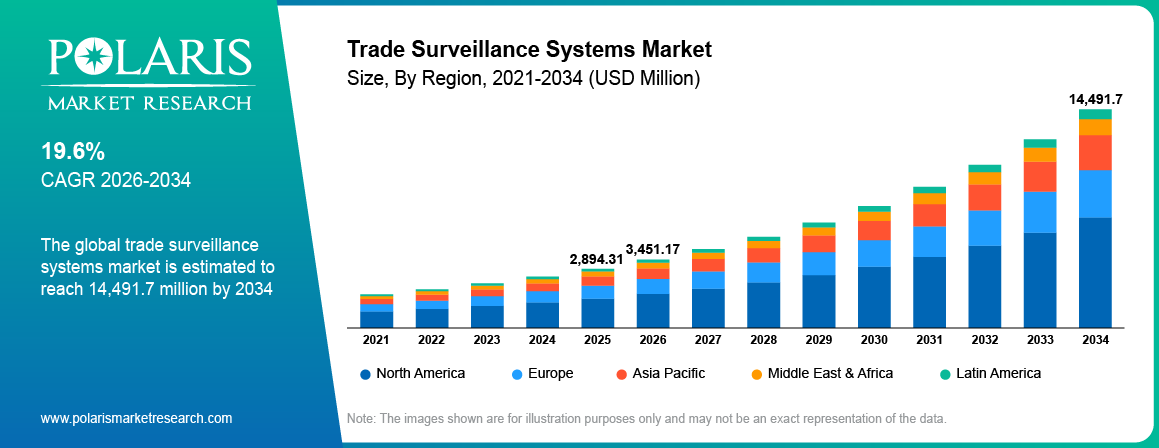
The global trade surveillance systems market was valued at USD 2,894.31 million in 2025. The market is expected to register a CAGR of 19.6% from 2026 to 2034. The increasing focus on compliance with regulations across various industries and the rising complexity of financial transactions boost the demand for trade surveillance systems. In addition, the growing adoption of cloud-based trade surveillance systems is expected to fuel the industry expansion in the coming years.
Market Statistics
Key Takeaways
- North America held substantial market with a 39.6% revenue share in 2025. It is attributed to the presence of major financial hubs, such as London, Frankfurt, and Paris.
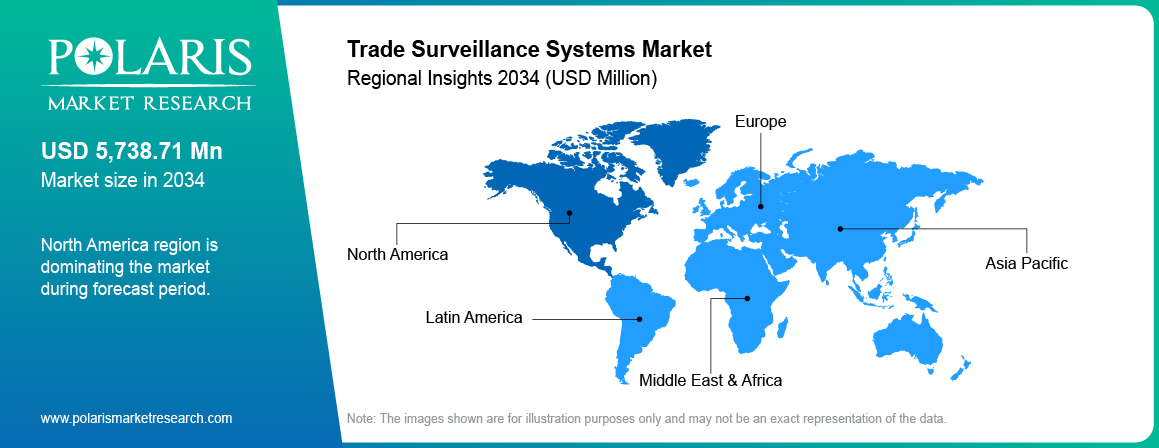
- The trade surveillance systems industry in North America is expected to grow at a 19.7% CAGR. The rapid adoption of AI-driven compliance solutions and evolving regulatory frameworks boost the regional market expansion.
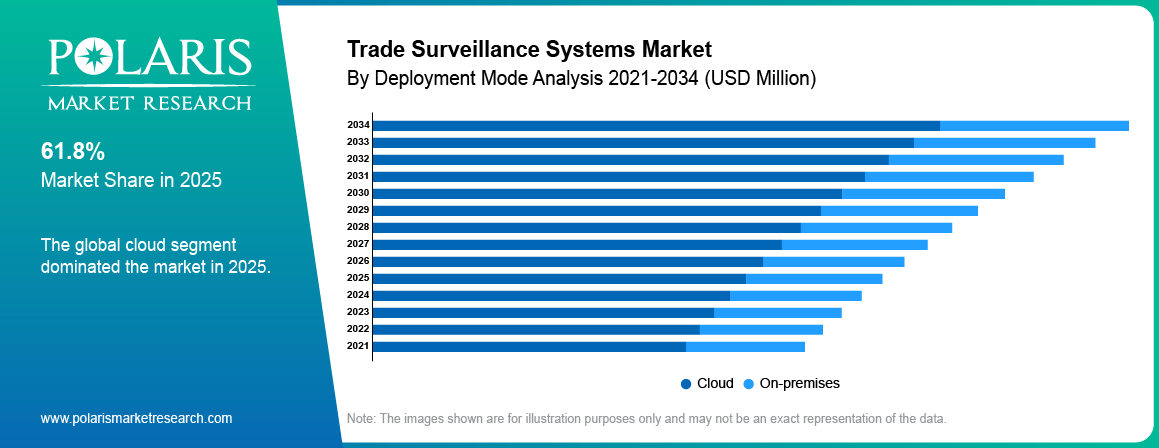
- The cloud segment is expected to register the highest growth rate of 61.8%. Its benefits, such as scalability and ease of implementation, propel this dominance.
- The large enterprises segment held the largest share of 71.9% in 2025. Their extensive trading activities and stringent regulatory compliance requirements propel the segment’s leading position.
- The banks segment accounted for the largest market share of 47.6% in 2025. This is because banks need to strictly comply with mandates such as MAR and MiFID II.
Note: Figures and projections outlined in this report are the result of Polaris Market Research’s proprietary analytical processes, grounded in the latest available datasets and market observations
AI Impact on Trade Surveillance Systems Market
- Artificial intelligence (AI) facilitates surveillance across equities, FX, derivatives, fixed income, and crypto markets.
- AI systems are transparent and regulator-friendly. They address concerns regarding decision-making accountability.
- The rising adoption of decentralized finance platforms and digital assets propels the demand for AI tools to monitor these complex ecosystems.
To Understand More About this Research: Download Sample Report
Trade surveillance systems monitor financial transactions to detect potentially illegal or abusive trading activities. These systems are typically automated web applications or software designed to capture a firm’s trade data and automatically test it to find and raise any potential instances of fraud. These systems identify irregularities such as market manipulation, insider trading, and other unethical or unlawful market behavior.
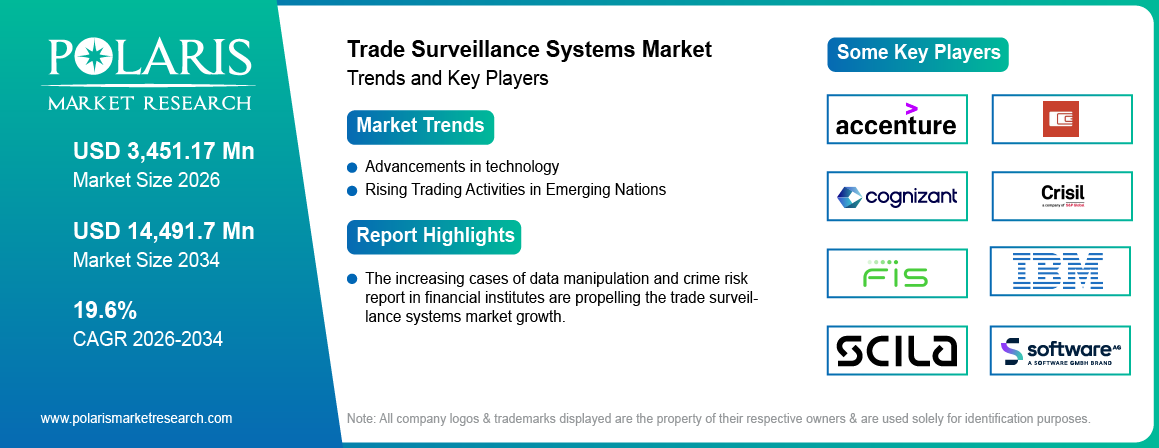
The increasing cases of data manipulation and crime risk report in financial institutes are propelling the trade surveillance systems market growth. As per published data, USD 387.67 million (₹3,207 crore) was lost because of 5,82,000 cases of cyber fraud in the banking sector between FY2020 and FY2024 in India. Regulators in the financial sector are imposing stringent compliance requirements, forcing finance firms to adopt advanced trading surveillance tools to analyze vast amounts of trading data in real time, which leads to early detection and prevention of data manipulation and fraud. The need for transparency and investor confidence further fuels the demand for trade surveillance systems, as these systems protect investors from losses caused by market abuse such as spoofing, layering, and wash trading.
The trade surveillance systems market demand is driven by the growing digitalization transformation. Digitalization leads to increased adoption of digital platforms that execute trades in milliseconds, creating massive data flows that require real-time monitoring. This drives financial firms to adopt advanced trade surveillance systems to detect and prevent manipulative practices such as insider trading.
Market Dynamics
Driver: Advancements in technology
The introduction of high-frequency trading, algorithmic trading, and digital asset exchanges generate massive volumes of transactions at high speeds, creating a need for advanced trade surveillance systems to monitor these activities in real time and detect potential market abuses such as spoofing and layering. Furthermore, artificial intelligence (AI) and machine learning (ML) are revolutionizing trade surveillance systems by enhancing the accuracy and efficiency of market monitoring. AI-powered trade surveillance tools learn from historical data, recognize emerging threats, and adapt to new forms of market manipulation. These systems process structured and unstructured data across multiple platforms, providing real-time alerts and predictive insights, encouraging financial institutions to invest in AI-driven trade surveillance to reduce false positives, improve detection capabilities, and stay ahead of evolving fraudulent tactics.
Blockchain and distributed ledger technology also contribute to the rising demand for trade surveillance systems. The expansion of cryptocurrency and decentralized finance (DeFi) introduces new risks, including wash trading, price manipulation, and illicit transactions. Regulatory bodies impose stringent compliance measures on digital asset trading, compelling firms to implement blockchain technology analytics and trade surveillance solutions. These tools track transactions across multiple exchanges, detect suspicious activities, and ensure transparency in decentralized markets.
Driver: Rising Trading Activities in Emerging Nations
Consumers in emerging nations such as India are participating in trading activities such as short selling, share buying, and others, creating a higher risk of data manipulation, insider trading, and fraud. This drives the need for trade surveillance systems to monitor transactions, identify suspicious activities, and comply with evolving regulations. Furthermore, governments and regulatory bodies in these nations are strengthening their financial oversight to attract foreign investments and ensure market transparency, thereby propelling the trade surveillance systems market development as these systems protect foreign investors from losses.
Driver: Rise of Algorithmic Trading and Market Monitoring
The rapid development of algorithms and high-frequency trading has significantly increased the complexity of market surveillance for financial exchanges worldwide. Modern algorithms can process thousands of orders and transactions within a few milliseconds, which results in an increased number of data transactions that cannot be monitored manually anymore. While many organizations adopt automated trading for its speed, financial institutions have seen an increase in the risk of market manipulation, spoofing, and other abusive trading practices. As a solution to this issue, more businesses are turning to trade surveillance software that enables real-time monitoring and analysis. This technology is designed to analyze data, identify abnormal market behavior, and ensure fair trade.
Restraint: Regulatory Compliance and Financial Regulations
The concept of compliance plays an important role in influencing the implementation of trade surveillance software among financial markets worldwide. Financial institutions must follow strict regulations such as MiFID II, MAR, and the Dodd-Frank Act. With trade surveillance software, companies will be able to track their trades, process their transactions, identify any suspicious activities, and generate regulatory reports. Trade surveillance software investment has become a common trend among many organizations because of regulatory pressures.
Market Assessment by Segments
Market Evaluation by Deployment Mode
Based on deployment mode, the trade surveillance systems market is divided into cloud and on-premises. The cloud segment is expected to register the highest growth rate of 61.8% due to its scalability, cost-effectiveness, and ease of implementation. Financial institutions increasingly preferred cloud solutions to reduce infrastructure costs while ensuring real-time monitoring and compliance with stringent regulatory requirements. Cloud-based platforms enabled firms to integrate advanced technologies such as AI and ML, enhancing their ability to detect fraudulent activities and market manipulation more efficiently. Additionally, the rising adoption of Software-as-a-Service (SaaS) models allowed organizations to access advanced surveillance tools without the burden of extensive hardware investments. The ability to rapidly deploy updates and security patches strengthened the appeal of cloud-based systems, making them the preferred choice for financial firms aiming to maintain regulatory compliance while optimizing operational efficiency.
Market Outlook by Organization Size
In terms of organization size, the trade surveillance systems market is segregated into small and medium-sized enterprises and large enterprises. The large enterprises segment held the largest share of 71.9% in 2025 due to their extensive trading activities and stringent regulatory compliance requirements. These organizations operate across multiple asset classes and jurisdictions, necessitating robust trade surveillance systems to detect market manipulation, insider trading, and other illicit activities. The need to comply with evolving global regulations, such as MiFID II, Dodd-Frank, and MAR, further accelerated the adoption of sophisticated trade monitoring systems in large organizations.
Market Regional Analysis
By region, the report provides the trade surveillance systems market insights into North America, Europe, Asia Pacific, Latin America, and the Middle East & Africa. Europe held substantial market with a 29.2% revenue share in 2025 due to the stringent regulatory environment and the presence of major financial hubs such as London, Frankfurt, and Paris. The region's strict enforcement of regulations, including MiFID II, MAR, and GDPR, compelled financial institutions to invest in advanced trade monitoring systems. The growing complexity of financial instruments and the increasing sophistication of fraudulent activities further accelerated the demand for trade surveillance technologies. The UK led the European market in 2024, benefiting from its status as a global financial center and its proactive approach to financial market supervision. The region's emphasis on transparency, investor protection, and regulatory alignment across multiple jurisdictions contributed to the Europe trade surveillance systems market expansion.
The trade surveillance systems market in North America held largest market with a 39.6% revenue share in 2025, owing to the rapid adoption of AI-driven compliance solutions and evolving regulatory frameworks. The US leads the regional market, with institutions strengthening their monitoring systems to comply with SEC, FINRA, and CFTC regulations. The rise of algorithmic and high-frequency trading has increased the need for real-time trade monitoring, pushing firms to integrate advanced analytics and cloud-based trade surveillance tools. The growing prevalence of digital assets and cryptocurrency trading further drives demand for trade surveillance systems in the region.
Key Players & Competitive Analysis Report
The competitive landscape of the trade surveillance systems market is shaped by leading players making significant investments in research and development to enhance their product offerings and gain a competitive edge. Companies are actively pursuing strategic initiatives such as product innovation, international collaborations, increased capital investments, and mergers and acquisitions to expand their global footprint. By developing advanced solutions, forging strategic partnerships, and strengthening manufacturing capabilities, these market participants are driving industry growth and positioning themselves for long-term success.
The trade surveillance systems market is fragmented, with the presence of numerous global and regional market players. A few major players in the market are Abel Noser Holdings LLC, Accenture, Aquis Technologies, B-next, CINNOBER FINANCIAL TECHNOLOGY, Cognizant, Crisil Limited, FIS, IBM, Red Deer, Scila AB, Software AG, and Trapets AB.
Cognizant, a prominent company in global IT consulting and outsourcing, has developed a comprehensive suite of trade surveillance systems aimed at enhancing compliance and operational efficiency within financial markets. Established in 1994 and headquartered in Teaneck, New Jersey, the company has evolved from its origins as an in-house technology unit of Dun & Bradstreet into a major provider of technology solutions across various sectors, including capital markets. The company’s trade surveillance systems are designed to address the complexities of trading environments by ensuring data integrity, compliance with regulatory requirements, and the ability to respond swiftly to market changes.
IBM is a global technology and consulting company that offers a robust suite of trade surveillance systems through its IBM surveillance insight platform, specifically designed for financial services. This platform is crucial for financial institutions aiming to enhance compliance, mitigate risks, and ensure market integrity. The IBM surveillance insight system further provides a comprehensive solution that proactively monitors vast volumes of trading data and communications to detect non-compliant behavior.
List of Key Companies
- Abel Noser Holdings LLC
- Accenture
- Aquis Technologies
- B-next
- CINNOBER FINANCIAL TECHNOLOGY
- Cognizant
- Crisil Limited
- FIS
- IBM
- Red Deer
- Scila AB
- Software AG
- Trapets AB
Trade Surveillance Systems Industry Developments
- May 2026: SEBI introduced new regulatory reforms for foreign portfolio investments, mutual fund operations, and commodity trade. It imposed strict compliance standards and AI-powered surveillance requirements in Indian markets. (source: sebi.gov.in)
- January 2026: LSEG launched its Trade Surveillance solution for MiFID and FX. The Trade Surveillance system evaluates millions of trades every day. It helps detect any financial crime or insider trading by combining the information from private companies and market data. (source: lseg.com)
- May 2025: NICE Actimize enhanced SURVEIL-X with generative AI, cutting false positives by up to 85% and significantly improving detection of misconduct across multilingual communications. (Source: niceactimize.com)
- April 2025: eflow Global partnered with DHI to enhance its TZTS Trade Surveillance system with AI-driven risk scoring, improving real-time market abuse detection and reducing false positives. (Source: ffnews.com)
- January 2025: Solidus Labs, a global player in cross-asset trade surveillance and risk monitoring, launched the first-of-its-kind Trade Surveillance Academy (TSA), a publicly available training program to address the knowledge gap in the emerging field of trade surveillance. (Source: businesswire.com)
Trade Surveillance Systems Market Segmentation
By Component Outlook (Revenue, USD Million, 2021–2034)
- Solutions
- Risk & Compliance
- Reporting & Monitoring
- Surveillance & Analytics
- Case Management
- Other Solutions
- Services
- Managed Services
- Professional Services
By Deployment Mode Outlook (Revenue, USD Million, 2021–2034)
- Cloud
- On-Premises
By Organization Size Outlook (Revenue, USD Million, 2021–2034)
- Small and Medium-Sized Enterprises
- Large Enterprises
By End User Outlook (Revenue, USD Million, 2021–2034)
- Banks
- Institutional Brokers
- Retail Brokers
- Market Centers and Regulators
By Regional Outlook (Revenue, USD Million, 2021–2034)
- North America
- US
- Canada
- Europe
- Germany
- France
- UK
- Italy
- Spain
- Netherlands
- Russia
- Rest of Europe
- Asia Pacific
- China
- Japan
- India
- Malaysia
- South Korea
- Indonesia
- Australia
- Vietnam
- Rest of Asia Pacific
- Middle East & Africa
- Saudi Arabia
- UAE
- Israel
- South Africa
- Rest of Middle East & Africa
- Latin America
- Mexico
- Brazil
- Argentina
- Rest of Latin America
Trade Surveillance Systems Market Report Scope
| Report Attributes | Details |
| Market Size Value in 2025 | USD 2,894.31 million |
| Revenue Forecast in 2026 | USD 3,451.17 million |
| Revenue Forecast in 2034 | USD 14,491.7 million |
| CAGR | 19.6% from 2026 to 2034 |
| Base Year | 2025 |
| Historical Data | 2021–2024 |
| Forecast Period | 2026–2034 |
| Quantitative Units | Revenue in USD Million and CAGR from 2026 to 2034 |
| Report Coverage | Revenue Forecast, Market Competitive Landscape, Growth Factors, and Trends |
| Segments Covered |
|
| Regional Scope |
|
| Competitive Landscape |
|
| Report Format |
|
| Customization | Report customization as per your requirements with respect to countries, regions, and segmentation. |
Source: Polaris Market Research Analysis
Trade Surveillance Systems Market FAQ's
The global trade surveillance systems market size was valued at USD 2,894.31 million in 2025 and is projected to grow to USD 14,491.7 million by 2034.
The global market is projected to register a CAGR of 19.6% during the forecast period.
North America held substantial market with a 39.6% revenue share in 2025.
A few of the key players in the market are Abel Noser Holdings LLC, Accenture, Aquis Technologies, B-next, CINNOBER FINANCIAL TECHNOLOGY, Cognizant, Crisil Limited, FIS, IBM, Red Deer, Scila AB, Software AG, and Trapets AB.
The cloud segment is expected to register the highest growth rate of 61.8%.
The large enterprises segment held the largest share of 71.9% in 2025.
Download Sample Report of Trade Surveillance Systems Market
Please fill out the form to request a customized copy of the research report.


