
Global Voluntary Carbon Credit Market Share, Analysis, Growth Report, 2026-2034
REPORT DETAILS
Voluntary Carbon Credit Market Summary
The global voluntary carbon credit market size was valued at USD 3,024.52 million in 2025. The industry is projected to exhibit a CAGR of 25.6% from 2026 to 2034. The growth is driven by technological advancements and the rising demand for carbon offset projects.
Market Statistics
Key Takeaways
- North America dominated with the largest share of 37.12% in 2025. This is due to well-developed financial markets and trading platforms facilitating the buying and selling of carbon credits.
- Asia Pacific is projected to witness the fastest growth at a 36.1% CAGR. This is owing to growing awareness and commitment to CSR initiatives.
- The power segment dominated with a 32.25% market share in 2025 due to its critical role in reducing greenhouse gas emissions.
- The avoidance/reduction projects segment is expected to witness the fastest growth at a 38.8% CAGR during the forecast period. The well-established methodologies and verification processes contribute to the segment's robust growth.
- The industrial segment accounted for a 32.2% market share in 2025. High energy demands and the use of carbon credits to offset emissions from power-intensive processes contribute to the segment's leading market position.
Note: Figures and projections outlined in this report are the result of Polaris Market Research’s proprietary analytical processes, grounded in the latest available datasets and market observations.
AI Impact on Voluntary Carbon Credit Market
- AI contributes towards the authentication of carbon credit programs through data and monitoring, thus increasing transparency within the market.
- AI contributes to organizing market data for a better understanding of the information.
- It assists in the efficient pricing of carbon credits based on project quality and market trends.
- AI enhances monitoring of emissions, thereby increasing confidence in carbon credits.
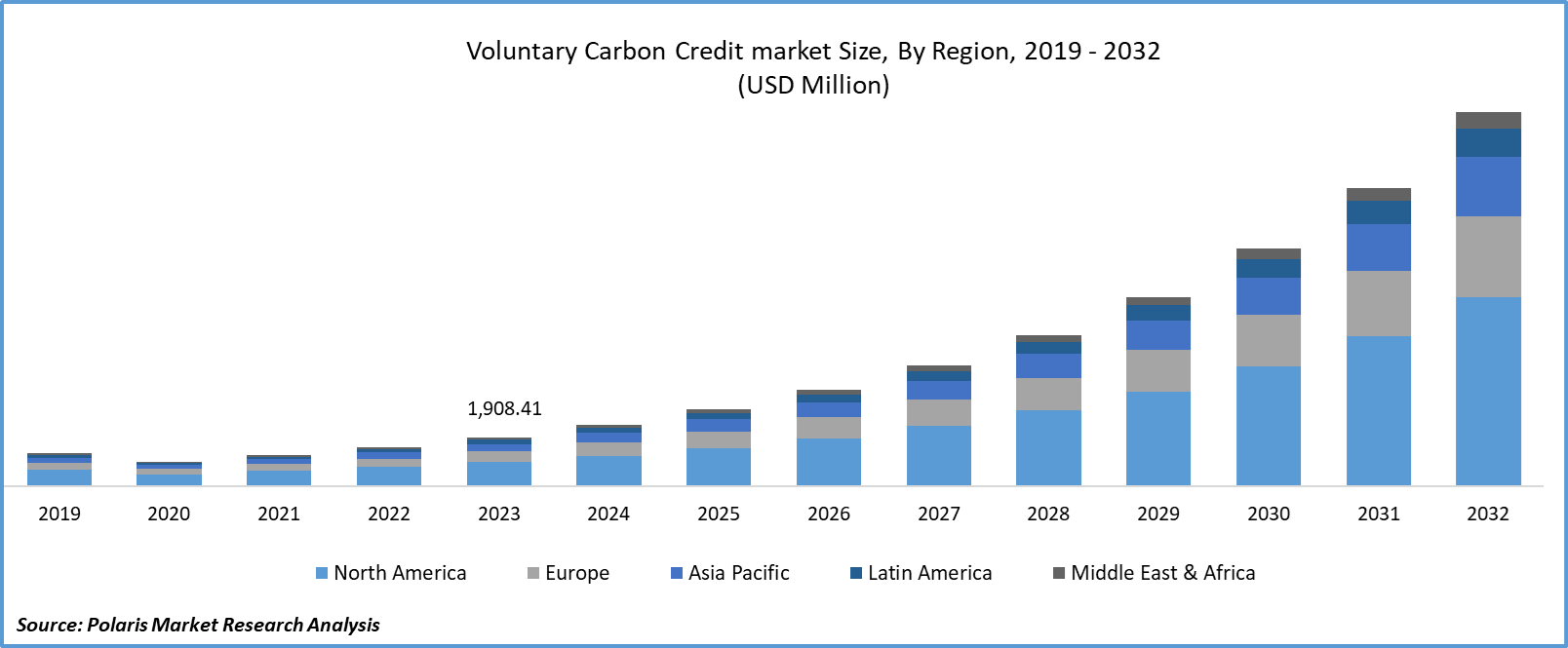
The voluntary carbon credit market is experiencing robust growth driven by several companies setting ambitious targets to achieve net-zero emissions. Purchasing carbon credits is a practical way to offset unavoidable emissions, thus boosting voluntary carbon credit market growth. Additionally, due to growing consumer preference for environmentally responsible products and brands, companies are responding by investing in carbon credits to enhance their green credentials.
Voluntary carbon credit allows businesses, organizations, and individuals to offset their carbon emissions by purchasing carbon credits from projects that reduce or remove greenhouse gases from the atmosphere. Unlike mandatory carbon markets, which governments regulate, the voluntary market operates on a discretionary basis, driven by the need to take proactive climate action and demonstrate environmental responsibility.
The growing interest in a diverse range of projects beyond traditional reforestation and renewable energy, including carbon capture and storage (CCS), soil carbon sequestration, and blue carbon projects (coastal and marine ecosystems), is driving the market growthAlso, advancements in monitoring, reporting, and verification technologies enhance the accuracy and transparency of carbon credits, boosting voluntary carbon credit market.
| Aspect | Voluntary Market | Compliance Market |
| Regulation | Not a legal requirement | Government regulated |
| Participants | Companies and individuals | Mandatory for regulated industries |
| Price | Determined by the market | Fixed price or regulated |
| Adaptability | Higher adaptability | Limited by regulation frameworks |
Source: Polaris Market Research Analysis
What Factors are Driving the Industry Growth?
Rising Technological Advancements: Market CAGR for voluntary carbon credits is being driven by technological advancements that enhance the accuracy and transparency of carbon credit projects, making it easier to verify and trust the carbon reductions claimed. The development of online marketplaces and exchanges facilitates the buying, selling, and trading of carbon credits, increasing market accessibility. Interest is growing in offset credits from engineered reduction technologies such as carbon capture and storage (CCS), direct air capture (DAC), and BECCS (bioenergy with carbon capture and storage). These technologies are currently less common due to their complexity and higher cost, but they are increasingly seen as crucial by large companies aiming to meet ambitious climate goals. Carbon financing is evolving, and as these technologies expand, their role in the voluntary carbon market is expected to grow significantly.
Rising Demand for Carbon Offset Projects and Related Credits: The rising demand for carbon offset projects and related credits is a significant growth driver for the voluntary carbon credit market. This demand is driven by various factors, including corporate sustainability goals, consumer preferences, regulatory pressures, and the broader push to address climate change. Many companies are committing to ambitious sustainability targets, including achieving net-zero emissions by specific dates. Offsetting unavoidable emissions through the purchase of carbon credits is a crucial strategy for meeting these targets. Corporations are increasingly aware that demonstrating environmental responsibility enhances their brand value and reputation. Investing in carbon offset projects allows them to showcase their commitment to sustainability, which attracts customers, investors, and partners. Some companies voluntarily exceed existing regulations to establish themselves as industry leaders in climate action. This proactive approach includes investing in high-quality carbon offset projects. Also, introducing new policy guidelines are aimed at fostering a robust and significant market growth. For instance, in 2024, the US government released new policy guidelines for the voluntary carbon credit market. The new guidelines aim to enhance and advance the market by establishing standards that ensure the high integrity of voluntary carbon markets (VCMs). They were introduced in response to the surging demand for carbon offset projects and related credits, driven primarily by enterprises seeking net-zero goals and utilizing offsets to complete their emissions reduction endeavors or to balance unavoidable emissions. Furthermore, the development of new and diverse carbon offset projects, such as blue carbon (coastal and marine ecosystems) and soil carbon sequestration, expands the range of options available for buyers. This variety attracts more participants to the market and drives the voluntary carbon credit market revenue.
Which Segment by Project Type is Exopected to Witness Fastest Growth?
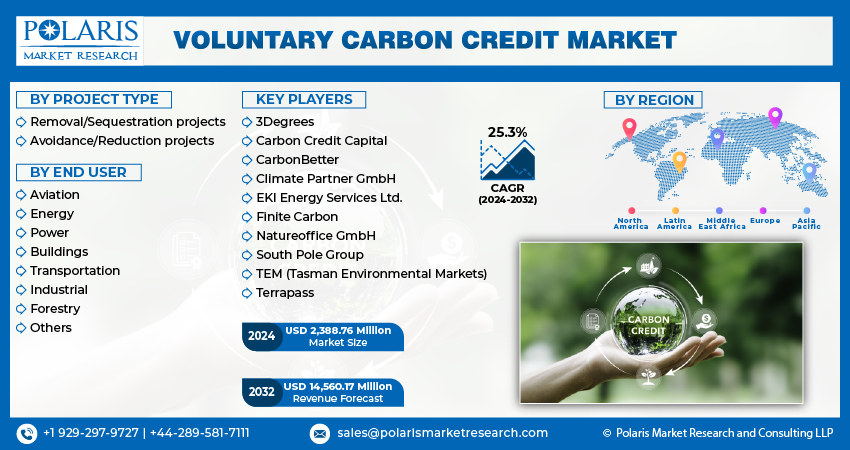
The avoidance/reduction projects segment is expected to witness the fastest growth of CAGR 38.8% during the forecast period due to well-established methodologies and verification processes, making them more accessible and easier to implement. These projects have a longer track record and are widely recognized for their effectiveness in reducing emissions. Many avoidance/reduction projects, such as renewable energy installations and energy efficiency improvements, often have lower upfront costs compared to advanced removal technologies. This cost efficiency enhances their attractiveness in the voluntary carbon credit market, driving adoption and contributing to sustainable development goals globally.
| Project Type | Simplified Description | Project Function | Project Examples |
| Removal/Sequestration Projects | Project that involves taking out CO₂ from the atmosphere and storing it | Storing captured carbon on a long-term basis | Reforestation projects, afforestation projects, carbon capture |
| Avoidance/Reduction Projects | Project that aims to avoid or reduce emissions | Reduce emissions of CO₂ | Energy generation projects using renewable energy sources |
Source: Polaris Market Research Analysis
Why Power Segment Dominated in 2025?
The power segment dominated with 32.25% share in 2025, emphasizing the critical role of renewable energy in reducing greenhouse gas emissions. Projects such as wind, solar, and hydropower effectively replace fossil fuels, leading to significant carbon credits. Companies with ambitious sustainability goals, like transitioning to 100% renewable energy, find it essential to purchase these credits to meet their environmental targets and support global emission reduction initiatives. Further, many corporations have set ambitious sustainability targets, including commitments to 100% renewable energy. Purchasing carbon credits from renewable energy projects helps companies meet these goals. For example, the RE100 initiative, where influential companies commit to use 100% renewable energy, has driven significant demand for renewable energy credits.
What is the Regional Statistics of Industry?
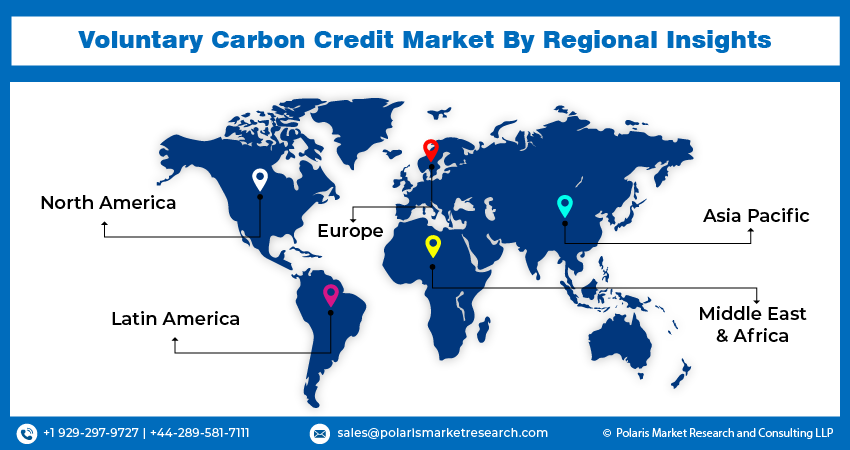
By region, the study provides market insights into North America, Europe, Asia-Pacific, Latin America, and Middle East & Africa. In 2025, North America accounted for the 37.12% share in the voluntary carbon credit market due to well-developed financial markets and trading platforms facilitating the buying and selling of carbon credits. High levels of investment in renewable energy, carbon capture, and other emissions reduction technologies boost the supply and diversity of carbon credits available and strengthen the voluntary carbon credit industry landscape in North America. The key market players are merging, acquiring, and collaborating to strengthen their market presence and serve better offerings in North America, further driving the market during the forecast period.
The U.S. voluntary carbon credit market has the largest market share due to high levels of investment in renewable energy, carbon capture, and other emissions reduction technologies, which boosts the supply and diversity of carbon credits available. The regulatory policies and incentives supporting carbon offset projects and emissions reductions contribute to a more active market. In May 2024, the U.S. Department of the Treasury, a key player in the U.S. voluntary carbon credit market, issued a joint policy statement and principles on VCMs. These involve the buying and selling of credits representing one tonne of carbon reduced or removed from the atmosphere, conducted voluntarily by companies, NGOs, governments, and other entities. Beyond their role in advancing decarbonization efforts, VCMs offer potential economic opportunities both domestically and internationally. These include opportunities for farmers, ranchers, small suppliers, and through initiatives in developing nations. According to the report, voluntary carbon markets can create new revenue streams for farmers, ranchers, private forest owners, and rural communities while also stimulating investments in nature-based climate solutions within the agriculture and forestry sectors.
The Canada voluntary carbon credit market held a significant share in 2025. This is largely due to the efforts of organizations like the International Federation of Accountants (IFAC), CPA Canada, and the Institute for Sustainable Finance. These entities provide resources and guidelines that help market participants understand and engage in VCMs, increasing confidence and participation in the market. For instance, in June 2024, the International Federation of Accountants (IFAC), CPA Canada, and the Institute for Sustainable Finance published a resource for professional accountants and market players, including capital providers, businesses, and the broader public, on the state of voluntary carbon markets (VCMs) and their future development. This report analyzes existing VCMs, corresponding standards, and the finest techniques to improve confidence in carbon markets and encourage investment in credible GHG reduction projects. It follows IOSCO's consultation report to promote the integrity and orderly functioning of VCMs, which now forms part of IOSCO's updated 2024 work plan. Such a dynamic market is poised to continue expanding as more stakeholders recognize the benefits and opportunities associated with carbon offsetting and drive the voluntary carbon credit market demand.
The Asia-Pacific voluntary carbon credit market is expected to grow at the fastest CAGR of 36.1% during the forecast period. Growing awareness and commitment to CSR initiatives are pushing businesses to invest in carbon offset projects. Moreover, China’s voluntary carbon credit market held the largest market share in 2024. The rapid industrialization and urbanization in China have led to increased emissions, requiring carbon offset strategies. Major infrastructure projects often seek carbon credits to mitigate their environmental impact. The Indian voluntary carbon credit market is expected to continue its steady growth during the forecast period due to advancements in carbon capture and storage (CCS) technologies, as well as renewable energy projects, which are increasing the availability and viability of carbon credits.
Key Market Players & Competitive Insights
Leading market players include project developers, brokers, standards organizations, and buyers from various sectors. The voluntary carbon credit market is highly fragmented, with numerous small and large players involved in different aspects of the market. This fragmentation leads to a competitive landscape where innovation, development, credibility, and partnerships play critical roles. To expand and survive in a more competitive and rising market environment, the voluntary carbon credit industry must offer advancements in technology, such as blockchain for carbon trading transparency and improved carbon capture techniques. Collaborations between corporates, NGOs, and governments are essential for scaling up carbon offset projects. Partnerships help pool resources, share expertise, and increase the global voluntary carbon credit industry reach. Major players in the voluntary carbon credit market include South Pole Group, 3Degrees, Finite Carbon, EKI Energy Services Ltd., CarbonBetter, Terrapass, Carbon Credit Capital, Natureoffice GmbH, Climate Partner GmbH, TEM (Tasman Environmental), etc.
Finite Carbon Corporation is a developer and supplier of forest carbon offsets that was founded in 2009. Since its establishment, the firm has developed high-integrity projects in voluntary and compliance markets, covering 4 million acres of forests across the mainland. In 2013, Finite Carbon registered and developed California’s first compliance offset project. Since then, the company has been responsible for developing and transacting over 100 million offsets, accounting for one-third of California’s compliance offset supply. Currently, Finite Carbon is developing a portfolio of voluntary improved forest management projects in North America. In May 2024, Finite Carbon launched a marketplace for carbon credit buyers in the voluntary carbon market.
Tasman Environmental (TEM) is a significant provider of carbon offsetting solutions in the Asia-Pacific region, operating in both voluntary and compliance markets. TEM is the provider of voluntary Australian carbon credits and offers comprehensive carbon offsetting solutions to support business goals. These solutions, which include corporate offset portfolios, digital sales and calculations, carbon project development and investment options, and a trading desk, have had a significant impact. Since 2014, TEM has financed over 300 carbon projects in 30 countries, reducing more than 11 million tonnes of carbon emissions and providing community and biodiversity benefits. In June 2021, TEM launched a voluntary carbon offset program for the Singapore Airlines Group.
List Of Key companies
- 3Degrees
- Carbon Credit Capital
- CarbonBetter
- Climate Partner GmbH
- EKI Energy Services Ltd.
- Finite Carbon
- Natureoffice GmbH
- South Pole Group
- TEM (Tasman Environmental Markets)
- Terrapass
Future Outlook
The voluntary carbon credit market is set to expand significantly due to global net-zero goals and increasing corporate responsibility for environmental, social, and governance (ESG) practices. Growth in climate finance investment, together with the emergence of standardization, will help build market confidence. The integration of digital technologies, such as blockchain, is expected to further boost this shift
Voluntary Carbon Credit Industry Developments
-
March 2026: The Indian government held the Prakriti 2026 conference. The conference provided a high-level platform for national and international specialists to deliberate on the evolving dynamics of carbon markets and opportunities for India’s green growth. (source: pib.gov.in)
-
February 2026: The EU developed its voluntary standard for permanent carbon removals. It announced new methodologies for carbon farming and bio-based construction scheduled for adoption. (source: climate.ec.europa.eu)
- April 2024: RVCMC announced its partnership with Xpansiv for the launch of a new carbon credit exchange platform. With the strategic move, RVCMC aims at improving transparency and direct climate finance to underserved regions. (Source: xpansiv.com)
Voluntary Carbon Credit Market Segmentation:
Voluntary Carbon Credit Project Type Outlook
- Removal/Sequestration projects
- Avoidance/Reduction projects
Voluntary Carbon Credit End User Outlook
- Aviation
- Energy
- Power
- Buildings
- Transportation
- Industrial
- Forestry
- Others
Voluntary Carbon Credit Regional Outlook
- North America
- US
- Canada
- Europe
- Germany
- France
- UK
- Italy
- Spain
- Netherlands
- Russia
- Rest of Europe
- Asia-Pacific
- China
- Japan
- India
- Malaysia
- South Korea
- Indonesia
- Australia
- Vietnam
- Rest of Asia-Pacific
- Middle East & Africa
- Saudi Arabia
- UAE
- Israel
- South Africa
- Rest of Middle East & Africa
- Latin America
- Mexico
- Brazil
- Argentina
- Rest of Latin America
Voluntary Carbon Credit Report Scope:
| Report Attributes | Details |
| Market Size Value in 2025 | USD 3,024.52 million |
| Market Size Value in 2026 | USD 3,725.28 million |
| Revenue Forecast in 2034 | USD 23,573.20 million |
| CAGR | 25.6% from 2026 – 2034 |
| Base Year | 2025 |
| Historical Data | 2021 – 2024 |
| Forecast Period | 2026 – 2034 |
| Quantitative Units | Revenue in USD million and CAGR from 2026 to 2034 |
| Report Coverage | Revenue Forecast, Market Competitive Landscape, Growth Factors, and Trends |
| Segments Covered |
|
| Regional Scope |
|
| Competitive Landscape |
|
| Report Format |
|
| Customization | Report customization as per your requirements with respect to countries, regions, and segmentation. |
Source: Polaris Market Research Analysis
Voluntary Carbon Credit Market FAQ's
Global voluntary carbon credit market size was valued at USD 3,024.52 million in 2025. The industry is projected to exhibit a compound annual growth rate (CAGR) of 25.6% during the forecast period (2026 - 2034)
The global market is projected to grow at a CAGR of 25.6% during the forecast period, 2026-2034
North America held the largest share of the 37.12% in 2025
The key players in the market are South Pole Group, 3Degrees, Finite Carbon, EKI Energy Services Ltd., CarbonBetter, Terrapass, Carbon Credit Capital, Natureoffice GmbH, Climate Partner GmbH, and TEM (Tasman Environmental).
The avoidance/reduction projects type is expected to witness the fastest CAGR of 38.8% during the forecast period
The power segment held the largest share of 32.25% in the global market
Voluntary carbon credits allow businesses, organizations, and individuals to offset their carbon emissions by purchasing credits from projects that reduce or remove greenhouse gases from the atmosphere, operating on a discretionary basis driven by proactive climate action and environmental responsibility.
Key trends include rising corporate net-zero commitments, growing adoption of carbon capture and storage technologies, expanding diversity of offset projects such as blue carbon and soil sequestration, advancements in blockchain-based trading transparency, and increasing government policy guidelines supporting high-integrity voluntary carbon markets.
Download Sample Report of Voluntary Carbon Credit Market
Please fill out the form to request a customized copy of the research report.


