
Battery Swapping Market Opportunity & Share Global Analysis Report, 2026-2034
REPORT DETAILS
Battery Swapping Market Summary
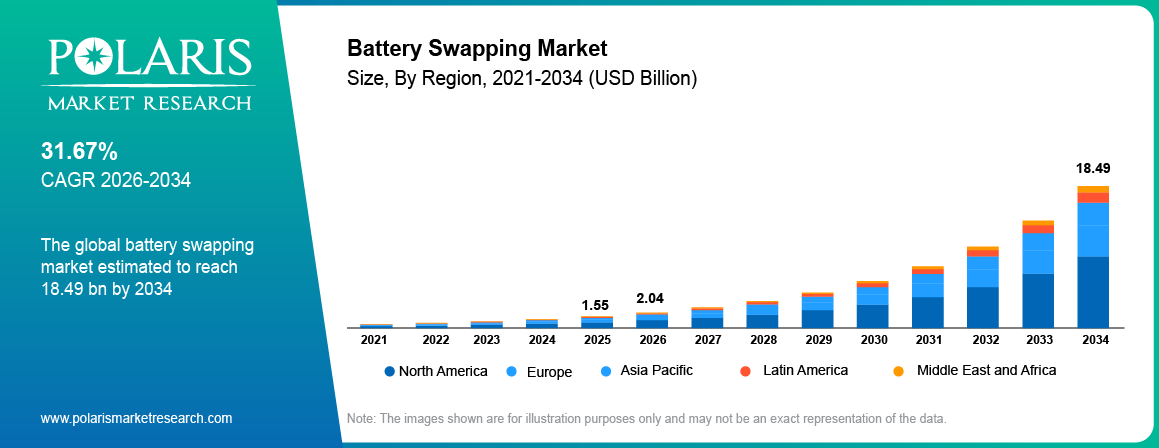
The global battery swapping market size was valued at USD 1.55 billion in 2025, growing at a CAGR of 31.67% from 2026 to 2034. Growing adoption of electric vehicles globally and rising advancements in technology are a few of the key factors driving market expansion.
Market Statistics
Battery Swapping Market Key Takeaways
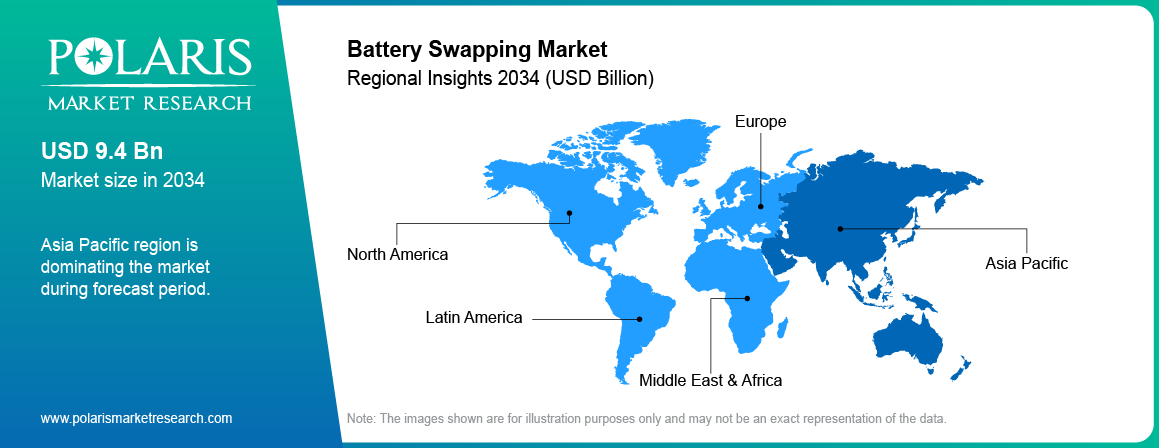
- Asia Pacific dominated the market with 58.4% share in 2025, driven by the growing focus on sustainability and rapid adoption of EVs in the region.
- The market in Europe is anticipated to record a significant CAGR of 30.8% during the projection period. The adherence to stringent emission reduction targets contributes to market growth in the region.
- The subscription segment dominated with the largest battery swapping market share of 54.7% in 2025, as EV owners are increasingly adopting cost-effective and convenient battery swapping services.
- The two-wheelers segment led the market with 71.6% share in 2025. The segment’s dominance is primarily attributed to the rising popularity of motorcycles and electric scooters in urban areas.
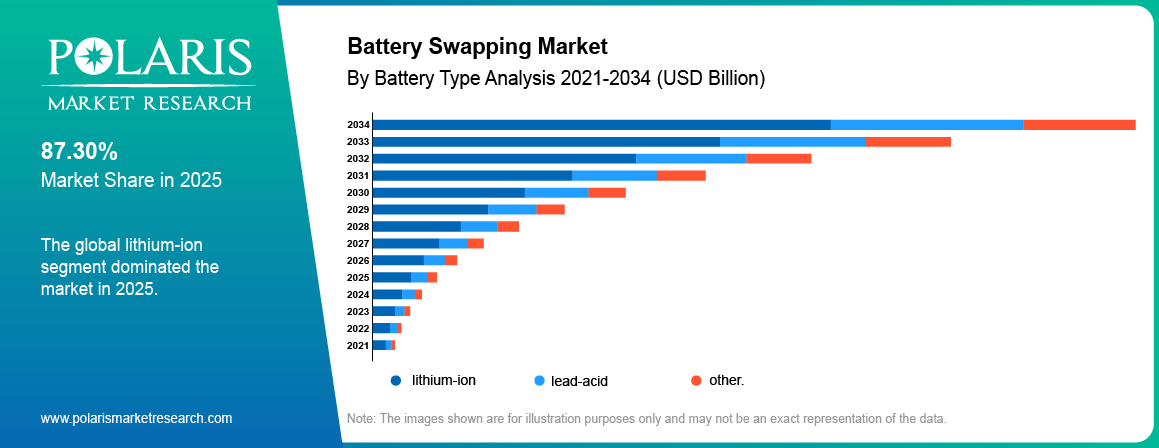
- The lithium-ion segment accounted for the largest market share of 87.3% in 2025, owing to the excellent performance and higher energy density of these battery types.
- The automated segment is projected to record a significant CAGR of 33.2% during the projected period. Their fast and convenient battery swapping services for customers boost the segment growth.
Note: Figures and projections outlined in this report are the result of Polaris Market Research’s proprietary analytical processes, grounded in the latest available datasets and market observations.
What is Battery Swapping?
Battery swapping allows EV drivers to exchange a depleted battery for a fully charged one at specialized stations. It is an innovative technology designed to enhance the recharging process for electric vehicles (EVs). This method aims to reduce the time required to recharge an EV. It takes only three to five minutes to swap a battery. The concept of battery swapping operates through a network of battery swapping stations (BSS), where automated or manual systems facilitate the exchange. A growing share of this market operates on a Battery-as-a-Service (BaaS) model. In this, the battery is leased or subscribed to separately from the vehicle itself. This lowers the upfront cost of buying an EV, shifts battery-health management to the swapping operator. It gives riders access to newer battery technology without buying a new pack.
As EV adoption scales up, the demand for shared and standardized battery systems rises. It makes battery swapping an attractive solution for manufacturers and consumers. International Energy Agency published a report stating that almost 20 million new electric cars were sold globally in 2025. As more people switch to EVs, the need for fast, efficient, and convenient energy-swapping solutions grows. Battery swapping stations allow drivers to replace depleted batteries with fully charged ones within minutes. It reduces downtime compared to traditional charging. This convenience attracts EV owners who prioritize time efficiency, especially in densely populated areas or commercial sectors such as ride-hailing and logistics (Source: iea.org).
The growing advancement in technology is also contributing to the EV battery swapping market growth. Innovations in battery design, such as modular and lightweight batteries, make swapping faster and more user-friendly. Smart swapping stations equipped with real-time monitoring and predictive analytics optimize battery performance and reduce maintenance downtime. Enhanced battery interoperability ensure compatibility across various EV models. Also, battery standardization encourages manufacturers to adopt the technology. Integration with renewable energy sources such as solar and wind further strengthens the appeal of battery swapping as a sustainable solution. These technological advancements make battery swapping more reliable and cost-effective, driving greater adoption among individual EV users and commercial fleet operators.
How Does Battery Swapping Work?
Battery swapping is a simple way to recharge electric vehicles quickly.
- When the vehicle’s battery is low, the driver takes it to a swapping station.
- The empty battery is removed and replaced with a fully charged battery. This process usually takes only a few minutes.
- The removed battery is then charged at the station for the next customer.
- Battery swapping reduces waiting time and allows EV users to continue their journey quickly.
- It is mainly used for electric two-wheelers, three-wheelers, and commercial vehicles.
Battery Swapping vs EV Charging
Battery swapping replaces a low battery with a charged one in a few minutes. EV charging infrastructure keeps the vehicle connected until the battery is charged. Swappable battery technology is faster, while charging is more widely available and easier for personal use.
| Dimension | Battery Swapping | Plug-in EV Charging |
| Time to full energy | 3–5 minutes | 30 minutes (fast DC) to several hours (AC) |
| Upfront vehicle cost | Lower (battery ownership separated via BaaS) | Higher (battery included in vehicle price) |
| Infrastructure cost | Higher per station (batteries + automation) | Lower per unit, but more units needed for parity |
| Best fit | Fleets, two/three-wheelers, high-utilization vehicles | Private passenger cars, home/overnight charging |
| Battery ownership | Often decoupled (subscription / BaaS) | Owned by the vehicle owner |
| Standardization need | High, battery formats must match across brands | Lower, connector standards only |
| Grid impact | Centralized, smoothable charging load | Distributed; can strain peak demand |
Source: Polaris Market Research Analysis
Impact of AI on Battery Swapping Market
- AI is improving battery swapping operations by enabling faster and more accurate battery identification, monitoring, and management.
- AI-powered systems can predict battery demand and optimize inventory, helping swapping stations maintain sufficient battery availability.
- Machine learning algorithms can monitor battery health and identify performance issues before they lead to failures or safety concerns.
- AI can optimize swapping station locations by analyzing EV usage patterns, traffic conditions, and customer demand.
- Intelligent software can personalize swapping services, automate payments, and improve the overall customer experience.
Market Dynamics
Driver: Growing Urbanization Globally
Expanding urbanization is driving the adoption of e-bikes and scooters, contributing to market growth. The ownership of electric scooters, bikes, and cars is rising among urban residents, which creates challenges such as limited parking spaces and the unavailability of private charging infrastructure. According to the United Nations, 68% of the world’s population is expected to live in urban areas as of 2050. This rapid urbanization is amplifying the need for solutions like battery swapping, which eliminates the need for private charging infrastructure. It also minimizes charging downtime and keeps vehicles in operation. Furthermore, businesses and delivery services in urban areas are highly dependent on e-bikes and e-scooters for operation. This is driving the demand and adoption of battery swapping (Source: un.org).
Driver: Rising Electrification of Commercial Fleet
Commercial businesses that operate taxis and logistics services are now turning to EVs to save on fuel costs. They are prioritizing the reduction of charging downtime to maintain productivity. Battery swapping enables these vehicles to stay on the road without lengthy charging sessions. Additionally, governments worldwide are implementing stricter environmental regulations to lower emissions. This factor is encouraging commercial fleet owners to adopt EVs. Thus, rising EV adoption for commercial use is driving demand for scalable, time-saving battery-swapping solutions.
Driver: Battery-as-a-Service (BaaS) Business Models
Battery-as-a-Service (BaaS) business models are driving the battery swapping market growth as it allows the customers to defer the purchase of the battery. The customers pay for the battery usage under this subscription-based business model. BaaS reduces the barrier to entry for electric vehicles and offers flexibility in battery swapping to the users. The battery swapping companies provide the end-users with the battery swap as a service. Under these services, companies charge for maintaining and replacing the battery. Businesses involved in the battery swapping services offer cost-efficient alternatives for delivery and commercial vehicle users, thereby driving the market growth.
Restraint: High Battery Swapping Infrastructure Cost
The high infrastructure setup cost is restraining the market growth. The companies providing battery swapping services have a high capital expenditure in terms of infrastructure, equipment, and battery storage. Companies have to keep a stock of batteries at swapping stations to ensure a continuous power supply to the customers. Additionally, the battery swapping stations have to be set up in highly traffic areas, which increases the company’s overheads. The companies might not expand their battery swapping network to untapped regions with fewer customers and take a long time before recouping the initial investment. Thus, high battery swapping station cost restrains the market growth.
Challenge: Lack of Battery Standardization
The major challenges for the market is standardizing battery sizes and specifications. Each electric vehicle (EV) manufacturer follows different design policies. This results in diverse battery sizes and shapes. The connection mechanisms also differ. This means batteries made by one company may not suit EVs from another. This issue significantly hampers the entire battery swapping process, thereby limiting the market expansion.
Opportunity: Growing Adoption of Electric Two- and Three-wheelers
The rising demand for electric two-wheelers and three-wheelers will create an opportunity for the market. Companies provide battery swapping services to two- and three-wheeler manufacturers and dealers. It helps develop a network of battery swapping stations around commercial centers, transport hubs, and petrol pumps to capture market share. The end-users are mostly delivery and commercial vehicle owners who require a vehicle that run continuously without spending hours at the charging station. The battery swapping service allows them to replace the dead battery in minutes and use the vehicle for commercial purposes.
Segment Insights
By Vehicle Insights
Based on vehicle, the battery swapping industry is divided into two-wheelers, three-wheelers, and four-wheelers. The two-wheelers segment accounted for a major battery swapping market share of 71.6% in 2025. The growing popularity of electric scooters and motorcycles in urban areas drives the dominance. Urban commuters are increasingly opting for two-wheelers as these vehicles offer them affordability, compact size, and the ability to navigate congested city streets efficiently. Electric two-wheelers have gained traction due to government subsidies, tax incentives, and infrastructure support aimed at accelerating the adoption of environmentally friendly vehicles. This factor drives the demand for electric two-wheeler battery swapping. Additionally, the rise of food delivery and e-commerce services has boosted the demand for electric two-wheelers, as they offer a cost-effective and sustainable solution for last-mile delivery operations.
Comparison By Vehicle Type
| Segment | 2025 Market Position | Primary Growth Driver | Typical Battery Type |
| Two-Wheelers | Leading segment | Urban commuting, food/e-commerce delivery | Lithium-ion, lead-acid |
| Three-Wheelers | High-growth commercial segment | Last-mile logistics, e-rickshaw fleets | Lithium-ion |
| Four-Wheelers | Emerging / niche | Fleet and taxi electrification pilots | Lithium-ion, solid-state (future) |
| Commercial / Fleet Vehicles | Fast-growing, cross-segment | Delivery, ride-hailing, logistics uptime | Lithium-ion |
Source: Polaris Market Research Analysis
By Battery Type Insights
In terms of battery type, the market is segregated into lithium-ion, lead-acid, and other. The lithium-ion segment dominated the market with an 87.3% share in 2025. This is attributed to its superior performance, higher energy density, and longer lifecycle compared to other battery types. Manufacturers and consumers favor lithium-ion batteries for their ability to deliver enhanced efficiency and reduced charging times. The widespread adoption of EVs, particularly in urban areas, has further propelled demand for these batteries. Li-ion batteries offer lightweight, compact solutions that enhance vehicle range and performance. Additionally, declining production costs due to technological advancements and economies of scale have made these batteries increasingly accessible. These advantages are contributing to their dominance in the market.
By Service Type
In terms of service type, the battery swapping market is segmented into subscription and on-demand. The subscription segment dominated with a larger market share of 54.7% in 2025. The leading share is driven by the increasing demand for cost-effective and convenient battery swapping services among electric vehicle (EV) owners. Battery swapping under the subscription model allows customers to subscribe to a service that provides access to a battery at an affordable price. It eliminates the need to purchase an additional battery. Additionally, it helps meet consumers' monthly budget requirements compared with buying a new battery. The EV subscription-based battery swapping services have gained popularity among delivery riders and commercial users as it enables them to switch batteries multiple times. Companies providing such services offer varying subscription plans to commercial and private users based on their battery-swapping needs, thereby driving segment growth.
By Station Type
In terms of station type, the market is segmented into automated and manual. The automated segment is expected to witness growth of CAGR 33.2% during the forecast period. Automated battery swapping systems provide fast and convenient services to customers. Automated battery swapping stations enable customers to get their batteries swapped within a short duration without requiring much human effort. The stations can remain operational for long hours and can facilitate a high rate of battery swapping. As a result, they can be considered convenient for commercial and private users, particularly delivery riders and commercial users. Additionally, companies are focusing on introducing advanced automated battery swapping stations for quicker and more convenient battery swapping services, thereby driving the segment growth.
By End User
Based on end user, the market is segmented into individual users, commercial fleets, and public transportation. The individual users segment dominated with the largest share of 46.32% in 2025. This segment comprises private electric vehicle owners who prefer a fast way to recharge their batteries. Additionally, battery swapping suits consumers who use their vehicles for short daily trips. These people benefit from a faster and a more convenient energy access method as it saves time over the conventional charging methods. Rising electric vehicle sales, increasing urban transportation, and demand for energy access are driving demand for battery swapping among individual users.
By Battery Capacity
In terms of battery capacity, the market is bifurcated into less than 30kWh and more than 30kWh. The more than 30kWh battery capacity segment is expected to record a CAGR 32.15% during the forecast period. This growth is fueled by emerging trends in which EVs are becoming larger and require more energy per charge. Moreover, these vehicles require a greater travel distance between swaps. Battery swapping enables faster travel without the hassle of spending long hours at a charging station. The demand for battery swapping for battery capacity above 30 kWh is expected to grow at a significant rate due to its use in electric cars and other larger vehicles. Advancements in the swapping station infrastructure and the growing need for a faster power source are expected to fuel the segment growth.
Real World Use Cases
| Application | Real-World Use Case | Examples | Primary Benefit |
| Electric Two-Wheelers | Battery replacement for electric scooters used in daily commuting and shared mobility. | Gogoro GoStation network in Taiwan; Yulu battery-swapping network in India. | Faster energy replenishment and reduced EV charging downtime. |
| Last-Mile Delivery | Frequent battery swaps for food, grocery, and parcel delivery fleets. | Zypp Electric, Zepto, Swiggy, Zomato, Amazon delivery fleets, and Battery Smart. | Higher vehicle utilization and longer daily operating range. |
| Electric Three-Wheelers | Swapping for e-rickshaws, electric autos, and urban freight vehicles. | SUN Mobility; Battery Smart; Indofast Energy; Yuma Energy. | Lower downtime and improved operating economics for high-mileage fleets. |
| Ride-Hailing & Shared Mobility | Rapid battery replacement for shared electric scooters and mobility fleets. | Gogoro; Yulu; SUN Mobility. | Enables continuous fleet availability without lengthy charging stops. |
| Electric Commercial Fleets | Battery-as-a-Service for fleet operators using electric scooters and delivery vehicles. | BattRE–Battery Smart partnership; Beez Electric deployed more than 1,000 swap-enabled e-scooters in Jaipur. | Reduces upfront battery cost and supports rapid fleet scaling. |
| Heavy Electric Trucks | Automated or semi-automated battery exchange for long-haul and heavy-duty electric trucks. | eHaul project in Germany; battery-swapping trials involving 40-ton trucks. | Shorter refueling time and improved suitability for long-distance logistics. |
| Electric Buses | Battery replacement for high-frequency urban and transit bus operations. | NIO Power and selected electric-bus battery-swapping pilots. | Maintains fleet uptime and avoids long depot-charging periods. |
| Off-Grid & Remote Mobility | Battery exchange for vehicles operating where grid-connected charging is limited. | SUN Mobility modular battery systems; solar-supported swap stations. | Supports distributed charging and reduces dependence on fixed charging infrastructure. |
| Fleet Energy Management | Centralized charging, battery inventory management, and predictive swap scheduling. | NIO Power Swap; Gogoro GoStation; Ample modular swapping system. | Optimizes battery utilization, station capacity, and energy costs. |
Source: Polaris Market Research Analysis
Regional Analysis
By region, the report provides the battery swapping market insights into North America, Europe, Asia Pacific, Latin America, and the Middle East & Africa. Asia Pacific held the largest market share of 58.4% in 2025. The regional dominance is supported by the rapid adoption of EVs and the growing focus on sustainability. The regional market growth is attributed to strong government initiatives, such as subsidies for EVs, investments in energy infrastructure, and favorable regulatory frameworks. Widespread use of shared mobility services has contributed significantly to this leadership. China’s well-established manufacturing ecosystem for batteries and EVs has reduced production costs, making battery swapping more accessible to a broader population. Additionally, the growing urbanization in countries such as India and Indonesia has increased the demand for efficient and sustainable energy solutions, driving regional market expansion.
China accounted for the largest share of 36.8% of the Asia Pacific market in 2025. The leading share is attributed to a rise in electric two-wheelers and commercial vehicles. The growth of the Battery Swapping Market China is supported by the large-scale presence of electric vehicles and improved battery swapping infrastructure in Tier-1 cities. Battery swapping facilitates uninterrupted rides, which is crucial for delivery personnel. Key players such as NIO and CATL are accelerating deployment, with NIO operating over 4,000 swap stations and CATL targeting more than 3,000 Choco-Swap stations by end-2026. Additionally, the rising support from automakers and battery manufacturers is further fueling the China battery swapping market size (Source: autonews.gasgoo.com).
Battery Swapping Market India is expected to witness a CAGR of 34.5% during the forecast period. The growth is attributed to the high adoption rate of electric two-wheelers and three-wheelers. For instance, sales of electric two-wheelers in the first eight months of 2026 crossed 13.6 lakh units, compared to 13.4 lakh units in 2025. Battery swapping provides convenience to users as it reduces the waiting time as compared to conventional charging methods. The electric vehicle battery swapping industry in the country is growing at a fast rate because of flexible battery ownership plans. These plans allow affordable ownership of electric vehicles without disturbing the overall budget. Moreover, the increasing focus on promoting EVs in the country and rising participation from commercial companies are anticipated to fuel the market growth (Source: autocarindia.com).
The Europe battery swapping market is projected to register a CAGR of 30.8% during the forecast period. This growth is attributed to Europe’s focus on achieving carbon neutrality by 2050 and adherence to stringent emission reduction targets. These efforts have spurred the adoption of EVs, thereby driving demand for battery swapping. Germany, a hub for automotive innovation, has seen significant investments in research and development, particularly in energy storage technologies such as battery swapping. The European Union’s policies, including subsidies and grants for EV adoption, coupled with growing consumer demand for eco-friendly transportation, have created lucrative market opportunities. Moreover, increasing awareness of sustainable practices and the expansion of EV-friendly infrastructure across countries such as France, the Netherlands, and Norway are expected to drive regional market demand.
North America is expected to witness a CAGR of 29.4% during the forecast period. The North American market growth is driven by the rising investments in the electric vehicle infrastructure, such as charging and battery swapping network. The increasing need for faster energy replacement with improved vehicle utilization is driving the market growth. The demand for battery swapping is further rising in the commercial vehicle sector. This is because swapping facilities provide uninterrupted transportation as compared to conventional charging methods. Thus, swapping systems meet the high demand for logistics and shared mobility services. Additionally, multiple companies are investing in developing the battery swapping infrastructure. It hels reduce vehicle downtime and increase the overall productivity of the fleets, thereby driving the market growth.
Competitive Insights
Major battery swapping market players are investing heavily in research and development in order to expand their offerings. Such strategies will help the market grow even more. These market participants are also undertaking a variety of strategic activities to expand their global footprint. The players are emphasizing innovative launches, international collaborations, higher investments, and mergers and acquisitions between organizations. The market is fragmented, with the presence of numerous global and regional market players.
List of Battery Swapping Key Players
- Amara Raja Group
- Ample, Inc.
- Aulton New Energy Automotive Technology Co., Ltd.
- BAIC
- Battery Smart
- Battswap Inc
- Bounce Infinity
- Contemporary Amperex Technology Co. Ltd. (CATL)
- Esmito Solutions Pvt Ltd
- Gogoro
- Honda Power Pack India Private Limited
- KWANG YANG MOTOR CO., LTD.
- Mooving Smart Mobility and Energy Private Limited
- NIO
- Numocity
- Oyika Pte. Ltd.
- Shenzhen Immotor Technology Limited
- Sun Mobility Private Limited
- U Power
Vendor Positioning
| Company | HQ / Region Focus | Core Offering |
| NIO | China | Integrated EV + battery swap network |
| Gogoro | Taiwan | Two-wheeler swap ecosystem |
| CATL | China | Battery manufacturing + swap ecosystem |
| Ample | United States | Modular automated swap stations |
| Sun Mobility | India | Two/three-wheeler swap infrastructure |
| Amara Raja | India | Battery manufacturing + swap |
Source: Polaris Market Research Analysis
Battery Swapping Industry Developments
- September 2026: Dongfeng expanded its eπ brand with a new battery-swapping version of the EP7 sedan, which appeared in China’s latest MIIT catalogue. The model used CATL’s LFP battery and strengthened the company’s growing battery-swapping ecosystem for passenger vehicles in China. (Source: carnewschina.com)
- September 2026: Magna International invested an additional USD 35 million in Yuma Energy, strengthening its commitment to India’s battery-swapping market. The funding supported Yuma’s expansion. It operates more than 2,500 swapping stations across 18 Indian cities. (Source: autonews.com)
- July 2026: Energy in Motion partnered with Hindustan Petroleum Corporation Limited to deploy battery-swapping and fast-charging hubs across India. The companies planned 40 swap-and-charge sites by March 2027, targeting key freight routes such as Mumbai-Pune and Delhi-Jaipur. (Source: evinfrastructurenews.com)
- April 2026: CATL, BAIC Group, and CAES launched a strategic partnership to develop battery-swapping vehicles and integrated charging infrastructure. The companies also planned full lifecycle battery management and expanded CATL’s Choco-Swap network across China. (Source: catl.com)
Future Outlook: Is Battery Swapping the Future of EV Charging?
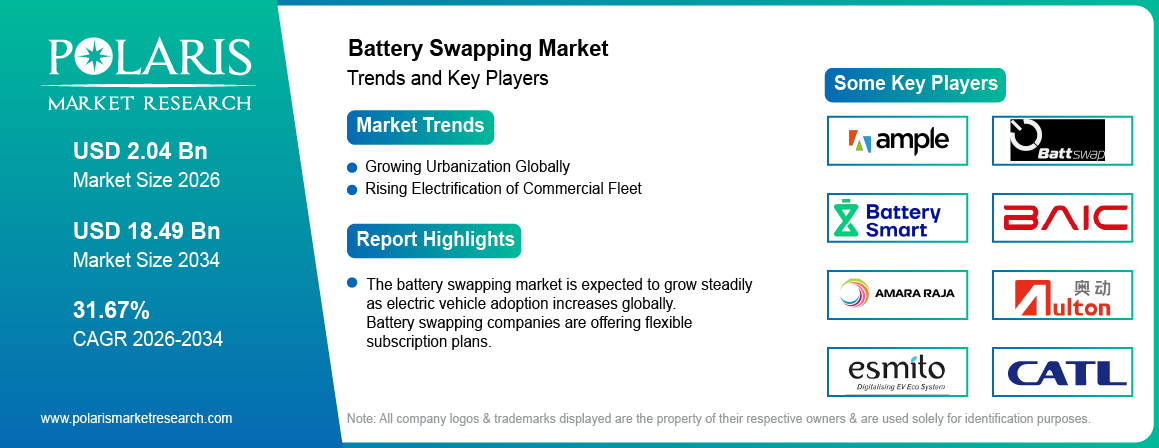
The battery swapping market is expected to grow steadily as electric vehicle adoption increases globally. Battery swapping companies are offering flexible subscription plans. Therefore, the market is expected to grow as the number of battery swap networks increases. Moreover, standardized battery formats and advanced swapping technologies are also projected to support market growth. Two-wheelers, three-wheelers, and commercial vehicles are anticipated to remain the dominant segments in the market. Furthermore, collaborations among automakers, battery manufacturers, energy companies, and fuel retailers are contributing to the growth of the market in the coming years.
Research Methodology
- Market estimates are derived using a blend of primary and secondary research, validated through weighted-average and combined top-down/bottom-up modeling approaches.
- Secondary research covers company filings, government EV and battery-swapping policy frameworks, charging infrastructure investment data, industry journals, and paid third-party databases to build baseline estimates.
- Primary research includes interviews with key industry participants such as battery swapping network operators, EV OEMs, fleet operators, and battery manufacturers, to validate accuracy and capture forward-looking insights.
- Base year considered is 2025, with a forecast provided through 2034; revenues are expressed in USD Billion.
- Parent market is identified as the global electric vehicle charging infrastructure market; the addressable segment is narrowed using battery-swapping adoption rates across two-wheelers, three-wheelers, and four-wheelers.
- Bottom-up model aggregates regional battery swapping demand across vehicle type, battery type, service type, station type, end user, and battery capacity, validated against vendor revenue disclosures from Gogoro, NIO, Sun Mobility, Battery Smart, and others.
- Regional coverage spans North America, Europe, Asia Pacific, Middle East & Africa, and Latin America, further segmented by major countries.
- Projected 31.67% CAGR (2026–2034) reflects weighted analysis of rising commercial EV fleet electrification, growing demand for reduced vehicle downtime, expanding battery-swapping infrastructure in Asia Pacific, and increasing government incentives for standardized swappable battery ecosystems.
- Findings are cross-validated across multiple estimation methods to ensure consistency, accuracy, and reliability of the final market sizing
Battery Swapping Market Segmentation
By Vehicle Outlook (Revenue – USD Billion, 2021–2034)
- Two-Wheelers
- Three-Wheelers
- Four-Wheelers
By Battery Type Outlook (Revenue – USD Billion, 2021–2034)
- Lithium-Ion
- Lead-Acid
- Other
By Service Type Outlook (Revenue – USD Billion, 2021–2034)
- Subscription
- On-demand
By Station Type Outlook (Revenue – USD Billion, 2021–2034)
- Automated.
- Manual
By End User Outlook (Revenue – USD Billion, 2021–2034)
- Individual Users
- Commercial Fleets
- Public Transportation
By Battery Capacity Outlook (Revenue – USD Billion, 2021–2034)
- Less than 30kWh
- More than 30kWh
By Regional Outlook (Revenue – USD Billion, 2021–2034)
- North America
- U.S.
- Canada
- Europe
- Germany
- France
- UK
- Italy
- Spain
- Netherlands
- Russia
- Rest of Europe
- Asia Pacific
- China
- Japan
- India
- Malaysia
- South Korea
- Indonesia
- Australia
- Vietnam
- Rest of Asia Pacific
- Middle East & Africa
- Saudi Arabia
- UAE
- Israel
- South Africa
- Rest of Middle East & Africa
- Latin America
- Mexico
- Brazil
- Argentina
- Rest of Latin America
Report Scope
| Report Attributes | Details |
| Market Size in 2025 | USD 1.55 billion |
| Market Size in 2026 | USD 2.04 billion |
| Revenue Forecast by 2034 | USD 18.49 billion |
| CAGR | 31.67% from 2026 to 2034 |
| Base Year | 2025 |
| Historical Data | 2021–2024 |
| Forecast Period | 2026–2034 |
| Quantitative Units | Revenue in USD billion and CAGR from 2026 to 2034 |
| Report Coverage | Revenue Forecast, Market Competitive Landscape, Growth Factors, and Trends |
| Segments Covered |
|
| Regional Scope |
|
| Competitive Landscape |
|
| Report Format |
|
| Customization | Report customization as per your requirements with respect to countries, regions, and segmentation. |
Source: Polaris Market Research Analysis
Battery Swapping Market FAQ's
The global battery swapping market size was valued at USD 1.55 billion in 2025 and is projected to grow to USD 18.49 billion by 2034.
The global market is projected to grow at a CAGR of 31.67% during the forecast period.
Asia Pacific accounted for the largest share of the global market, with a 58.4% share in 2025, driven by rising demand and expanding market adoption.
Some of the key players in the market are BattSwap Future; Aulton New Energy Automotive Technology Co., Ltd.; Contemporary Amperex Technology Co. Ltd. (CATL); Numocity; Esmito Solutions Pvt Ltd; Shenzhen Immotor Technology Limited; Sun Mobility Private Limited; Ample, Inc.; NIO; KWANG YANG MOTOR CO., LTD.; and Gogoro.
The two-wheeler segment accounted for the largest market share of 71.6% in 2025, driven by rising demand for two-wheelers.
Battery swapping replaces a discharged battery with a fully charged one within minutes, while EV charging requires the vehicle to remain connected to a power source until the battery reaches the required charge level.
Battery swapping generally takes only a few minutes, making it faster than conventional EV charging. This helps reduce vehicle downtime, especially for commercial and high-use electric vehicles.
Battery swapping can reduce upfront EV costs through battery-as-a-service models, while traditional charging may offer lower operating costs for users who already own the battery. The overall cost depends on usage, service fees, and battery ownership.
Download Sample Report of Battery Swapping Market
Please fill out the form to request a customized copy of the research report.


