
Activated Alumina Market Share, Size, Trends, Industry Analysis Report, 2026 - 2034
REPORT DETAILS
Activated Alumina Market Summary
The activated alumina market size was valued at USD 1,261.63 million in 2025. It is projected to exhibit a CAGR of 5.9% from 2026 to 2034. Rising demand for water treatment and air purification is supporting market growth. Increasing use of activated alumina in oil and gas and chemical industries is also contributing to overall market growth.
Market Statistics
Key Takeaways
- Asia Pacific held the largest share of the activated alumina market in 2025, accounting for 49.80% of revenue. This is due to strong industrial growth and high demand from the water treatment and refining sectors.
- North America is expected to grow at a CAGR of 6.2% during 2026–2034. Growth is driven by strict wastewater rules and rising use in oil & gas and purification applications.
- In the application segment, the adsorbent segment dominated the market in 2025, accounting for 37.20% of revenue. It is widely used to remove fluoride and other contaminants from water.
- The water treatment segment is growing at a faster pace under the end-use industry. This is due to increasing demand for clean water and environmental rules.
- By form, the beaded segment dominated the market in 2025, accounting for 26.90% of revenue. It is widely used in industrial purification and drying applications that require stable performance.
Note: Figures and projections outlined in this report are the result of Polaris Market Research’s proprietary analytical processes, grounded in the latest available datasets and market observations.
Industry Dynamics
- Rising environmental concerns are increasing the use of activated alumina in water treatment. It removes fluoride and other contaminants and helps meet water quality standards.
- The need for clean process water is backing market growth. Industries such as chemicals, pharmaceuticals, and food processing depend on effective impurity control.
- The increasing reliance on gas fuels is driving up the demand for activated alumina. This material effectively extracts moisture and contaminants from gases like LNG and CNG, thereby mitigating corrosion and other potential problems within the system.
- Use of activated alumina in gas drying and purification is increasing. It boosts smooth operations in refineries, petrochemical plants, and gas processing systems.
- The presence of alternative adsorbents may limit market growth. Materials such as silica gel and molecular sieves are used in similar applications.
Source: Polaris Market Research Analysis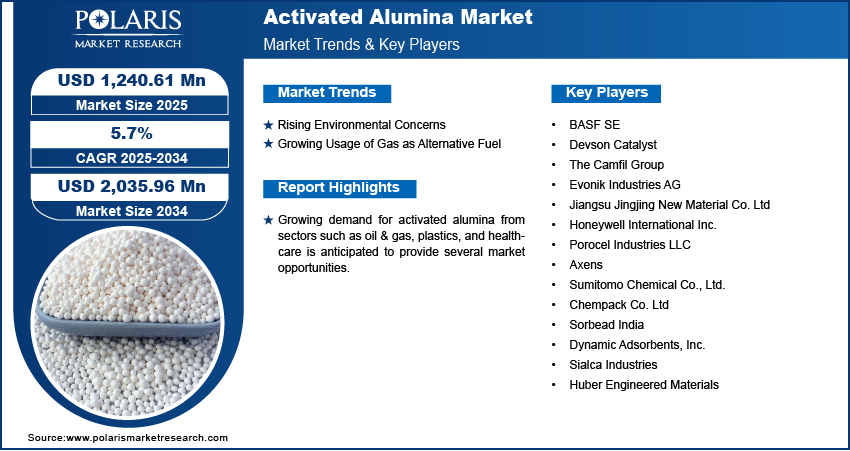
To Understand More About this Research:Download Sample Report
Activated alumina is a solid form of aluminum oxide with a porous structure. The material has low abrasion and handles pressure changes well. Resistance to water and tolerance to temperature variations make it suitable for use in industrial conditions. High adsorption capacity supports effective removal of moisture and impurities. Common uses include acting as a desiccant, a support for catalysts, and a way to remove fluoride. It is also used in purification processes, the drying of organic liquids, and the treatment of liquids from steam cracking. In addition, it is utilized in water purification, hydrogen generation, and gas drying in air separation plants.
Activated alumina is often chosen in industrial settings because it consistently performs well and is stable during use. It performs well in continuous processing environments and supports longer service cycles. Ease of handling and process compatibility make it suitable for integration across different systems. Cost efficiency and dependable output further help its use across large-scale industrial operations.
The demand for activated alumina is largely driven by the need to provide clean water to communities. As economies grow and industrial activities increase, the pressure on water resources is becoming more significant. This has increased the demand for home water filtration. Rapid population growth is also expanding the need for better water treatment systems.
The market's growth is fueled by increased focus on both drinking water infrastructure and the treatment of industrial wastewater. As levels of fluoride, arsenic, and heavy metals continue to rise, the need for effective filtration systems is becoming more urgent. Activated alumina is a common choice for removing fluoride from water supplies. Furthermore, its application is expanding within industrial wastewater treatment processes to ensure reliable purification and adherence to regulatory standards.
Technological developments and government efforts to ensure a consistent supply of clean water are supporting the demand for activated alumina. Its use in the chemical industry as an adsorbent, catalyst, and filtration medium is expected to help market growth. Demand from sectors such as oil & gas, plastics, and healthcare is also creating new opportunities over the forecast period.
In addition, demand is rising in gas purification and hydrogen generation systems. Use is also increasing in petrochemical processing, where removal of moisture and impurities is required. The material performs well as an industrial adsorption medium in continuous operations. This supports stabilize processes and improve efficiency, contributing to steady market demand.
Activated Alumina Market Dynamics
Rising Environmental Concerns
Activated alumina is widely used to remove fluoride and other contaminants from water. This has increased its use in water treatment. Strict water quality regulations are supporting continued demand. Concerns over fluoride pollution are also driving the activated alumina market.
The material is also used for broader contaminant removal. It works as an arsenic removal adsorbent and helps remove impurities such as lead and sulfur compounds. This supports its use in municipal and industrial systems under wastewater regulations. These applications are maintaining constant demand, especially in regions facing water quality issues and industrial growth.
The market is supported by the need for better treatment quality. This is seen across industries such as food processing, pharmaceuticals, chemicals, and power generation. These sectors require reliable process water treatment. They also depend on effective impurity control. Activated alumina applications support industrial purification. They are used where consistent performance is required. The use of specialty adsorbents helps meet quality standards. It also supports compliance requirements.
Growing Use in Gas Drying and Purification Applications
The consumption of gases such as liquefied petroleum gas, liquefied natural gas, and compressed natural gas has increased in recent years. These gases must remain free from moisture and contaminants. This helps avoid blockages in fuel systems and prevents corrosion in storage units caused by hydrate formation. Activated alumina removes impurities such as hydrogen sulfide and carbon dioxide. This supports LNG purification and CNG purification. Rising use of industrial and fuel gases is supporting market revenue.
The material is widely used across industrial setups such as refineries, petrochemical plants, and air separation units. These environments require stable and continuous performance. Activated alumina desiccant works reliably under demanding conditions. Its use is rising in refinery purification, petrochemical processing, and air separation systems, supporting efficient industrial operations.
Opportunity: Higher Use in Specialty Chemical and Process Industries
The market is seeing new opportunities in specialty chemicals and advanced industrial manufacturing. Activated alumina is used as a catalyst support material and in purification steps. It is preferred where strong adsorption capability and process consistency are required. Industries are focusing on improving productivity and reducing contamination risks. This is increasing the use of activated alumina as both a process aid and purification medium. These trends are opening new possibilities for suppliers.
Restraint: Competition from Alternative Adsorbents
Activated alumina faces competition from other adsorbents, including silica gel, molecular sieves, and activated carbon. In some uses, consumers choose alternatives based on cost and performance demand. Factors including pore structure, selectivity, and regeneration requirements also influence material selection. This makes the material choice application-specific.
Manufacturers need to improve product quality to stay competitive. Focus areas include higher purity grades, better mechanical strength, and improved adsorption efficiency. Customization for specific applications is important in specialty purification media.
Activated Alumina vs Alternative Adsorbents
Activated alumina is compared with silica gel, molecular sieves, and activated carbon based on use. In an adsorbent comparison, silica gel is used for moisture control. In contrast, activated alumina is better than silica gel in industrial systems, offering better durability and more effective removal of impurities.
Molecular sieves provide high selectivity in deep drying. But in a molecular sieves comparison, they may not be cost-effective for general application. Activated carbon works well for organic compounds. In an activated carbon comparison, it serves a different role in water and gas treatment.
Activated alumina is preferred for its balanced performance. It supports practical adsorbent selection for both drying and purification. The material offers stable operation and good strength. This makes it suitable as an industrial purification medium in many systems.
| Parameter | Activated Alumina | Silica Gel | Molecular Sieves |
| Main Application | Adorption and purification | Moisture Absorption | Molecular separation |
| Absorption Capacity | High | Moderate | High |
| Typical Uses | Water purification, gas drying | Humidity control and packaging | Gas and petrochemicals refining |
| Cost | Moderate | Low | High |
| Regeneration Capacity | Good | Moderate | Excellent |
Source: Polaris Market Research Analysis
Source: Polaris Market Research Analysis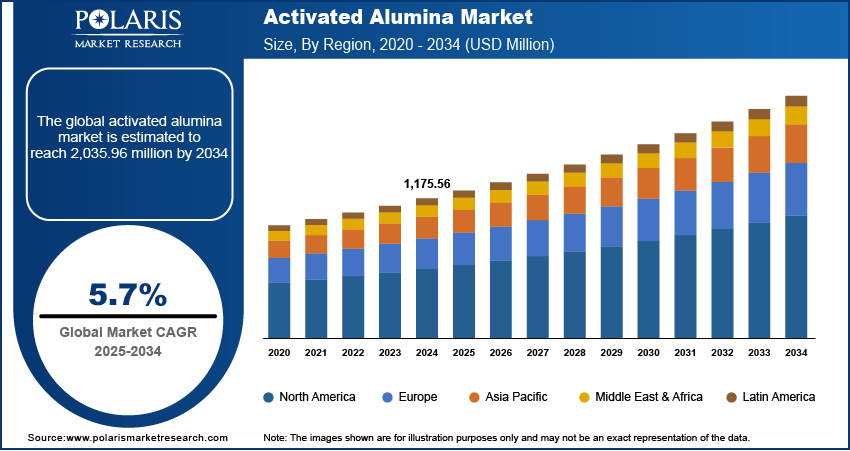
Activated Alumina Market Segment Insights
Activated Alumina Market Outlook Based on Form
The activated alumina market, based on form, is segmented into beaded and powdered. Beaded activated alumina is widely used as a packed-bed adsorbent in industrial purification and drying systems due to its strong mechanical properties and low dust formation. It works as a low-pressure drop adsorbent and helps stabilize performance during repeated operations. These features make it suitable as an industrial drying medium in gas drying, water treatment, and process purification systems, and accounted for 26.90% of revenue in 2025.
Powdered activated alumina is used where finer particle distribution and faster interaction are required. It acts as a fine particle adsorbent in specialized chemical procedures and selected treatment systems. Demand for powdered activated alumina and specialty alumina grades is projected to grow as manufacturers focus on targeted solutions for chemical processing applications.
Activated Alumina Market Outlook Based on Application
The activated alumina market, based on application, is segmented into catalyst, adsorbent, desiccant, drying agent, and others. The adsorbent segment dominated the market with the largest share of 37.20% in 2025. Activated alumina is largely used as a fluoride adsorbent in water treatment. It is also used across industries for separation processes. In addition to fluoride, contaminants such as sulfur, arsenic, and lead are removed through arsenic adsorption and lead removal media. Increasing industrial activity and stricter safety rules are fueling the growth of the adsorbent segment.
The adsorbent segment holds a strong position across municipal and industrial systems. Its ability to remove different impurities supports demand in regions facing water quality concerns. The need for reliable separation materials in processes where product purity and equipment protection matter also supports the growth of activated alumina applications.
The catalyst segment remains important due to its use as a catalyst carrier and catalyst support material. It is used in refining and petrochemical processes where stability and surface area are important. Demand for refining catalyst support and petrochemical catalyst media is supported by efforts to improve process efficiency.
The desiccant and drying agent segments are supported by the need for moisture control across industries. Applications include compressed air systems, hydrocarbon streams, and industrial gases. Moisture removal is important to avoid corrosion and process issues. Activated alumina is used in gas dehydration, compressed air drying, and hydrocarbon drying due to its high adsorption capacity.
Activated Alumina Market Evaluation Based on End-Use Industry
The activated alumina market, based on end-use industry, is segmented into healthcare, water treatment, chemical, oil & gas, and others. The water treatment segment is projected to grow at the highest CAGR of 6.1% from 2026 to 2034. Activated alumina water treatment is used to remove fluoride and other contaminants. Rising demand for clean water and stricter effluent treatment rules are supporting this growth.
The outlook for the water treatment segment is linked to public health and regulatory needs. Municipal systems focus on improving drinking water quality. Industries require reliable solutions for industrial wastewater treatment. These factors are supporting steady use across treatment systems.
The chemical industry is another key segment. Activated alumina works as a chemical industry adsorbent in purification and drying processes. It is also used as a catalyst support. Demand is strong in specialty chemicals, where product quality and process stability matter. It is also used as an industrial drying adsorbent in production systems.
The oil & gas sector remains an essential demand area. Activated alumina in oil & gas is used for gas purification and hydrocarbon drying. It controls moisture and supports hydration prevention. Growth in natural gas processing is supporting demand from this sector.
In healthcare and high-purity uses, activated alumina supports controlled processes. Activated alumina in healthcare is used in pharmaceutical processing and other high-purity uses. The need for specialty adsorbents is growing as quality standards become stricter.
Source: Polaris Market Research Analysis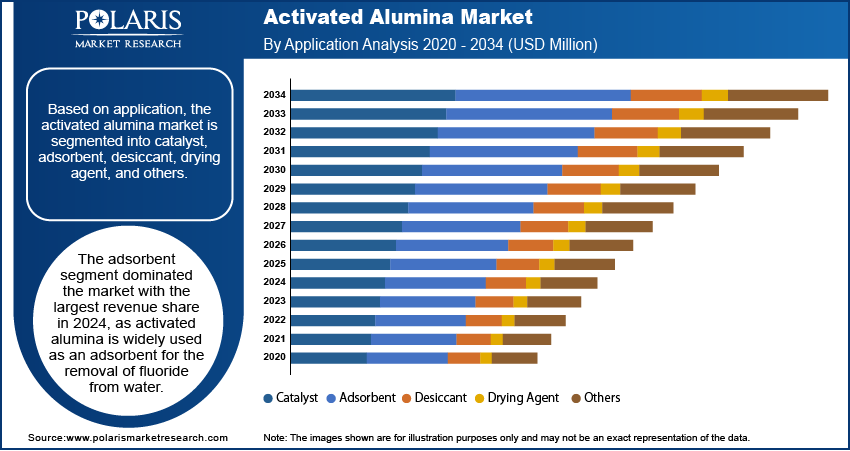
Activated Alumina Market Regional Analysis
By region, the market includes North America, Europe, Asia Pacific, Latin America, and the Middle East & Africa. The Asia Pacific activated alumina market held a 49.80% share in 2025. Demand is supported by industrial growth in China, India, and Japan. Rising refining capacity, urban development, and expansion by key players are also supporting growth.
The region benefits from a large manufacturing base and rising investment in treatment systems. China activated alumina demand remains high due to industrial activity and water treatment needs. The India water treatment market is expanding with growing infrastructure and population. Demand for Japan industrial adsorbents is supported by high-quality industrial applications.
Urban growth and the increasing demand for industrial wastewater treatment are supporting demand. The use of gas purification media and refinery applications is also increasing. These factors support strong regional market dominance and steady consumption across industries.
The North America activated alumina market is projected to grow at a CAGR of 6.2% from 2026 to 2034. Need is rising across oil & gas, water treatment, and pharmaceuticals. Strict wastewater treatment regulations are also supporting market growth. The region benefits from a strong industrial base and advanced systems. Growth in the gas processing market and demand for US industrial purification support further expansion.
The Europe activated alumina market shows stable growth. Strong environmental standards and industrial systems support demand. Focus on contamination control and reliable purification solutions is increasing. Use in industrial purification Europe remains steady across sectors.
The Latin America activated alumina market shows steady growth. Investment in municipal water treatment and industrial systems is increasing. Awareness of purification needs is also rising. These factors support industrial purification growth and emerging market demand.
The Middle East & Africa activated alumina market is driven by water scarcity and industrial needs. Demand for water scarcity treatment and desalination systems is increasing. Growth in petrochemical purification and gas drying applications is also backing regional demand.
Source: Polaris Market Research Analysis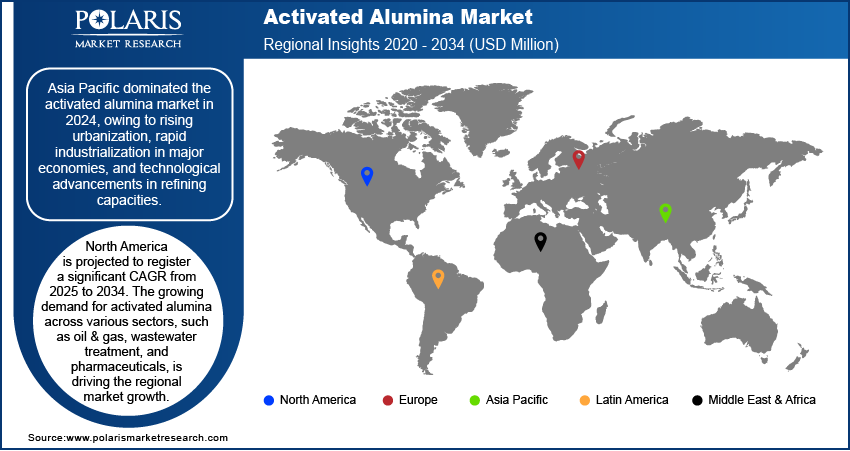
Activated Alumina Market – Key Players and Competitive Insights
The activated alumina market is competitive, with companies concentrating on product development, technology improvements, and partnerships. Industry participants compete on price, quality, product range, and service. Many activated alumina manufacturers are investing in R&D to improve adsorption efficiency and meet industry needs.
Competition also depends on product consistency, particle design, and regeneration performance. Buyers in water treatment, gas purification, and chemical processing look for reliable performance and a steady supply. This supports the position of strong industrial purification suppliers in the market.
Companies are also working on sustainable and eco-friendly options to meet regulatory standards. Key players include BASF SE, Devson Catalyst, Camfil Group, Evonik Industries AG, Jiangsu Jingjing New Material Co. Ltd, Honeywell International Inc., Porocel Industries LLC, Axens, Sumitomo Chemical Co., Ltd., Chempack Co. Ltd, Sorbead India, Dynamic Adsorbents, Inc., Sialca Industries, and Huber Engineered Materials.
These key players in the activated alumina market compete based on industrial specialization, regional presence, and product offerings. The demand for technical service and tailored alumina grades is increasing, driven by the need to address particular application requirements.
BASF SE is a key player in the activated alumina market, with a strong presence in catalyst and adsorbent solutions. The company focuses on material development and process improvement for use in refining, water treatment, and chemical processing. Its global operations and wide product range support its position in the market.
Honeywell International Inc. holds a strong position through its UOP division, which provides adsorbents and catalyst technologies. The company focuses on applications in gas processing, petrochemicals, and industrial purification. Its technical expertise and global presence help its position in the market.
List of Key Players in Activated Alumina Market
- BASF SE
- Devson Catalyst
- The Camfil Group
- Evonik Industries AG
- Jiangsu Jingjing New Material Co., Ltd
- Honeywell International Inc.
- Porocel Industries LLC
- Axens
- Sumitomo Chemical Co., Ltd.
- Chempack Co. Ltd
- Sorbead India
- Dynamic Adsorbents, Inc.
- Sialca Industries
- Huber Engineered Materials
Activated Alumina Industry Developments
- April 2026: National Aluminium Company Limited (NALCO) announced an extraordinary performance in FY 2025–26. The company recorded alumina hydrate production of 23.00 lakh tonnes. Its production of calcined alumina stood at 22.75 lakh tonnes. The company stated that these new benchmarks further support its path towards sustained business excellence. (source: nalcoindia.com)
- In April 2025, the European Union accepted the use of activated alumina in drinking water treatment. This supports wider adoption. It also indicates growth in gas treatment innovation and purification methods. (Source: european-union.europa.eu)
- In February 2024, BASF SE, through its Chemetall division, opened a new aluminum competence center in Italy. This helps its work in surface treatment and reflects ongoing activated alumina industry developments. (Source: basf.com)
The latest trends indicate a move toward solutions that prioritize performance. Industries are increasingly focused on both efficiency and stability. Furthermore, there's a clear emphasis on addressing specific application requirements, particularly in relation to BASF's activated alumina technologies.
Pricing and Cost Drivers
Activated alumina pricing depends on factors including alumina feedstock costs, energy use, grade type, particle form, and logistics. Application needs also influence pricing. High-performance grades fall under specialty alumina pricing and are used in demanding conditions. These grades support performance and impact activated alumina price trends. Overall, industrial adsorbent cost vary by quality and use.
Energy and transport costs also affect pricing and supply. These factors influence margins and buying decisions. Buyers commonly look at the total cost of ownership instead of only price. They consider regeneration economics, service life, and system fit. The adsorbent replacement cycle and overall procurement strategy are also important.
Buyer Selection Criteria
For industrial buyers, selection depends on adsorption capacity, crush strength, particle size, and attrition resistance. Bed life and regeneration behavior are also considered. In packed-bed systems, pressure drop and durability matter. In water treatment, consistent removal is important, while gas purification focuses on moisture control and stable operation.
This type of guidance helps buyers make better decisions. It acts as an industrial buyer’s guide for activated alumina selection across applications. It also supports process engineer keywords and improves relevance for procurement content.
Value Chain and Supply Chain Overview
The activated alumina value chain begins with upstream alumina processing and related raw materials. These inputs are converted into activated forms for adsorption, drying, and catalyst-support uses. The activated alumina supply chain then connects manufacturers with industrial distributors, treatment system providers, and end consumers throughout sectors. This includes water treatment, chemicals, healthcare, and oil & gas through established industrial distribution networks.
Supply chain performance is important for industrial buyers. They require consistent quality, proper technical documentation, and reliable delivery. Strong supplier reliability supports long-term operations. As the market becomes more specialized, companies with strong industrial supply chain systems and good regional supply responsiveness gain an advantage.
Future Outlook
The future of the activated alumina industry is indeed very promising, owing to rising global demand for clean water, clean air, and more environmentally friendly methods for industrial facility operations. Increased infrastructure for hydrocarbon exploitation, industrialization, and the imposition of stronger environmental regulations will also fuel further market growth. Advances in adsorbents and their regeneration methods will increase efficiency and increase efficacy in application. In addition, increased spending on industrial water treatment facilities will emphasize the importance of activated alumina in the transition of the world towards sustainability and efficient resource utilization.
Activated Alumina Market Segmentation
By Form Outlook (Revenue, USD Million, 2021–2034)
- Beaded
- Powdered
By Application Outlook (Revenue, USD Million, 2021–2034)
- Catalyst
- Adsorbent
- Desiccant
- Drying Agent
- Others
By End-Use Industry Outlook (Revenue, USD Million, 2021–2034)
- Healthcare
- Water Treatment
- Chemical
- Oil & Gas
- Others
By Regional Outlook (Revenue, USD Million, 2021–2034)
-
North America
- US
- Canada
-
Europe
- Germany
- France
- UK
- Italy
- Spain
- Netherlands
- Russia
- Rest of Europe
-
Asia Pacific
- China
- Japan
- India
- Malaysia
- South Korea
- Indonesia
- Australia
- Rest of Asia Pacific
-
Middle East & Africa
- Saudi Arabia
- UAE
- Israel
- South Africa
- Rest of the Middle East & Africa
-
Latin America
- Mexico
- Brazil
- Argentina
- Rest of Latin America
Activated Alumina Market Report Scope
| Report Attributes | Details |
| Market Size Value in 2025 | USD 1,261.63 million |
| Market Size Value in 2026 | USD 1,332.49 million |
| Revenue Forecast by 2034 | USD 2,110.27 million |
| CAGR | 5.9% from 2026 to 2034 |
| Base Year | 2025 |
| Historical Data | 2021-2024 |
| Forecast Period | 2026-2034 |
| Quantitative Units | Revenue in USD million and CAGR from 2026 to 2034 |
| Report Coverage | Revenue Forecast, Market Competitive Landscape, Growth Factors, and Trends |
| Segments Covered |
|
| Regional Scope |
|
| Competitive Landscape |
|
| Report Format |
|
| Customization | Report customization as per your requirements with respect to countries, regions, and segmentation. |
Source: Polaris Market Research Analysis
Activated Alumina Market FAQ's
The global activated alumina market was valued at USD 1,261.63 million in 2025 and is projected to reach USD 2,110.27 million by 2034, growing at a CAGR of 5.9% from 2026 to 2034.
Activated alumina is used as an adsorbent, desiccant, catalyst carrier, and drying medium in water treatment, gas purification, hydrogen generation, chemical processing, and air separation applications
It is largely used to remove fluoride and other contaminants from water. This makes it suitable for drinking water treatment and industrial wastewater purification.
The adsorbent segment held the largest share, accounting for 37.20% in 2025. This is due to its wide use in fluoride removal and impurity control across industries.
The water treatment segment is expected to register the highest CAGR of 5.9% from 2026 to 2034. Growth is fueled by increasing need for clean water and stricter environmental laws.
Asia Pacific dominated the market with a revenue share of 49.80% in 2025. This is supported by strong industrial growth and increasing water treatment needs in countries such as China and India.
Demand is fueled by rapid industrial growth, urban development, expansion in refining capacity, and rising demand for water treatment and industrial purification materials.
It adsorbs moisture and selected impurities from gas streams. This helps reduce corrosion, limits hydrate formation, and supports smooth system operation.
Download Sample Report of Activated Alumina Market
Please fill out the form to request a customized copy of the research report.


