
Advanced Ceramics Market Share, Size, Trends, Industry Analysis Report, 2026 - 2034
REPORT DETAILS
Advanced Ceramics Market Summary
The global advanced ceramics market size was valued at USD 121.23 billion in 2025, exhibiting a CAGR of 4.3% from 2026 - 2034. Market growth is fueled by their superior characteristics, increasing industrial applications, expanding demand in the medical and electronics sectors, environmental concerns for sustainability, and continuous R&D and nanotechnology advancements.
Market Statistics
Key Takeaways
- The monolithic segment accounted for a significant share of 70.1% in 2025. The share is backed by its widespread use in structural and electronic applications.
- The ceramic coatings segment is expected to grow at a CAGR of 5.1% from 2026 to 2034. This is supported by increasing demand for thermal protection and corrosion resistance.
- The alumina segment dominated the market with 37.5% in 2025, primarily due to its cost-effectiveness, superior performance, and extensive applications, which include high thermostability and wear resistance.
- Asia Pacific led the market in 2025, with a 44.4% revenue share, primarily attributed to the growth of the medical industry and increasing demand for sophisticated and flexible electronics.
- North America captured the second-largest market share of the advanced ceramics market in 2024, holding 28.6% o global market which was driven by growing demand for materials used in the production of electrical and electronic products.
Note: Figures and projections outlined in this report are the result of Polaris Market Research’s proprietary analytical processes, grounded in the latest available datasets and market observations
Industry Dynamics
- The increasing applications of advanced ceramics in nanotechnology will provide numerous market opportunities in the future.
- The demand for advanced ceramics in medical applications is increasing rapidly, as they protect equipment from damage caused by corrosive environments or high temperatures, thereby promoting market growth.
- The increasing applications of high-end ceramics in the electronics sector, courtesy of their superior electrical conductivity, thermal stability, and low dielectric loss, are strongly driving market revenue.
- The high cost of high-end ceramics and the complexity of their production processes are significant barriers to market growth.
Source: Polaris Market Research Analysis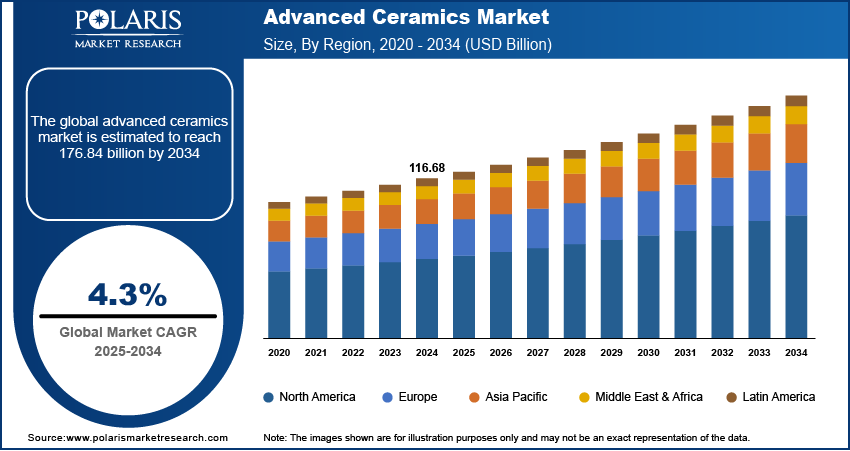
What are Advanced Ceramics?
Advanced ceramics, also referred to as engineering ceramics and high-performance advanced ceramics, are products made from inorganic, high-purity compounds. Various technologies such as hydraulic pressing, isostatic pressing, tape, and compression casting are employed to improve the properties of advanced ceramics. These materials exhibit a wide range of properties, including heat, wear, and temperature resistance, as well as chemical resistance, food compatibility, and biocompatibility.
Advanced ceramics outperform traditional ceramics in terms of corrosion resistance, vehicle maintenance, and armor. As a result, they are widely used across various industries, including aerospace, electric energy, automotive, electronics, and army and defense. The versatility and widespread applications of advanced ceramics drive the advanced ceramics market growth. In addition, rising environmental concerns driving the demand for sustainable and eco-friendly materials are supporting the market growth.
Rising research and development initiatives focused on improving the performance characteristics of advanced ceramics are one of the key market trends anticipated to drive their increased adoption. The rising use of advanced ceramics in nanotechnology is projected to provide several advanced ceramics market opportunities in the coming years.
Market Dynamics
Rising Demand from Medical Sector
In the medical sector, advanced ceramics are used for surgical tools, medical devices, and diagnostic services. These ceramics are used in surgical blades and dental cleaning tools, as they are thermally and electrically insulating, hard, and wear-resistant. Also, the chemical stability and low friction of advanced ceramics means they find applications in orthopedic implants, heat pumps, and endoscopic equipment. The demand for advanced ceramics is rapidly increasing in medicine as they help reduce damage to equipment from exposure to mordant atmospheres or conflagration, impacting the advanced ceramics market development favorably.
Increased Usage in Electronics Industry
The electronics industry is one of the primary end users of advanced ceramics. They are used in the manufacturing of various electronic products such as tablets, laptops, and smartphones. Also, they find applications in the production of several electronics components such as sensors, capacitors, and insulators. Advanced ceramics offer high electrical conductivity and thermal stability and have low dielectric loss, making them ideal for use in electronic products and components. Thus, the increased usage of advanced ceramics in the electronics industry is propelling the advanced ceramics market revenue.
Source: Polaris Market Research Analysis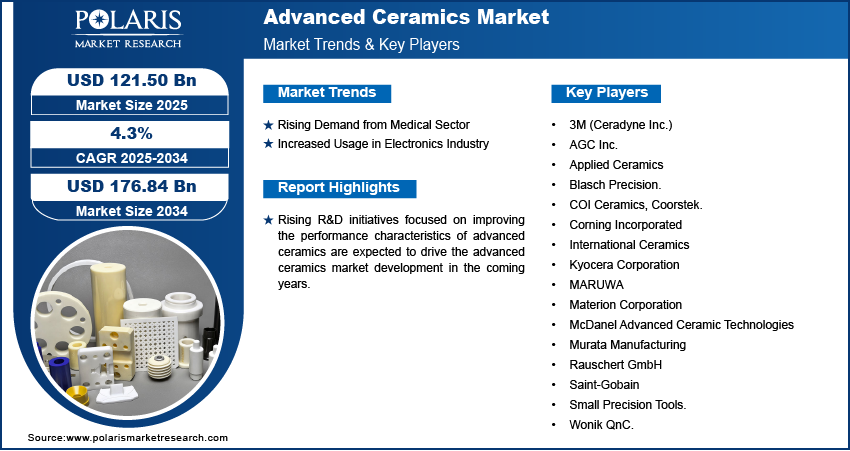
Segment Insights
Market Outlook Based on Material
The advanced ceramics market, based on material, is segmented into alumina, titanate, zirconate, ferrite, aluminum nitride, silicon carbide, and silicon nitride. The alumina segment dominated the market with a revenue share of 37.5% in 2025. Alumina advanced ceramics are the most affordable material in the advanced ceramics market and offer excellent performance. Based on aluminum, they are used in demanding applications that require high thermostability and wear resistance. High-voltage separators, mechanical seals, semiconductor parts, and ballistic armor are among the key applications of these ceramics. Thus, the desirable characteristics and versatility of alumina advanced ceramics drive their dominance in the market.
Material Overview
| Material | Key Properties | Major Applications | Market Insight |
| Alumina | High thermostability, wear resistance, cost-effective, good electrical insulation | High-voltage separators, mechanical seals, semiconductor parts, ballistic armor | Dominated the market due to versatility, performance, and affordability |
| Zirconia | High fracture toughness, thermal resistance, corrosion resistance | Dental implants, cutting tools, oxygen sensors, thermal barriers | Strong demand driven by usage in medical and industrial applications |
| Silicon Carbide | High hardness, excellent thermal conductivity, chemical resistance | Automotive components, aerospace parts, electronics, armor | Growing adoption in high-temperature and high-performance environments
|
Source: Polaris Market Research Analysis
Market Evaluation Based on Product
The advanced ceramics market, based on product, is segmented into monolithic, ceramic coatings, and ceramic matrix composites (CMCs). The ceramic matrix composites (CMCs) segment is projected to register the growth of 4.7% from 2026 to 2034. CMCs are made by combining ceramic materials with reinforcing materials. This combination enhances their properties, making CMCs lightweight, strong, and capable of withstanding thermal shock. The increasing focus on developing CMCs with a variety of benefits by leading market participants is expected to support the robust growth of the segment.
Product Overview
| Product Type | Key Characteristics | Major Applications | Market Insight |
| Monolithic Ceramics | High strength, durability, wear resistance, cost-effective | Structural components, electrical insulators, electronics | Widely used across industries due to reliabilit |
| Ceramic Coatings | Thermal protection, corrosion resistance, surface enhancement | Aerospace components, automotive parts, energy systems | Increasing demand driven by need for surface protection and longer component life |
| Ceramic Matrix Composites (CMCs) | Lightweight, high strength, thermal shock resistance, enhanced toughness | Aerospace, defense, high-temperature industrial applications | Fastest growing segment supported by performance advantages and ongoing innovation |
Source: Polaris Market Research Analysis
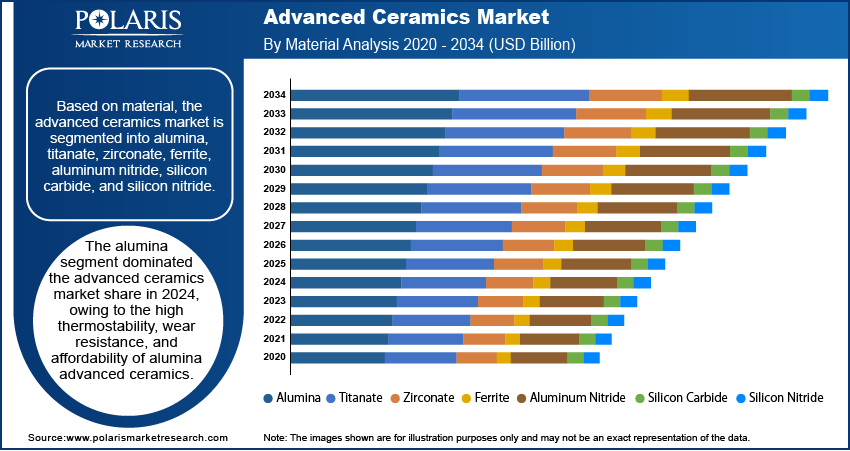
Source: Polaris Market Research Analysis
Regional Analysis
By region, the market report offers advanced ceramics market insights into North America, Europe, Asia Pacific, Latin America, and the Middle East & Africa. Asia Pacific dominated the market with a revenue share of 44.4% in 2025. This is primarily attributed to the expanding medical sector and the increasing need for advanced electronics in the region. Further, rapid technological advancements, increased research and development efforts, and the introduction of supportive government policies for advanced ceramics further support the regional market dominance.
The North America advanced ceramics market held the second-largest market share of 28.65% in 2025. The regional market growth is attributed to the increased demand for advanced ceramics in the production of electrical and electronic gadgets. Further, the rapidly growing medical and electric vehicle (EV) industries contribute to the regional market growth.
Source: Polaris Market Research Analysis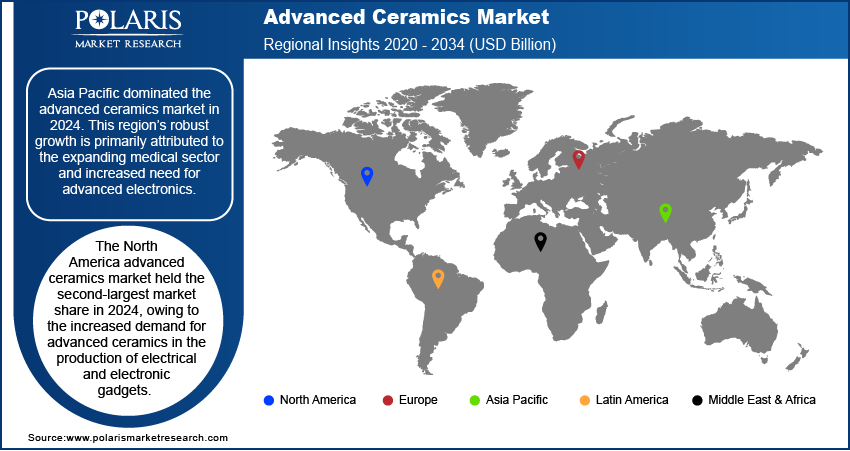
Key Players and Competitive Insights
The advanced ceramics market is characterized by intense competition, driven by factors such as innovative product offerings, technological advancements, mergers and acquisitions, and other strategic partnerships. The key players in the market strive to differentiate themselves in terms of pricing, quality, offering, and customer service. Also, they are making significant investments in R&D initiatives to introduce new ceramics to cater to diverse consumer needs.
Several market participants are prioritizing the development of sustainable and eco-friendly ceramics that comply with stringent government regulations. The advanced ceramics market research report offers a market assessment of all the major players, including 3M (Ceradyne Inc.), AGC Inc., Applied Ceramics, Blasch Precision., COI Ceramics, Coorstek., Corning Incorporated, International Ceramics, Kyocera Corporation, MARUWA, Materion Corporation, McDanel Advanced Ceramic Technologies, Murata Manufacturing, Rauschert GmbH, Saint-Gobain, Small Precision Tools., and Wonik QnC.
List of Key Companies
- 3M (Ceradyne Inc.)
- AGC Inc.
- Applied Ceramics
- Blasch Precision.
- COI Ceramics
- Coorstek.
- Corning Incorporated
- International Ceramics
- Kyocera Corporation
- MARUWA
- Materion Corporation
- McDanel Advanced Ceramic Technologies
- Murata Manufacturing
- Rauschert GmbH
- Saint-Gobain
- Small Precision Tools
- Wonik QnC
Advanced Ceramics Industry Developments
March 2025: Lithoz introduced LithaBite at IDS 2025. It is an alumina-based material made for 3D printing translucent orthodontic ceramic brackets. Source: lithoz.com
March 2025: KYOCERA expanded its fine ceramics facility in Japan to boost capacity for semiconductor, EV, and telecom applications. Source: businesswire.com
August 2024: CoorsTek Inc. opened its third plant in Gumi, South Korea, establishing it as a new-product-introduction hub for advanced semiconductor equipment components. Source: jeffcobdb.com
February 2024: Murata Manufacturing’s Izumo subsidiary began construction of a multilayer ceramic capacitor facility in Shimane, Japan, expanding capacity to meet medium- and long-term demand. Source: murata.com
Advanced Ceramics Market Segmentation
By Material Outlook
- Alumina
- Titanate
- Zirconate
- Ferrite
- Aluminum Nitride
- Silicon Carbide
- Silicon Nitride
By Product Outlook
- Monolithic
- Ceramic Coatings
- Ceramic Matrix Composites (CMCs)
By Application Outlook
- Electric Equipment
- Catalyst Supports
- Electronic Devices
- Wear Parts
- Engine Parts
- Filters
- Bioceramic
- Others
By End-Use Industry Outlook
- Electric & Electronics
- Automotive
- Machinery
- Environmental
- Medical
- Others
By Regional Outlook
- North America
- US
- Canada
- Europe
- Germany
- France
- UK
- Italy
- Spain
- Netherlands
- Russia
- Rest of Europe
- Asia Pacific
- China
- Japan
- India
- Malaysia
- South Korea
- Indonesia
- Australia
- Rest of Asia Pacific
- Middle East & Africa
- Saudi Arabia
- UAE
- Israel
- South Africa
- Rest of the Middle East & Africa
- Latin America
- Mexico
- Brazil
- Argentina
- Rest of Latin America
Future Outlook
Future of the advanced ceramics market is driven by rising demand from electronics. This is due to miniaturization and need for better performance. Growing use of electric vehicles is supporting demand. Ceramics are used in batteries, sensors, and thermal systems. Medical use is also increasing. Ceramics are used in implants and devices because they are durable and safe. Nanotechnology is creating new opportunities. It helps improve material properties. Demand for durable and sustainable materials is also increasing. This is supporting long-term market growth.
Report Scope
| Report Attributes | Details |
| Market Size Value in 2025 | USD 121.23 billion |
| Market Size Value in 2026 | USD 126.07 billion |
| Revenue Forecast by 2034 | USD 177.04 billion |
| CAGR | 4.3% from 2026–2034 |
| Base Year | 2025 |
| Historical Data | 2021–2024 |
| Forecast Period | 2026–2034 |
| Quantitative Units | Revenue in USD billion and CAGR from 2026–2034 |
| Report Coverage | Revenue Forecast, Market Competitive Landscape, Growth Factors, and Trends |
| Segments Covered |
|
| Regional Scope |
|
| Competitive Landscape |
|
| Report Format |
|
| Customization | Report customization as per your requirements with respect to countries, regions, and segmentation. |
Source: Polaris Market Research Analysis
Advanced Ceramics Market FAQ's
The market was valued at USD 121.23 billion in 2025 and is projected to grow to USD 177.04 billion by 2034.
The market is projected to register a CAGR of 4.3% from 2026 to 2034.
Asia Pacific accounted for the largest region-wise market size of 44.40% in 2025.
A few of the key players in the market are 3M (Ceradyne Inc.), AGC Inc., Applied Ceramics, Blasch Precision., COI Ceramics, Coorstek., Corning Incorporated, International Ceramics, Kyocera Corporation, MARUWA, Materion Corporation, McDanel Advanced Ceramic Technologies, Murata Manufacturing, Rauschert GmbH, Saint-Gobain, Small Precision Tools., and Wonik QnC.
The alumina segment accounted for the largest market share of 37.5% in 2025.
The ceramic matrix composites (CMCs) segment is anticipated to register the fastest growth of 4.7% during the forecast period.
They improve strength, heat resistance, and durability of polymer-based materials.
Used in electronics, automotive, aerospace, and medical for components like sensors, insulators, and tools.
Yes, they are chemically stable and safe, including for medical applications.
Demand is increasing due to growth in electronics, EVs, medical use, and new technologies.
Download Sample Report of Advanced Ceramics Market
Please fill out the form to request a customized copy of the research report.


