
Alpha-Gal Syndrome Allergy Market Opportunity & Share, Analysis Report, 2026-2034
REPORT DETAILS
Alpha-Gal Syndrome Allergy Market Summary
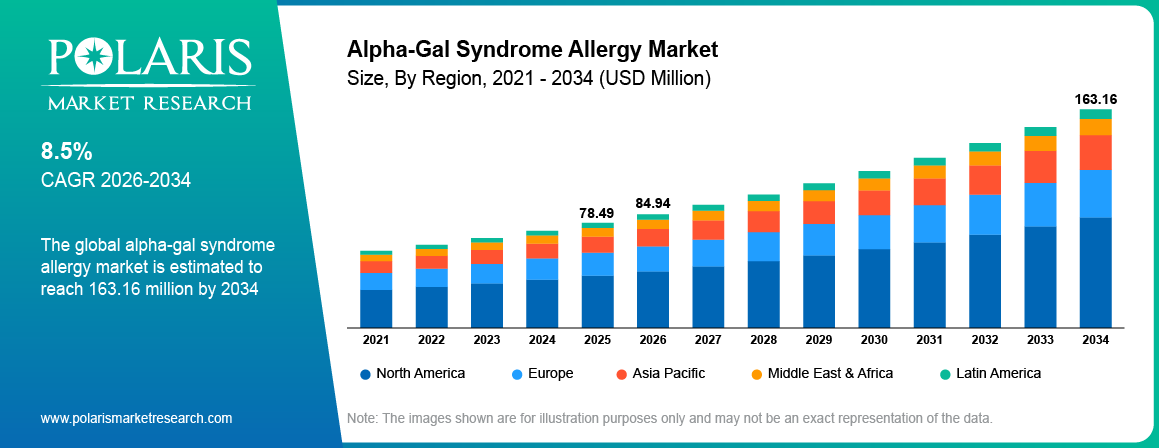
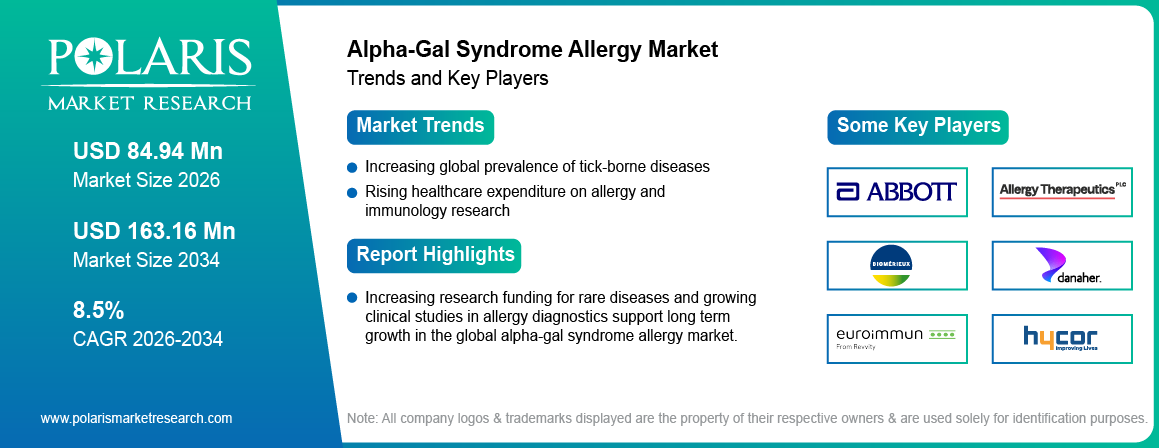
The global alpha-gal syndrome allergy market is estimated around USD 78.49 million in 2025,with consistent growth anticipated during 2026–2034. Growth is driven by rising cases of tick-borne diseases and increasing awareness of rare food allergies. The market is projected to grow at a CAGR of 8.5% during the forecast period.
Market Statistics
Key Takeaways
- North America accounted for the largest regional share of around 41.9% in 2025, driven by high prevalence of tick-borne diseases, increasing awareness, and advanced diagnostic infrastructure.
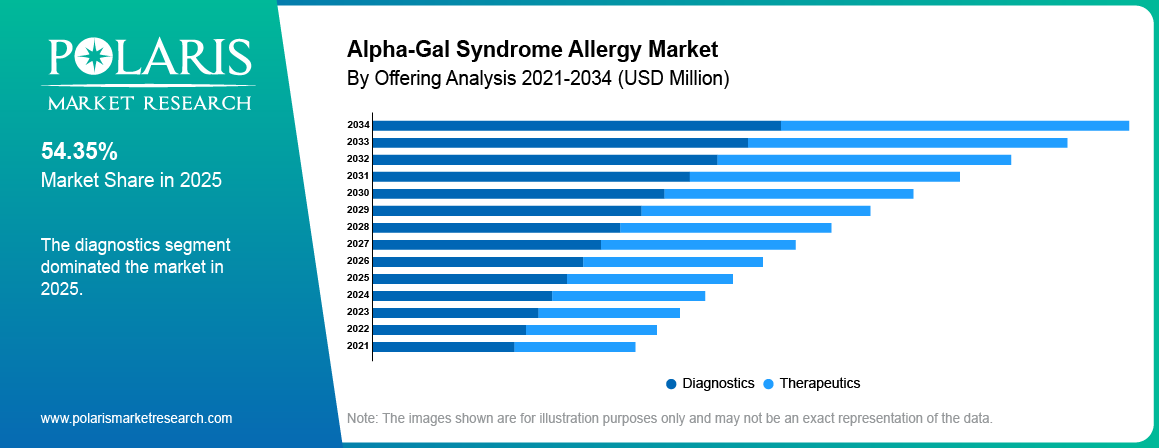
- By Offering, Diagnostics segment accounted for the largest share of approximately 63.5% in 2025, supported by rising clinical testing, improved laboratory capabilities, and growing awareness of alpha-gal antibody detection.
- By Drug Class, Epinephrine segment is projected to grow at a CAGR of 7.8%, driven by increasing demand for emergency treatment of severe allergic reactions and rising awareness of anaphylaxis management.
- By Distribution Channel, Hospital Pharmacies segment accounted for the largest share of nearly 61.7% in 2025, supported by high demand for emergency care and availability of immediate medical support.
Industry Dynamics
- Rising tick-borne disease cases are increasing the number of diagnosed alpha-gal syndrome patients.
- Growing healthcare investment in allergy and immunology research supports diagnostic innovation.
- Limited standardized treatment protocols restrict effective clinical management.
- Increasing research funding for rare diseases creates opportunities for new diagnostics and therapeutic development.
What is Alpha-Gal Syndrome?
The allergy associated with the alpha-gal syndrome allergy refers to the food allergy that results from the carbohydrate compound called galactose-α-1,3-galactose. The allergy results from tick bites that introduce the alpha-gal compound into the human system. The healthcare ecosystem involves various entities that include laboratories, healthcare providers, allergy management, and research centers that deal with the management of the allergy. The ecosystem targets various entities that include hospitals, clinics, and diagnostic centers that are essential in the management of the allergy.
The alpha-gal syndrome allergy ecosystem involves various entities that include diagnostic testing, allergy management, and therapy. These services support patients who experience allergic reactions after consuming mammalian meat products such as beef, pork, or lamb. Healthcare providers use blood tests and clinical assessments to confirm alpha-gal sensitivity. Medical institutions supply treatment support through allergy counseling, dietary management programs, and emergency care for severe allergic reactions.
To Understand More About this Research:Download Sample Report
The alpha-gal syndrome allergy differs from common food allergies that trigger immediate immune responses. This condition results in delayed allergic reactions occurring several hours after the consumption of red meat. The healthcare system is focused on the early detection of the condition, educating the patient, and the long-term management of the diet in order to reduce the allergy risks. Increasing awareness among the public and clinicians is helping in the better management of the emerging allergy condition.
Drivers & Opportunities
Increasing global prevalence of tick-borne diseases: Increasing global prevalence of tick-borne diseases: The rising prevalence of tick-borne diseases is causing the incidence of Alpha Gal Syndrome in many parts of the world. Tick bites result in the transfer of the alpha-gal molecule into the body of the host, resulting in allergic reactions. In October 2025, researchers at Virginia Commonwealth University (VCU) observed a sharp increase in the incidence of Alpha Gal Syndrome in the U.S., which is associated with the rising prevalence of the lone star tick, which is responsible for red meat allergies. The growing exposure to ticks is increasing the diagnosed patient population and demand for allergy testing services.
Growing elderly population: Healthcare systems are increasing investments in allergy and immunology research. These investments support the development of improved diagnostic tools and laboratory testing methods for rare allergies. Increasing funding for research is boosting innovation in diagnostic tests for alpha-gal syndrome.
Opportunity
Rising funding for rare disease research: Increasing funding for research on rare diseases: Government organizations and research centers are increasing funding for research on rare diseases. This is boosting research on alpha-gal syndrome. Growing research programs are creating opportunities for improved diagnostic and treatment approaches. For instance, in October 2025, the National Institutes of Health (NIH) granted about USD 26 million in 2025 to start the fifth funding cycle of the Rare Diseases Clinical Research Network (RDCRN).
Restraints & Challenges
Limited availability of standardized treatment protocols: Limited availability of standardized treatment protocols: The treatment of alpha-gal syndrome is still in the early stages. There is a scarcity of standardized treatment protocols. Healthcare professionals rely on dietary restrictions and allergy treatment protocols.
Segmental Insights
This report offers detailed coverage of the alpha-gal syndrome allergy market by offering, drug class, and distribution channel to help readers identify the fastest expanding and most attractive demand segments.
By Offering
-
Diagnostics
Diagnostics held the largest market share in 2025, due to rapid increase in clinical testing for alpha-gal sensitivity. Healthcare professionals use blood tests and lab tests to confirm the presence of alpha-gal antibodies. There is an increase in awareness among healthcare professionals, as well as improved lab testing capabilities.
-
Therapeutics
Therapeutics is expected to experience the highest CAGR during the forecast period. This is attributed to an increase in the need to manage allergies. Doctors recommend drugs to help manage allergies. This is done to prevent reactions that occur during an allergy attack. There is an increase in the rate of patient diagnosis.
By Drug Class
-
Antihistamines
Antihistamines had the highest market share in 2025 due to their extensive use in controlling allergic reactions such as itching, hives, and inflammation. Antihistamines are prescribed by physicians to treat mild to moderate allergic reactions. The availability of different antihistamines results in a consistent demand for allergy treatment.
-
Epinephrine
Epinephrine segment is projected to grow at the fastest CAGR during the forecast period, due to increasing use in emergency treatment of severe allergic reactions. Patients with high allergy risk carry devices that inject epinephrine to respond to anaphylactic reactions. Awareness of the management of severe allergy reactions results in a high demand for epinephrine devices.
By Distribution Channel
-
Hospital Pharmacies
Hospital pharmacies had the highest market share in 2025 due to the high demand for emergency allergy treatment. Hospitals provide patients with drugs for the management of severe allergy reactions and anaphylaxis. The availability of medical personnel results in the availability of medication for patients.
-
Online Pharmacies
Online pharmacies segment is projected to grow at the fastest CAGR during the forecast period, due to increasing digital healthcare adoption. Patients are purchasing allergy medications through online platforms for convenience and home delivery. The expansion of e-pharmacy services is improving access to allergy treatment products.
Regional Analysis
North America Market Assessment
North America alpha-gal syndrome allergy market dominated in 2025, driven by the high prevalence of tick-borne diseases across the U.S. The U.S. CDC reported that state and local health departments recorded an average of 46,115 tick-borne disease cases annually between 2019 and 2022. Health agencies in the U.S. have reported increasing cases of alpha-gal syndrome linked to Lone Star tick exposure. Rising awareness among healthcare providers and growing allergy testing services are strengthening diagnosis rates and supporting market growth in the region.
Asia Pacific Alpha-Gal Syndrome Allergy Market Insights
Asia Pacific alpha-gal syndrome allergy market is projected to grow at the fastest CAGR during the forecast period, owing to expanding healthcare infrastructure and rising awareness of rare allergic conditions. IBEF reported that India’s healthcare sector grew from USD 372 billion in 2023 and is expected to reach USD 638 billion by 2025, with a CAGR of 17.5–22.5%. Healthcare spending in India was at 3.3% of its GDP in 2022, but it is expected to rise to 5% by 2030. Also, countries like China and India are stepping up their spending in diagnostic centers as well as allergy research programs. This is helping in better identification of new food allergies in these regions.
Europe Alpha-Gal Syndrome Allergy Market Overview
Europe was the second largest market for alpha-gal syndrome allergy, driven by increasing research on tick-borne diseases and expanding allergy diagnostics. Countries like Germany, France, UK, and Spain are also strengthening their clinical research in rare types of allergies. For instance, in February 2026, the BIOGAL project, led by Spain’s Instituto de Investigación en Recursos Cinegéticos (IREC), aims at advancing knowledge and prevention of Alpha-Gal Syndrome by studying tick saliva molecules.

Key Players & Competitive Analysis Report
The competitive scenario is influenced by ongoing research in allergy diagnostic tools and immunology drugs. Firms are focused on creating better diagnostic tools and drugs to ensure efficient management of alpha-gal syndrome. Collaboration between pharmaceutical companies, research institutions, and healthcare providers is supporting innovation in allergy detection and treatment solutions.
Leading companies in the alpha-gal syndrome allergy market are Abbott Laboratories, Thermo Fisher Scientific Inc., Quest Diagnostics Inc., Labcorp Holdings Inc., Siemens Healthineers AG, Danaher Corporation, bioMérieux SA, EUROIMMUN Medizinische Labordiagnostika AG, Omega Diagnostics Group PLC, HYCOR Biomedical LLC, Stallergenes Greer International AG, Allergy Therapeutics PLC, and many more.
Future Trends and Technology Innovations
Smart and Bioactive Alpha-Gal Syndrome Allergy
Smart and bioactive alpha-gal syndrome allergy are advancing the development of next generation medical implants and therapeutic materials. These materials interact with biological tissues and support faster healing and improved implant performance. Research in advanced alpha-gal syndrome allergy technology is increasing the use of smart alpha-gal syndrome allergy and bioactive alpha-gal syndrome allergy in orthopedic implants, cardiovascular devices, and tissue regeneration.
3D Printing Alpha-Gal Syndrome Allergy
3D printing of alpha-gal syndrome allergy has revolutionized the production of medical devices. Firms involved in medical devices have started creating customized implants to fit the exact patient anatomy. The use of 3D printing of alpha-gal syndrome allergy has led to an increase in its application in orthopedic surgery, dental implants, and tissue engineering.
Nanotechnology in Alpha-Gal Syndrome Allergy
Nanotechnology alpha-gal syndrome allergy is helping improve the structural and biological properties of medical materials. Nanostructured surfaces improve cell attachment in medical implants. Continuous research in nanotechnology alpha-gal syndrome allergy is supporting the development of advanced alpha-gal syndrome allergy technology used in regenerative medicine and biomedical devices.
Emerging Diagnostic Technologies
Advances in molecular diagnostics of alpha-gal syndrome allergy are helping improve detection in patients. There is a focus on biomarker discovery to aid in early detection of alpha-gal syndrome.
Drug Development and Therapeutic Pipeline
Pharmaceutical companies and research organizations are exploring biologics and immunotherapy in managing severe allergic reactions. Ongoing research is aimed at developing therapies to improve long-term management of allergy.
Long-Term Market Outlook
The alpha-gal syndrome allergy market is expected to expand due to rising awareness of tick-borne diseases and increasing patient diagnosis rates. Growing healthcare investments in allergy research and diagnostic infrastructure are supporting future market development.
List Of Key Companies
- Abbott Laboratories
- Allergy Therapeutics PLC
- bioMérieux SA
- Danaher Corporation
- EUROIMMUN Medizinische Labordiagnostika AG
- HYCOR Biomedical LLC
- Labcorp Holdings Inc.
- Omega Diagnostics Group PLC
- Quest Diagnostics Inc.
- Siemens Healthineers AG
- Stallergenes Greer International AG
- Thermo Fisher Scientific Inc.
Industry Developments
- February 2026: Researchers at the University of Missouri are working to understand the increase in Alpha-Gal Syndrome by analyzing the condition based on the patients’ data and raising awareness of the condition in order to help the affected patients.
- February 2025: IgGenix identified over 60 specific monoclonal antibodies against alpha-gal from red meat allergy patients utilizing their technology known as SEQ SIFTER, which offers further insights into Alpha-Gal Syndrome and helps in the development of future diagnostic and therapeutic products.
Alpha-Gal Syndrome Allergy Market Segmentation
By Offering Outlook (Revenue, USD Million, 2021-2034)
- Diagnostics
- Therapeutics
By Drug Class Outlook (Revenue, USD Million, 2021-2034)
- Antihistamines
- Epinephrine
- Corticosteroids
By Distribution Channel Outlook (Revenue, USD Million, 2021-2034)
- Hospital Pharmacies
- Retail Pharmacies
- Online Pharmacies
By Regional Outlook (Revenue, USD Million, 2021-2034)
- North America
- US
- Canada
- Europe
- Germany
- France
- UK
- Italy
- Spain
- Netherlands
- Russia
- Rest of Europe
- Asia Pacific
- China
- Japan
- India
- Malaysia
- South Korea
- Indonesia
- Australia
- Vietnam
- Rest of Asia Pacific
- Middle East & Africa
- Saudi Arabia
- UAE
- Israel
- South Africa
- Rest of Middle East & Africa
- Latin America
- Mexico
- Brazil
- Argentina
- Rest of Latin America
Alpha-Gal Syndrome Allergy Market Report Scope
| Report Attributes | Details |
| Market Size in 2025 | USD 78.49 Million |
| Market Size in 2026 | USD 84.94 Million |
| Revenue Forecast by 2034 | USD 163.16 Million |
| CAGR | 8.5% from 2026 to 2034 |
| Base Year | 2025 |
| Historical Data | 2022–2024 |
| Forecast Period | 2026–2034 |
| Quantitative Units | Revenue in USD Million and CAGR from 2026 to 2034 |
| Report Coverage | Revenue Forecast, Competitive Landscape, Growth Factors, and Industry Trends |
| Segments Covered |
|
| Regional Scope |
|
| Competitive Landscape |
|
| Report Format |
|
| Customization | Report customization as per your requirements with respect to countries, regions, and segmentation. |
Source: Polaris Market Research Analysis
Alpha-Gal Syndrome Allergy Market FAQ's
The global market size was valued at USD 78.49 Million in 2025 and is projected to grow to USD 163.16 Million by 2034.
North America dominates due to rising prevalence of tick-borne diseases and increasing allergy diagnostic testing.
Major applications include diagnostic testing, allergy management therapies, emergency treatment for severe reactions, and clinical monitoring services.
A few of the key players in the market are Abbott Laboratories, Thermo Fisher Scientific Inc., Quest Diagnostics Inc., Labcorp Holdings Inc., Siemens Healthineers AG, Danaher Corporation, bioMérieux SA, EUROIMMUN Medizinische Labordiagnostika AG, Omega Diagnostics Group PLC, HYCOR Biomedical LLC, Stallergenes Greer International AG, Allergy Therapeutics PLC, and others.
The factors propelling growth include increasing tick-borne disease cases and rising healthcare investment in allergy and immunology research.
Download Sample Report of Alpha-Gal Syndrome Allergy Market
Please fill out the form to request a customized copy of the research report.


