
Automotive Sun Visor Market Share, Trends and Forecasts, 2026-2034
REPORT DETAILS
Automotive Sun Visor Market Summary
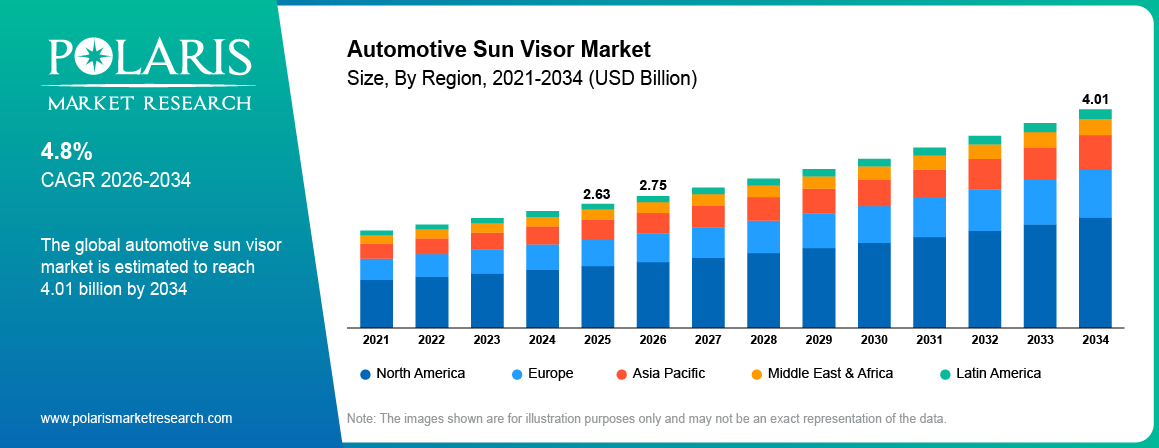
The global automotive sun visor market size was valued at USD 2.63 billion in 2025. The market is expected to exhibit a CAGR of 4.8% from 2026 to 2034. As automakers add more comfort and safety features to vehicles, sun visors are being upgraded as well. From basic shades to smart visors with lighting and electronics, the market is growing in line with vehicle production. The increasing demand for premium interiors is also contributing to this upward trend.
Market Statistics
Key Takeaways
- North America het held the largest revenue share of 39.5% in 2025. The regional market dominance is attributed to the rising demand for electric vehicles in the region.
- Asia Pacific is projected to register significant growth at a 5.3% CAGR. This is due to growing M&As between major automotive players to boost production capacities.
- India is anticipated to account for a 5.9% CAGR. The expansion of local automotive manufacturers contributes to market growth in the country.
- The conventional segment is expected to experience a significant CAGR of 5.1%. This is owing to simplicity and affordability.
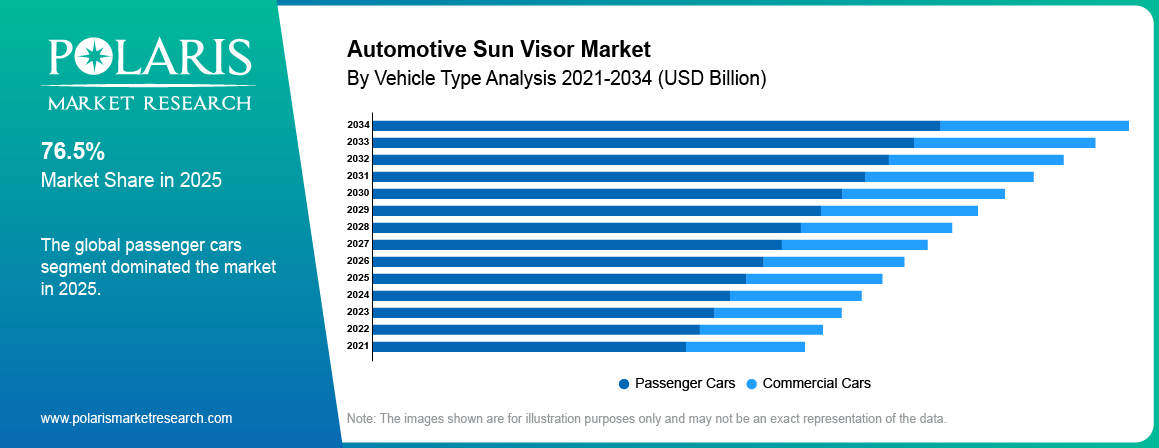
- The passenger cars segment dominated the market with a 76.5% share in 2025. The rising passenger vehicle sales contribute to the segment’s leading position.
Note: Figures and projections outlined in this report are the result of Polaris Market Research’s proprietary analytical processes, grounded in the latest available datasets and market observations.
AI Impact on Automotive Sun Visor Market
- AI helps in designing better car sun visors through analysis of driver behavior, visibility requirements, and comfort preferences.
- It helps in creating sun visors with improved technology that adjusts the tinting and position depending on the sunlight and road conditions.
- The quality of products is improved using AI since it helps in detecting defects, streamlining production processes, and ensuring uniformity during development.
- Car manufacturers can make better decisions about their supply chain management and product development using AI.
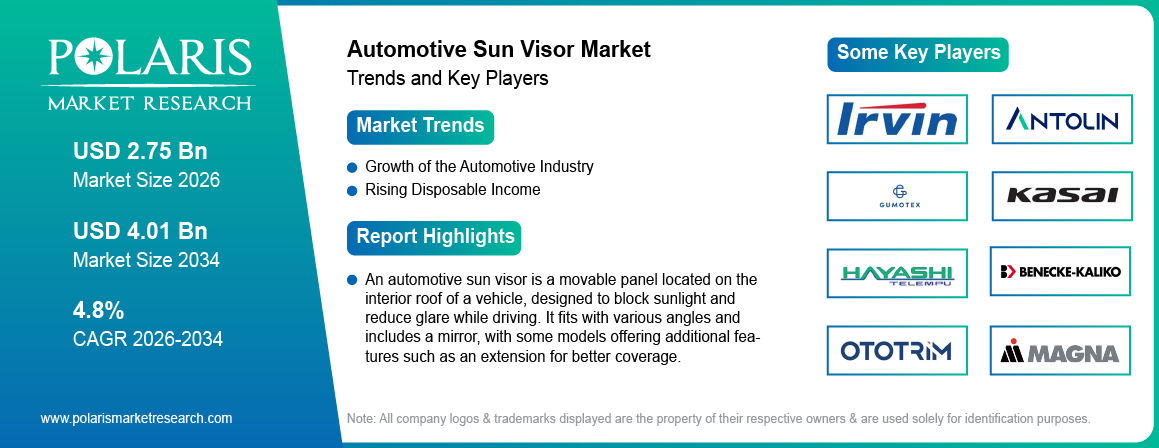
An automotive sun visor is a movable panel located on the interior roof of a vehicle, designed to block sunlight and reduce glare while driving. It fits with various angles and includes a mirror, with some models offering additional features such as an extension for better coverage.
The growing emphasis on driver safety is significantly driving their demand. The awareness about road safety is increasing, due to which automakers are prioritizing features that improve driver comfort and reduce distractions, making sun visors an essential component. Sun visors help reduce glare from the sun, which improves visibility and prevents accidents caused by impaired vision. Additionally, regulations requiring vehicles to meet certain safety standards are positively impacting the automotive sun visor market demand.
To Understand More About this Research: Download Sample Report
Technological advancements in sun visors are expected to fuel the automotive sun visor market growth during the forecast period. Innovations such as electrochromic or smart sun visors, which automatically adjust to light conditions to provide better glare protection and convenience, are anticipated to drive the demand. Additionally, materials are becoming lighter, more durable, and UV-resistant, improving both functionality and aesthetics. Features such as built-in LED lights or integrated mirrors are also adding value, which is making modern sun visors more versatile and appealing to consumers.
Conventional vs Smart Automotive Sun Visors
| Aspect | Conventional Sun Visor | Smart Automotive Sun Visor |
| Functionality | Mechanical blocking of sun and glare. | Use of sensors and digital displays for automatic glare reduction. |
| Visibility | May obstruct part of the driver’s line of sight. | Enhances visibility while enabling clear road vision by drivers. |
| Technology Compatibility | Simple mechanical design. | Comes with integrated cameras, LCD/OLED screens, sensors, and electronics. |
| Driver Assistance Features | Limited features for sun blocking only. | Can run simultaneously with enhanced visibility and driver assistance functions. |
| Vehicle Segment | Used extensively in economy/mid-level cars. | Mainly used in high-end and futuristic car models. |
| Cost | Low production/replacement costs. | High production costs because of complex electronics and computer technology. |
Driver Analysis
Driver: Growth of the Automotive Industry
The rising production and sale of vehicles are propelling the need for essential interior components such as sun visors. According to the International Organization of Motor Vehicle Manufacturers, sales climbed from 95.3 million to 99.8 million units, up 4.7% from 2024 to 2025, highlighting the growth of the automotive industry. Additionally, the expansion of the automotive industry in emerging regions such as India and Africa is driving greater demand for affordable and feature-rich vehicles. Therefore, the growth of the automotive industry is fueling the industry.
Driver: Rising Disposable Income
An increase in disposable income is supporting the general population to spend more on luxury. According to the US Bureau of Economic Analysis, in the US alone, disposable income rose by 0.1% from August to September 2024. Additionally, higher income levels have enabled consumers to invest in premium vehicles or aftermarket modifications, including improved sun visors. Therefore, the rising disposable income of the general population is driving the industry..
Trend: Integration with Advanced Driver Assistance Systems (ADAS)
With the increasing adoption of ADAS, intelligent sun visor applications have emerged. Modern cars incorporate many cameras, sensors, and other monitoring systems that aim to enhance driver efficiency. Incorporating smart sun visors into modern cars would assist such devices by minimizing any possible distraction or interference in the functionality of these mechanisms due to excessive glare. Moreover, the latest designs use an automatic mechanism to track sunlight and minimize glare in that area.
Trend: Smart and Electronic Sun Visor Technologies
Intelligent and electronic sun visor systems have become an innovative trend in the development of advanced visibility enhancement systems, moving beyond ordinary interior components in automobiles. Modern vehicle manufacturers focus on creating LCD visors, transparent OLED display screens, cameras that reduce glare, and shade systems driven by sensors that adjust according to changing sunlight conditions. Unlike traditional sun visors, which simply cover part of the windscreen, intelligent visors filter excessive brightness while maintaining clear visibility of the road. They are effective in reducing glare and ensuring driver safety in cars. Innovations in connected cars, digital cockpits, electric vehicles, and driver assistance systems are fueling the trend.
Segment Analysis
Component Outlook
The conventional segment is expected to experience a significant CAGR of 5.1% in the global market during the forecast period due to its lightweight materials, such as fabric and plastic. It remains popular due to its affordability and simplicity. Many consumers prefer these basic models for their practicality and effectiveness in blocking sunlight. Automakers continue to include conventional sun visors in a wide range of vehicle models, driving demand for conventional sun visors.
Vehicle Type Outlook
The passenger cars segment dominated the market with a 76.5% share in 2025, due to the rising passenger vehicle sales. Increased demand for personal transportation, coupled with the growing middle-class population in emerging regions, has led to higher passenger car sales. Sun visors are a standard feature in nearly all passenger vehicles. Therefore, growing passenger vehicle sales are leading to segmental dominance in the global market.
Regional Analysis
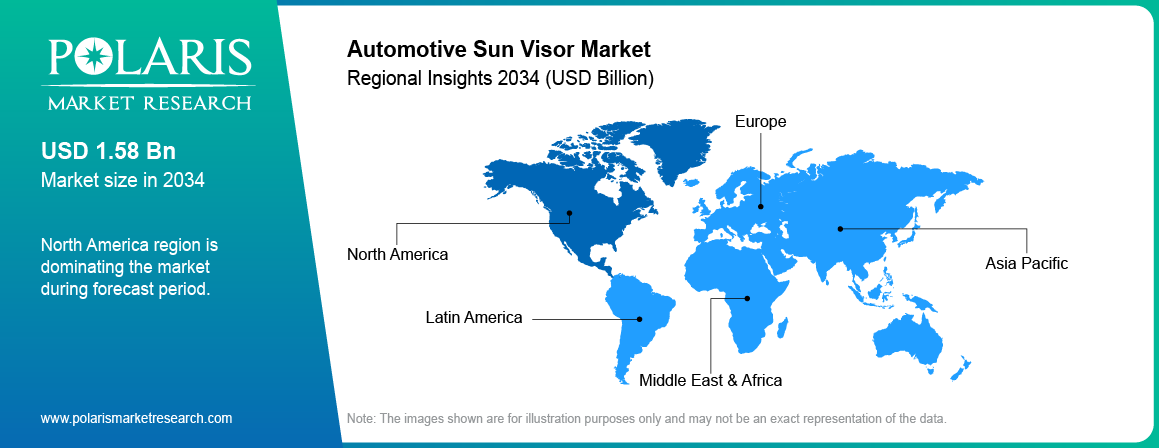
North America held the largest revenue share of 39.5% in 2025 due to the rising demand for electric vehicles in the region. Manufacturers are expanding their production capacities to fulfil the demand from the general population, due to which the demand is increasing. According to the Federal Reserve Bank of Chicago, in 2021, EV sales reached 1.4 million in the US, highlighting significant demand for electric vehicles. Additionally, growing disposable income in the region is driving the demand for electric vehicles, further propelling the industry growth in North America.
Asia Pacific is projected to register significant growth at a 5.3% CAGR due to growing mergers and acquisitions between major automotive players aimed at the expansion of production capacities. Automotive manufacturers in the region are strategically acquiring and partnering with key competitors for the expansion of manufacturing capacity. Additionally, these mergers and acquisitions have led to the exchange of resources and technology, aiming at a broader market reach. Further, the increasing sales of vehicles are driving the demand in the Asia Pacific region.
The market in India is experiencing substantial growth due to the expansion of local automotive manufacturers. These automotive manufacturers are expanding their production capacities to meet consumer demand. Tata Motors, an Indian multinational automotive company, sold 215,034 passenger vehicles in the second quarter of FY 2024–2025, highlighting the expansion of their operations. Additionally, government incentives for local automotive manufacturers are driving this expansion, positively impacting the demand in India.
Competitive Analysis
The industry is constantly evolving, with numerous companies striving to innovate and distinguish themselves. Leading global corporations dominate the market by leveraging extensive research and development and advanced techniques. These companies pursue strategic initiatives such as mergers and acquisitions, partnerships, and collaborations to enhance their product offerings and expand into new markets.
New companies are impacting the industry by introducing innovative products to meet the demand of specific sectors. This competitive environment is amplified by continuous progress in product offerings. A few major players in the industry include Irvin Automotive Products, Inc.; Grupo Antolin; GUMOTEX; KASAI KOGYO CO., LTD.; Atlas Holdings; FOMPAK; Hayashi Telempu Corporation; Benecke-Kaliko AG; BRACE; Grios s.r.o.; OTOTRIM Panel Industry and Trade SA; ContiTech AG; Magna International Inc.; ACME Specialty Manufacturing; and Mirror Lite Company, Inc.
Irvin Automotive Products, Inc. is a manufacturer of automotive components. The company's offering lies in three primary product segments—automotive lighting, electrical systems, and interior components. In the automotive lighting segment, Irvin offers solutions such as headlights, taillights, and interior lighting systems. The electrical systems division focuses on components such as wiring harnesses and connectors. Additionally, Irvin produces a variety of interior components, including dashboard assemblies and seating systems. These diverse offerings cater to original equipment manufacturers (OEMs) and aftermarket suppliers. Irvin Automotive Products operates primarily in North America, with a strong presence in the US, but it also extends its operations internationally to markets in Europe and Asia.
KASAI KOGYO CO., LTD. is a Japanese manufacturing company established in 1944, specializing in automotive interior and exterior trim components. The company’s product portfolio primarily includes interior trim components such as dashboard assemblies, door panels, and console components. Additionally, KASAI KOGYO manufactures exterior trim components such as bumpers and grilles, which contribute to the vehicle's design and aerodynamics. KASAI KOGYO operates on a global scale, with a geographical footprint that spans multiple regions. Its headquarters in Japan serves as the hub for its manufacturing capabilities, while production facilities across Asia cater to the growing demand for automotive components. The company also has a strong presence in North America.
List of Key Companies
- Irvin Automotive Products, Inc.
- Grupo Antolin
- GUMOTEX
- KASAI KOGYO CO., LTD.
- FOMPAK
- Hayashi Telempu Corporation
- Benecke-Kaliko AG
- BRACE
- Grios s.r.o.
- OTOTRIM Panel Industry and Trade SA
- ContiTech AG
- Magna International Inc.
- ACME Specialty Manufacturing
- Mirror Lite Company, Inc.
Market Development
- January 2026: Gentex showcased new automotive tech at CES 2026. The company highlighted its next generation of large-area dimmable devices. They included dimmable sunroofs and sun visors incorporating several integrated vanity mirror designs. (source: gentex.com)
Automotive Sun Visor Market Segmentation
By Component Outlook (Revenue USD Billion, 2021–2034)
- Conventional
- LCD
By Vehicle Type Outlook (Revenue USD Billion, 2021–2034)
- Passenger Cars
- Commercial Cars
By Regional Outlook (Revenue USD Billion, 2021–2034)
- North America
- US
- Canada
- Europe
- Germany
- France
- UK
- Italy
- Spain
- Netherlands
- Russia
- Rest of Europe
- Asia Pacific
- China
- Japan
- India
- Malaysia
- South Korea
- Indonesia
- Australia
- Rest of Asia Pacific
- Middle East & Africa
- Saudi Arabia
- UAE
- Israel
- South Africa
- Rest of Middle East & Africa
- Latin America
- Mexico
- Brazil
- Argentina
- Rest of Latin America
Automotive Sun Visor Market Report Scope
| Report Attributes | Details |
| Market Size in 2025 | USD 2.63 billion |
| Market Size in 2026 | USD 2.75 billion |
| Revenue Forecast by 2034 | USD 4.01 billion |
| CAGR | 4.8% from 2026 to 2034 |
| Base Year | 2025 |
| Historical Data | 2021–2024 |
| Forecast Period | 2026–2034 |
| Quantitative Units | Revenue in USD billion and CAGR from 2026 to 2034 |
| Report Coverage | Revenue Forecast, Market Competitive Landscape, Growth Factors, and Trends |
| Segments Covered |
|
| Regional Scope |
|
| Competitive Landscape |
|
| Report End User |
|
| Customization | Report customization as per your requirements with respect to countries, regions, and segmentation. |
Source: Polaris Market Research Analysis
Automotive Sun Visor Market FAQ's
The market size was valued at USD 2.63 billion in 2025 and is projected to grow to USD 4.01 billion by 2034.
The global market is projected to register a CAGR of 4.8% during 2026–2034.
North America held the largest revenue share of 39.5% in 2025.
A few key players in the market are Irvin Automotive Products, Inc.; Grupo Antolin; GUMOTEX; KASAI KOGYO CO., LTD.; Atlas Holdings; FOMPAK; Hayashi Telempu Corporation; Benecke-Kaliko AG; BRACE; Grios s.r.o.; OTOTRIM Panel Industry and Trade SA; ContiTech AG; Magna International Inc.; ACME Specialty Manufacturing; and Mirror Lite Company, Inc.
The conventional segment is expected to experience a significant CAGR of 5.1%.due to its affordability and simplicity.
The passenger cars segment dominated the market with a 76.5% share in 2025.
Download Sample Report of Automotive Sun Visor Market
Please fill out the form to request a customized copy of the research report.


