
Computational Photography Market Size, Share & Forecast 2026-2034
REPORT DETAILS
Computational Photography Market Overview
The global computational photography market is estimated around USD 18.34 Billion in 2025,with consistent growth anticipated during 2026–2034. This growth is driven by increasing integration of AI in imaging systems, rising demand for premium smartphone cameras, and growing adoption of AI-assisted image processing technologies. The market is projected to grow at a CAGR of 13.34% during the forecast period.
Market Statistics
Key Takeaways
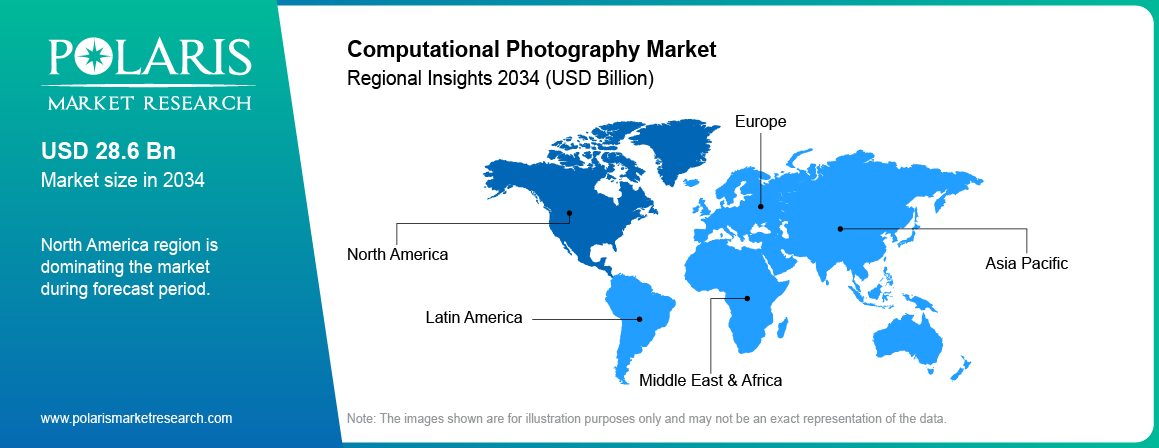
- North America dominated the market with 34.0% share in 2025 due to strong semiconductor and AI technology ecosystem.
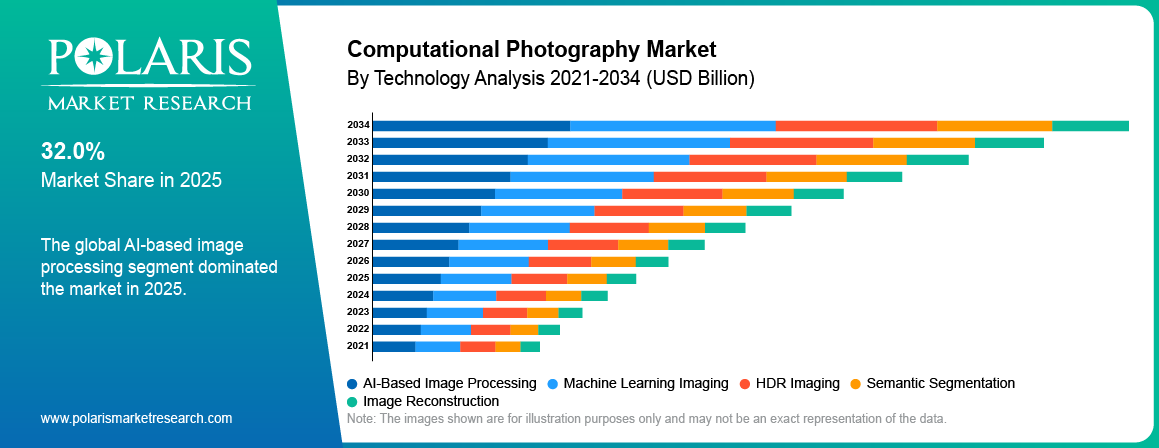
- AI-based image processing segment dominated the market with 32.0% share in 2025 due to rapid integration of deep learning technologies in imaging systems.
- Smartphones segment dominated the market with 54.0% share in 2025 owing to strong global demand for premium mobile photography.
- Healthcare imaging segment is projected to grow at the fastest CAGR of 13.9% during the forecast period due to increasing AI-assisted diagnostics adoption.
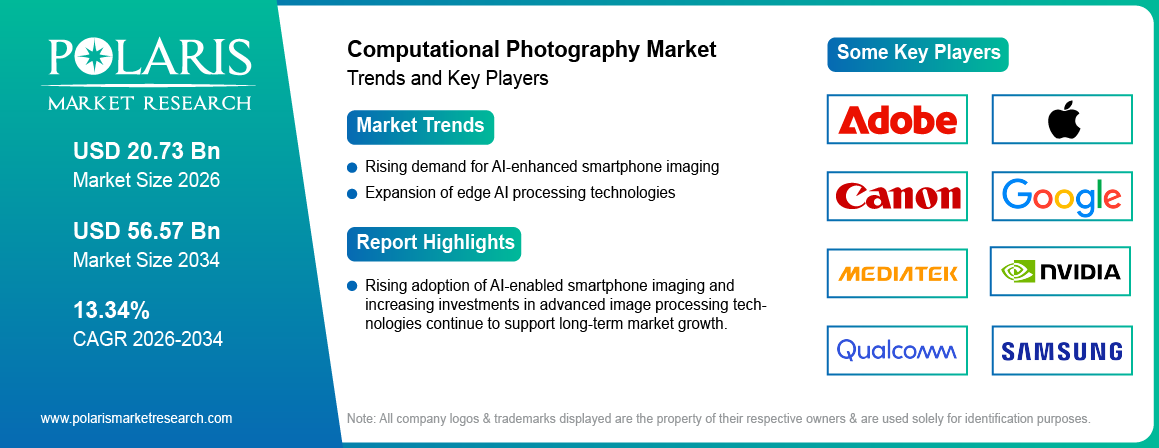
- Major companies operating in the market include Adobe Inc., Apple Inc., Canon Inc., Google LLC, MediaTek Inc., NVIDIA Corporation, and others.
*Note: Figures and projections outlined in this report are the result of Polaris Market Research’s proprietary analytical processes, grounded in the latest available datasets and market observations.
Industry Dynamics
- Rising demand for AI-enhanced smartphone imaging supports market expansion.
- Increasing edge AI adoption improves real-time image processing efficiency.
- Thermal limitations and battery consumption continue to create hardware challenges.
- Automotive and healthcare imaging applications create long-term growth opportunities.
What is Computational Photography? Definition, Techniques & Applications in Smartphones, Automotive & Healthcare
Computational photography refers to the use of artificial intelligence, software algorithms, and machine learning technologies to improve digital image quality beyond traditional camera limitations. The technology is widely used in smartphones, healthcare imaging systems, industrial vision equipment, and automotive imaging applications. Computational photography allows for developments in low light photography, HDR creation, semantic segmentation, and imaging processing.
Value chain consists of semiconductor providers, AI chipset manufacturers, camera sensor providers, phone makers, software firms, cloud computing providers, distribution channel firms, and consumers. Hardware providers design and develop sophisticated chips and sensors used in image rendering technologies. Software vendors supply image processing products through artificial intelligence to remove noise, recognize objects, and predict renderings.
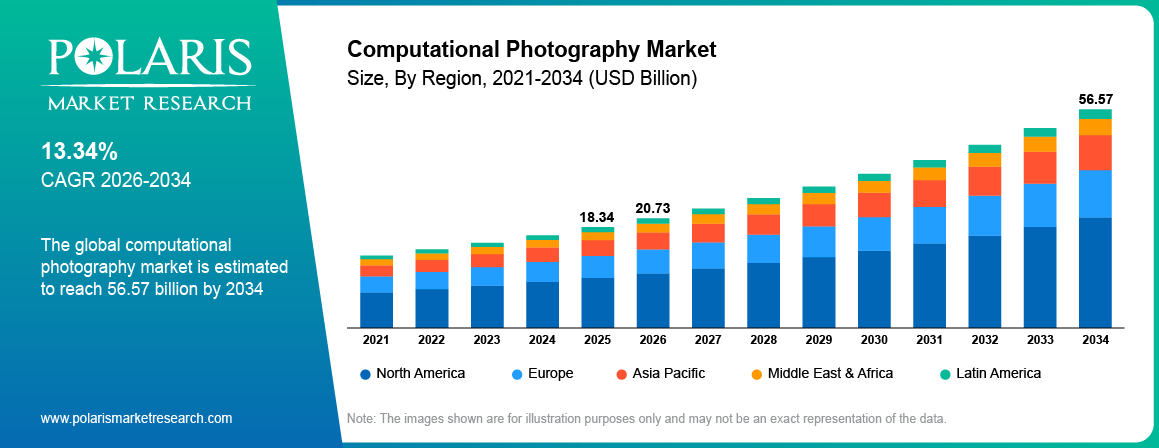
Growth in the market is fueled by increasing shipments of smartphones, creation of more social media content, and adoption of AI-powered imaging solutions. There is a growing trend of incorporating neural engines and NPU capabilities in flagships by the leading smartphone brands. Higher demands from the creator economy as well as premium smartphones contribute to the market growth.
Computational Photography Market Dynamics: Drivers, Restraints & Opportunities
DRIVER: Rising Smartphone Penetration & Demand for AI-Enhanced Mobile Camera Features (HDR, Night Mode, Portrait):
There is a rising demand for DSLR-like photo capturing features in phones. For instance, in May 2026, Sony released a new smartphone model known as the Xperia 1 VIII with AI-assisted camera features that help improve the art of mobile photography through scene, lens, color, and bokeh recommendation. Thus, AI-driven imaging technology continues to be implemented in phones for capturing better photos in portrait, night, and real-time HDR scenarios. Premium smartphone sales and replacement cycles are expected to drive growth.
DRIVER: Edge AI Processing & NPU Integration — Real-Time On-Device Computational Imaging Without Cloud Dependence:
The use of edge AI processing allows for the rendering of images directly within the device without relying on any clouds. The AMD company introduced the Ryzen AI Embedded process family in January 2026, which comprises CPUs, GPUs, and NPUs to make AI-powered cars, industries, and edge computing work better. These processes makes the operations more confidential and lower latency, making image processing faster. The chipmakers are concentrating on designing AI chips and NPUs.
Restraints & Challenges
RESTRAINT: Thermal Limits & Power Consumption Challenges for Real-Time AI Imaging in Mid-Range Devices:
The implementation of computational imaging systems requires a higher level of computational ability to achieve real-time rendering. This involves extensive GPU and AI computations, which is expected to have implications on energy efficiency in the devices. The mid to lower-end mobile phones continue to face difficulties due to their limited hardware capabilities.
Computational Photography Market Opportunities 2026-2034
OPPORTUNITY: Expansion into Automotive ADAS, Medical Imaging & Industrial Machine Vision Applications:
The increasing application of computational photography in autonomous vehicles, ADAS, medical diagnostic machines, and machine vision technology opens up several opportunities for this industry. In May 2026, May Mobility introduced its latest model of an autonomous car that incorporates artificial intelligence reasoning and modeling of the surroundings to make decisions in difficult driving conditions. The automotive industry has started implementing new imaging technology to detect obstacles and map the surroundings. Healthcare providers are increasing investments in AI-assisted imaging systems to improve diagnostic accuracy.
Computational Photography Market Segmentation Analysis
The report provides a comprehensive analysis of the computational photography market by technology, application, device type to pinpoint the key revenue generating and growth segments.
Computational Photography Market by Technology: AI-Based Image Processing, Machine Learning Imaging, HDR & Semantic Segmentation
-
AI-Based Image Processing
AI-based image processing segment dominated the market in 2025 with 32.0% share due to increasing integration of deep learning algorithms into imaging systems. These technologies improve image reconstruction, denoising, facial recognition, and semantic segmentation capabilities. Smartphone manufacturers continue to invest heavily in AI-powered image enhancement solutions.
-
Machine Learning Imaging
Machine learning imaging segment is projected to grow at the fastest CAGR of 13.6% during the forecast period due to increasing adoption across healthcare and industrial imaging applications. Machine learning technologies improve predictive rendering and image restoration efficiency. Increasing AI infrastructure development is fueling growth in this segment.
Computational Photography Market by Application: 3D Imaging, AR/VR & Mixed Reality, Smartphones, Healthcare & Industrial Imaging
-
Smartphones
Smartphones segment dominated the market with 54.0% share in 2025 owing to the growing consumer inclination towards having higher mobile camera experience. Major smartphone brands keep embedding AI-based camera technology in their top models. Rising social media usage and creator-focused applications continue to support segment growth.
-
Healthcare Imaging
Healthcare imaging segment is projected to grow at the fastest CAGR of 13.9% during the forecast period due to increasing use of AI-assisted diagnostics and image reconstruction technologies. Advanced computational imaging systems in hospitals and imaging facilities have been adopted by healthcare institutions. Higher investments in precision medicine is further driving the growth of the segment.
Computational Photography Market by Device Type: Smartphones & Tablets, Automotive Imaging, Medical Imaging Devices & Industrial Vision
-
Smartphones & Tablets
The smartphones and tablets segment dominated the market with 56.0% share in 2025 owing to widespread consumer adoption and large shipments. Mobile device manufacturers continue integrating AI cameras and neural processing units into premium devices. Continuous product innovation supports segment dominance globally.
-
Automotive Imaging Systems
Automotive imaging systems segment is projected to grow at the fastest CAGR of 14.4% during the forecast period due to increasing deployment of autonomous driving and ADAS technologies. Vehicle manufacturers are integrating advanced computational imaging systems for lane monitoring and object detection. Rising investments in autonomous mobility continue to support market growth.
Regional Analysis
North America Computational Photography Market Overview
North America dominated the computational photography market in 2025 capturing 34.0% share due to strong presence of semiconductor companies, AI technology providers, and smartphone innovation firms across the US and Canada. Companies in the region continue to invest in advanced imaging technologies and AI research. Stanford University’s AI Index Report 2025 stated that US private AI investment reached USD 109.1 billion in 2024, far exceeding China’s USD 9.3 billion and the UK’s USD 4.5 billion. Rising adoption of premium smartphones and creator economy expansion continue to support regional market growth.
Asia Pacific Computational Photography Market Insights
Asia Pacific is projected to grow at the fastest CAGR of 14.3% during the forecast period due to rapid expansion of smartphone manufacturing across China, South Korea, Taiwan, Japan, and India. Omdia reported that Southeast Asia’s smartphone market grew 2% year-on-year in 4Q25, with shipments reaching 100 million units in 2025. Regional semiconductor production continues to strengthen AI imaging infrastructure. Higher consumer electronics consumption and the export of smartphones have positively contributed to the region’s expansion.
Europe Market Insights
Europe had a substantial market share of 26.0% in 2025 owing to the adoption of computational imaging technologies in the automotive sector and industrial automation. As per ACEA, the number of new registrations of passenger cars in the EU rose from 10.55 million units in 2023 to 10.82 million units in 2025, thus creating a higher need for computational photography in vehicle cameras. Countries like Germany, France, and the UK are investing in machine vision and autonomous vehicles.
Competitive Landscape & Key Players
The market for computational photography is moderately fragmented owing to the involvement of worldwide semiconductor manufacturers, smartphone makers, artificial intelligence software developers, and imaging technology players. Competitive factors include image quality, efficiency of artificial intelligence processing algorithms, innovation, and hardware and software combination abilities. The strategies that these organizations are implementing involve partnerships, acquisitions, research on AI and global expansion.
The leading players involved in the industry include Adobe Inc., Apple Inc., Canon Inc., Google LLC, MediaTek Inc., NVIDIA Corporation, OMNIVISION Technologies, Qualcomm Incorporated, Samsung Electronics Co., Ltd., Sony Group Corporation, Xiaomi Corporation, and ZEISS Group, and others.
Premium Insights
Generative AI Imaging Expansion
Generative AI technologies are transforming computational photography capabilities across smartphones and digital imaging systems. Investments are made by organizations in AI-enabled image enhancement and image synthesis solutions.
Growth of Multimodal Imaging Systems
Multi-modality imaging systems are increasingly becoming popular in automotive, healthcare, and industrial applications. The use of these systems enables enhanced environmental sensing, imaging, and real-time object detection.
Key Players
- Adobe Inc.
- Apple Inc.
- Canon Inc.
- Google LLC
- MediaTek Inc.
- NVIDIA Corporation
- OMNIVISION Technologies
- Qualcomm Incorporated
- Samsung Electronics Co., Ltd.
- Sony Group Corporation
- Xiaomi Corporation
- ZEISS Group
Industry Developments
- May 2026: MicroAlgo Inc., designed the quantum image edge extraction algorithm to perform edge detection of images under adverse conditions by utilizing quantum state encoding and parallel processing capabilities. [source: prnewswire.com]
- June 2025: Adobe released Project Indigo which is an AI-powered camera application for iPhones and was built with the collaboration of Marc Levoy. [source: adobe.com]
Computational Photography Market Segmentation
By Technology Outlook (Revenue, USD Billion, 2021-2034)
- AI-Based Image Processing
- Machine Learning Imaging
- HDR Imaging
- Semantic Segmentation
- Image Reconstruction
By Application Outlook (Revenue, USD Billion, 2021-2034)
- Smartphones
- Healthcare Imaging
- Automotive Imaging
- Industrial Imaging
- Security & Surveillance
By Device Type Outlook (Revenue, USD Billion, 2021-2034)
- Smartphones & Tablets
- Digital Cameras
- Automotive Imaging Systems
- Medical Imaging Devices
- Industrial Vision Systems
By Regional Outlook (Revenue, USD Billion, 2021-2034)
- North America
- US
- Canada
- Europe
- Germany
- France
- UK
- Italy
- Spain
- Netherlands
- Russia
- Rest of Europe
- Asia Pacific
- China
- Japan
- India
- Malaysia
- South Korea
- Indonesia
- Australia
- Vietnam
- Rest of Asia Pacific
- Middle East & Africa
- Saudi Arabia
- UAE
- Israel
- South Africa
- Rest of Middle East & Africa
- Latin America
- Mexico
- Brazil
- Argentina
- Rest of Latin America
Computational Photography Market Report Scope
| Report Attributes | Details |
| Market Size in 2025 | USD 18.34 Billion |
| Market Size in 2026 | USD 20.73 Billion |
| Revenue Forecast by 2034 | USD 56.57 Billion |
| CAGR | 13.34% from 2026 to 2034 |
| Base Year | 2025 |
| Historical Data | 2021–2024 |
| Forecast Period | 2026–2034 |
| Quantitative Units | Revenue in USD Billion and CAGR from 2026 to 2034 |
| Report Coverage | Revenue Forecast, Competitive Landscape, Growth Factors, and Industry Trends |
| Segments Covered |
|
| Regional Scope |
|
| Competitive Landscape |
|
| Report Format |
|
| Customization | Report customization as per your requirements with respect to countries, regions, and segmentation. |
Source: Polaris Market Research Analysis
Computational Photography Market FAQ's
The global market size was valued at USD 18.34 Billion in 2025 and is projected to grow to USD 56.57 Billion by 2034.
North America dominated the market with 34.0% share in 2025 due to strong AI ecosystem and semiconductor innovation.
Major applications include smartphones, healthcare imaging, automotive imaging, industrial imaging, and security systems.
A few of the key players in the market are Adobe Inc., Apple Inc., Canon Inc., Google LLC, MediaTek Inc., NVIDIA Corporation, OMNIVISION Technologies, Qualcomm Incorporated, Samsung Electronics Co., Ltd., Sony Group Corporation, Xiaomi Corporation, and ZEISS Group, and others.
Market growth is driven by rising AI-enabled smartphone imaging demand and increasing adoption of advanced image processing technologies.
Smartphones segment dominated the market with 54.0% share in 2025 due to increasing demand for premium mobile photography experiences.
Generative AI imaging, edge AI processing, and multimodal vision systems are expected to support future market growth.
Download Sample Report of Computational Photography Market
Please fill out the form to request a customized copy of the research report.


