
Digital Isolator Market Size, Share, Trends & Forecast, 2026–2034
REPORT DETAILS
Digital Isolator Market Summary
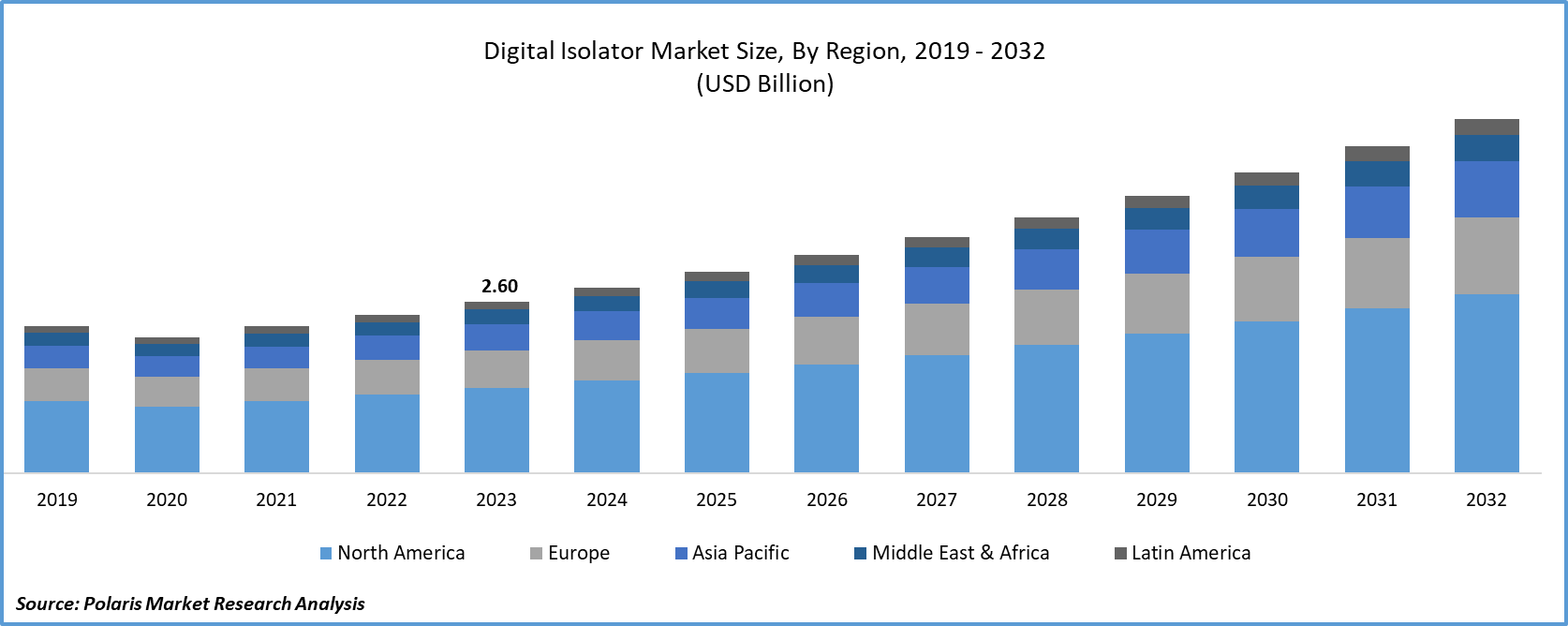
The global digital isolator market size was valued at USD 2.92 billion in 2025. The market is projected to expand at an 8.3% CAGR from 2026 to 2034. Rising electric safety concerns and growing electric vehicle adoption are driving the demand for digital isolators. The shift towards renewable energy systems is also supporting the digital isolator market growth.
Market Statistics
Digital Isolator Market Key Takeaways
- Asia Pacific accounted for the largest digital isolator market share of 42.8% in 2025. This is owing to rapid industrialization and booming automotive production in the region.
- North America held the second-largest market share of 28.6% in 2025. Early technology adoption and heavy industrial investment contribute to the regional demand.
- By technology, the captive coupling segment held an 36.5% share in 2025. The segment’s dominance stems from its widespread use in industrial and automotive gate-driver designs.
- By data rate, the more than 75 Mbps segment is projected to grow at an 9.4% CAGR. This is because modern applications require massive data throughput.
- By vertical, the industrial segment held an 31.7% digital isolator market share in 2025. Digital isolators protect sensitive equipment and operators from high voltages and electrical noise.
Note: Figures and projections outlined in this report are the result of Polaris Market Research’s proprietary analytical processes, grounded in the latest available datasets and market observations.
What Is a Digital Isolator?
A digital isolator is an electronic device that transfers digital data between two systems through galvanic isolation. The process of transferring data is accomplished using capacitance, inductance, or optical coupling. These devices help to protect sensitive components from the effects of voltage spikes and noise. Digital isolators find wide application in industrial, automotive, and consumer electronic circuits.
How Digital Isolators Work?
The digital isolator transfers digital information without establishing a direct electrical contact between the circuits. Digital isolators usually function in accordance with the following steps:
Input signal: The transmitter accepts a digital signal from the input circuit.
Conversion of signal: The electrical signal is converted to a signal that will be able to go through the isolation barrier.
Isolation: The signal travels through the isolation barrier that could either be capacitive, magnetic, or optical.
Signal detection: The receiver will detect the signal transmitted via the isolation barrier.
Digital output signal: The receiver will convert the received signal into a digital output.
Circuit protection: The isolation barrier will ensure that no voltage transfer occurs between the two circuits.
Digital Isolators vs. Optocouplers
The digital isolator and the optocoupler have similarities because they provide electrical insulation between circuit connections. But the two devices use different methods of signal transmission. The digital isolator uses magnetic coupling, while the optocoupler uses light. The digital isolator allows fast and energy-efficient data transfer in many systems. Optocoupler usage remains widespread when isolation is easy and reliable.
| Comparison Factor | Digital Isolators | Optocouplers |
| Isolation Technology | Capacitive or magnetic coupling | Optical coupling using an LED and photodetector |
| Data Rate | Supports high-speed digital signal transmission | Generally suited to low- and medium-speed signal transmission |
| Power Consumption | Typically lower power requirements | LED operation can result in higher power consumption |
| Signal Integrity | Provides stable performance at high switching speeds | Performance can change with LED aging and operating conditions |
| Response Time | Faster response for high-frequency switching | Generally slower response compared with high-speed digital isolators |
| Integration | Supports multiple channels and compact semiconductor integration | Available in established configurations for different isolation needs |
| Typical Applications | EVs, industrial automation, renewable energy systems, and electric motor drives | Power supplies, industrial controls, medical equipment, and consumer electronics |
| Key Consideration | Suitable for applications requiring speed, efficiency, and compact designs | Preferred for established designs where proven isolation technology is important |
Source: Polaris Market Research Analysis
Source: Polaris Market Research Analysis
Digital Isolator Market Dynamics
The digital isolator market is experiencing rapid growth due to the need for safer and reliable signal transmission in electronic devices. Rising power safety considerations have contributed to the adoption of digital isolators in many applications. Increased usage of electric vehicles and expansion of renewable energy systems have generated demand for digital isolators.
Driver : Escalating Power Safety Concerns
There is a growing shift toward using electronics with high levels of voltage, and hence, there is an increasing need for electrical isolation. The use of digital isolators contributes to the segregation of control and power circuits, enabling digital signal transfer between them. Consequently, the probability of a voltage spike reaching sensitive components will become smaller, ensuring proper operation of the system. Isolation is a key requirement in automotive and industrial applications with high voltage levels. Another shift related to the development of products is an increased isolation capability. In August 2026, Texas Instruments documented its ISOW644x-Q1 series of quad-channel digital isolators with an integrated DC-DC converter. The maximum data rate in these products equals 150 Mbps, and isolated power reaches up to 550 mW. Some of their features are electromagnetic compatibility and surge immunity. Their areas of application include factory automation, motor control, smart grid, and electric vehicles (source: ti.com). These developments reflect digital isolator market efforts towards enhancing isolation performance while simplifying circuit design in modern electronics.
Driver : Electric Vehicle Adoption Driving Market Growth
Electric vehicles use high-voltage batteries and multiple electronic systems to control power consumption. The connection between high-voltage systems and low-voltage control circuits requires protection for the system. Digital isolators for electric vehicles ensure this and transfer signals between the two sides. These isolators find application in battery management system (BMS) isolation, onboard chargers, traction inverters, and DC/DC converters. The shift towards high-voltage electric vehicle platforms is increasing the need for isolation. Higher voltage increases the influence of faults and electrical interference on control circuits. In addition, car manufacturers integrate additional electronic systems to improve efficiency and charging performance. This leads to a need for isolation across an increasing number of circuits.
Driver : Industry 4.0 & Industrial Automation Applications
The integration of interconnected machines that facilitate monitoring and controlling of the production process requires the use of a range of electrical devices such as PLCs, sensors, motor drives, inverters, and others. Each device uses a particular voltage to function. Digital isolators ensure proper isolation and safety in signal transmission between devices that use different voltage levels. Moreover, digital isolators ensure no impact on signal transmission speed during transfer. In July 2026, Toshiba launched four quad-channel digital isolators to its DCL34xx0B family. The products support data transmission rates of up to 25 Mbps. The isolators will be used in industrial equipment, such as PLCs, I/O interfaces, sensors, motor drives, and inverters (source: toshiba.com). The launch demonstrates the increasing usage of digital isolation technology in factory equipment.
Driver : Renewable Energy Systems Supporting Demand
With the increased adoption of solar and wind energy, inverters and other power-conversion devices are also being used more. Power converters connect high-voltage power systems with low-voltage control electronics, requiring electrical isolation ICs. Digital isolators allow signals to pass across the isolation barrier without electrical connections. Inverters in solar systems use digital isolators for tasks such as gate-drive control, voltage and current monitoring, and control-circuit communication. Isolation is also required in wind energy systems as part of power conversion and control systems. As renewable energy sources are installed more widely, the use of these electronic parts has also increased.
Challenges : Balancing Performance With Cost
Digital isolators must perform reliably and meet requirements for isolation, speed, and power. Improving any of these complicates device design and adds manufacturing costs. This can be an issue in cost-driven applications where the optocoupler can still serve as an effective solution. Higher data rates could also lead to more design specifications, particularly when fast switching signals need to be processed within the device. Fulfilling such criteria without increasing the size and costs of the device may prove to be difficult. Therefore, cost and performance become critical factors in choosing one isolation solution over another.
Opportunities : Expansion of Isolated Gate Driver Solutions
The growing use of power semiconductors, including SiC and GaN devices, is creating opportunities to incorporate digital isolators into isolated gate drivers. Power semiconductors are faster and operate at higher voltages than many conventional silicon components. As these components become more common in power conversion equipment, maintaining strong separation between control and power circuits becomes more important. Digital isolation allows communication between the various sections without being susceptible to the effects of voltage changes on the control electronics. This presents manufacturers with the opportunity to develop isolators based on the switching nature of the power semiconductor technology.
Opportunities : Integration of Isolation With Additional Functions
There is an opportunity to integrate digital isolation along with functionalities that have been traditionally performed by other discrete components. Integrated parts may include power-supply isolation, signal processing, fault protection, and more. This could lead to reducing the quantity of parts installed on the circuit board. It can help manufacturers address space constraints in small electronic devices. With customers' demand for simple circuitry, suppliers can develop integrated isolation devices that will fit into applications where board space and the number of components matter.
Trend : Shift Toward Integrated Isolation Solutions
Digital isolators are increasingly being integrated into other functionalities in the same piece of hardware. Some designs combine isolation with isolated power, signal conditioning, or even fault protection. This can minimize the number of components needed in a circuit. Moreover, it will facilitate simpler board layout design for equipment manufacturers. The integration of such functionalities is especially advantageous in situations where there are space constraints and the requirement of more than one protection function in the same system. The current trend is slowly shifting digital isolators away from their conventional role as simple signal-transfer elements. Device makers are focusing on products that can meet more than one circuit requirement at the same time.
Trend : Development of Smaller Form-Factor Isolators
Manufacturers are paying more attention to smaller digital isolators while maintaining the required level of isolation. Small packages enable engineers to integrate more electronic functions into smaller circuit boards. This is especially helpful for smaller, high-density equipment. Small packages can also support flexible design of control boards and power management systems. Semiconductor packaging technologies make it possible to pack more isolation channels and other functions into small devices. This is especially important because electronics are shrinking and integration is increasing. Digital isolator vendors that can offer small packages without affecting electrical characteristics and reliability may help address equipment downsizing.
Source: Polaris Market Research Analysis
Report Segmentation
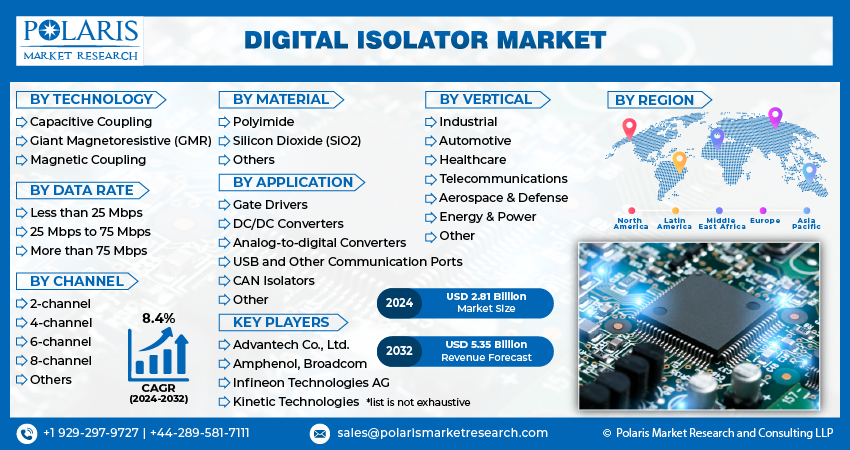
The market is primarily segmented based on technology, data rate, channel, insulating material, application, vertical, and region.
| Segmentation Axis | Segments |
| By Technology | Capacitive Coupling · Giant Magnetoresistive (GMR) · Magnetic Coupling |
| By Data Rate | Less than 25 Mbps · 25 Mbps to 75 Mbps · More than 75 Mbps |
| By Channel | 2-channel · 4-channel · 6-channel · 8-channel · Others (single-, 3-, 5-, 7-, 9-, and 10-channel) |
| By Insulating Material | Polyimide · Silicon Dioxide (SiO2) · Others |
| By Application | Gate Drivers · DC/DC Converters · Analog-to-Digital Converters (ADCs) · USB and Other Communication Ports · CAN Isolators · Others |
| By Vertical | Industrial · Automotive · Healthcare · Telecommunications · Aerospace & Defense · Energy & Power · Others |
| By Region | North America (U.S., Canada) · Europe (France, Germany, UK, Italy, Netherlands, Spain, Russia, Rest of Europe) · Asia Pacific (Japan, China, India, Malaysia, Indonesia, South Korea, Rest of Asia Pacific) · Latin America (Brazil, Mexico, Argentina, Rest of Latin America) · Middle East & Africa (Saudi Arabia, UAE, Israel, South Africa, Rest of Middle East & Africa) |
Source: Polaris Market Research Analysis
By Technology Analysis
The capacitive coupling segment accounted for the largest digital isolator market share of 36.5% in 2025. Capacitive digital isolators consist of an isolation barrier that ensures the transfer of digital data from one circuit to another in such a way that electrical insulation is ensured. The compact nature of these components makes them appropriate in areas where board space is minimal. In addition, they allow for quick transmission of data and reliability in power and control systems. These properties have contributed to the popularity of capacitive digital isolators in applications like industrial machinery, automotive electronics, and power conversion systems. Additionally, the increasing usage of electronic control circuits that must have electrical isolation in the high- and low-voltage parts drives the demand for capacitors.
The giant magnetoresistive (GMR) segment is projected to account for an 9.1% CAGR. GMR digital isolators use magnetic fields for transmitting signals through the isolation barrier. These components have the potential to offer fast signal transmission as well as robust protection against electrical interference. The above characteristics make GMR isolators suitable for use in signal transfer under harsh conditions. Increasing demand for isolated communications in industrial equipment, automobiles, and power systems will drive adoption of the technology. As electronics continue to rely on robust signal transmission, the GMR technology will find extensive use in the digital isolator industry.
Capacitive vs. Magnetic vs. GMR Digital Isolators
| Attribute | Capacitive Coupling | Magnetic Coupling | Giant Magnetoresistive (GMR) |
| Isolation performance | High | High | Very high |
| Switching speed | High | Moderate–High | Highest — up to ~150 Mbps |
| Noise immunity | Good | Good | Best-in-class |
| Accuracy / sensitivity | Moderate | Moderate | High |
| Relative cost | Lowest | Moderate | Highest |
| Typical industrial application | General digital signal isolation | Gate drivers, power conversion | High-speed, high-accuracy industrial and automotive isolation |
Source: Polaris Market Research Analysis
By Data Rate Analysis
The 25 Mbps to 75 Mbps segment accounted for the largest digital isolator market share of 34.8% in 2025. At this data rate, digital isolators can balance speed and power. Therefore, they can be used in applications that need communication but do not necessarily require very high speeds. Digital isolators are used in industrial control systems, automotive systems, power conversion systems, and communication interfaces. This segment is driven by an increase in the adoption of digital control systems, which require faster signal transmission compared to low-speed applications. At the same time, many of the systems do not require the higher data rates provided by high-end digital isolators. This creates a demand for digital isolators in the 25 Mbps to 75 Mbps range.
The more than 75 Mbps segment is projected to grow at an 9.4% CAGR. These isolators are well suited in applications that require high-speed signaling and reduced communication delays. Some examples of such applications are high-speed data communications, motor control, power conversion, and high-tech machinery. The requirement for faster signaling has made isolators increasingly popular, owing to the fast switching capabilities of power electronic circuits. Faster communications have proven to be more effective in automobiles and industrial electronics because they offer better control and monitoring. Demand for faster data rate isolators (above 75 Mbps) will increase as electronics get faster.
By Channel Analysis
The 4-channel segment accounted for the largest digital isolator market share of 41.2% in 2025. Four-channel digital isolators enable the transfer of multiple signals between circuits using a single unit. This reduces the number of elements required on the circuit board. These isolators are widely used in industrial control systems, power systems, motor drivers, and automobile electronics. The number of channels offered by four-channel digital isolators is suited for such systems that need multiple isolated signals but do not require a higher number of channels provided by bigger units. The widespread use of the four-channel isolators in control and power systems helps drive demand in this channel segment.
The 8-channel segment is projected to account for an 8.9% CAGR during the forecast period. 8-channel digital isolators can transmit a series of multiple signals through a single device, thus being applicable to systems requiring more isolated links. The isolators find application in industrial control devices, motor drives, power supplies, and communications. Their greater capacity in channels may contribute to reducing the number of isolators used on a circuit board. The demand for these isolators is fueled by the growing complexity of control systems that involve several signals' isolation. Thus, as equipment manufacturers try to achieve a more advanced circuitry design that enables more control functions, the popularity of 8-channel digital isolators is likely to grow.
By Insulating Material Analysis
The silicon dioxide (SiO2) segment held the largest market share of 46.3% in 2025. SiO2 is widely used in digital isolators as the insulation layer between circuits. It acts as an electrical separator for signal transfer while ensuring both sides of the circuit are isolated. SiO2 is widely used in the semiconductor industry, which supports its application in digital isolators. SiO2 digital isolators are used in areas such as industrial controls, automotive electronics, and power systems. SiO2’s presence in electronic device manufacturing remains a key driver of demand in the digital isolator market.
The polyimide segment is projected to grow at an 8.7% CAGR. Polyimide is used as an insulating material for digital isolators because of its capability to provide electrical isolation through a thin layer of material. The material is also suitable for electronic products that may be used in varied temperatures. These properties of the material make polyimide relevant for use in small circuits. The material is applied in digital isolation devices in industrial machines, vehicles, and power-related products. The growing requirement for small electronic products is resulting in the increased need for insulation materials that can be used in developing small-sized devices. The development is anticipated to drive the usage of polyimide in digital isolators in the coming years.
By Application Analysis
The gate drivers segment led with an 38.5% digitalisolator market share in 2025. Digital isolators are used in gate driver circuits for transmitting control signals from low-voltage controllers to high-voltage power switches with electrical isolation between them. This is important in systems where power switches work at high voltage levels and need safe control. Gate drivers can be used in motor drives, power converters, inverters, and any other type of power electronics systems. An increasing number of applications based on power semiconductor devices creates demand for isolated gate drivers. The growing popularity of power electronics in industry and automotive electronics makes gate drivers a significant segment for digital isolator applications.
The DC/DC converters segment is projected to grow at an 8.6% CAGR. Digital isolators are used in such converters to ensure isolation between the control side and power side. This is necessary when the two sides operate at different voltage levels. Digital isolator technology is used in a wide variety of applications, including power supplies, automobiles, and industrial applications. The growing use of DC/DC converters in electronic devices has increased demand for isolated signal transfer. This will help grow the market segment over the forecast period.
By Vertical Analysis
The industrial segment dominated the market with an 31.7% share in 2025. Digital isolators have become common components in industrial machinery where control circuitry must connect to high-voltage power circuits. These are incorporated in devices such as programmable logic controllers, motor controls, inverters, power supplies, and factory control systems. Industrial machines have a variety of circuits that work at different voltage levels, and isolation is necessary in such cases. Increasing use of electronic control systems in factories is fueling the demand for digital isolators. Extensive use of digital isolators in industrial machines and control systems has contributed to the segment’s leading position.
The automotive segment is projected to grow at an 9.2% CAGR. Modern automobiles use many control modules and power electronics that necessitate isolation among different parts of the automobile electrical system. Digital isolators can be found in various applications such as battery management systems, onboard charging systems, power conversion systems, and motor control systems. The growing inclination towards the electrification and hybridization of vehicles can propel the demand for these isolators. The growing inclusion of electronic functions to enhance vehicle performance and efficiency is another factor driving this shift.
Source: Polaris Market Research Analysis
Regional Insights
Asia Pacific
Asia Pacific led the global digital isolator market with an 42.8% share in 2025. The region has many manufacturers of electronic goods and industrial machinery. Therefore, demand for digital isolators in such regions is likely to remain high. The main application markets would be China, Japan, South Korea, and India. This is due to the growth in factory automation and power electronics. Another market where digital isolators will be used extensively is automobiles, since electric cars require signal isolation in their battery charging and power electronics systems. In addition, the APAC region continues to invest in solar power generation and energy storage facilities. These factors would ensure that the number of electronic equipment requiring signal isolation increases.
North America
North America accounted for the second-largest market share of 28.6% in 2025. The region boasts a mature electronics industry and manufacturers who deal with industrial automation and power systems. The U.S. remains an important contributor to the market where digital isolators are used in automotive electronics, industrial equipment, renewable energy, and power conversion applications. The need for digital isolators is also linked with the development of electric cars and electronic controls. Investment in modernizing power infrastructure creates more uses for isolated signal transmission. The availability of semiconductor and electronic component producers in the region contributes to the regional market. These factors are expected to keep North America among the leading digital isolator markets over the forecast period.
Europe
Europe is expected to witness growth of CAGR 8.9% during the forecast period. Germany, France, the United Kingdom, and Italy are among European countries with well-developed industries, such as the automobile industry and manufacturing industry, requiring isolation devices in power and control circuits. The production of electric vehicles adds to this demand, especially for battery management systems, chargers, and power converters. Isolation devices are also installed in industrial equipment and devices that generate renewable energy in Europe. Vehicle electrification and the development of environmentally friendly methods of power generation lead to a growing need for electronic devices that are able to work at different voltage levels. As a result, the regional market can support a wide range of applications.
Latin America
Latin America is projected to grow at an 7.5% CAGR. Brazil, Mexico, and Argentina are some of the leading markets in the region where demand is associated with industrial machinery, automotive electronics, and electric power systems. As manufacturing activities increase in the region, there is a growing utilization of electronic controls that require the isolation of different voltage levels. Renewable energy projects also open opportunities for various digital isolation systems in solar energy plants and converters. As these technologies become more prominent in the region, the need for reliable signal isolation will remain high.
Middle East & Africa
The Middle East & Africa is anticipated to account for an 6.9% CAGR. Demand is increasing as countries invest in energy infrastructure and projects involving renewable energies. Digital isolators are used in inverters, converters, industrial controllers, and monitoring equipment. The importance of solar energy is driving growth in some markets, creating additional use cases for isolated electronic circuits. Saudi Arabia, the UAE, Israel, and South Africa are some of the markets contributing to the growth of demand in the region. Further growth of energy and industrial infrastructure should open new opportunities for digital isolator manufacturers.

Source: Polaris Market Research Analysis
Emerging Technologies in Digital Isolation
- Capacitive Isolation: Capacitors continue to improve in isolation materials and signal-transfer design.
- Magnetic Isolation: The technology of magnetic isolation is being upgraded to provide fast signaling to devices. The improvement in the transformer and semiconductor technology are helping manufacturers make magnetic isolators smaller.
- High Voltage Isolation: There are new isolators that work under high voltage and fast switching. This is crucial in power converters, electric cars, and renewable energy devices.
- Integrated Isolators: The design of isolators is not just confined to isolation anymore. Modern designs have additional features like power conversion and fault detection.
- Advanced Packaging: Advanced packaging technology is enabling manufacturers to reduce channel density without altering package size.
Key Market Players & Competitive Insights
Competition in the digital isolator market centers on offering superior product performance and the ability to meet varying electronic system needs. Competition is defined by parameters such as isolation voltage, data rate, number of channels, power dissipation, package, and temperature range. Additionally, players are developing products for applications in high-voltage power electronics, electric vehicles, industrial automation, and renewable energy systems. Product developments include faster devices, smaller packaging, and combinations of isolation with other features. Portfolio expansion is therefore an important competitive factor.
| Vendor | Primary Technology Focus | Strength | Vertical Emphasis |
| Industrial computing and automation | Broad industrial hardware portfolio | Industrial automation, manufacturing | |
| Amphenol | Interconnect and sensor technologies | Strong connectivity portfolio | Automotive, industrial, aerospace & defense |
| Analog Devices, Inc. | Digital isolation and mixed-signal solutions | High-performance signal and power solutions | Industrial, automotive, healthcare |
| Broadcom | Digital isolation and semiconductor solutions | Broad semiconductor portfolio | Industrial, automotive, communications |
| Infineon Technologies AG | Digital isolation and power semiconductors | Strong power electronics capabilities | Automotive, industrial, energy |
| Power management and interface ICs | Specialized power and signal solutions | Automotive, industrial | |
| Littelfuse, Inc. | Circuit protection and isolation solutions | Strong protection technology portfolio | Automotive, industrial, energy |
| Microchip Technology Inc. | Digital isolation and embedded solutions | Wide range of embedded and control products | Automotive, industrial, aerospace & defense |
| Monolithic Power Systems, Inc. | Power management and isolation | Integrated power solutions | Industrial, automotive, communications |
| MORNSUN Guangzhou Science & Technology Co. Ltd. | Isolated power and signal solutions | Broad isolation product range | Industrial, power, telecommunications |
| Murata Manufacturing Co., Ltd. | Isolation and electronic components | Strong component manufacturing capabilities | Automotive, industrial, telecommunications |
| NVE Corporation | Magnetic digital isolation | Specialized magnetoresistive technology | Industrial, medical, aerospace & defense |
| NXP Semiconductors | Digital isolation and automotive semiconductors | Strong automotive semiconductor portfolio | Automotive, industrial |
| Renesas Electronics Corporation | Digital isolation and power management | Broad control and power semiconductor portfolio | Automotive, industrial |
| ROHM CO., LTD. | Digital isolation and power electronics | Strong power semiconductor expertise | Automotive, industrial, energy |
| STMicroelectronics | Digital isolation and power semiconductors | Broad semiconductor portfolio | Automotive, industrial, energy |
| Texas Instruments, Inc. | Digital isolation and analog ICs | Extensive isolation and analog product portfolio | Industrial, automotive |
| Vishay Intertechnology | Isolation, passive components, and semiconductors | Broad electronic component portfolio | Industrial, automotive, energy |
| Navitas Semiconductor | GaN, SiC, and power semiconductor technologies | Focus on high-performance power conversion | Automotive, energy, industrial |
Source: Polaris Market Research Analysis
Recent Developments
- June 2026: Toshiba Electronics Europe GmbH announced the launch of two quad-channel, compact low-power standard digital isolators. The new DCL341x0B series supports reliable operation with high common mode transient immunity (CMTI) of 30kV/μs (min.). It features medium-speed data transfer of 25Mbps (max.). (source: toshiba.semicon-storage.com)
- April 2026: Skyworks introduced Si86Px Digital Isolators with integrated power. The company stated that the compact solution combines high‑performance digital isolation with an integrated isolated dc‑dc converter. It is designed for industrial and automotive electronics. (source: skyworksinc.com)
Research Methodology
The digital isolator market study combines primary and secondary research to validate market size, segmentation, and forecast figures. Primary research involves structured interviews with component manufacturers, distributors, systems integrators, and end-use OEMs across automotive, industrial, healthcare, and telecommunications verticals. Primary research helps gather perspective on demand drivers, pricing, and technology adoption. Secondary research draws on company annual reports, investor presentations, regulatory filings, trade association data, and technical standards documentation to cross-verify company revenues and segment shares.
Market sizing follows a bottom-up approach: company-level revenue and shipment data are aggregated by technology, data rate, channel, insulating material, application, vertical, and region, then reconciled against top-down macroeconomic and semiconductor-industry indicators. The forecasts are based on assumptions regarding the penetration of electric vehicles, spending on industrial automation capital investment, and semiconductor prices, all subjected to sensitivity analysis against the pattern of growth observed historically.
This approach undergoes a rigorous multi-level validation process before the numbers are finalized. This process involves statistical validation, validation by industry experts, and cross-referencing against the publicly available company financial information. The base year and forecast numbers are validated for consistency with the published market-size and CAGR numbers at every update of the report.
Digital Isolator Market Report Scope
| Report Attributes | Details |
| Market Size Value in 2025 | USD 2.92 billion |
| Market Size Value in 2026 | USD 3.16 billion |
| Digital Isolator Market Forecast 2034 | USD 6.00 billion |
| CAGR | 8.3% from 2026 to 2034 |
| Base Year | 2025 |
| Historical Data | 2021–2024 |
| Forecast Period | 2026–2034 |
| Quantitative Units | Revenue in USD billion and CAGR from 2026 to 2034 |
| Report Coverage | Revenue Forecast, Market Competitive Landscape, Growth Factors, and Industry Trends |
| Segments Covered |
|
| Regional Scope |
|
| Competitive Landscape |
|
| Report Format |
|
| Customization | Report customization as per your requirements with respect to countries, regions, and segmentation. |
Source: Polaris Market Research Analysis
Digital Isolator Market FAQ's
The digital isolator market was valued at USD 2.92 billion in 2025. The market is projected to reach USD 6.00 billion by 2034.
The digital isolator market is projected to account for an 8.3% CAGR from 2026 to 2034.
Asia Pacific led with an 42.8% market share in 2025. This is due to rapid industrialization and booming automotive production in the region.
The captive coupling segment accounted for an 36.5% share in 2025. The segment’s leading position is due to its widespread use in industrial and automotive gate-driver designs.
A few of the key market players include Advantech Co., Ltd.; Amphenol; Analog Devices, Inc.; Broadcom; Infineon Technologies AG; Kinetic Technologies; Littelfuse, Inc.; Microchip Technology Inc.; Monolithic Power Systems, Inc.; MORNSUN Guangzhou Science & Technology Co. Ltd.; Murata Manufacturing Co., Ltd.; NVE Corporation; NXP Semiconductors; Renesas Electronics Corporation; ROHM CO., LTD.; STMicroelectronics; Texas Instruments, Inc.; Vishay Intertechnology; and Navitas Semiconductor.
A digital isolator is an electronic component that transfers digital signals between two circuits while keeping them electrically separated. It uses technologies such as capacitive or magnetic coupling to transmit signals across an isolation barrier.
The difference between a digital isolator and an optocoupler depends on the type of transition of the signal over the isolation barrier. While the former makes use of capacitive or magnetic coupling, the latter relies on optical signal transition. Higher speed operation, lower power consumption, and quicker response time can be achieved with digital isolators.
The application areas of digital isolators include gate drivers, DC/DC converters, battery management, motor drivers, industrial control circuits, and communication interfaces. Digital isolators can often be found in places where there is a requirement for interconnection without physical electrical connection.
Digital isolators are important for electric cars since it is necessary to isolate power circuits operating at high voltage levels from low-voltage electronic control systems. Digital isolators are used in such systems as the battery management system, onboard charger, traction inverter, and DC/DC converter.
Selection criteria include isolation voltage, data rate, number of channels, propagation delay, power dissipation, operating temperature range, and common-mode transient immunity (CMTI).
Download Sample Report of Digital Isolator Market
Please fill out the form to request a customized copy of the research report.


