
Blood Transfusion Diagnostics Market Share, Report, 2026-2034
REPORT DETAILS
Blood Transfusion Diagnostics Market Summary
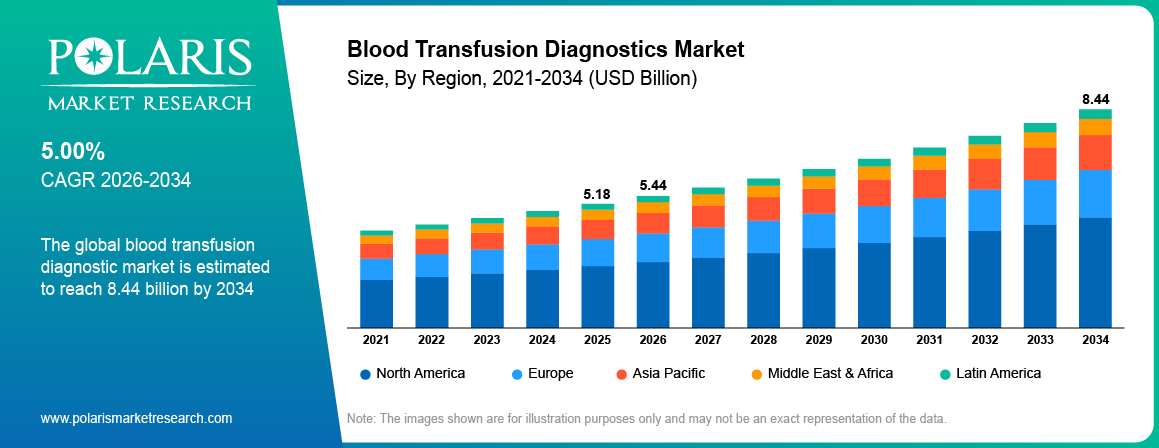
The global blood transfusion diagnostic market was valued at USD 5.18 billion in 2025 and is expected to grow at a CAGR of 5.00% from 2026 to 2034. The market is driven by the need for safe blood screening and technological advancements in diagnostic assays.
Market Statistics
Blood Transfusion Diagnostics Market Key Takeaways
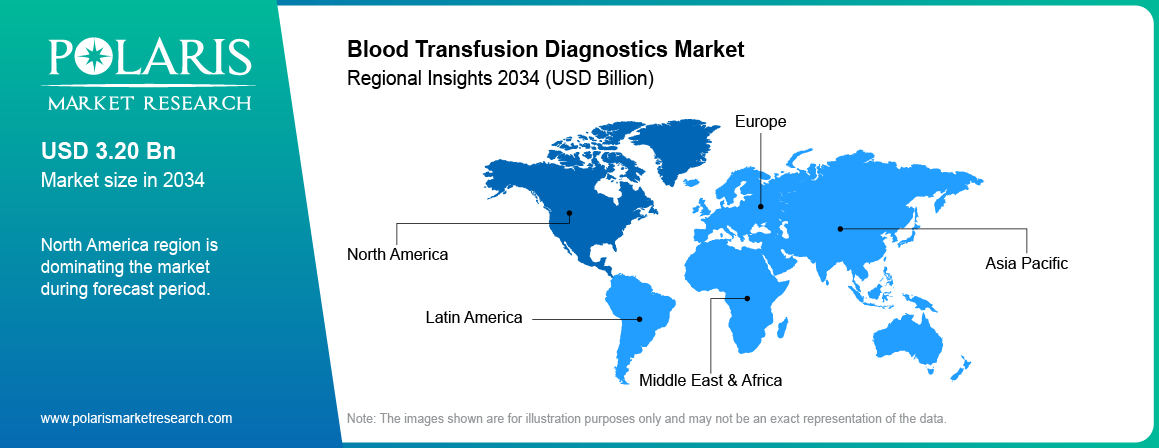
- North America held the largest market share of 38.0% in 2025. The presence of key companies and the rising adoption of healthcare technology boost the dominance.
- The U.S. dominated the regional market with 90.0% share in 2025. Increasing awareness of blood donation and growing demand for blood components fuel the leading position.
- The Asia Pacific market is expected to register the highest CAGR of 4.98% during the forecast period. Surging investments in healthcare infrastructure and the increasing adoption of innovative diagnostic technologies would fuel the regional market growth.
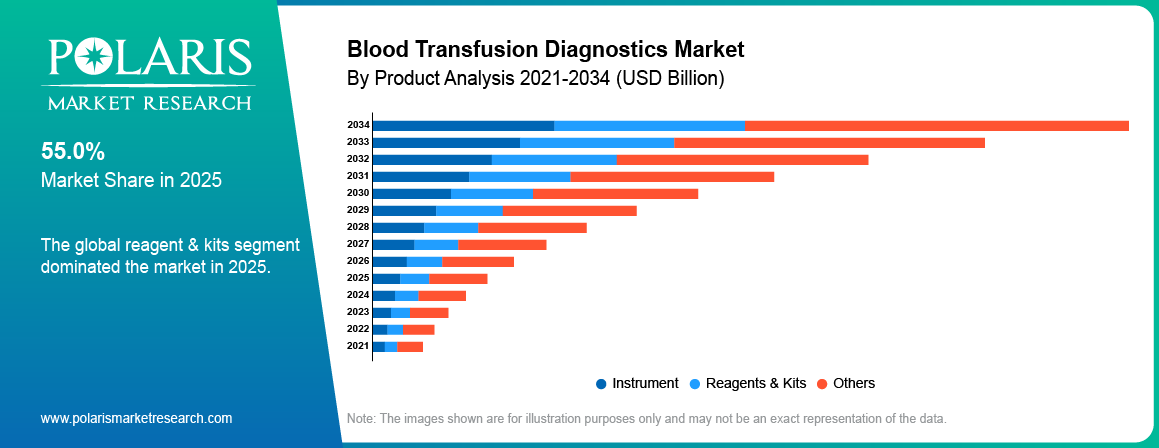
- The reagent & kits segment held the largest revenue share of 55.0% in 2025. The proliferation of donor screening reagents, typing, and a wide range of blood grouping, assays, and kits introduced by global and local entities drives the growth.
- The disease screening segment led the market with 56.0% share in 2025. The rising incidence of infectious diseases boosts the demand for disease screening.
Note: Figures and projections outlined in this report are the result of Polaris Market Research’s proprietary analytical processes, grounded in the latest available datasets and market observations.
What is Blood Transfusion Diagnostics?
Blood transfusion diagnostics is the process of testing blood and its components prior to its administration to patients. Each unit of blood is tested for both blood group typing and disease screening prior to transfusion. This critical process aims to reduce the possibility of adverse reactions or infection transmission. It is critical in transfusion therapy, providing vital information to healthcare professionals and ensuring the compatibility of donor and recipient blood samples.
Several factors are driving the growth of the blood transfusion diagnostics market. The global market for blood and blood components is expanding rapidly, owing to increased demand from trauma and accident cases. Advances in blood transfusion diagnostic technology, particularly the improvement of precise and accurate instruments, have contributed to an increase in demand for these products. Major market players are actively developing technologically advanced solutions that are available at competitive prices, leading to greater adoption of blood transfusion diagnostics.
Source: Polaris Market Research Analysis
To Understand More About this Research: Download Sample Report
For instance, according to data published by the National Cancer Institute, almost 490,875 individuals in the United States were reported to be undergoing leukemia in the year 2020.
The rising prevalence of blood-related disorders is the primary driver of the blood transfusion market's expansion. There has been a significant increase in the number of people undergoing blood loss as a result of various issues and chronic illnesses over the last decade. Blood loss is caused by a variety of chronic conditions, including but not limited to cancer, hemophilia, and renal disease. Furthermore, the rise in severe infections, liver disorders, and other medical conditions causes the occurrence of significant blood loss.
The pandemic of COVID-19 has had a significant impact on the blood transfusion diagnosis market. On one side, the increased demand for blood products as a result of the virus and its complications has highlighted the importance of strong diagnostic tools to ensure transfusion safety. On the other side, disruptions in healthcare services, supply chain issues, and the diversion of resources to fight the pandemic, have created challenges for the blood transfusion diagnostics sector. In the midst of the pandemic, the need for rapid and precise diagnostic solutions has become even more critical, driving innovation and technological advancements in the market. Despite the challenges, the increased focus on healthcare and the need to address emerging infectious threats contribute to the growth of the market.
The research report offers a quantitative and qualitative analysis of the Blood Transfusion Diagnostics Market to enable effective decision-making. It covers the key trends and growth opportunities anticipated to have a favorable impact on the market. Besides, the study covers segment and regional revenue forecasts for market assessment.
Increased occurrences of injuries and fatalities as a result of traffic accidents are anticipated to drive the blood transfusion market. Road traffic accidents are a major public health concern, accounting for the majority of global fatalities and injuries. Such incidents frequently result in serious injuries that necessitate immediate medical attention, including blood transfusions. The rising number of traffic accidents and injuries is anticipated to increase the demand for blood, boosting the growth of the blood transfusion market.
AI Impact on Blood Transfusion Diagnostics Market
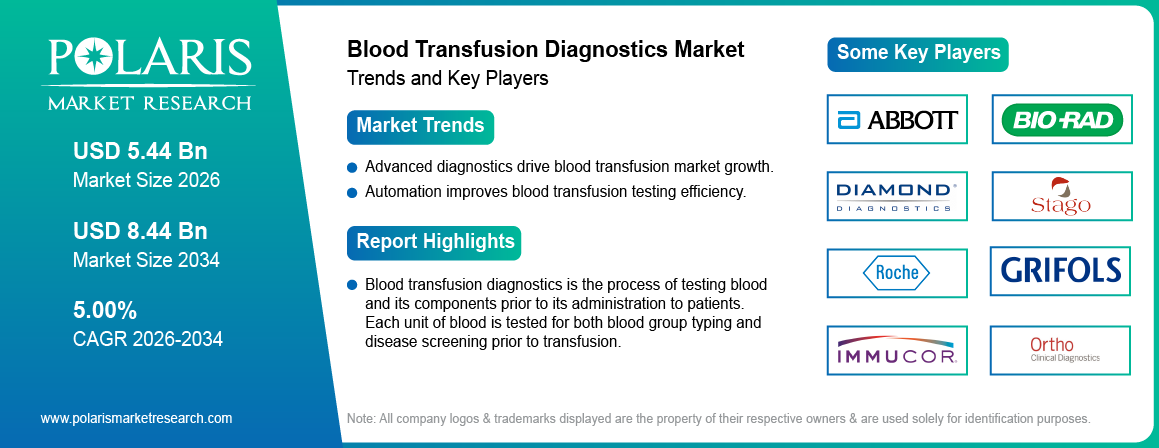
- AI-enabled diagnostic algorithms improve accuracy in blood typing and cross-matching procedures.
- Machine learning (ML) tools boost the detection of transfusion-transmitted infections in donor blood samples.
- In blood screening laboratories, AI-driven automation helps reduce manual errors and turnaround time.
- Intelligent screening systems supporting early identification of rare blood group incompatibilities.
- AI-assisted laboratory instruments are improving operational efficiency and lowering diagnostic processing costs.
- Integration of AI with molecular diagnostics supports faster and more precise donor-recipient compatibility analysis.
Source: Polaris Market Research Analysis
Market Dynamics
Driver: Improvements in the Diagnostic Technologies will Drive the Growth of the Market
The betterment in the diagnostic technologies will drive the growth of the market in the forecast period. The evolution of advanced tests and systems that provide greater precision, faster results, and increased automation has transformed the field of blood transfusion diagnostics. For instance, the incorporation of NAT techniques, such as polymerase chain reaction (PCR) and real-time PCR, has transformed the identification of infectious agents in donated blood.
These molecular-based techniques have high sensitivity and specificity, allowing pathogens to be identified quickly and reducing the risk of transfusion-related infections. Also, the incorporation of automation and robotics into laboratory workflows has optimized laboratory workflows, resulting in increased capacity and efficiency in blood transfusion diagnostics. The continuous advancement of technology maintains the market's growth by providing healthcare practitioners with dependable and effective tools to ensure the safety of blood transfusions.
Report Segmentation
The market is primarily segmented based on product, application, end-use, and region.
| By Product | By Application | By End-Use | By Region |
|
|
|
|
Source: Polaris Market Research Analysis
To Understand the Scope of this Report: Request Customization
By Product Analysis
The Reagent & Kits Segment Accounted for the Largest Revenue Share
In 2025, the reagent & kits segment held the largest revenue share of 55.0%. The easy availability of products and frequent purchases highlight the importance of screening both donor and recipient samples, serving as a significant catalyst for the growth of this segment. Furthermore, the proliferation of a donor screening reagents typing, and wide range of blood grouping, assays, and kits introduced by both global and local entities contributes to the growth of the market.
The increasing risk of Transfusion-Transmitted Infections (TTIs) has driven donor screening demand. The increasing risk necessitates stringent screening to prevent the transmission of contaminated blood and blood products, thereby addressing the TTI challenge. The easy accessibility and widespread availability of sophisticated donor analyzers are driving the growth of the market.
By Application Analysis
The Disease Screening Segment Accounted for the Highest Market Share
The disease screening segment held the highest market share of 56.0% in 2025, improving the significance of disease screening has become critical in order to prevent the spread of infections. The risk of blood transfusions is the spread of infections within the recipient's body. To ensure the safety of donated blood, thorough disease screening for transfusion purposes is essential.
Furthermore, the rising prevalence of blood-related diseases has increased the demand for blood transfusions. This increased need for transfusions increases the risk of transfusion-transmitted diseases like Hepatitis B and HIV-1, which may deteriorate a patient's health. As a result, there is a growing need for thorough screening of donors prior to blood transfusions, particularly in less developed countries where the prevalence of these diseases is higher.
Technological Advancements in Blood Transfusion Diagnostics
| Technology | Function | Key Advantage | Impact on Diagnostics |
| Nucleic Acid Testing (NAT) | Detects viral genetic material in donor blood samples | Enables early detection of infections before antibody formation | Improves blood safety and reduces transfusion-transmitted infection risk |
| Molecular Diagnostics | Identifies blood group antigens and genetic variations at the molecular level | Provides highly precise donor-recipient matching | Enhances compatibility testing accuracy and supports rare blood group identification |
| Automated Blood Screening Systems | Automates serology and infectious disease screening workflows | Reduces manual intervention and testing errors | Increases laboratory efficiency and throughput |
| AI-Integrated Diagnostic Platforms | Uses AI algorithms for result interpretation and workflow optimization | Accelerates data analysis and improves decision-making | Enhances testing accuracy and operational productivity |
| High-Throughput Analyzers | Processes large volumes of blood samples simultaneously | Delivers faster turnaround time for screening and typing | Supports growing demand in blood banks and hospitals |
| Digital Data Management Systems | Integrates laboratory data, donor records, and traceability functions | Improves data accuracy and regulatory compliance | Strengthens transfusion safety monitoring and reporting |
Source: Polaris Market Research Analysis
Source: Polaris Market Research Analysis
Regional Insights
North America Accounted for the Largest Market Share
In 2025, North America held the largest market share of 38.0% in the blood transfusion diagnostics market. owing to the presence of prominent key companies in the region and the widespread adoption of cutting-edge healthcare technology. Furthermore, blood transfusion market in north america is anticipated to expand in revenue due to the rising prevalence of chronic diseases and the increasing number of medical procedures.
Raising blood donation awareness, ensuring easy access to testing facilities, and involving both international and key players are anticipated to drive market expansion in this region. As per the American Red Cross, about 16 million blood components are transfused in the United States each year. The surging demand for these blood components is likely to drive demand for blood transfusion diagnostics.
Asia Pacific is witnessed for the fastest growth at a CAGR of 4.98% in the blood transfusion diagnostics market. The increased demand for blood transfusion diagnostics in emerging markets such as India and China are anticipated to drive market growth. The increase is attributed to an increasing demand for blood transfusions, which has been fueled by an increase in medical procedures and a high prevalence of chronic illnesses. Increased investments in healthcare infrastructure and the adoption of innovative diagnostic technologies are substantial contributors to the market's growth in the region.
Source: Polaris Market Research Analysis
Key Market Players & Competitive Insights
The market is characterized by intense competition, with established players relying on advanced technology, high-quality products, and a strong brand image to drive revenue growth. These companies employ various strategies such as research and development, mergers and acquisitions, and technological innovations to expand their product portfolios and maintain a competitive edge in the market.
Some of the major players operating in the global market include:
- Abbott Laboratories
- Bio-Rad Laboratories, Inc.
- Diamond Diagnostics
- Diagnostica Stago
- Electro Medical Technologies
- F. Hoffmann-La Roche Ltd
- Grifols S.A.
- Immucor Inc.
- Ortho Clinical Diagnostics
- Quotient Ltd.
Recent Developments
- March 2025: Inpeco announced a partnership with Grifols, a global player in plasma-derived medicines and diagnostic solutions. Through this deal, Inpeco plans to deliver its its open automation system, FlexLab X, to transfusion medicine laboratories. (Source: inpeco.com)
- February 2025: Abbott launched its Alinity i System to enhance blood transfusion diagnostics. The system offers high accuracy and efficiency, enabling faster, safer blood screening, crucial for managing blood donations and ensuring the safety of transfusion-transmitted infections. (Source: abott.com)
What is the Future of the Blood Transfusion Diagnostics Market?
The blood transfusion diagnostics market is expected to witness rapid growth in the coming years. The growth would be driven by the increasing global demand for safe and reliable blood transfusion procedures. Advancements in molecular diagnostics, nucleic acid testing, and laboratory automation improve the speed, precision, and efficiency of blood screening and compatibility testing. Rising healthcare investments and modernization of blood bank infrastructure support market expansion across developed and emerging economies. In addition, growing public awareness regarding blood donation safety and infection prevention is accelerating adoption of advanced diagnostic technologies. These factors are positioning blood transfusion diagnostics as a critical component of modern healthcare systems and clinical diagnostic practices worldwide.
Blood Transfusion Diagnostics Market Report Scope
| Report Attributes | Details |
| Market size value in 2025 | USD 5.18 billion |
| Market size value in 2026 | USD 5.44 billion |
| Revenue forecast in 2034 | USD 8.44 billion |
| CAGR | 5.00% from 2026 – 2034 |
| Base year | 2025 |
| Historical data | 2021 – 2024 |
| Forecast period | 2026 – 2034 |
| Quantitative units | Revenue in USD billion and CAGR from 2026 to 2034 |
| Segments Covered | By Product, By Application, By End-Use, By Region |
| Regional scope | North America, Europe, Asia Pacific, Latin America, Middle East & Africa |
| Customization | Report customization as per your requirements with respect to countries, region, and segmentation |
Source: Polaris Market Research Analysis
We strive to offer our clients the finest in market research with the most reliable and accurate research findings. We use industry-standard methodologies to offer a comprehensive and authentic analysis of the Blood Transfusion Diagnostics Market. Besides, we have stringent data-quality checks in place to enable data-driven decision-making for you.
Browse Our More Top Selling Reports:
Non-Invasive Prenatal Testing (Nipt) Market Size & Share
Dental Laboratory Welders Market Size & Share
Molecular Quality Controls Market Size & Share
Blood Transfusion Diagnostics Market FAQ's
The blood transfusion diagnostics market report covering key segments are product, application, end-use, and region.
Blood Transfusion Diagnostics Market Size Worth USD 8.44 Billion By 2034.
The global blood transfusion diagnostics market is expected to grow at a CAGR of 5.00% during the forecast period.
North America held the largest market share of 38.0% in 2025.
key driving factors in blood transfusion diagnostics market are 1. Improvements in the diagnostic technologies will drive the growth of the market
Download Sample Report of Blood Transfusion Diagnostics Market
Please fill out the form to request a customized copy of the research report.


