
Mass Spectrometry Market Business Overview, and Strategic Insights, 2026-2034
REPORT DETAILS
Mass Spectrometry Market Summary
The global mass spectrometry market size was valued at USD 6.77 billion in 2025, growing at a CAGR of 7.41% from 2026–2034. Key factors driving demand for mass spectrometry include pharmaceutical and biopharmaceutical sector's growth, demand for high sensitive instruments, demand for environment monitoring, and integration of advanced analytical instruments.
Market Statistics
Key Takeaways
- The instruments segment held the largest revenue share around 60% in 2025, . This is due to increasing investments in high-resolution, faster, and more accurate instruments.
- The metabolomics segment is expected to witness the fastest growth of 8.2% during the forecast period. The adoption of metabolomics workflows across academic, clinical, and pharmaceutical research boosts their adoption.
- The pharmaceutical and biotechnology companies segment led the mass spectrometry market in 2025 with an estimated 45% share. This was because there was a growing need for accurate analytical methods in drug manufacturing, biomarker identification, and clinical research.
- North America held 43.75% of the global market share in 2025. This is attributed to the use of precise analytical tools for drug development, clinical research, and quality testing.
- Asia Pacific is projected to grow fastest at 8.0% from 2026 to 2034. This is due to the increasing focus on biomedical research, proteomics, metabolomics, and environmental testing.
Industry Dynamics
- Rising government investments in metabolomics and proteomics drive the market growth. This is due to the proteomics and metabolomics which
- relies on high-precision analytical technologies to study biological systems.
- Advancement in mass spectrometry system technology. This is due to their molecular structure, accuracy, and throughput. This allows researchers to improve ionization techniques, data acquisition speed, resolution, and automation.
- Complexity and high-cost limit widespread adoption, which creates challenges.
- The expansion of the biopharmaceutical industry is boosting demand for advanced analytical techniques, creating an opportunity to grow.
AI Impact on the Industry
- Discovery and interpretation accelerate the automation of data analysis.
- Predictive maintenance and instrument precision enhance reliability.
- Data interpretation complexity democratizes for non-expert users.
- Biomarker discovery and novel discovery unlock complex datasets.
What is Included in Mass Spectrometry Landscape?
Mass spectrometry measures the mass-to-charge ratio of ions. It is an analytical technique used to identify and quantify molecules. This technique is recognized for the increased dependence on analytical tools precision that are used for quality control, regulatory compliance, and research. The market is driven by the pharmaceutical and biopharmaceutical sector's growth, as it depends on mass spectrometry for metabolite profiling, biomarker identification, drug discovery, and quality assurance throughout product development. According to the IFPMA 2025 report, pharmaceutical R&D spending in 2021 reached USD 276 billion. Moreover, the demand for high sensitive instruments capable of delivering accurate and rapid characterization has boosted the rising complexity of personalized medicine and biologics. This platform has become essential to support innovation, regulatory submissions, and safety assessment for biopharmaceutical and pharmaceutical workflows. Thus, the adoption of this platform across manufacturing and research laboratories boost their demand.
How Mass Spectrometry Works?
Mass spectrometry is an analytical process in which a sample is subjected to procedures that generate molecular information about the material being analyzed. First, the sample is introduced into the machine and ionized. In this stage, the molecule is ionized by electrospray and other ionization methods. Afterwards, the ionized molecules are subjected to a mass analyzer wherein the molecules are separated according to the mass-to-charge ratio. Lastly, the mass spectrum is detected and formed. The results are then analyzed to get information such as compound identification and concentration measurement
Source: Polaris Market Research Analysis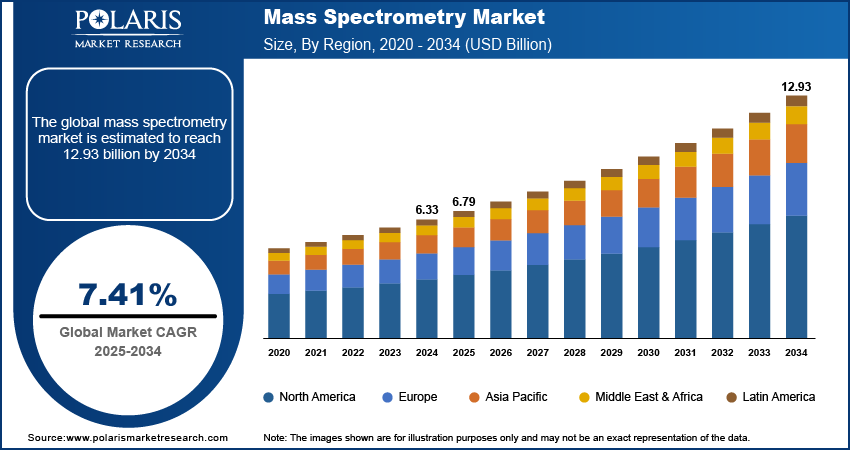
The demand for environment monitoring boost the market growth. This is due to the focus on ecosystem protection and pollution control, which is increasing continuously. Their role in detecting trace levels of contaminants such as microplastics, pesticides, heavy metals, and industrial chemicals across water, air, and soil samples is crucial for accuracy. Moreover, spectrometry techniques support environmental testing agencies and regulatory bodies in assuring compliance efficiently. The integration of advanced analytical instruments that are capable of supporting large environmental surveillance programs drives the increasing concerns for waste management, climate change, and natural resources safety. Thus, these trends position as an essential tool for risk mitigation and monitoring boost their wider adoption.
Drivers & Opportunities
What are the Factors Driving the Market Expansion?
Rising Government Investments in Metabolomics and Proteomics: Increasing government investments drive the market growth. This is attributed to the proteomics and metabolomics, as research in these fields relies on high-precision analytical technologies for the study of biological systems. The presence of advanced research centers, higher volume of biomedical projects, and expansion of industry collaboration requires accurate molecular profiling. This is achieved with the rising government funding. For example, in September 2023, NIH funded USD 50.3 million for multi-omics research on human health and disease across genomics, epigenomics, transcriptomics, proteomics, and metabolomics. Furthermore, the spectrometry's role in identification of proteins, biomarkers, and metabolites make them an essential tool for the study of diagnostics, therapeutic development, and disease mechanism. The demand for sensitive spectrometry platform have increased across drug discovery, clinical research, and transactional biology as government support for precision medicine and life sciences rise. Thus, the momentum boost their adoption and also broadens the application in modern biological research.
Advancement in Mass Spectrometry System Technology: Continuous innovation has increased the efficiency, capability, and usability of analytical instruments with advancements in mass spectrometry technology. Deep insights into molecular structure with accuracy and throughput allow researchers to improve ionization techniques, data acquisition speed, resolution, and automation. Simplified workforce and improved instrument sensitivity make them accessible across biotechnology and pharmaceutical industries for environmental monitoring and food testing. Furthermore, mass spectrometry is transforming into a powerful and versatile analytical platform. For example, in June 2024, SCIEX and Mass Analytica collaborated for the development of artificial intelligence quantitation (AI quant) software. This system is expected to process data from the SCIEX 7500+ and ZenoTOF 7600 systems. This transformation is due to the integration of software driven artificial intelligence, data analytics, and high-throughput workflows. Thus, these upgrades in technology expand its range of application and boost their adoption.
Types of Mass Spectrometry
There are various forms of mass spectrometry depending on the requirement.
- LC-MS (liquid chromatography-MS) is a technique combining liquid separation with mass analysis. The technique is extensively employed in pharmaceutical and biologically related studies.
- GC-MS (gas chromatography-MS) is employed in identifying volatiles. It is commonly used in environmental analysis and forensics.
- MALDI-TOF is used in proteomics and microbiology. It assists in rapid protein identification and microbial classification.
- ICP-MS (inductively coupled plasma-MS) is used in the detection of trace elements. It is extensively applied in environmental analysis and food testing
Mass Spectrometry: Benefits vs Limitations
| Advantages | Challenges |
| Sensitivity and high precision for detecting molecules | Expensive machines |
| Compatible with biological and chemical samples | Specialized knowledge required |
| Useful in discovering drugs and diagnoses | Complex sample preparation procedures |
| Capable of detecting traces of the substance | High level of operational complexity |
Source: Polaris Market Research Analysis
Source: Polaris Market Research Analysis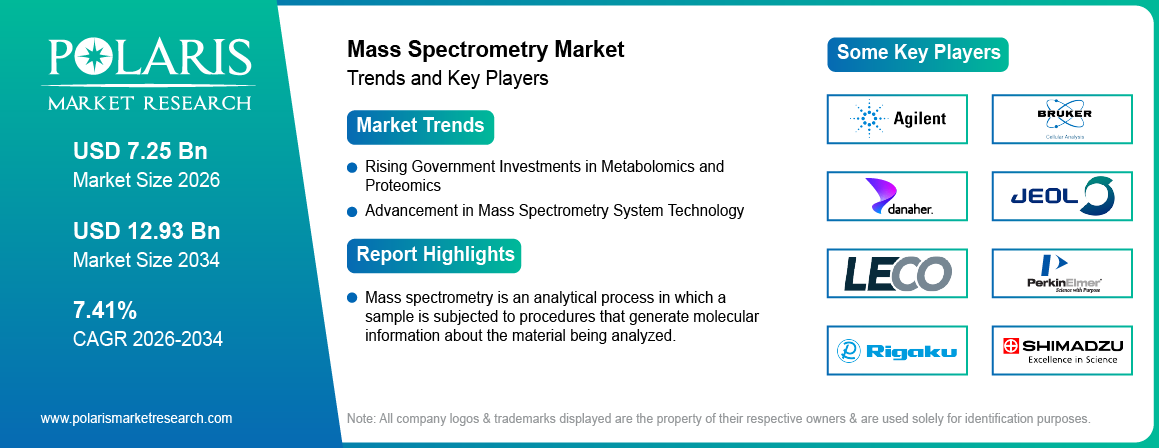
Segmental Insights
Which Segments Contributed to the Market Growth?
Product Analysis
Based on product, the segmentation includes instruments and consumables & services. The instruments segment held the largest revenue share in 2025. This is due to the core functional component of mass spectrometry workflows with the continued demand for high-performance analytical platforms. Advanced instruments investments for high resolution, faster analysis, and greater accuracy boosts. This is prioritized by laboratories across biotechnology, clinical, pharmaceutical, and environmental sectors. Organizations adopt next generation systems to boost productivity and maintain government compliance, with upgrades and replacement cycles, contributing to the instrument demand. Furthermore, the need for refined hardware that are capable of detecting and quantifying molecules at trace levels has boosted the complexity of analytical requirements in biologics development and molecular diagnostics.
Application Analysis
In terms of application, the segmentation includes proteomics, metabolomics, glycomics, and others. The metabolomics segment is expected to witness the fastest growth during the forecast period. This is due to the focus on metabolic pathways and their role in health, disease, and therapeutic development. This segment makes mass spectrometry a preferred platform for such studies as their research requires ultra-sensitive and high-resolution analytical systems. The adoption of metabolomics workflows across academic, clinical, and pharmaceutical research is increasing with the rising interest in precision medicine, nutritional science, and biomarker discovery. Metabolite profiling complements genomics, proteomics, and glycomics for a comprehensive biological understanding benefits from increasing integration of multi-omics approaches. Therefore, mass spectrometry usage within this field is expected to expanding rapidly.
Source: Polaris Market Research Analysis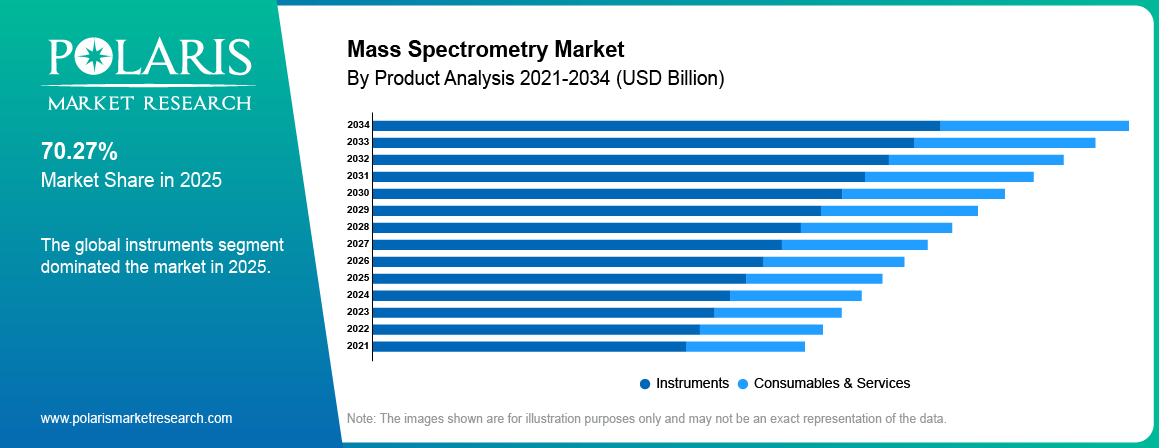
Regional Analysis
What are the Factors for Regional Expansion?
North America held 41.42% of global market share in 2025. This is due to the rapid adoption of research and healthcare ecosystem that prioritizes advanced analytical technologies. Pharmaceutical and biotechnology organizations, clinical laboratories, and academic research institutes consistently invest in cutting-edge instrumentation with strong adoption in the NA region. Furthermore, the culture of innovation and regulatory frameworks promote the use of precise analytical tools for drug development, clinical research, and quality testing. The penetration of mass spectrometry systems across diverse industries strengthen the presence of major market players and widespread availability of technical expertise.
Asia Pacific Mass Spectrometry Market
The market in Asia Pacific is projected to grow fastest from 2026 to 2034, owing to the rising adoption of advanced analytical capabilities and rapid expansion of life sciences research infrastructure in the region. Laboratories in Asia are integrating mass spectrometry into core analytical workflows. This increases the focus on biomedical research, proteomics, metabolomics, and environmental testing. Moreover, private organizations, governments, and research institutions investments have strengthened access to modern laboratory equipment. The demand for high-accuracy testing and quality assurance tools in this region is also experiencing a surge in pharmaceutical and biopharmaceutical manufacturing activities. Therefore, APAC is expected to witness sustained and accelerated market growth.
Source: Polaris Market Research Analysis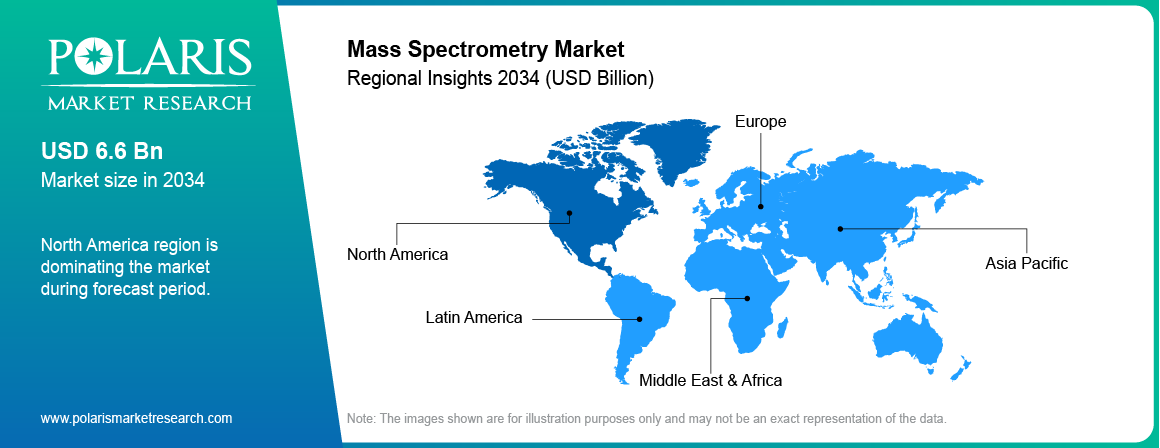
Key Players & Competitive Analysis Report
The mass spectrometry competitive landscape is characterized by innovation and alliances among key vendors. Innovation of trends characterize mass spectrometry, as continued efforts towards miniaturization and automation and hyphenated techniques create strong opportunities in emerging markets. This is where latent demand for clinical and biopharmaceutical applications is substantial. Small and medium-sized enterprises need to use competitive intelligence and strategy to find viable niches to compete with larger entrenched competitors. The future of industry ecosystems depends on a sustainable value chain and adapting to significant global economic and geopolitical shifts. Therefore, the market is expected to be driven by vendors who leverage expert’s knowledge and insight to define their competitive position and find ways to capitalize on new disruption and trends to establish strong regional places in the marketplace.
Major companies operating in the mass spectrometry industry include Agilent Technologies, Inc.; Bruker Corporation; Danaher Corporation (SCIEX); JEOL Ltd.; LECO Corporation; PerkinElmer, Inc.; Rigaku Corporation; Shimadzu Corporation; Thermo Fisher Scientific, Inc.; Waters Corporation.
Key Players
- Agilent Technologies, Inc.
- Bruker Corporation
- Danaher Corporation (SCIEX)
- JEOL Ltd.
- LECO Corporation
- PerkinElmer, Inc.
- Rigaku Corporation
- Shimadzu Corporation
- Thermo Fisher Scientific, Inc.
- Waters Corporation
Industry Developments
- January 2026: Scientists at Cold Spring Harbor Laboratory came up with a new high-sensitivity mass spectrometry method that makes it easier to find and study molecules. This helps drug discovery and biomedical research move forward. (Source: cshl.edu)
- October 2025: Waters Corporation launched the Waters Xevo Charge Detection Mass Spectrometer (CDMS). This device can measure and characterize a wide range of mega-mass biomolecules that are important for next-generation therapeutics and structural biology. (Source: ir.waters.com)
Mass Spectrometry Market Segmentation
By Product Outlook (Revenue, USD Billion, 2021–2034)
- Instruments
- Consumables & Services
By Technology Outlook (Revenue, USD Billion, 2021–2034)
- Quadrupole Liquid Chromatography-Mass Spectrometry
- Gas Chromatography-Mass Spectrometry (GC-MS)
- Fourier Transform-Mass Spectrometry (FT-MS)
- Time-of-Flight Mass Spectrometry (TOFMS)
- Matrix-Assisted Laser Desorption/Ionization-Time-of-Flight Mass Spectrometry (MALDI-TOF)
- Magnetic Sector Mass Spectrometry
- Others
By Application Outlook (Revenue, USD Billion, 2021–2034)
- Proteomics
- Metabolomics
- Glycomics
- Others
By End Use Outlook (Revenue, USD Billion, 2021–2034)
- Government & Academic Institutions
- Pharmaceutical & Biotechnology Companies
- Others
By Regional Outlook (Revenue, USD Billion, 2021–2034)
- North America
- US
- Canada
- Europe
- Germany
- France
- UK
- Italy
- Spain
- Netherlands
- Russia
- Rest of Europe
- Asia Pacific
- China
- Japan
- India
- Malaysia
- South Korea
- Indonesia
- Australia
- Vietnam
- Rest of Asia Pacific
- Middle East & Africa
- Saudi Arabia
- UAE
- Israel
- South Africa
- Rest of Middle East & Africa
- Latin America
- Mexico
- Brazil
- Argentina
- Rest of Latin America
Mass Spectrometry Market Report Scope
| Report Attributes | Details |
| Market Size in 2025 | USD 6.77 Billion |
| Market Size in 2026 | USD 7.25 Billion |
| Revenue Forecast by 2034 | USD 12.93 Billion |
| CAGR | 7.41% from 2026 to 2034 |
| Base Year | 2025 |
| Historical Data | 2021–2024 |
| Forecast Period | 2026–2034 |
| Quantitative Units | Revenue in USD Billion and CAGR from 2026 to 2034 |
| Report Coverage | Revenue Forecast, Competitive Landscape, Growth Factors, and Industry Trends |
| Segments Covered |
|
| Regional Scope |
|
| Competitive Landscape |
|
| Report Format |
|
| Customization | Report customization as per your requirements with respect to countries, regions, and segmentation. |
Source: Polaris Market Research Analysis
Mass Spectrometry Market FAQ's
The global market size was valued at USD 6.77 billion in 2025 and is projected to grow to USD 12.93 billion by 2034.
The global market is projected to register a CAGR of 7.41% during the forecast period.
North America dominated the market in 2025, holding 41.42% share.
A few of the key players in the market are Agilent Technologies, Inc.; Bruker Corporation; Danaher Corporation (SCIEX); JEOL Ltd.; LECO Corporation; PerkinElmer, Inc.; Rigaku Corporation; Shimadzu Corporation; Thermo Fisher Scientific, Inc.; Waters Corporation.
The instruments segment held the largest revenue share in 2025.
The metabolomics segment is expected to witness the fastest growth during the forecast period.
Download Sample Report of Mass Spectrometry Market
Please fill out the form to request a customized copy of the research report.


