
Material Informatics Market Size, Share, Trends & Forecast, 2026–2034
REPORT DETAILS
Material informatics Market Summary
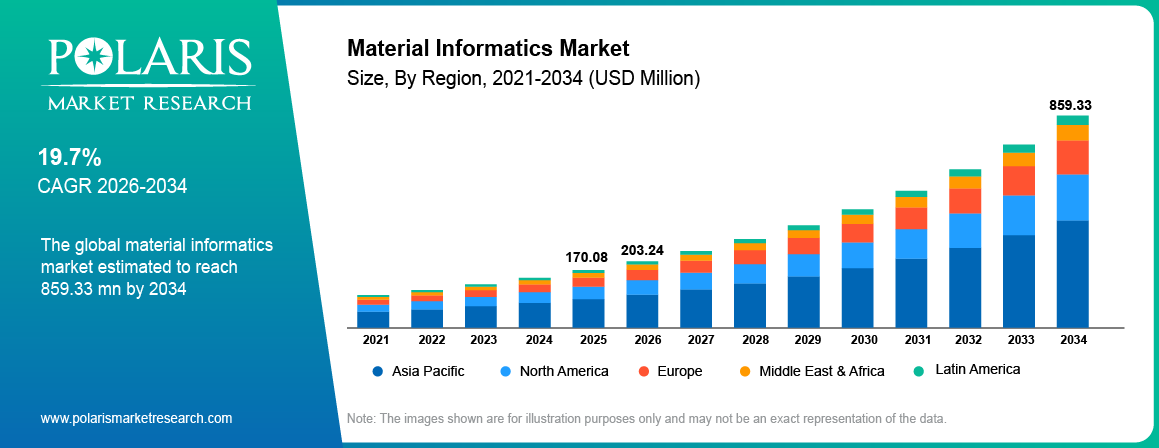
The global material informatics market size was valued at USD 170.08 million in 2025. The market is projected to account for an 19.7% CAGR from 2026 to 2034. The rising use of artificial intelligence (AI) and machine learning (ML) for material discovery and development is shaping the market landscape. The rising emphasis on standardizing materials data is also shaping the market landscape.
Market Statistics
Key Takeaways
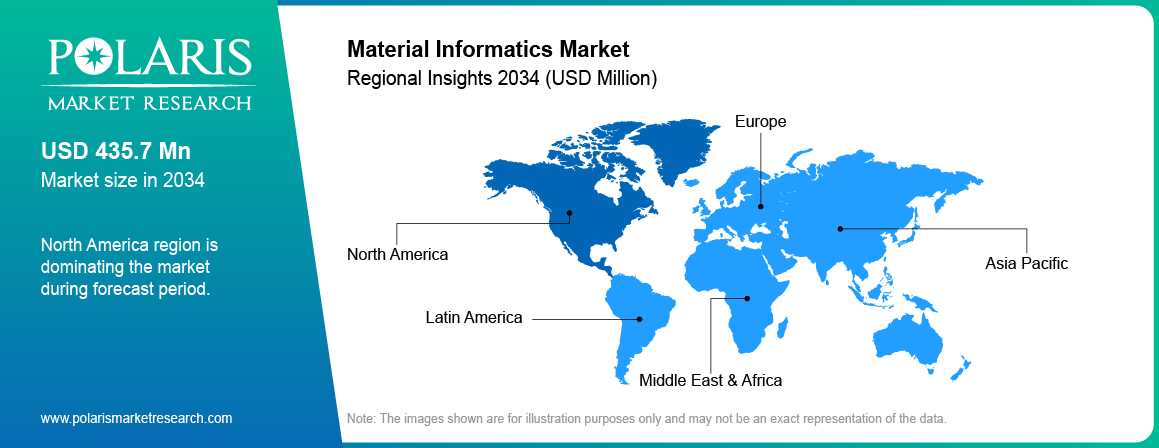
- North America led the global material informatics market with an 37.82% share in 2025. High R&D spending and early adoption of AI technologies contribute to the regional market dominance.
- Asia Pacific is projected to witness the fastest growth. The material informatics market CAGR for the regional market is expected to be 23.11%. The region is witnessing rising investments in material science across emerging economies. Asia Pacific also benefits from a strong electronics base.
- By deployment, the cloud-based segment accounted for an 64.72% share in 2025. This is owing to the flexibility and scalability offered by cloud-based material informatics platforms.
- By technology, the machine learning segment held an 34.72% share in 2025. The ability of machine learning to identify patterns from large-scale data drives its leading market position.
- By application, the synthesis route prediction segment is projected to grow at an 24.69% CAGR. Synthesis method prediction enables researchers to find methods suitable for obtaining the desired material.
Note: Figures and projections outlined in this report are the result of Polaris Market Research’s proprietary analytical processes, grounded in the latest available datasets and market observations.
What Is Material Informatics?
Material Informatics is a data-driven approach to materials science. It uses data to study material properties and behaviors. Scientists rely on computer models to analyze large datasets related to materials. Machine Learning assists in identifying patterns in this data. Also, it can help in predicting the properties of materials. These predictions may be helpful for conducting laboratory tests of materials.
The material informatics market comprises the technologies and solutions that are used in data-oriented materials research. It is widely used across research and industry sectors. An example of the application of this field is battery research. Another application is electronics.
Materials informatics vs cheminformatics refers to two related but different fields. Material informatics focuses on materials and their properties. Cheminformatics mainly focuses on chemical data. It usually involves molecular structure and chemical properties. Material informatics is more focused on how materials behave.
How Does Materials Informatics Work?
Material informatics helps researchers make better decisions when developing materials. The steps involved include:
Collecting Data: Researchers collect data regarding different materials. Data can be obtained through experimental testing in laboratory conditions. Researchers can also use results from existing databases and simulations.
Building Materials Databases: The obtained data is stored in materials databases. The databases provide easy access to the data. Researchers can use the stored data for further analysis.
Analyzing the Data: Researchers analyze the data in order to find any patterns useful for research. Data analytics assist in identifying the patterns in question. Findings can reveal correlations between materials' properties and their performance.
Materials Property Prediction: Researchers use models in order to predict material behavior. Predicting materials' properties will allow finding materials with desirable properties.
Designing Materials: Based on the research findings, researchers design new materials. Computational materials design may prove helpful during this stage. Researchers are able to test hypotheses by means of computer simulations.
Testing Results: Selected materials are tested in the laboratory. Test results are compared with predictions. New data obtained in this way can be analyzed in further research.
How AI Is Transforming Materials Science
Artificial intelligence technologies are changing the process of researching new materials. AI in the materials science market is becoming more relevant because computational techniques are becoming more advanced in working with complicated datasets in materials science. AI can be used to filter out the large number of material candidates prior to conducting experiments. The technology can also be useful for analyzing the results of the experiment. Generative models can suggest new material structures using a certain set of properties. This reduces the time required for initial research activities. Generative models may aid in AI-driven materials discovery in fields like energy storage, electronics, manufacturing, and others. Artificial intelligence may be embedded into laboratory machinery. This results in a better connection between prediction and validation.
Role of Machine Learning in Material Discovery
Machine learning in materials science allows researchers to work with large amounts of data and find patterns that cannot be easily detected with traditional methods. The models have the capability of learning from data relating to the nature of material, its structure, the process environment, and the measurement of its properties. Using these models, the researchers can predict the performance of new materials whose performance has not been tested yet. This will help in reducing the number of material candidates that require physical testing.
Machine learning algorithms can also help predict the properties of batteries, catalysts, polymers, alloys, and semiconductors. These predictions can be used by researchers to identify the best candidates before experimental testing. This approach makes research much more focused.
Another application is optimizing material compositions. Models predict how compositional changes affect the target property. Researchers can then refine the material composition according to the results of predictions. These applications strengthen computational materials design. They also support faster material development.
Generative AI and Large Language Models in Materials Design
The use of generative AI for materials discovery creates an additional layer of computational research. Generative models can offer new materials designs based on the needed properties and other design limitations. The outcomes of the generative models can be used by researchers as a basis for further computational screening and experiments in laboratories. Thus, they can expand the variety of materials under consideration at an initial stage.
Also, large language models can work with scientific literature and structured research data. They can assist in extracting information from scientific papers, comparing properties of materials, and summarizing findings from different sources. This approach can save time when performing literature reviews.
Moreover, research planning can benefit from using generative AI. It may assist in identifying promising material combinations or conducting certain experiments based on the results obtained previously. However, generated materials have to be validated scientifically. Physical experiments and computational methods are still needed in order to verify the performance of the candidate materials. In this respect, the use of LLMs for materials discovery is growing alongside modeling and simulations.
Autonomous Laboratories and High-Throughput Experimentation
High-throughput experimentation makes it possible for researchers to test many material combinations in less time. The process may involve sample preparation, experiment performance, measurement, and recording of experimental results by an automated process with little need for human involvement. Such large datasets may also help enhance computational models.
The integration of enterprise agentic AI and lab automation helps create autonomous or self-driving laboratories. Such labs are capable of selecting the next batch of experiments based on past experimental results. The process can then be repeated as new results become available. Researchers can specify the desired properties and leave the system to discover the right material candidates.
Self-driving labs are being investigated for their applications in the fields of battery materials, catalysts, polymers, and many others. The advantage of these labs is the ability to combine prediction with physical validation. The AI can provide potential candidates, and the automated system can test these candidates. The obtained results can then be fed back into the lab process. This creates a faster cycle for material screening and optimization.
Material Informatics Market Dynamics
Several factors influence the use of AI and digital solutions in materials science. Materials databases and data analytics may help facilitate research and analysis. Technical and operational challenges may hinder adoption of these technologies. Meanwhile, new uses are emerging in sustainable materials development and advanced research.
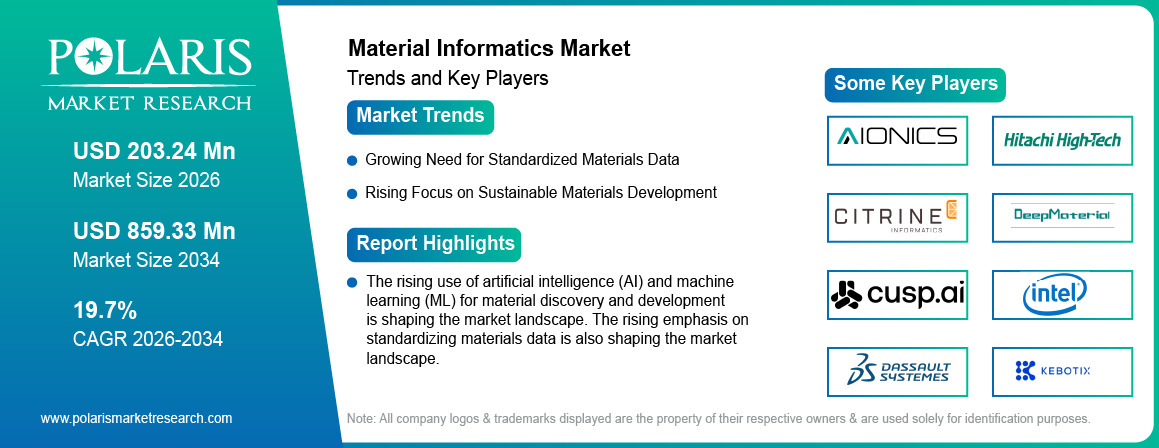
Driver : Growing Need for Standardized Materials Data
With more materials data being produced, the requirement for tools to help structure this data in an organized way becomes ever more crucial. Researchers frequently deal with data gathered using various approaches and stored in different places. Well-structured data can help make such information more accessible and easier to compare and utilize. This facilitates faster scientific research workflows. It also improves collaboration between researchers and industry. A March 2026 Fraunhofer project illustrates this shift. The project focuses on developing a digital material data space that makes material and manufacturing data machine-readable and exchangeable across the supply chain (source: iese.fraunhofer.de). Such efforts can contribute to creating a strong foundation for materials databases and data analytics. It can also support wider adoption of material informatics market tools.
Driver : Rising Focus on Sustainable Materials Development
The electric vehicle market and other sectors are shifting towards sustainable materials. This has led to an increased necessity for improved material evaluation. Researchers and manufacturers must consider several criteria before choosing or designing a material. Information systems could be used to analyze these criteria while working on the material. In March 2026, the Safe and Sustainable by Design Framework for chemicals and materials was revised by the European Commission. This framework encourages the early consideration of sustainability criteria and provides for improved data handling and material assessment (source: europa.eu). This policy direction can promote the development of information technologies for material data organization and evidence-based decision-making. Moreover, it increases the importance of sustainable materials development in materials research.
Restraints and Challenges : Data Quality and Integration Barriers
Reliability of material data is important for materials informatics. Materials data can vary in format, quality, and detail depending on the source of information. This can influence the reliability of analysis models as well as complicate the comparison of outcomes. Information integration from different databases may require additional technical work. All these issues may result in extended implementation time as well as demand additional expenditures on data management systems by companies. Small research teams may have additional problems with the maintenance of such an infrastructure.
Opportunities : Expanding Use in Product Lifecycle Management
Material informatics does not have to be restricted to the early phases of research. Informatics can be used by companies to follow up on the effect of the material selection on the manufacturing process requirements, as well as the product performance and design. Material informatics could assist in evaluating alternative materials when specifications change. Informatics can also contribute to more rapid decisions in product redesign and qualification phases. Increased integration with product lifecycle management systems could therefore broaden its use in industrial development processes.
Opportunities : Growing Role in Material Qualification and Certification
Material informatics can support the qualification of materials prior to their approval for use. The qualification process involves ensuring that materials adhere to the necessary specifications. Informatics can be used to assist in organizing the test data involved in the qualification process. They can also make it easier to conduct comparisons across various samples. This can improve consistency in qualification processes. The time consumed in examining large amounts of data may also be reduced. With material development becoming increasingly data-driven, there is room for informatics platforms in the qualification process. This presents an opportunity for vendors to develop qualification-focused material informatics tools.
Trend : Greater Use of Digital Twins in Materials Research
The use of digital twins is expanding into materials research. The digital twin generates a digital model of the material or its performance characteristics. Researchers can then use the digital twin to evaluate how the material could react under various circumstances. This approach allows evaluations to happen before actual testing is performed. Digital twins can be used to investigate the material performance changes over time. Digital twins can be constantly updated based on newly acquired research data. This makes them valuable tools in the process of materials evaluation, which requires repeated material evaluations. The use of digital twins can reduce physical tests at particular research stages. Additionally, it can provide researchers with an additional tool to investigate material properties prior to physical development.
Trend : Integration of Material Informatics With Simulation Tools
Informatics is becoming increasingly intertwined with simulation software. Simulation software can provide valuable information on the behavior of materials. Informatics software can assist researchers in analyzing the data. In this way, it becomes easier to interpret the large datasets from simulation software. In addition, the data obtained may be used by the researchers to evaluate different materials in the early stages of research. Such an approach also eliminates the necessity to test all the options available through physical means. At the same time, it may reveal issues that demand further scrutiny. Increasing interconnectivity of these technologies allows computational research to be utilized more efficiently in the process of material evaluation. This shift is expanding the role of informatics beyond data management.
Material Informatics vs Traditional Materials Research
Materials informatics vs traditional R&D shows how materials are researched and assessed. Traditional R&D is based predominantly on physical tests and evaluations. Materials informatics provides a data-driven evaluation to support more informed materials research.
| Feature | Material informatics | Traditional materials research |
| Approach | Data-driven: models screen candidates before any lab work | Hypothesis-driven, one experiment at a time |
| Speed | Computational screening of thousands of candidates in a cycle | Sequential make-and-test cycles |
| Cost profile | Software and data investment up front; fewer physical experiments | Lab, materials and staff time scale with each iteration |
| Data use | Learns from experimental, simulation and literature data together | Results often stay in notebooks or isolated systems |
| Role of the lab | Validates the shortlisted candidates | Primary discovery engine |
| Scalability | Extends to new materials with additional data and retraining | Scales with headcount and equipment |
| Main limitation | Needs sufficient, clean data and domain expertise | Long timelines (several years between discovery and commercialization) |
Source: Polaris Market Research Analysis
Material Informatics Market Segmentation
The material informatics market is segmented by material type, technology outlook, deployment mode, application, end-user industry, and region. The segmentation reflects differences in adoption and use.
| Segmentation Axis | Segments |
| By Material Type | Elements · Chemicals · Others |
| By Technology | Machine Learning · Deep Learning · Generative Models · Statistical Analysis · Genetic Algorithms & Others |
| By Deployment Mode | Cloud-Based · On-Premises |
| By Application | Materials Discovery · Material Property Prediction · Product Development & Optimization · Synthesis Route Prediction |
| By End-User Industry | Chemicals and Advanced Materials · Pharmaceuticals and Life Sciences · Energy and Power (Batteries, Fuel Cells) · Electronics and Semiconductors · Automotive and Transportation · Aerospace and Defense |
| By Region | North America (US, Canada) · Europe (Germany, France, UK, Italy, Spain, Netherlands, Russia, Rest of Europe) · Asia Pacific (China, Japan, India, Malaysia, South Korea, Indonesia, Australia, Vietnam, Rest of Asia Pacific) · Middle East & Africa (Saudi Arabia, UAE, Israel, South Africa, Rest of Middle East & Africa) · Latin America (Mexico, Brazil, Argentina, Rest of Latin America) |
Source: Polaris Market Research Analysis
By Material Type
The elements segment accounted for the largest material informatics market share of 43.86% in 2025. Elemental materials have attracted significant attention in terms of materials research and development processes. Properties may vary depending on the composition and processing of the material in question. Material informatics can assist in organizing this data in a structured way. It can help compare different elemental candidates as well. These insights can be used by researchers in determining which of the materials suit particular performance specifications. The segment also includes materials that can be used as inputs for creating more advanced material systems. This creates a broad base for collecting and analyzing data. Increased dependence on material data can also drive the need for informatics solutions in this segment.
The chemicals segment is projected to grow at an 21.37% CAGR. Chemicals are widely used in various activities related to material development. Properties of these chemicals can vary according to formulation and process conditions. Material informatics can assist in this kind of research. It can help compare chemical formulations in accordance with specific material specifications. This way, researchers can reduce the number of options under consideration. It can also be helpful in examining historical data of chemical formulations. These tools can be valuable for companies dealing with large amounts of chemical data. Increasing focus on rapid evaluation of materials can encourage adoption within this segment. Thus, the chemicals segment can benefit from digitization of materials research.
By Deployment Mode
The cloud-based segment accounted for an 64.72% material informatics market share in 2025. With cloud deployment, researchers have access to informatics platforms through internet-connected systems. This minimizes the requirement for local hardware. It can also provide access for researchers in different locations. Cloud platforms also make it much easier to store and manage data in one place. This becomes especially beneficial for organizations where researchers are spread out in different locations. With cloud deployment, users also have the flexibility to configure computing power depending on the requirements of the projects. This flexibility can support organizations where there are varying research workloads. The segment can benefit from the increasing inclination towards scalable digital infrastructures in materials science research.
The on-premises segment is projected to grow at an 17.52% CAGR. On-premises deployment gives firms complete control over their informatics infrastructure, which is especially critical in environments with stringent data governance. Organizations may want to ensure that any data related to sensitive materials stays on their own systems. On-site deployment enables control over system configuration and permissions. It allows internal teams to update their systems according to their operational requirements. This approach can suit companies that already have an IT infrastructure in place. The need for on-premises deployment is expected to remain wherever data control is important.
By Application
The material property prediction segment led the material informatics market with an 31.84% share in 2025. Property prediction helps researchers make predictions about how a certain material will behave without testing it physically. Predictions can be made on the basis of properties like strength, conductivity, stability, or thermal characteristics. With predicted results, researchers can reduce the number of materials for which laboratory tests are necessary. The usefulness of this technique lies in its ability to facilitate comparisons of materials with respect to specific parameters. Its use is relevant in several material classes and research areas. As datasets for different materials become available, property prediction can support faster evaluation during early material development stages.
The synthesis route prediction segment is projected to grow at an 24.69% CAGR. Synthesis method prediction allows researchers to find methods that are suitable for obtaining the desired material. This allows for the comparison of various conditions of the chemical reaction according to the data from previous research. It assists researchers in selecting appropriate routes before conducting any laboratory experiment. Moreover, the method could be used for analyzing parameters such as the time of the reaction, the temperature at which it occurs, and the materials involved in the process. Researchers can use these insights to conduct an appropriate experiment without choosing unsuitable routes, thus saving much time in the initial stages of research.
Segmentation Snapshot
| Segmentation Axis | Largest Share (2025) | Fastest Growing (2026-2034) |
| By Material Type | Elements (43.86%) | Chemicals (21.37%) |
| By Technology | Machine Learning (34.72%) | Generative Models (27.21%) |
| By Deployment | Cloud-Based (64.72%) | Cloud (20.80%) |
| By Application | Material Property Prediction (31.84%) | Synthesis Route Prediction (24.69%) |
| By End-User Industry | Chemicals and Advanced Materials (29.64%) | Aerospace and Defense (26.23%) |
Source: Polaris Market Research Analysis
Uses of Material Informatics
Material informatics is being used in industries where material choice influences the performance, cost, and time of development of products. Its use ranges from energy storage and semiconductor fabrication to chemicals and advanced materials. It also aligns with the wider adoption of AI in manufacturing. Some important applications and recent examples are presented in the following table.
Materials Informatics Use Cases
| Application | How Material Informatics is Used | Named Example |
| Battery materials | Screen electrolyte and electrode candidates before lab work | Johns Hopkins University and Toyota Research Institute are using AI and automated experiments to investigate fluoride-ion battery materials (source: jhu.edu) |
| Semiconductor and critical materials | Discover substitutes for supply-constrained inputs | SandboxAQ received a $500 million CHIPS R&D award for AI-driven discovery of PFAS-free chemicals, catalysts, rare-earth-free magnets, and battery chemistries (source: sandboxaq.com) |
| Aerospace coatings | Virtual testing of durability, adhesion and corrosion resistance | BIOVIA's platform helping Boeing analyze coating formulations |
| Advanced composites | Optimize processing of carbon fiber | Citrine platform used by KCarbon |
| Plastics and polymers | Guide formulation work on innovative plastics | MaterialsZone's MIP tool |
| Magnetic and thermoelectric materials | Map composition space to predict new phases | NIMS machine-learning materials maps |
Source: Polaris Market Research Analysis
Material Informatics in Battery Development
Battery materials discovery is an area where materials informatics can speed up the early stages of research. Researchers can analyze material characteristics in extensive databases. They can identify candidates that suit certain requirements for batteries. Informatics also plays an important role in researching dependencies between material composition and its behavior. These findings can be used by researchers for material selection before conducting any physical tests. Material informatics is useful for exploring new battery chemistry. It can also be helpful in improving materials that have already been developed in the lithium-ion battery market. Another use is analyzing results of previous research. It allows researchers to continue their work where they left off. Thus, material informatics can make battery research more structured and support the development of materials for the solid-state battery market.
Material Informatics in Semiconductor Research
Semiconductor materials discovery can benefit from the use of data mining to analyze characteristics of the materials. Informatics can be used to study and compare materials against specific electrical and physical property specifications. This may enable researchers to select fewer candidate materials. Informatics can facilitate the study of relationships between material composition, structure, and performance. This is relevant where researchers are investigating alternative materials for semiconductor applications. It can assist in identifying materials that need to be further investigated. Material informatics can enable the better management of research information. This facilitates reviewing results from earlier studies. Material informatics is important for selecting materials without undermining laboratory testing. Its use can become more valuable with the increasing complexity of semiconductor research.
Chemicals, Pharmaceuticals and Other Uses
There are other areas where material informatics can find practical uses. Chemical producers can utilize this method to analyze material characteristics during the development of formulas. Similar methods may be applied by pharmaceutical companies when working with materials that are needed for drug development and production. Material informatics can be useful for other fields such as polymers, coatings, composites, catalysts, and special materials. These fields have their own material needs. Material informatics may also be used to help compare existing materials with new potential materials. It can assist researchers in choosing alternative materials at an early stage. Moreover, material informatics may also be used for sustainable materials development when environmental considerations are among the criteria for material choice.

Regional Analysis
North America
North America led the global material informatics market with an 37.82% share in 2025. There exists a well-established foundation of materials research in the U.S. and Canada. Both countries are making investments in the area of AI and digital infrastructure to be used in materials research and development. In July 2026, Rice University was awarded $19.9 million by NSF for developing an AI-driven laboratory for electronic and quantum materials (source: rice.edu). There have been developments in Canada as well. In August 2026, researchers from the University of Toronto successfully developed new metal alloys using self-driving laboratories (source: utoronto.ca). AI-powered platforms for the discovery of battery materials are another area being advanced by the National Research Council of Canada (source: canada.ca). Such developments strengthen the research ecosystem in the region. They also support the widespread use of data-driven materials development.
Asia Pacific
Asia Pacific is projected to witness the fastest growth at an 23.11% CAGR. This region is characterized by a growing materials research base in China, Japan, South Korea, India, and other large economies. In September 2026, researchers at the Chinese Academy of Sciences revealed MatBrain, which is an AI agent meant for assistance in materials research activities. The agent can assist with structure design and property prediction. It can also help with synthesis route planning (source: cas.cn). It was also tested in an electrocatalyst research pipeline. Such developments are indicative of increasing interest in AI-enabled materials research in the region. More investment in advanced manufacturing and research facilities can further support the adoption of material informatics solutions.
Europe
Europe held an 23.46% material informatics market share in 2025. The region has strong scientific research and development in advanced materials and a developed industrial infrastructure. Countries lik e Germany, France, the UK, and the Netherlands have significant scientific research projects in the field of materials science. Europe also possesses advanced expertise in computational sciences and information technology. These factors support the use of informatics techniques in material analysis. The region’s emphasis on sustainable materials is another factor that drives the demand. Manufacturers and researchers in the region are increasingly required to assess materials not only for performance but also sustainability. This creates the need for better organization and analysis of material data.
Latin America
The Latin America material informatics market is projected to grow at an 19.49% CAGR. Adoption is aided by increasing research on materials in industrial sectors. Brazil and Mexico provide significant markets because of their research and manufacturing capabilities. There are many uses of material informatics in applications like chemicals, energy, automotive, and manufacturing. Local research organizations are also working with larger databases to enhance the evaluation of materials. This may result in higher demand for software that helps in organizing research data and selecting materials. Material informatics can gain wider use as companies try to optimize research operations.
Middle East & Africa
The Middle East & Africa material informatics market is projected to grow at an 20.15% CAGR. Adoption is supported by investments made in advanced manufacturing and industrial research within the region. Countries like Saudi Arabia, UAE, Israel, and South Africa have increasing capabilities in conducting materials research. Material informatics can be used in chemical, energy materials, polymer, and engineered materials research. There is also a need to develop better evaluation techniques for industries developing new products and improving materials within the industries. Informatics can be applied by research institutions to analyze data from experiments and benchmark the performance of materials. These applications can progressively extend material informatics adoption within the region.
Competitive Landscape & Key Players
The competitive environment revolves around the differences in platform capability, data handling, and workflow for materials research. Material informatics platforms are being developed to allow users to handle research data and perform analysis for materials development. The ability to be integrated into an existing research infrastructure may be a determining factor in purchasing decisions. Differentiation among offerings may come from handling a specific material type or research purpose. Flexibility of the platform is one of the factors in choosing a vendor for companies operating across multiple projects. Customer service and implementation services also affect vendor choice. There are established materials informatics companies with industrial and research solutions. Competition may strengthen as more companies begin to use digital means to assess and develop materials.
| Archetype | Representative Companies | Typical Offering and Positioning |
| Enterprise materials, PLM and simulation platforms | Dassault Systèmes BIOVIA; Siemens Digital Industries Software; Synopsys (Granta MI); Hitachi High-Tech | Materials data management, simulation, and engineering tools integrated with broader enterprise software. |
| AI-native materials informatics platforms | Citrine Informatics; MaterialsZone; Mat3ra; Intellegens; Noble.AI; Phaseshift Technologies | Data management, materials property prediction, formulation analysis, and research workflow tools for materials development. |
| Computational and physics-based materials platforms | Schrödinger, Inc.; Materials Design, Inc.; SandboxAQ | Computational modeling and simulation tools used to study material properties and evaluate potential materials. |
| AI-driven materials discovery platforms | Aionics, Inc.; DeepMaterials; CuspAI | Computational platforms focused on identifying and designing new materials for specific performance requirements. |
| Autonomous materials discovery and foundry platforms | Kebotix; Orbital Industries | Materials discovery platforms that connect computational design with automated experimentation and laboratory workflows. |
Source: Polaris Market Research Analysis
List of Key Companies
- Aionics, Inc.
- Citrine Informatics
- CuspAI
- Dassault Systèmes BIOVIA
- DeepMaterials
- Hitachi High-Tech
- Intellegens
- Kebotix
- Mat3ra
- Materials Design, Inc.
- MaterialsZone
- Noble.AI
- Orbital Industries
- Phaseshift Technologies
- SandboxAQ
- Schrödinger, Inc.
- Siemens Digital Industries Software
- Synopsys (Granta MI)
Recent Industry Developments
- September 2026: Mat3ra and the University of Tsukuba’s Center for Computational Sciences signed a two-year research partnership. Mat3ra will provide the center with access to its computational materials platform for research and education. The agreement also includes training and wider outreach across Japan’s computational science community. (source: tsukuba.ac.jp)
- September 2026: Citrine Informatics partnered with Forum Rathenau on Germany’s Scale New Chemistry program. The collaboration provides participating teams with access to a materials informatics platform and technical support. The program focuses on challenges in chemicals and materials development. It includes resource use and circular production. (source: citrine.io)
Future of the Material Informatics Market
The future of the material informatics market will be shaped by the increased application of information in material research and industrialization. The use of material informatics software is likely to increase across more organizations as research teams use more data from both experiments and historical records. Integrating such software with existing databases would make it even more user-friendly for researchers. Deploying material informatics software in the cloud could increase accessibility. This is especially true for teams dispersed across different geographical locations. There could be an increased demand for standardization of material information among industrial companies due to faster comparison of different material samples and review of previous research works.
Research Methodology
Scope and Definition. The study covers software platforms and related services used in materials research. These solutions support material discovery, design, and development. The market is measured in USD million. The analysis covers material type, deployment mode, technology, application, end-use industry, and region.
Secondary Research. Analysts study reports of companies and their filings. Press releases and presentations to investors are also studied by analysts. Peer-reviewed research is another source of industry data. Patent data and government publications are analyzed too. Databases containing open material data are utilized for analysis purposes. This research is helpful in identifying market players and product development.
Primary Research. Analysts interview industry participants. The industry participants include software vendors, materials, and R&D specialists. Other industry experts and academic researchers are also interviewed. This research is useful in validating market assumptions and determining regional adoption.
Market Sizing and Triangulation. Market estimates are developed using multiple data sources. Vendor revenues provide a basis for the bottom-up analysis. Industry-level data is used for comparison. Demand-side estimates provide another reference point. Differences between estimates are reviewed before the final market size is determined.
Forecasting. Historical data provides the basis for the forecast. Market drivers and restraints are assessed during the process. Technology adoption is also considered. These inputs are used to develop the forecast and CAGR. Different assumptions are reviewed to test the reliability of the estimates.
Quality Control. The research undergoes internal review before publication. Analysts check the figures and supporting assumptions. The report is updated when the base year changes.
Material Informatics Market Report Scope
| Report Attributes | Details |
| Market Size Value in 2025 | USD 170.08 million |
| Market Size Value in 2026 | USD203.24 million |
| Material Informatics Market Forecast 2034 | USD859.33 million |
| CAGR | 19.7% from 2026 to 2034 |
| Base Year | 2025 |
| Historical Data | 2021–2024 |
| Forecast Period | 2026–2034 |
| Quantitative Units | Revenue in USD million and CAGR from 2026 to 2034 |
| Report Coverage | Revenue Forecast, Market Competitive Landscape, Growth Factors, and Industry Trends |
| Segments Covered |
|
| Regional Scope |
|
| Competitive Landscape |
|
| Report Format |
|
| Customization | Report customization as per your requirements with respect to countries, regions, and segmentation. |
Source: Polaris Market Research Analysis
Material Informatics Market FAQ's
The material informatics market size was valued at USD 170.08 million in 2025. The market is projected to witness rapid growth in the coming years. It is anticipated to reach USD 859.33 million by 2034.
The material informatics market is expected to grow at an 19.7% CAGR from 2026 to 2034.
North America led with an 37.82% share in 2025. The region has a well-established foundation of materials research. North America also benefits from rising investments in artificial intelligence and digital platforms.
Asia Pacific is projected to witness the fastest growth at an 23.11% CAGR. There is increasing research into materials in the region within the emerging countries. In addition, there is growing investment in state-of-the-art manufacturing and research facilities.
The machine learning segment dominated with an 34.72% share in 2025. Machine learning can identify patterns from large-scale data. Machine learning algorithms can also help predict the properties of batteries, polymers, and alloys.
Some of the key players include Citrine Informatics; Dassault Systèmes BIOVIA; Schrödinger, Inc.; MaterialsZone; Mat3ra; Kebotix; Intellegens; Phaseshift Technologies; Noble.AI; Synopsys (Granta MI); Aionics, Inc.; Materials Design, Inc.; DeepMaterials; Hitachi High-Tech; and SandboxAQ.
Materials informatics is a field that utilizes computational and data-driven techniques for materials science. It involves the investigation of materials information in terms of their composition, structure, properties, and behavior. It supports research in areas such as metals, polymers, ceramics, batteries, and semiconductor materials.
Material informatics uses data to study materials. Researchers can use this data to find useful patterns. They can then compare different material candidates. This can help them decide which candidates need physical testing.
Generative AI for materials discovery can suggest new material candidates. Researchers can set specific design requirements. The model then generates possible options. Researchers can study these options before laboratory testing. Physical testing is still needed to confirm the results.
Materials informatics vs traditional R&D differs in the way research data is used. Traditional R&D often depends on physical experiments. Materials informatics uses data analysis during research. This can help researchers screen material candidates before testing them.
Materials informatics vs cheminformatics covers different areas of research. Materials informatics focuses on materials. Cheminformatics focuses mainly on chemical information. Materials informatics can cover areas such as metals and polymers. Cheminformatics is more focused on molecules and chemical structures.
Download Sample Report of Material Informatics Market
Please fill out the form to request a customized copy of the research report.


