
Micro Inverter Market Size, Share, Trends & Forecast, 2026–2034
REPORT DETAILS
Micro Inverter Market Summary
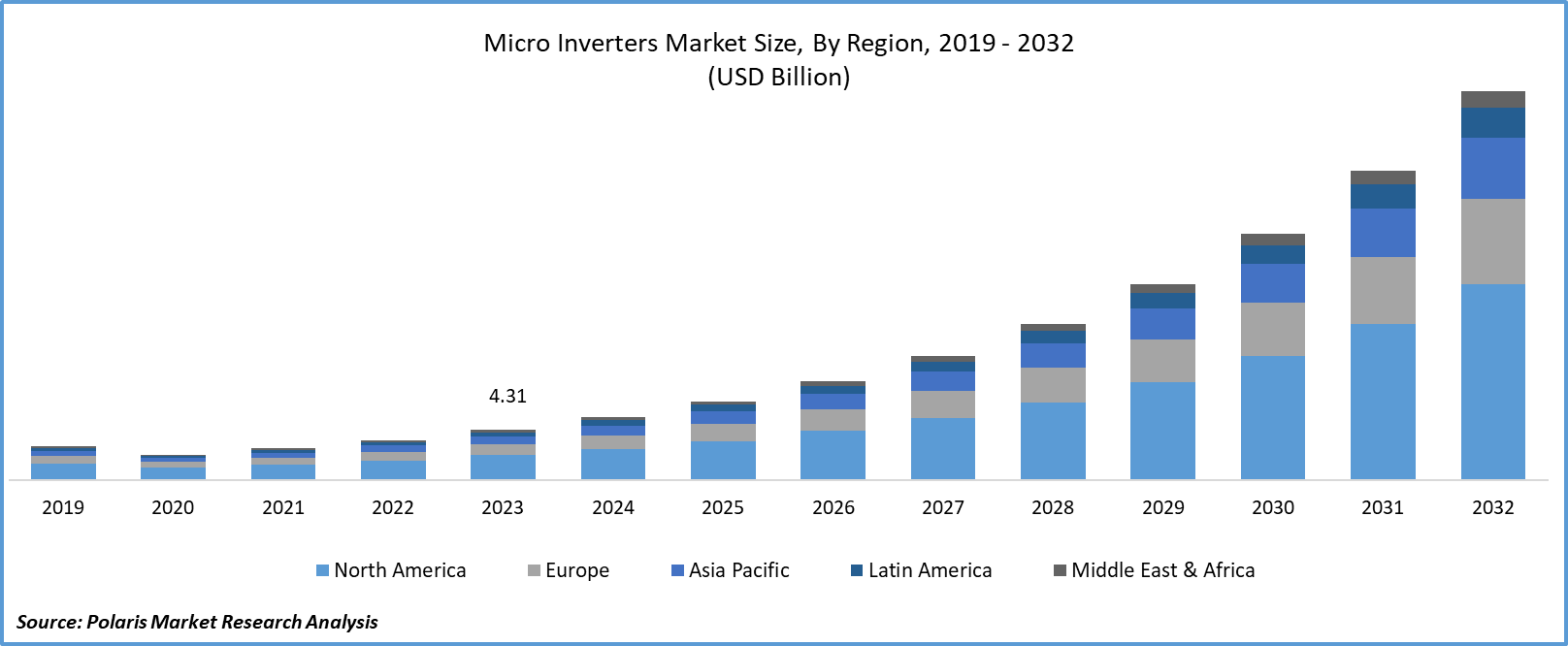
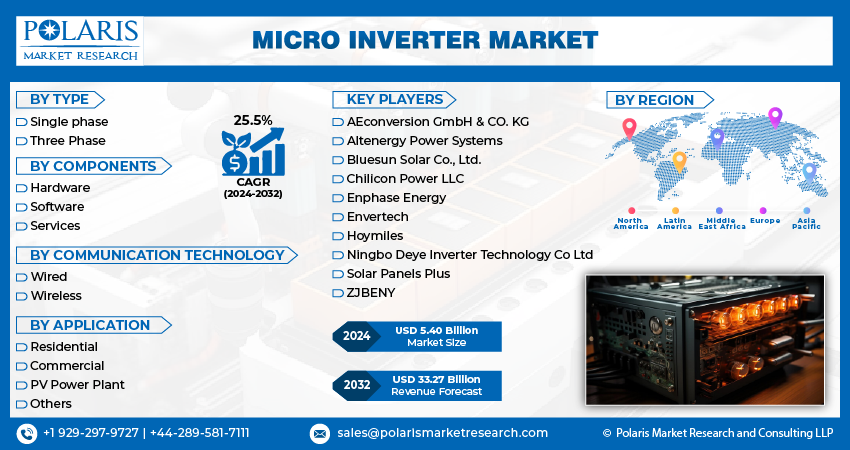
The global micro inverter market size was valued at USD 5.84 billion in 2025. The market is projected to account for an 22.10% CAGR from 2026 to 2034. Rising adoption of rooftop solar and panel-level optimization needs are a few of the key factors driving the micro inverter market growth. The market is also benefiting from the introduction of favorable government policies.
Market Statistics
Micro Inverter Market Key Takeaways
- North America dominated with an 37.20% micro inverter market share in 2025. Strong adoption of residential rooftop systems drives the regional market dominance.
- Asia Pacific is projected to witness rapid growth at an 26.10% CAGR. Expanding solar installations are contributing to increased demand for micro inverters in the region.
- The single-phase segment led the global market with an 72.40% share in 2025. This is primarily due to its widespread adoption in booming residential rooftop systems.
- The residential segment accounted for the largest micro inverter market share of 73.20% in 2025. Panel-level power optimization and ease of installation drive the segment’s leading market position.
- The direct sales channel is projected to account for an 24.49% CAGR. The segment’s growth is driven by rising OEM partnerships and online purchasing trends.
Note: Figures and projections outlined in this report are the result of Polaris Market Research’s proprietary analytical processes, grounded in the latest available datasets and market observations.
What Is a Micro Inverter?
A micro inverter is a compact power converter used in a PV system for converting DC power produced by one solar panel into AC power. Unlike the central inverter that functions for many panels, a micro inverter is generally mounted on a single solar panel. In this way, a separate operation of each solar panel is achieved. This configuration may be advantageous for systems where panels receive different levels of sunlight.
How Does a Micro Inverter Work?
The operation of a micro inverter can be explained in the following steps:
Production of DC power by solar panels: Solar panels gather solar energy and generate DC power.
Power supply to the micro inverter: The micro inverter is fed by the DC power generated by the corresponding solar panel.
Transformation of DC into AC power: The micro inverter transforms the DC power into AC power.
Maximizing the efficiency of power production: The micro inverter manages the output of the corresponding panel. Thus, the negative impact of the shading and orientation effects on system performance is reduced.
AC power supply to the system: AC power is supplied to the house for use or to the power grid.
Information on the output of the panels: Microinverter systems are capable of supplying information regarding the output of the panels.
Micro Inverter vs String Inverter
The methods used to transform the electricity produced by the solar panels into energy differ between the micro inverters and the string inverters. The micro inverters are attached to the panels individually, whereas the string inverters link several panels to the single unit. Such differences result in varied performance of both inverters when shading, positioning, monitoring and expansion are considered. Micro inverters can also help when it comes to the different requirements that exist at varying sites. String inverters may also make things much easier and cheaper when there is uniformity within the panels. These considerations influence the choice of an inverter for solar energy projects.
| Parameter | Micro Inverter | String Inverter |
| System Architecture | Panel-level architecture | Centralized architecture |
| Power Optimization | Optimizes power for individual panels | Can control the connected string of panels |
| Effect of Shading | Less effect of partial shading | Connected string affected by shading |
| Orientation of Panels | Various panel orientations possible | Better when same orientation |
| Monitoring | Individual panel monitoring | String/system level monitoring |
| Fault Diagnosis | Identification of panel-level faults | Generally troubleshooting of string |
| Flexibility of Installation | Suitable for complex layouts | Suited to simpler panel layouts |
Source: Polaris Market Research Analysis
Source: Polaris Market Research Analysis
Micro Inverter Market Dynamics
What Drives Demand for the Micro Inverter Market?
Rising Installation of Solar Products
Solar panel installation growth is increasing the demand for micro inverters as well. Solar installations need to have components capable of converting the power produced by the panels into usable AC power. Micro inverters are gaining popularity where there is a need to convert power at the panel level. This is being fueled by the increase in solar installations across commercial and distributed power projects. In January 2026, Hoymiles secured a 360 MW micro-inverter supply deal with Kosol Energie in India. The initiative aims to cover approximately 100,000 solar installations (source: hoymiles.com). This move demonstrates the increasing adoption of micro-inverter technology in the installation of solar energy at scale. As solar power expands, micro inverter market providers are expected to have more opportunities.
Growing Use of High-Power Solar Modules
With the increased popularity of solar modules that generate higher energy output, there is a growing demand for micro inverters with a larger capacity in terms of power and current. High-output solar panels may place greater demands on the inverter equipment connected to each individual panel. Hence, manufacturers are developing products that are compatible with the latest generation of solar panels. The development of new products can support replacement demand as installers shift to high-capacity solar panels. In June 2026, Enphase Energy launched the IQ9N micro inverter in the U.S. residential solar energy market. The product has been developed to accommodate high power solar modules and incorporates gallium nitride technology (source: enphase.com). This is indicative of the changes that are being incorporated by the manufacturers of micro inverters with regard to developments in solar panels. In the future, with the increasing use of high power solar modules, this will continue to be significant.
Drivers Impact Snapshot
| Driver | Demand Impact | Key Effect |
| Rising solar panel installations | High | Expands the addressable installation base |
| High-power solar module adoption | Medium-High | Supports demand for higher-capacity micro inverters |
Source: Polaris Market Research Analysis
What Is Restraining Micro Inverter Adoption?
Higher Upfront System Costs
Micro inverters typically use individual inverters for each photovoltaic panel. Such an approach could be quite costly in comparison with the string inverter system that uses a single inverter. The cost difference between these two technologies could affect purchasing choices, especially in those projects where costs still remain a significant issue. In addition, installing a large number of inverters takes much more time, requiring additional work. Cost sensitivity is another important aspect that can affect the choice of the technology configuration in solar projects where it is not necessary to have panel-level optimization. Cost differences become especially noticeable in large projects that could require more panels and, hence, more micro inverters. Consequently, the micro inverter cost difference could become a major factor when choosing system configuration. Therefore, the relatively higher initial cost of the micro inverters may slow down adoption of this technology in some solar projects.
Opportunities : Growing Demand for Module-Level Rapid Shutdown Solutions
Increasing safety requirements for solar equipment are leading to new opportunities for micro inverter companies to develop products capable of performing rapid shutdown operations. Module-level shutdown helps minimize the risk of electrical hazards when emergency or maintenance work is being done. It is possible for micro inverters to perform such operations because power conversion takes place on a module-by-module basis. Combining inverter technology with rapid shutdown capability can enable manufacturers to meet the safety demands of their customers and provide them with an integrated solution. This can help increase the value proposition of micro inverters as solar safety becomes increasingly crucial in certain markets.
Opportunities : Expansion of Micro Inverter Use in Small-Scale Distributed Generation
Small-scale distributed generation provides an opportunity for micro inverter suppliers to get into markets other than traditional rooftop solar panels. Small-scale distributed generation may involve the use of a few panels or generation points. The use of micro inverters is possible even without a large centralized inverter. Compactness and modularity in the design of the system can help the manufacturers target this opportunity. Thus, the increased usage in small-scale distributed generation projects could increase sales opportunities for micro inverters.
Trends : Smart Monitoring, AI & IoT Integration
Smart monitoring and connected systems are currently being adopted by micro inverter systems. IoT connectivity enables operators to have access to performance information of individual solar panels, which would assist in identifying any fluctuations in the power generation or problems with the equipment. AI technology could be used to further analyze the system data and identify any unusual performance patterns. Also, manufacturers are incorporating the use of digital platforms and inverter systems in order to get more information on how the system is performing. These capabilities can be helpful in making the systems visible to the installer and the user. This trend is supporting the shift towards more connected and data-driven solar power systems.
Trends : Solar-Plus-Storage Integration
Integration of solar energy generation with energy storage systems is gaining importance among distributed generation systems. In solar storage systems, the energy generated during the periods of sunlight is stored for future use. This changes the requirements for inverters used in such systems. Micro inverter companies are now coming up with inverters that can integrate with storage systems and manage energy flows better. Integration with the storage system can increase flexibility with regard to the use of generated energy. Compatibility with energy storage systems is a requirement being considered by micro inverter companies as battery storage systems become popular in solar systems.
Source: Polaris Market Research Analysis
Report Segmentation
The micro inverter market is primarily segmented based on type, component, communication technology, application, sales channel, and region.
| By Type | By Component | By Communication Technology | By Application | By Sales Channel | By Region |
|
|
|
|
|
|
Source: Polaris Market Research Analysis
By Type Insights
The single-phase segment led the global micro inverter market with an 72.40% share in 2025. This dominant position in the market is supported by the wide distribution of single-phase electrical systems in small solar energy facilities. Single-phase microinverters are suitable for facilities where the consumption of electrical energy is less than in larger-scale businesses or industrial enterprises. This type of microinverter is compatible with household electricity distribution and can be widely applied in different solar facilities. In addition, the growth of distributed solar power generation adds value to the segment. More solar panel installations are driving the demand for compact inverter systems capable of functioning at the panel level. With the growth of distributed solar power generation, single-phase micro inverters are forecasted to remain dominant.
The three-phase segment is projected to account for an 24.50% CAGR. The growth of the segment is driven by the increased use of three-phase power systems in those applications where there are higher power needs. The three-phase microinverters can support larger installation capacities due to better power handling abilities. In addition, three-phase microinverters may be used to enable panel-level power conversion in systems that have higher electric power demands. The segment is expected to gain traction as solar installations become more widespread in commercial and other large-scale applications. Higher demand for distributed power generation may contribute to the demand for three-phase micro inverters.
| Parameter | Single Phase | Three Phase |
| Electrical Configuration | Uses a single-phase AC connection | Uses a three-phase AC connection |
| Typical Power Requirement | Suited to lower power requirements | Suited to higher power requirements |
| Common Applications | Residential solar systems | Commercial and higher-capacity systems |
| Power Distribution | Power is delivered through one phase | Power is distributed across three phases |
| System Capacity | Generally suitable for smaller installations | Supports larger solar installations |
| Load Handling | Suitable for lighter electrical loads | Better suited to heavier electrical loads |
| Installation Complexity | Relatively simpler configuration | Requires three-phase electrical infrastructure |
| Market Positioning | Strong presence in distributed energy generation applications | Growing relevance in larger solar projects |
Source: Polaris Market Research Analysis
By Application Insights
The residential segment dominated the global micro inverter market with an 73.20% share in 2025. The dominance of this segment is driven by the rising deployment of micro inverters in household solar energy systems. This type of system is well suited to residential systems, as it is possible to have panels installed on different sections of the roof. Through the use of the micro-inverter, each panel can operate independently, hence keeping the output level consistent even when the amount of sunlight varies. This segment also benefits from the rising use of rooftop solar panels by residential customers. As more households adopt solar power, demand for panel-level inverters is projected to remain high.
The commercial segment is projected to grow at an 26.00% CAGR. The growth of this segment is due to the rising use of solar power in commercial buildings. Companies are installing solar systems in order to produce their own electricity and minimize the need to rely on traditional sources of energy. There can be different roof shapes and different panel installations in the commercial project; hence the requirement for more flexible inverters. The micro inverters enable individual panels to function independently, thus contributing to better performance of the system in such cases. The segment is likely to witness increasing popularity due to the continued investments in distributed solar power.
By Sales Channel Insights
The indirect segment led the global market with an 63.80% share in 2025. The segment involves distributors and installers, who connect manufacturers with end consumers as well as solar project developers. Distributors are involved in ensuring that micro inverter products are distributed in the regional markets. Installers also influence product selection depending on system and installation needs. This channel can be particularly important where consumers rely on the availability of products from their local suppliers. The wide distribution channels help in ensuring market accessibility for micro inverter manufacturers. As solar energy installations grow across different markets, distributors and installers are expected to remain important in the supply and sales process.
The direct segment is projected to grow at an 24.49% CAGR. This segment comprises direct sales through OEM channels and online channels. With direct sales, the manufacturer can build better relations with the client and exercise control over the distribution of the products. OEM partnerships can support the integration of micro inverters into the solar equipment and system solutions. Online platforms have also been offering manufacturers an alternative way to reach installers and other customers. With the growing trend of online purchasing in the solar equipment industry, the use of direct sales channels could become increasingly important. This growth can support manufacturers seeking to expand their market outreach and strengthen direct customer engagement.
Real-World Use Cases
Microinverters are used across solar installations where panel-level power conversion will be useful for design and performance. Microinverter usage is not confined to a specific category of solar project. Microinverters are used for residential projects, commercial projects, and any other distributed solar installations. Microinverters can be utilized for projects involving mixed orientations or constrained installation spaces. The table below highlights the different use cases and the role of microinverters for the particular application.
| Use Cases | Function of Micro Inverters |
| Residential Rooftop Solars | Converts power from each panel and offers flexibility with the roof design of residential units. |
| Solar Systems at Commercial Locations | Supports panel level operations with commercial solar systems that have different designs. |
| Solar System with Shaded Areas | Helps reduce the impact of low production from shaded panels on other panels. |
| Complex Roof Structures | Lets panels having different tilts operate independently. |
| Small-scale Solar Power Systems | Offers module power conversion with fewer panels. |
| Solar System Expansion | Assists with additions where more inverter capacity for panels is needed. |
Source: Polaris Market Research Analysis
Source: Polaris Market Research Analysis
Regional Insights
Regional demand for micro inverters varies based on the presence of solar power systems, electricity networks, and distributed energy systems. Installation trends and investments in renewable energy are also factors that play a role in regional market development.
North America
North America dominated the global market with an 37.20% share in 2025. There is an established solar industry in the region with substantial installations of distributed and rooftop solar solutions. The U.S. represents a sizable percentage of the demand from the region due to solar installations in residential and other distributed applications. Micro inverters are becoming increasingly popular in applications where flexible solar panel arrangements are required. In addition, there is a robust installer and equipment supplier base in the region. Increased investment in distributed energy solutions is helping boost demand for advanced inverter technology. In addition, Canada is contributing to the regional growth due to increasing solar installations. Overall, North America is expected to remain a key market throughout the forecast period.
Asia Pacific
Asia Pacific is projected to witness rapid growth at an 26.10% CAGR. The region has substantial capacity in terms of solar installations and is consistently growing in terms of adding renewable energy capacity. China, India, Japan, and Australia are some of the major countries driving demand in the region. Distributed solar energy systems are creating scope for the use of micro inverters. India is becoming more important due to the increase in investments in solar infrastructure. Japan and Australia also have developed distributed solar markets, which can drive demand for inverter systems at the panel level. Increased demand for electricity and the development of renewable energy capacities can further support market development across the region.
Europe
Europe accounted for an 29.80% micro inverter market share in 2025. The regional market is driven by the continued expansion of solar power production. Several nations are enhancing their capacity in renewable energy to reduce reliance on conventional energy sources. Rooftop and distributed solar plants are some of the key deployments in the region. Microinverters may be used with these virtual power plants, which have varied orientations or operating conditions. Germany, Italy, the UK, and other mature solar markets are some of the drivers of the regional demand. An increasing trend in decentralized power generation is creating an opportunity for panel-level inverters. Solar investment and renewable energy policies are anticipated to fuel the growth in the regional market.
Latin America
Latin America is projected to grow at an 23.10% CAGR. The micro inverter market in Latin America is anticipated to witness steady growth as the uptake of solar energy continues to rise. Brazil is one of the important markets for this region, owing to the increase in distributed solar energy production. Also, other nations in the region are developing capacities for renewable energy in order to increase electricity production. Micro inverters are useful in small-scale and decentralized solar installations that require flexibility in the system design. Increasing awareness regarding decentralized electricity production is another factor driving demand.
Middle East & Africa
The Middle East & Africa is projected to grow at an 22.50% CAGR. The Middle East & Africa market is forecasted to witness growth with increasing investments in renewable energy and solar infrastructure among various countries. High solar availability creates an enabling environment for solar projects. Solar energy production is becoming relevant in markets that require more electricity generation capacity. Micro inverters may be useful for small solar projects where there is a need to convert solar power at the panel level. Market demand will depend upon investments in renewable energy, grid infrastructure, and solar equipment. The increasing focus on energy diversification is expected to create additional demand for micro inverters.

Source: Polaris Market Research Analysis
Trade Policy & Tariff Impact, 2026 Update
Trade policy considerations have become more important for the development of micro inverters, their components, and solar equipment. This is due to changes in import duties that may influence the cost of equipment, its sourcing, and price levels in regions. Besides, the U.S. continues to be an important country in terms of trade policies for solar products. In May 2026, the U.S. International Trade Commission found that antidumping and countervailing duty orders for crystalline silicon photovoltaic cells from China and Taiwan should remain in effect. (source: usitc.gov)
Further, the U.S. introduced additional trade measures in 2026 that can influence the entire solar supply chain. In July, the U.S. Trade Representative implemented Section 301 duties on imports from 60 countries. They included rates usually set from 10 to 12.5% for all the relevant goods, with certain exceptions. India was placed in the group with 10% duty rates. Such factors can raise landed costs for the imported materials and machinery and can also affect the choice of suppliers. (source: ustr.gov)
The solar value chain is experiencing shifts concerning upstream materials. In August 2026, the U.S. imposed an extra duty of 15% on specific derivatives of polysilicon along with the minimum import price scheme on such items. The measures will take effect starting December 4, 2026. Even though the measures are aimed at polysilicon and not the microinverters directly, any increase in prices within the solar value chain can affect project economics. (source: whitehouse.gov)
For manufacturers of micro inverters, such changes can result in increased diversification of their supply chains. Manufacturers may even need to explore alternative locations to avoid micro inverter tariff 2026 exposure. Further changes in U.S. trade policies could influence procurement and pricing decisions across the micro inverter market.
Regulatory & Compliance Landscape
Electrical safety standards and grid interconnection regulations need to be met before micro inverters can be used in many markets. UL 1741 is an important standard in the USA for inverters and other devices associated with distributed energy resources. Testing may involve compliance with IEEE 1547, a standard that outlines technical requirements for the connection of distributed energy resources to the electrical grid. Tests can cover functions such as anti-islanding, voltage and frequency response, among other things.
PV installations have to comply with both national and local electrical codes as well. The National Electrical Code (NEC) contains requirements on the installation and inspection of electrical installations in the U.S. This code includes the requirements relevant to photovoltaic installations and rapid shutdown of the system. Moreover, the 2026 edition also reflects changes related to power control systems and new distributed energy technologies.
There is another set of regulations that European markets abide by. They can include IEC safety standards and regionally specific rules for connecting to the electricity grid, like EN 50549. Those regulations relate to the safe operation of generator systems in distribution grids. Consequently, product and certification modifications are required for each market.
Also, cybersecurity is becoming increasingly important for inverters as they have more connected capabilities. In February 2026, UL Solutions announced a new certification program for cybersecurity of distributed energy resources and inverter-based equipment (source: ul.com). Such developments clearly indicate that compliance requirements are widening beyond electrical safety.
Certification may impact the timelines of introduction, market entry, and even installation for manufacturers of micro inverters. Maintaining compliance with evolving standards is likely to remain important as solar systems on the grid become increasingly digital.
Competitive Landscape
The competitive landscape of the micro inverter market is shaped by factors such as product performance, price, availability of the product, and technical support services. Suppliers have been concentrating on improving the conversion rate and developing products capable of handling high power generation from solar modules. It has become vital for the products to be compatible with a range of solar system setups.
The competition is no longer limited to hardware, with organizations now improving their surveillance technologies and getting more involved with the energy management system. Installer connections continue to play a key role because installers often influence the products used and how they are developed. Warranties and after-sales service might also impact decision making in regions where the use of solar panels is being expanded. Companies, therefore, have to strike a balance between performance and price while expanding their distribution networks.
Microinverter Companies
| Company | Origin | Core Strength |
| U.S. | Module-level power electronics (MLPE) and microinverter systems | |
| Bluesun Solar Co., Ltd. | China | Solar inverters and PV equipment |
| Darfon Electronics Corp. | Taiwan | Power electronics and energy management |
| Ningbo Deye Inverter Technology Co., Ltd. (Deye) | China | Inverters and energy storage systems |
| Enphase Energy, Inc. | U.S. | Microinverters and integrated solar energy systems |
| Zhejiang Envertech Corporation Ltd. (Envertech) | China | Module-level power electronics and microinverters |
| Generac Power Systems, Inc. | U.S. | Home energy systems and power management |
| China | Microinverters and distributed solar solutions | |
| Zhejiang Benyi Electric Co., Ltd. (BENY New Energy / ZJBeny) | China | PV protection equipment and microinverter solutions |
| Solar Panels Plus LLC (SPP) | U.S. | Solar equipment supply and PV system components |
Source: Polaris Market Research Analysis
Recent Industry Developments
- July 2026: Hoymiles introduced its new plug-in microinverter, HiFlow Pro, in the U.S. The company stated that the microinverter is designed to meet UL 3700 requirements. The product aims to make plug-and-play solar systems easier to install and increase the use of microinverters in small distributed solar systems. (source: hoymiles.com)
- April 2026: Hoymiles launched its HiFlow and HiFlow Pro microinverter series. The company stated that the products were developed for European plug-in solar applications. They expanded the company’s offering for compact distributed solar systems. (source: hoymiles.com)
Future Outlook
The micro inverter market is expected to grow steadily as solar energy becomes a larger source of electricity production. With new distributed solar installations in both developed and emerging markets, demand for this equipment is expected to rise. Further innovations are expected due to the ability of solar modules to produce more power, making it necessary to have microinverters that can handle high electrical loads. Solar integration with batteries is another expected trend among solar panel owners since there will be more control over the time at which the generated energy is utilized. Other trends include improvements in product reliability and reduced installation costs. Digital components could also be important as users try to understand their system better. Future growth will depend on solar installations, product innovations, installation costs, and grid requirements.
Report Coverage
The micro inverter industry report emphasizes key regions across the globe to provide a better understanding of the product to users. Also, the report provides market insights into recent developments and trends and analyzes the technologies that are gaining traction around the globe. Furthermore, the report covers in-depth qualitative analysis pertaining to various paradigm shifts associated with the transformation of these solutions. The report provides a detailed market analysis and future growth opportunities.
Research Methodology
Polaris Market Research builds the micro inverter market estimate through a combined top-down and bottom-up approach. Top-down sizing starts from global solar photovoltaic installation volumes, segmented by rooftop and utility-scale share. It narrows to the addressable pool of panels compatible with module-level power electronics. Bottom-up validation cross-checks this figure against disclosed shipment volumes and revenue from leading microinverter manufacturers, distributor and installer channel checks, and country-level import/export and customs data.
Primary research includes structured interviews with inverter manufacturers, solar EPCs, installers, and distributors across key regions to validate pricing, channel margins, and adoption drivers, with particular attention to fast-moving inputs such as rapid-shutdown code enforcement, tariff and duty schedules, and three-phase product availability.
Secondary research draws on company annual reports and investor disclosures, national energy-agency statistics, standards and regulatory filings (UL, IEEE, national electrical codes), and trade-policy notices from the U.S. Trade Representative and equivalent bodies. Forecasts are built using scenario analysis, revisited whenever a material policy, tariff, or supply-chain shift is observed, with a full data refresh at each report edition and interim updates for major market-moving events.
Micro Inverter Market Report Scope
| Report Attributes | Details |
| Market Size Value in 2025 | USD 5.84 billion |
| Market Size Value in 2026 | USD 7.12 billion |
| Micro Inverter Market Forecast 2034 | USD 35.15 billion |
| CAGR | 22.10% from 2026 to 2034 |
| Base Year | 2025 |
| Historical Data | 2021–2024 |
| Forecast Period | 2026–2034 |
| Quantitative Units | Revenue in USD billion and CAGR from 2026 to 2034 |
| Report Coverage | Revenue Forecast, Market Competitive Landscape, Growth Factors, and Industry Trends |
| Segments Covered |
|
| Regional Scope |
|
| Competitive Landscape |
|
| Report Format |
|
| Customization | Report customization as per your requirements with respect to countries, regions, and segmentation. |
Source: Polaris Market Research Analysis
Micro Inverter Market FAQ's
The micro inverter market size was valued at USD 5.84 billion in 2025. The market is projected to reach USD 35.15 billion by 2034.
The market is projected to account for an 22.10%CAGR from 2026 to 2034.
A few of the key market players include APsystems (Altenergy Power Systems); Bluesun Solar Co., Ltd.; Darfon Electronics Corp.; Enphase Energy, Inc.; Generac Power Systems, Inc.; Hoymiles Power Electronics Inc.; Ningbo Deye Inverter Technology Co., Ltd. (Deye); Solar Panels Plus LLC (SPP); Zhejiang Benyi Electric Co., Ltd. (BENY New Energy / ZJBeny); and Zhejiang Envertech Corporation Ltd. (Envertech).
North America accounted for the largest market share of 37.20% in 2025. Favorable government incentives and strong adoption of residential rooftop systems drive the regional market dominance
The direct sales channel is anticipated to account for an 24.4% CAGR. The rise of large-scale commercial and industrial projects drives the segment’s growth.
A micro inverter is a system used to convert the DC electrical energy produced by an individual solar panel to AC energy.
The major advantage of micro inverters is that they enable solar panels to function as standalone entities. Micro inverters may help boost system performance in case the solar panels are installed on surfaces receiving varying amounts of sunlight.
Micro inverters are usually placed separately on individual solar panels, whereas string inverters link multiple solar panels to a single inverter.
Download Sample Report of Micro Inverter Market
Please fill out the form to request a customized copy of the research report.


