
Middle East Energy-based Aesthetic Devices Market Share, and Future Demand Dynamics, 2025-2034
REPORT DETAILS
Market Statistics
What is the Middle East energy-based aesthetic devices market size?
The Middle East energy-based aesthetic devices market size was valued at USD 103.93 million in 2024, growing at a CAGR of 11.56% from 2025 to 2034. Growing demand for non-invasive treatments and wider acceptance among men and youth are driving market growth.
Key Insights
- Medical laser-based devices segment dominated in 2024.
- HCP-owned clinic segment is growing fastest.
- UAE market driven by medical tourism and non-invasive treatment demand.
- Saudi Arabia expanding with rising youth demand and private investment.
Industry Dynamics
- Rising demand for non-invasive cosmetic treatments is driving steady growth in this industry.
- Expanding network of aesthetic clinics and medical tourism hubs is boosting device utilization.
- Integration of AI-based skin diagnostics improving treatment personalization creates opportunity.
- High equipment costs and limited skilled professionals are restraining large-scale adoption.
Market Statistics
- 2024 Market Size: USD 103.93 Million
- 2034 Projected Market Size: USD 310.10 Million
- CAGR (2025–2034): 11.56%
- UAE: Largest market in 2024
What is Middle East energy-based aesthetic devices market?
The Middle East energy-based aesthetic devices market mainly includes laser, radiofrequency, ultrasound, and light-based systems for skin rejuvenation, hair removal, and body contouring across dermatology clinics and medical spas. These devices support non-invasive cosmetic procedures that are favored by men and women in urban centers.
The market is expanding due to increasing demand for minimally invasive treatments and the growing acceptance among younger consumers of aesthetic procedures. For example, in October 2025, Cynosure Lutronic launched a new fractional CO₂ system called the eCO2 3D Laser for advanced skin resurfacing. Expanding aesthetic clinics and medical tourism infrastructure in the UAE and Saudi Arabia projected to facilitate the adoption of energy-based devices.
Source: Polaris Market Research Analysis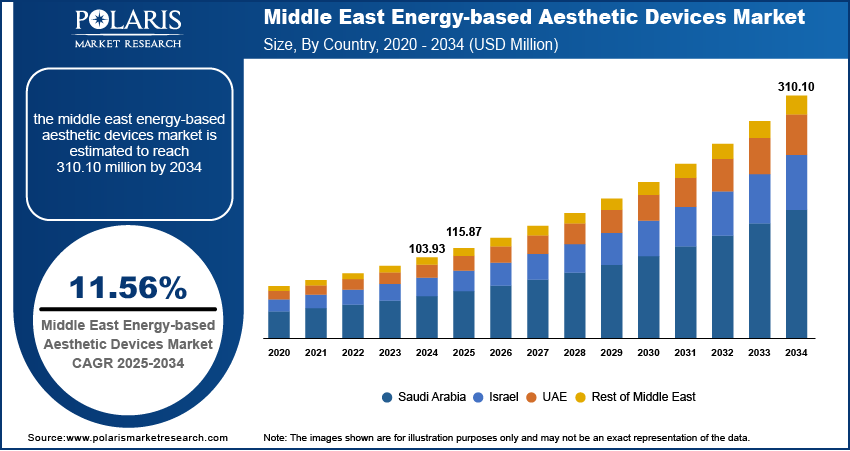
High costs of devices and shortage of skilled practitioners remain key restraints. However, increasing investment in localized distribution networks and development of portable multifunctional systems designed for Middle Eastern skin types are creating new growth opportunities for manufacturers.
Drivers & Opportunities
Which are the factors driving Middle East energy-based aesthetic devices market growth?
Rising demand for non-invasive cosmetic treatments across urban populations: There is a growing demand for safe and time-saving aesthetic solutions with minimal recovery time among urban consumers. This is driving the adoption of laser, RF, and ultrasound-based systems at higher rates in the clinics. Increasing awareness and greater affordability expected to drive steady market growth.
Increasing acceptance of aesthetic procedures among men and younger consumers: Growing social openness and digital influence are encouraging men and younger individuals to opt for cosmetic enhancements. Israeli Association of Plastic Surgery stated that around 54,000 aesthetic surgeries were performed in 2023, with breast lift procedures accounting for about 65% or 35,000 of them. Demand for procedures such as skin rejuvenation and hair removal is expanding across this group. This trend is strengthening overall device utilization across regional aesthetic centers.
Source: Polaris Market Research Analysis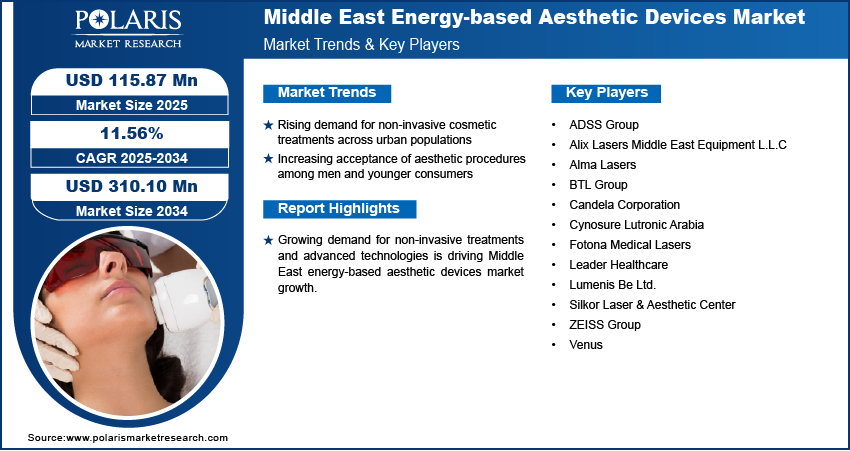
Segmental Insights
Product Analysis
By product, the market is divided into medical laser-based devices, light-based devices, radiofrequency (RF) based devices, ultrasound, and others. The medical laser-based devices segment dominated in 2024, driven by wide use in hair removal and skin rejuvenation. Moreover, continuous innovation and precise treatment performance strengthened adoption across dermatology clinics.
The radiofrequency (RF) based devices segment is projected to grow fastest, supported by rising use in skin tightening and body contouring. In addition, advancements in RF technologies are improving comfort and recovery outcomes.
Application Analysis
Based on application, the market is segmented into body contouring, skin tightening, skin rejuvenation, hair removal, leg vein treatment, vaginal rejuvenation, pigmented lesion, tattoo removal, and others. The hair removal segment dominated in 2024, owing to the strong demand from male and female consumers.
The skin tightening segment is projected to grow fastest, driven by higher preference for non-surgical anti-aging solutions. In addition, increased use of RF and ultrasound systems is enhancing patient satisfaction.
End User Analysis
Based on end user, the market is segmented into hospital/surgery centre, medspa, traditional spa, and HCP-owned clinic. The medspa segment dominated in 2024, driven by expansion of aesthetic centers offering non-invasive treatments. Moreover, higher spending on cosmetic enhancement supported device utilization.
The HCP-owned clinic segment is projected to grow fastest, supported by preference for physician-led procedures. In addition, investment in advanced systems is improving service capability and outcomes.
Source: Polaris Market Research Analysis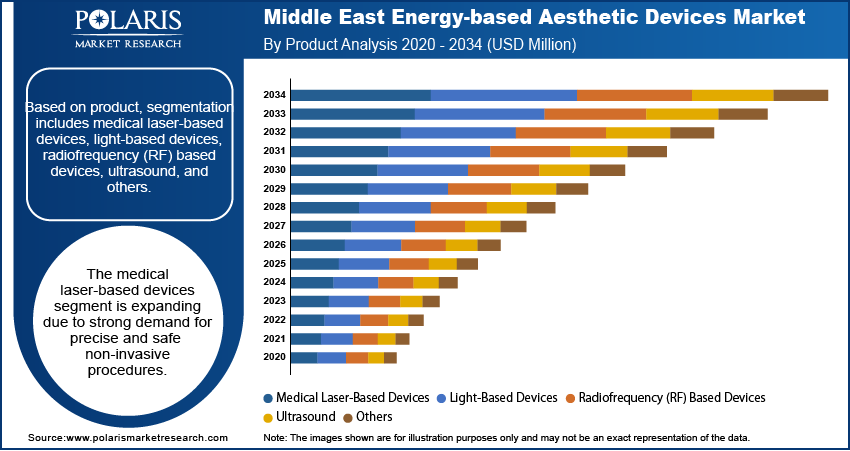
Regional Analysis
The UAE dominated the Middle East energy-based aesthetic devices market in 2024, driven by strong medical tourism and rapid expansion of premium aesthetic clinics in Dubai and Abu Dhabi. In addition, high disposable income and early adoption of advanced laser technologies strengthened market growth. According to the U.S. Energy Information Administration (EIA), disposable income per capita in the Middle East was approximately USD 5,290 and by 2030 it is projected to rise to roughly USD 5,525.
Saudi Arabia Energy-based Aesthetic Devices Market Trends
Saudi Arabia is projected to grow at the fastest CAGR during the forecast period, fueled by rising demand for cosmetic procedures among youth and increasing investments in private healthcare infrastructure. For example, Saudi Arabia announced to invest over USD 65 billion within the Vision 2030 for health care, including augmenting e-health and increasing private sector contribution to 65%.
Source: Polaris Market Research Analysis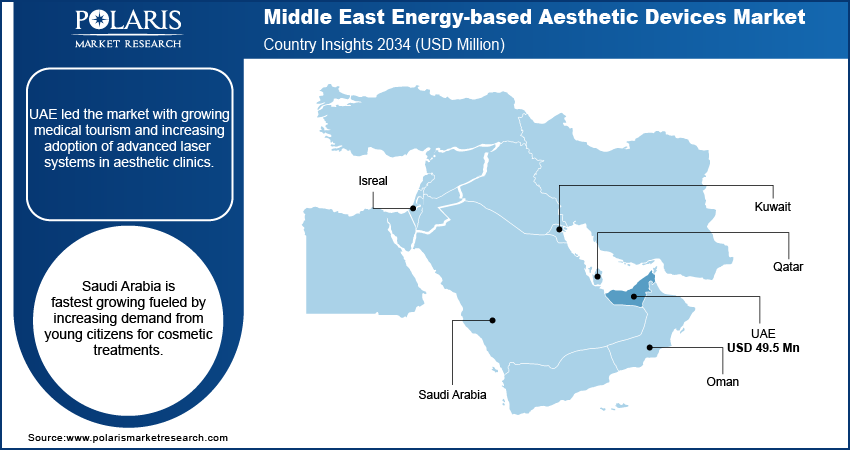
Key Players & Competitive Analysis
The Middle East energy-based aesthetic devices market is competitive with leading manufacturers are focusing on technological innovation and product diversification to enhance treatment performance and safety. Moreover, strategic partnerships with clinics and regional distributors facilitate market expansion and long-term business sustainability.
Some of the major firms in the Middle East energy-based aesthetic devices sector are Lumenis Be Ltd., ADSS Group, Alma Lasers, Alix Lasers Middle East Equipment L.L.C, Cynosure Lutronic Arabia, Candela Corporation, ZEISS Group, Leader Healthcare, Silkor Laser & Aesthetic Center, Fotona medical lasers, BTL Group, and Venus.
Key Players
- ADSS Group
- Alix Lasers Middle East Equipment L.L.C
- Alma Lasers
- BTL Group
- Candela Corporation
- Cynosure Lutronic Arabia
- Fotona Medical Lasers
- Leader Healthcare
- Lumenis Be Ltd.
- Silkor Laser & Aesthetic Center
- ZEISS Group
- Venus
Middle East Energy-based Aesthetic Devices Industry Developments
September 2025: The Technology Innovation Institute (TII) introduced a 2 mm fiber laser for precision medical and industrial applications.
May 2025: Wontech, a South Korean medical-device firm, obtained regulatory approval in Saudi Arabia for its “V-Laser” aesthetic laser device.
Middle East Energy-based Aesthetic Devices Market Segmentation
By Product Outlook (Revenue, USD Million, 2020–2034)
- Medical Laser-Based Devices
- Light-Based Devices
- Radiofrequency (RF) Based Devices
- Ultrasound
- Others
By Application Outlook (Revenue, USD Million, 2020–2034)
- Body Contouring
- Skin Tightening
- Skin Rejuvenation
- Wrinkles
- Acne & Other Scars
- Skin Pigmentation
- Aging
- Hair Removal
- Leg Vein Treatment
- Vaginal Rejuvenation
- Pigmented Lesion
- Tattoo Removal
- Others
By End User Outlook (Revenue, USD Million, 2020–2034)
- Hospital/Surgery Centre
- Medspa
- Traditional Spa
- HCP-Owned Clinic
By Regional Outlook (Revenue, USD Million, 2020–2034)
- Middle East
- Saudi Arabia
- UAE
- Israel
- Rest of Middle East
Middle East Energy-based Aesthetic Devices Market Report Scope
| Report Attributes | Details |
| Market Size in 2024 | USD 103.93 Million |
| Market Size in 2025 | USD 115.87 Million |
| Revenue Forecast by 2034 | USD 310.10 Million |
| CAGR | 11.56% from 2025 to 2034 |
| Base Year | 2024 |
| Historical Data | 2020–2023 |
| Forecast Period | 2025–2034 |
| Quantitative Units | Revenue in USD Million and CAGR from 2025 to 2034 |
| Report Coverage | Revenue Forecast, Competitive Landscape, Growth Factors, and Industry Trends |
| Segments Covered |
|
| Competitive Landscape |
|
| Report Format |
|
| Customization | Report customization as per your requirements with respect to countries, regions, and segmentation. |
Source: Polaris Market Research Analysis
Middle East Energy-based Aesthetic Devices Market FAQ's
The global market size was valued at USD 103.93 million in 2024 and is projected to grow to USD 310.10 million by 2034.
The global market is projected to register a CAGR of 11.56% during the forecast period.
UAE led the market driven by strong medical tourism and growing demand for advanced non-invasive cosmetic treatments.
A few of the key players in the market are Lumenis Be Ltd., ADSS Group, Alma Lasers, Alix Lasers Middle East Equipment L.L.C, Cynosure Lutronic Arabia, Candela Corporation, ZEISS Group, Leader Healthcare, Silkor Laser & Aesthetic Center, Fotona medical lasers, BTL Group, and Venus.
The medical laser-based devices segment dominated resulting from the widespread use in hair removal and skin rejuvenation.
The HCP-owned clinic segment is growing steadily due to rising investment in advanced systems and preference for physician-led treatments.
Download Sample Report of Middle East Energy-based Aesthetic Devices Market
Please fill out the form to request a customized copy of the research report.


