
Nano Copper Oxide Market Size, Growth Drivers, 2026-2034
REPORT DETAILS
Nano Copper Oxide Market Summary
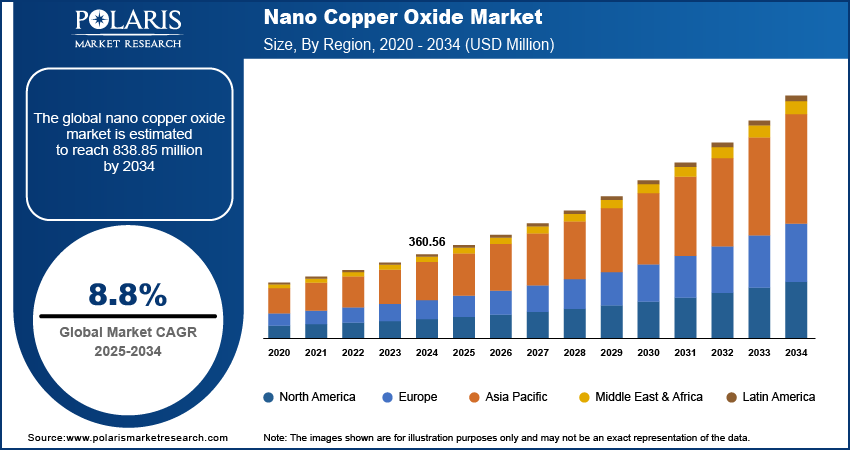
The global nano copper oxide market size was valued at USD 385.85 million in 2025, exhibiting a CAGR of 8.71% during 2026–2034. Rising antimicrobial demand, increased nanotech investments, electronics industry growth, expanding energy storage use, and portable device advancements collectively drive the market.
Market Statistics
Key Takeaways
- North America is expected to grow at a CAGR of 8.08% during the forecast period with strong research, nanotech investments, and healthcare industry presence.
- Asia Pacific dominated the market with 35.7% share in 2025, due to industrialization and electronics manufacturing.
- The nano copper oxide market in India is experiencing substantial growth at a CAGR of 10.90% due to its growing focus on nanotechnology and government initiatives promoting innovation and advanced materials.
- The pharmaceuticals segment is expected to witness 8.90% during 2026-2034, due to nano copper oxide’s antibacterial, antiviral, and antifungal medical uses.
- The electronics & optics segment dominated with 32.0% share in 2025, with demand for miniaturized, high-performance components.
Note: Figures and projections outlined in this report are the result of Polaris Market Research’s proprietary analytical processes, grounded in the latest available datasets and market observations.
Industry Dynamics
- Growing demand for antimicrobial materials in healthcare and consumer goods drives the adoption of nano copper oxide.
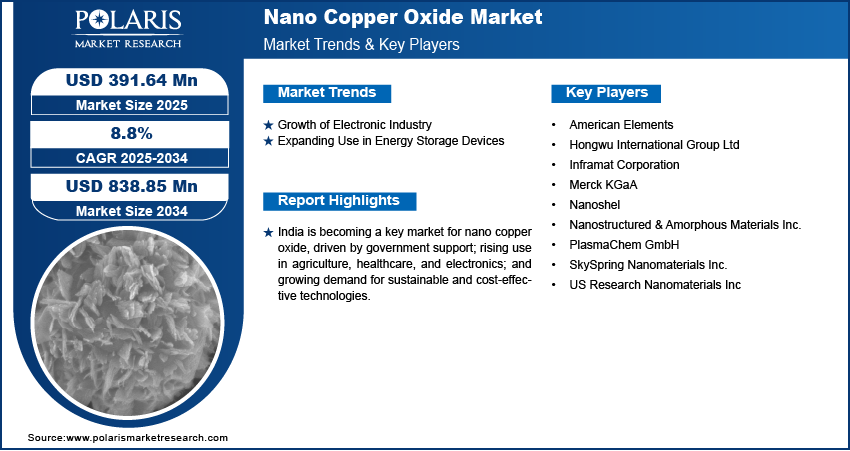
- Expansion of the electronics industry boosts usage in semiconductors, sensors, and printed circuit boards.
- Increasing applications in energy storage devices enhance battery efficiency and charging capabilities.
- Rising investments in nanotechnology research accelerate the development and commercialization of nano copper oxide.
- Production challenges and high costs may limit large-scale manufacturing and market penetration.
Source: Polaris Market Research Analysis
To Understand More About this Research: Download Sample Report
What is Nano Copper Oxide?
Nano copper oxide (CuO) is a nanomaterial composed of copper and oxygen particles at the nanometer scale, typically less than 100 nm in size. It is known for its unique electrical, catalytic, and antimicrobial properties, making it useful in applications such as sensors, batteries, and antimicrobial coatings.
Nano copper oxide is well known for its strong antimicrobial properties, meaning it destroys or stops the growth of harmful bacteria and viruses. This has become especially important after the COVID-19 pandemic, as the crisis increased awareness about hygiene and infection prevention. Industries such as healthcare, textiles, and consumer goods are using nano copper oxide in coatings, face masks, hospital equipment, and clothing to help prevent the spread of germs. For instance, KN95 Ply face mask from ucare is made from nano copper oxides for the prevention of germs. The demand for antimicrobial materials such as nano copper oxide continues to rise as public health concerns grow and people seek safer environments, thereby driving the nano copper oxide market growth.
Nanotechnology is a rapidly growing field focused on designing and using materials at an extremely small-scale nanoscale. Governments, research institutions, and private companies are investing heavily in this area to develop new solutions across industries. Nano copper oxide is one of the key materials being explored due to its low cost and versatile properties. Increased research and funding are leading to more applications in medicine, electronics, agriculture, and energy. The demand for high-performance nanomaterials such as nano copper oxide is growing as nanotechnology becomes more advanced and widely adopted, thereby driving the nano copper oxide market development.
Difference Between Nano Copper Oxide vs Traditional Copper Materials
| Parameter | Nano Copper Oxide | Traditional Copper Materials |
| Particle Size | Consists of ultra-fine particles at the nanoscale, allowing greater interaction with surrounding materials | Exists in bulk form, wires, sheets, powders, or larger oxide particles with limited nanoscale effects |
| Surface Area | High surface area enhances chemical reactions, adsorption capacity, and material interactions | Lower surface area reduces active sites and limits reaction efficiency |
| Conductivity | Provides improved electrical and thermal performance in nanocomposites, conductive inks, and electronic materials | Copper metals offer excellent conductivity, while conventional copper oxide has comparatively lower electrical performance |
| Antimicrobial Efficiency | Exhibits stronger antimicrobial properties due to increased surface contact and controlled release of copper ions, enabling use in coatings, textiles, and medical materials | Traditional copper surfaces show antimicrobial effects but with slower ion release and lower active surface exposure |
| Catalytic Performance | Acts as an efficient catalyst due to high reactivity, making it useful in chemical synthesis, environmental remediation, and energy applications | Traditional copper materials generally require larger quantities and higher temperatures for similar catalytic effects |
| Industrial Applications | Used in advanced electronics, sensors, batteries, solar cells, antimicrobial coatings, catalysts, and nanocomposites | Used mainly in electrical wiring, construction materials, plumbing, heat exchangers, and conventional industrial components |
Market Dynamics
Growth of Electronic Industry
The electronics industry is rapidly expanding. According to the US Bureau of Labor Statistics, in the US alone, the electronic industry employed 287,800 people in 2023, showcasing the growth of the industry. Nano copper oxide is becoming a valuable material in the industry due to its excellent electrical and thermal properties. It is used in making components such as compound semiconductors, pressure sensors, and printed circuit boards. These tiny particles help improve performance while allowing manufacturers to make devices smaller and more efficient. There is a growing need for advanced materials such as nano copper oxide with the increasing use of smart gadgets, wearables technology, and high-performance electronics, thereby driving the nano copper oxide market expansion.
Expanding Use in Energy Storage Devices
Nano copper oxide plays an important role in improving the performance of batteries and other energy storage devices. Its small size and large surface area help store and transfer energy more efficiently, making it ideal for lithium-ion batteries and supercapacitors. These are widely used in smartphones, laptops, electric vehicles (EVs), and renewable energy systems. The need for better battery technology is growing as demand for clean energy and portable electronics is rising. According to Apple's Annual Report, smartphone sales rose from USD 191,973 million in 2021 to USD 205,489 million in 2022, showcasing the growing demand for portable electronics. Nano copper oxide helps make these batteries last longer and charge faster, which is crucial for modern technology. Thus, rising use in the energy storage sector propels the nano copper oxide market demand.
Source: Polaris Market Research Analysis
Nano Copper Oxide Market Segment Analysis
Market Assessment by End Use Industry Outlook
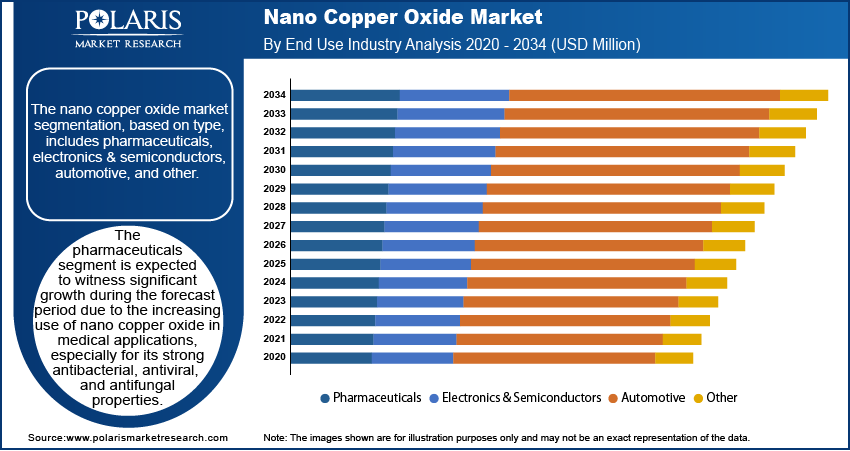
The market segmentation, based on end-use industry, includes pharmaceuticals, electronics & semiconductors, automotive, and other. The pharmaceuticals segment is expected to witness significant growth at a CAGR of 8.90% during the forecast period due to the increasing use of nano copper oxide in medical applications, especially for its strong antibacterial, antiviral, and antifungal properties. It is being used in wound dressings, drug delivery systems, and coatings for medical equipment to prevent infections. The demand for nano copper oxide in the pharmaceutical industry is growing with rising health concerns and demand for advanced medical treatments, thereby driving the segmental growth.
Market Evaluation by Application Outlook
The market segmentation, based on application, includes electronics & optics, medical & personal care, paints & coatings, energy & environment, and others. The electronics & optics segment dominated the nano copper oxide market with 32.0% share in 2025, due to the increasing demand for high-performance and miniaturized electronic components. Nano copper oxide is widely used in semiconductors, sensors, conductive films, and printed circuit boards because of its excellent electrical conductivity and thermal stability. The need for reliable and efficient materials such as nano copper oxide has surged as the electronics industry continues to grow, especially with advancements in smart devices, wearables, and flexible electronics, thereby driving segmental dominance.
Source: Polaris Market Research Analysis
Regional Analysis
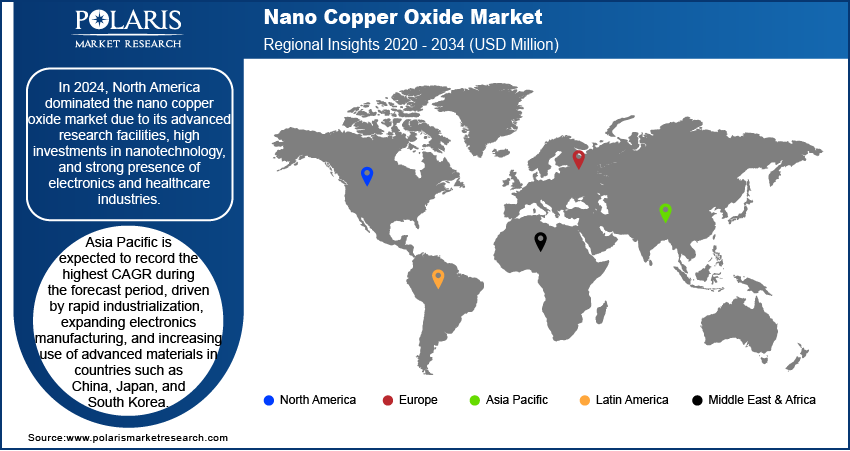
By region, the study provides the nano copper oxide market insights into North America, Europe, Asia Pacific, Latin America, and the Middle East & Africa. North America is expected to grow at a CAGR of 8.08% during the forecast period due to its advanced research facilities, high investments in nanotechnology, and strong presence in the electronics and healthcare industries. The US, in particular, is leading in the development and application of nanomaterials for use in pharmaceuticals, electronics, and antimicrobial coatings. Government support for innovation and strict hygiene standards are further boosting demand. In addition, the growing use of nano copper oxide in energy storage devices such as batteries is contributing to the growing demand for nano copper oxide in the region.
Asia Pacific dominated the market with 35.7% share in 2025, driven by rapid industrialization, expanding electronics manufacturing, and increasing use of advanced materials in countries such as China, Japan, and South Korea. These countries are heavily investing in nanotechnology to improve electronics, renewable energy, and healthcare. The demand for nano copper oxide is rising due to its role in batteries, sensors, and antimicrobial products. The region's large population and booming tech industry create a strong demand for batteries used for portable electronics, thereby driving the nano copper oxide market opportunity in Asia Pacific.
The nano copper oxide market in India is experiencing substantial growth at a CAGR of 10.90% due to its growing focus on nanotechnology and government initiatives promoting innovation and advanced materials. The country is witnessing increasing applications of nano copper oxide in agriculture, pharmaceuticals, and electronics. In farming, it is being explored for use in nano pesticides and fertilizers to improve crop yield. Indian startups and research institutions are also working on healthcare uses, such as antimicrobial coatings and wound healing, thereby driving the market growth in India.
Emerging Innovations in Nano Copper Oxide
| Innovation Area | Description | Impact on Market |
| AI-Assisted Nanomaterial Development | Artificial intelligence and machine learning are being used to optimize nanoparticle size, structure, synthesis methods, and performance characteristics | Accelerates material discovery, reduces development time, and enables customized nano copper oxide solutions |
| Printable Conductive Inks | Nano copper oxide-based inks are being developed for printed electronics, circuit boards, sensors, and smart devices | Supports growth of flexible electronics, low-cost manufacturing, and next-generation electronic components |
| Advanced Antimicrobial Coatings | Nano copper oxide is integrated into coatings for healthcare equipment, textiles, packaging, and high-touch surfaces due to enhanced microbial control | Increases demand for durable, long-lasting antimicrobial materials across healthcare and consumer industries |
| Hydrogen Energy Catalysts | Nano copper oxide is being explored as a catalyst material for hydrogen production, fuel cells, and energy conversion processes | Creates opportunities in clean energy technologies and sustainable hydrogen-based applications |
| Nano-Enabled Flexible Electronics | Nano copper oxide materials are incorporated into flexible sensors, wearable devices, and lightweight electronic systems | Drives adoption in wearable technology, IoT devices, and next-generation smart electronics |
Source: Polaris Market Research Analysis
Key Players & Competitive Analysis Report
The nano copper oxide market trends are constantly evolving, with numerous companies striving to innovate and distinguish themselves. Leading global corporations dominate the market by leveraging extensive research and development, and advanced techniques. These companies pursue strategic initiatives such as mergers and acquisitions, partnerships, and collaborations to enhance their product offerings and expand into new markets.
New companies are impacting the industry by introducing innovative products to meet the demand of specific sectors. This competitive trend is amplified by continuous progress in product offerings. A few major players in the market are American Elements, Hongwu International Group Ltd, Inframat Corporation, Merck KGaA, Nanoshel, Nanostructured & Amorphous Materials Inc., PlasmaChem GmbH, SkySpring Nanomaterials Inc., and US Research Nanomaterials Inc.
American Elements is a global manufacturer and distributor of engineered and advanced materials, serving various industries, including green technology, space exploration, nanotechnology, electronics, and military applications. Founded in 1998 by Michael Silver, the company is headquartered in Los Angeles, California, with additional facilities in Salt Lake City, Utah; Monterrey, Mexico; Baotou, China; and Manchester, UK. The company produces a wide range of products, including high-purity chemicals and metals, semiconductors, nanoparticles, isotopes, ceramics, and crystalline materials. Its catalog encompasses over 16,000 items used in applications such as battery storage, hydrogen energy, solar power, aerospace, defense systems, optics/photonics, pharmaceuticals, and cosmetics. American Elements also provides customized formulations and technical support for product applications. The company serves sectors such as energy, electronics, aerospace and defense, automotive, and pharmaceuticals. In the energy sector, the company supplies materials for renewable energy systems, while in electronics, it provides components for advanced devices. American Elements operates globally, with facilities in North America, Asia, and Europe. This international presence enables the company to serve a large customer base, including many major corporations. American Elements Copper Oxide (CuO) Nanoparticles are high-purity, nanoscale particles (1–30 nm) with a black-to-brown appearance, offering catalytic, antimicrobial, and biocidal properties for diverse industrial applications.
Merck KGaA, established in 1668, is one of the oldest pharmaceutical and chemical companies in operation. Based in Darmstadt, Germany, it operates across three main sectors—healthcare, life science, and electronics. The healthcare sector focuses on treatments for conditions such as cancer, cardiovascular diseases, diabetes, thyroid disorders, multiple sclerosis, and fertility issues. Key products include Erbitux (cetuximab), Metformin, Bisoprolol, Levothyroxine, and Digitoxin. The company collaborates with other entities to improve its research capabilities. In the life science sector, Merck provides materials, technologies, and services for laboratories and the biopharmaceutical industry. This includes brands such as Sigma-Aldrich, Milli-Q, and Millipore. The electronics sector is involved in the development of semiconductors and display solutions for electronic devices, with notable acquisitions such as Versum Materials and Intermolecular Inc. Merck KGaA has a global presence in 65 countries, with 101 production sites across 19 countries. It organizes its operations into five regions: Europe, North America, Asia Pacific, Latin America, and the Middle East & Africa. In North America, it operates under brands such as MilliporeSigma (Life Science), EMD Serono (Healthcare), and EMD Electronics (Electronics). The company provides Copper nanopowder with a 25 nm particle size, used in applications like nanofluids and electronics, available from Sigma-Aldrich with a density of 8.94 g/mL at 25°C.
List of Key Companies
- American Elements
- Hongwu International Group Ltd
- Inframat Corporation
- Merck KGaA
- Nanoshel
- Nanostructured & Amorphous Materials Inc.
- PlasmaChem GmbH
- SkySpring Nanomaterials Inc.
- US Research Nanomaterials Inc
Nano Copper Oxide Industry Development
May 2025: Grid Africa and TCL Solar partnered to deploy 100 MW of distributed solar systems with battery storage in Zambia and Zimbabwe, using optimized TOPCon-based modules suited for high-temperature, high-irradiation conditions. (Source: prnewswire.com)
March 2025: the United States issued an executive order to streamline mineral permitting and increase funding for projects like copper to reduce foreign dependence and strengthen domestic industry. (Source: whitehouse.gov)
Nano Copper Oxide Market Segmentation
By Application Outlook (Revenue USD Million, 2021–2034)
- Electronics & Optics
- Medical & Personal care
- Paints & Coatings
- Energy & Environment
- Others
By End-Use Industry Outlook (Revenue USD Million, 2021–2034)
- Pharmaceuticals
- Electronics & Semiconductors
- Automotive
- Other
By Regional Outlook (Revenue USD Million, 2021–2034)
- North America
- US
- Canada
- Europe
- Germany
- France
- UK
- Italy
- Spain
- Netherlands
- Russia
- Rest of Europe
- Asia Pacific
- China
- Japan
- India
- Malaysia
- South Korea
- Indonesia
- Australia
- Vietnam
- Rest of Asia Pacific
- Middle East & Africa
- Saudi Arabia
- UAE
- Israel
- South Africa
- Rest of the Middle East & Africa
- Latin America
- Mexico
- Brazil
- Argentina
- Rest of Latin America
Nano Copper Oxide Market Report Scope
| Report Attributes | Details |
| Market Size Value in 2025 | USD 385.85 million |
| Market Size Value in 2026 | USD 419.11 million |
| Revenue Forecast by 2034 | USD 818.29 million |
| CAGR | 8.71% from 2026 to 2034 |
| Base Year | 2025 |
| Historical Data | 2021–2024 |
| Forecast Period | 2026–2034 |
| Quantitative Units | Revenue in USD million and CAGR from 2026 to 2034 |
| Report Coverage | Revenue Forecast, Market Competitive Landscape, Growth Factors, and Trends |
| Segments Covered |
|
| Regional Scope |
|
| Competitive Landscape |
|
| Report Format |
|
| Customization | Report customization as per your requirements with respect to countries, regions, and segmentation. |
Source: Polaris Market Research Analysis
nano copper oxide market FAQ's
The market size was valued at USD 385.85 million in 2025 and is projected to grow to USD 818.29 million by 2034.
The global market is projected to register a CAGR of 8.71% during the forecast period.
Asia Pacific dominated the market with 35.7% share in 2025.
A few key players in the market are American Elements, Hongwu International Group Ltd, Inframat Corporation, Merck KGaA, Nanoshel, Nanostructured & Amorphous Materials Inc., PlasmaChem GmbH, SkySpring Nanomaterials Inc., and US Research Nanomaterials Inc.
The electronics & optics segment dominated with 32.0% share in 2025 due to the increasing demand for high-performance and miniaturized electronic components.
The pharmaceuticals segment is expected to witness 8.90% during 2026-2034 due to the increasing use of nano copper oxide in medical applications.
Download Sample Report of nano copper oxide market
Please fill out the form to request a customized copy of the research report.


