
Network Engineering Services Market Share, Size, Trends, Industry Analysis Report, 2022 - 2030
REPORT DETAILS
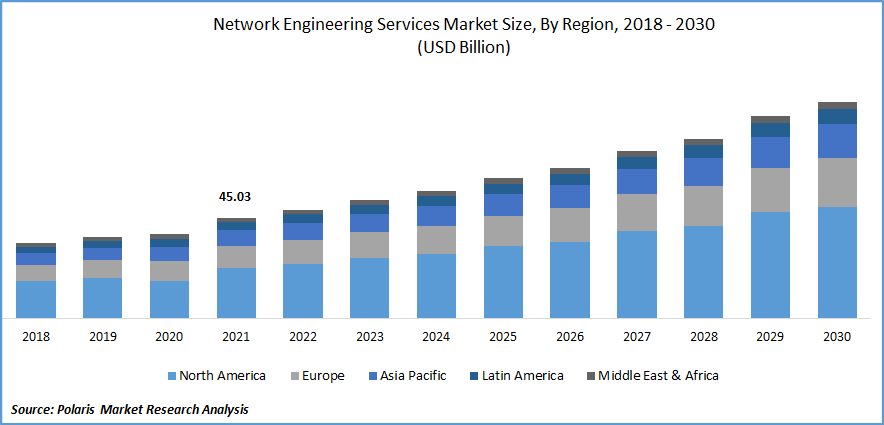
The global network engineering services market was valued at USD 45.03 billion in 2021 and is expected to grow at a CAGR of 9.32% during the forecast period. The growing demand for network engineering services is expected to be driven by rapid digitization, increasing penetration of cloud-based services, and growing demand from enterprises to maintain network connectivity.
The rising demand for IoT devices and the growing penetration of smart automation in various end-use industries is expected to fuel market growth. The growing number of devices with artificial intelligence and increasing universal and cyber-physical networks require extensive design and engineering systems to interconnect these devices and networks to communicate the data offered by network engineering services. For instance, ZigBee is a wireless mesh networking technology that allows devices to communicate numerous data across various network topologies; such factors are expected to propel market growth.
Source: Polaris Market Research Analysis
Know more about this report: Download Sample Report
The COVID-19 pandemic had a moderate to a significant impact on the growth of the market. Many businesses started working remotely, which increased the demand for broadband connections. Furthermore, there was a rise in network providers across various countries, which raised the value of the network and highly influenced the market. Additionally, the rapid adoption of cloud networking to enhance agility while working supported market growth. However, to some extent, the network faces uncertainty about bandwidth requirements, locations, and replacement cycles.
With the growing innovation and digitization, the risk of data abuse has also increased. The organization incorporated with various data networks also possesses a vast number of confidential data that needs to be protected to avoid data theft. Networking engineering services offer the interconnection of networks with a cloud-based solution. Still, they do not promise to protect data from leakage, which is a major factor restraining market growth.
Source: Polaris Market Research Analysis
For Specific Research Requirements, Request for a Customized Report
Industry Dynamics
Growth Drivers
The global network engineering services are likely to be driven by increasing big data analytics across verticals to enhance flexibility and performance. The growing adoption of smartphones and tablets has led to an increase in internet websites, online services, and mobile network subscribers, creating a massive amount of raw data requiring proper network planning and engineering. These network engineering services derive methods to detect failure, analyze root causes, and carry out troubleshooting tasks with the help of machine learning which bolsters market growth.
The demand for increased bandwidth has led to rising demand for broadband services. Many key players collaborate with various communication networks to implement better infrastructure for broadband technologies across developing and developed nations. For instance, CHR partnered with electric coops and telephone and cable companies to implement various communication networks and provide long-term solutions to minimize risk and manage technology implementation; such factors influence market growth.
Report Segmentation
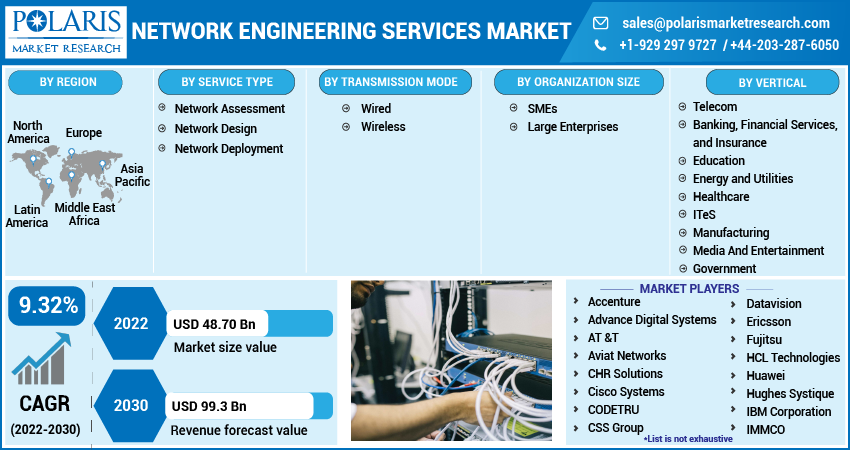
The market is primarily segmented based on service type, transmission mode, organization size, vertical, and region.
| By Service Type | By Transmission Mode | By Organization Size | By Vertical | By Region |
|
|
|
|
|
Source: Polaris Market Research Analysis
Know more about this report: Download Sample Report
Network design accounted for the largest share in 2021
The network design segment accounted for the highest revenue share in 2021 owing to its customized process depending on the network. Network design entails evaluating, understanding, and scoping the network to be deployed. The growing number of consumer electronic products and services, such as smartwatches, and OTT platforms, has created many data that needs to be tailored and managed for better performance which is expected to drive network design service segment growth.
Furthermore, network design constructs a physical network and suggests types of networks and equipment required for the setup, such as routers, servers, and switches. It also considers the positioning of equipment which improves the network’s performance, propelling the market growth.
Wireless segment is expected to spearhead the market growth
The demand for network engineering services through the wireless transmission mode is due to its flexibility and efficiency. Wireless networking helps to access data while on the move, improving productivity efficiently. In addition, information can be transferred within enterprises quickly with the help of enhanced data connectivity which is expected to boost segment growth.
Furthermore, a wireless network is cheaper and more accessible than a wired one. The rising consumer demand for better bandwidth and easy accessibility can be met by wireless transmission as it upgrades and meets new configurations. For instance, many telecom carriers and mobile operators can now use the real-time wireless network and easily access timely, accurate, and secure competitive intelligence data without investing in equipment or drive tests; such factors are expected to fuel the segment’s growth.
Large enterprises are anticipated to witness faster growth
The demand for pouring organization size is expected to surge significantly over the forecast period owing to the increasing network requirement across businesses. Large businesses operating at a high level consist of massive data which needs to be transferred among individuals and enterprises. The growing demand for the network has led to an increase in the number of service providers to offer better network resources to enhance the organization's productivity. Such factors complement the market growth.
Moreover, network engineering services also help to track utilization patterns of departments, identify problems related to the network and analyze utilization of even signal users, which allows an organization to monitor the exact requirement and cost incurred, which is expected to drive the market growth.
BFSI segment is expected to account for the largest share in 2030
The banking, financial services, and insurance (BFSI) segment are anticipated to dominate the market over the forecast period owing to the increasing adoption of open banking with the rising digitalization. Consumer shift from direct cash payment to various application programming interfaces (APIs) such as e-wallet, net banking, and e-bill payments has increased financial firms’ growth and improved competitive edge among other enterprises, which is expected to propel the market growth.
Furthermore, open banking playing a crucial role in network engineering, enables users to share their financial data with third-party financial institutions. Networked accounts also give consumers an accurate picture of the economic situation and risk. Moreover, banks working with fintech firms make their services accessible to their customers for simple payments, essential in boosting market growth.
North America is dominating region over the forecast period
North America is the largest region for network engineering services. It is expected to witness faster growth over the forecast period owing to its well-established IT hub and adoption of novel technologies in various organizations. In addition, the rapid movement of advanced technologies such as 5G and fibers has improved the corporate landscape. For Instance, Cyient offers a comprehensive portfolio of services that enable CSPs to efficiently plan, design, and manage fixed-line and mobile networks in the USA.
Moreover, the increasing ICT investments to implement cutting-edge technology to enhance business operations bolster the market growth in this region. For instance, XenTegra collaborated with Mindcentric, which manages infrastructure and data centers and delivers managed services to large enterprises and SMEs. This venture goal is to meet the requirements of end-use computing and digital transformation by complementing each other strengths and supporting sales of the businesses, which is expected to drive market growth.
Competitive Insight
Some of the major players operating in the global market include:
- Accenture,
- Advance Digital Systems,
- AT &T,
- Aviat Networks,
- CHR Solutions,
- Cisco Systems,
- CODETRU,
- CSS Group,
- Cyient,
- Datavision,
- Ericsson,
- Fujitsu,
- HCL Technologies,
- Huawei,
- Hughes Systique,
- IBM Corporation,
- IMMCO,
- Infosys,
- Inspira Enterprise,
- Juniper Networks,
- Mphasis Ltd,
- Nexius Solution Inc.,
- NTT Global Networks,
- Sincera,
- SkyMax,
- TCS,
- Tech Mahindra,
- Velocis Systems,
- Vertical6,
- Wipro.
Recent Developments
In January 2025: Tata Consultancy Services TCS partnered with Google Cloud on network services. The deal helps companies use AI tools to speed up telecom innovation by launching the TCS Cognix Platform for Network Services on Google Cloud. They also plan to set up a GenAI Experience Centre where businesses can test and scale new network solutions.
In January 2025: Vodafone Idea Vi teamed up with HCLSoftware to deploy the HCL Augmented Network Automation platform for smoother operations across its 4G and 5G networks. The platform will help Vi improve network performance, boost energy efficiency, and deliver better services to mobile customers.
In October 2024: MTM Engineering expanded globally by acquiring three firms: CET Connect, ATSS Ventures, and TA Ronan, growing its workforce to 1,000 employees and revenues to €100 million.
In August 2024: TPG Telecom sold its government and enterprise fixed and fiber assets to Vocus for $5.25 billion, allowing TPG to focus on consumer services and Vocus to improve its network infrastructure.
In July 2024: HPE announced plans to fund its $14 billion purchase of Juniper Networks using term loans and a seven-part bond deal, aiming to strengthen its networking business.
Network Engineering Services Market Report Scope
| Report Attributes | Details |
| Market size value in 2022 | USD 48.70 billion |
| Revenue forecast in 2030 | USD 99.3 billion |
| CAGR | 9.32% from 2022 - 2030 |
| Base year | 2021 |
| Historical data | 2018 - 2020 |
| Forecast period | 2022 - 2030 |
| Quantitative units | Revenue in USD billion and CAGR from 2022 to 2030 |
| Segments Covered | By Service Type, By Transmission mode, By Organization Size, By Vertical, By Region. |
| Regional scope | North America, Europe, Asia Pacific, Latin America; Middle East & Africa |
| Key Companies | Accenture, Advance Digital Systems, AT &T, Aviat Networks, CHR Solutions, Cisco Systems, CODETRU, CSS Group, Cyient, Datavision, Ericsson, Fujitsu, HCL Technologies, Huawei, Hughes Systique, IBM Corporation, IMMCO, Infosys, Inspira Enterprise, Juniper Networks, Mphasis Ltd, Nexius solution Inc., NTT Global Networks, Sincera, TCS, Tech Mahindra, Velocis Systems, Vertical6, and Wipro |
Source: Polaris Market Research Analysis
Network Engineering Services Market FAQ's
The global network engineering services market is expected to reach USD 99.3 billion by 2030, reflecting strong growth in demand for professional networking solutions across industries.
The market is projected to grow at a compound annual growth rate (CAGR) of 9.32% from 2022 to 2030, driven by increased digitization and network optimization demand.
In 2021, the global network engineering services market was valued at approximately USD 45.03 billion, laying the foundation for rapid market expansion.
The network design segment accounted for a significant share of revenue, as enterprises invest in customized network architectures to support data, connectivity, and performance needs.
The wireless transmission mode is anticipated to drive growth due to its flexibility, improved productivity, and capability for efficient data access without physical constraints.
The Banking, Financial Services, and Insurance (BFSI) segment is expected to drive revenue growth, as digital transactions and API integrations increase demand for secure network services.
The Asia Pacific region is expected to grow substantially over the forecast period, supported by the increasing adoption of smart devices and broadband services across the region.
Download Sample Report of Network Engineering Services Market
Please fill out the form to request a customized copy of the research report.


