
Recycled Plastics Market Share, Size, Trends, Industry Analysis Report, 2026 - 2034
REPORT DETAILS
Recycled Plastics Market Summary
The global recycled plastics market size was valued at USD 62.80 billion in 2025. According to our recycled plastics market forecast, the industry is expected to grow at a CAGR of 9.8% during the forecast period. The market is supported by expanding sustainability mandates and growing demand for recycled resins across packaging, automotive, construction, and textiles.
Market Statistics
Key Takeaways
- Asia Pacific dominated with the largest share of 49.20% in 2025. Rapid industrialization and urbanization are contributing to the regional market expansion.
- North America is projected to register the highest CAGR of 9.5% during the forecast period. Rising government incentives for recycled plastics boost the North America recycled plastics market growth.
- Based on type, the polyethylene terephthalate segment is expected to register a significant CAGR of 8.5% during 2026–2034. The growth is attributed to rising demand for PET in food packaging and bottles.
- Based on source, the bottles segment accounted for the largest market share of 75.16% in 2025. The dominance is driven by its easy availability and efficient collection network.
Note: Figures and projections outlined in this report are the result of Polaris Market Research’s proprietary analytical processes, grounded in the latest available datasets and market observations.
Industry Dynamics
- Government regulations promoting recycled plastics are driving the market's growth.
- The increasing demand from the packaging, automotive, and construction industries is further driving the recycled plastics market expansion.
- The application of advanced technologies to recycling creates numerous opportunities.
- Expensive, complex sorting and processing of plastics can affect the quality of the recyclable material. As a result, companies increasingly prioritize feedstocks with stable collection systems such as recycled plastic bottles.
Source: Polaris Market Research Analysis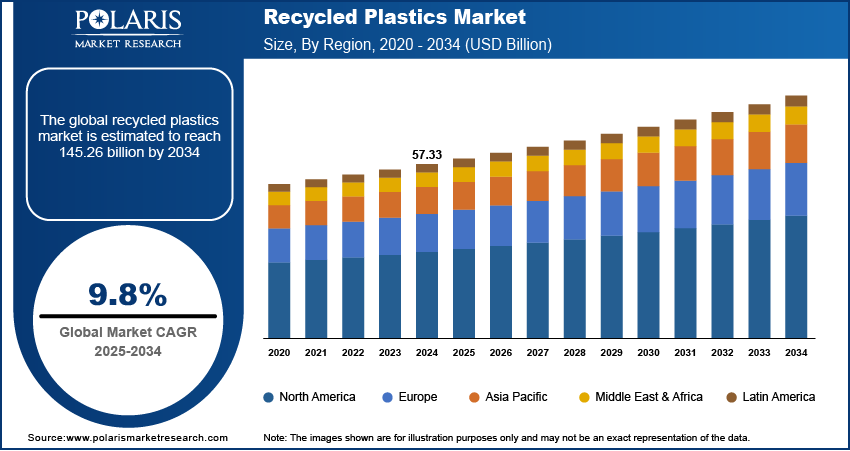
To Understand More About this Research:Download Sample Report
Recycled plastics involve reusing and recovering plastic waste to produce functional, valuable products. They are obtained by sorting and cleaning plastic waste, then identifying, extruding, and reprocessing. The recycled plastic material is typically in the form of recycled plastic flakes or pellets, and its suitability depends on the effectiveness of sorting, cleaning, or processing. The use of recycled plastic, such as in food packaging, bottles, or textiles, is determined by the effectiveness of sorting, cleaning, or processing the material. The process of recycling uses mechanical recycling, especially for bottles, whereas chemical recycling is used for difficult-to-recycle materials.
Several countries around the world are introducing incentives to promote the adoption of recycled plastics. In January 2021, the E.U. announced a plastic tax on non-recycled plastic packaging. The U.K. also introduced a charge on plastic packaging that does not contain 30% recycled content by April 2022. Similar legislation has come into force in the U.S. as well, with California at the forefront of recycled plastic adoption. California has announced a minimum of 15% recycled plastic for PET bottles, which came into effect in 2022. Such developments are encouraging companies to use different types of materials to help meet various regulatory requirements.
The growth is driven by rising government incentives for the adoption of recycled plastic, rising demand from end-use industries, and advancements in recycling technologies that improve yields and performance. From a supply perspective, the market is influenced by the availability of post-consumer recycled (PCR) and post-industrial recycled (PIR) plastics. Firms increasingly prefer PCR plastics, especially when recycled content compliance and brand sustainability goals are priorities.
Types of Recycled Plastics
Common recycled plastic types are PET, HDPE, PP, PS, and PVC. They make up a large part of global plastic use and recycling. Each type has its own benefits in strength, flexibility, chemical resistance, and cost. These features affect how widely they are used in different commercial and industrial applications
| Type | Description | Common Use Cases |
| PET (Polyethylene Terephthalate) | Lightweight, clear plastic widely used in packaging; easily recyclable and strong. | Beverage bottles, food containers, textile fibers (polyester), packaging films |
| HDPE (High-Density Polyethylene) | Strong, durable, and moisture-resistant plastic with high chemical resistance. | Milk jugs, detergent bottles, pipes, crates, recycling bins |
| PP (Polypropylene) | Tough, heat-resistant plastic with good flexibility and fatigue resistance. | Food containers, automotive parts, caps & closures, medical devices |
| PS (Polystyrene) | Lightweight plastic available in rigid or foam form; relatively brittle. | Disposable cups, packaging foam, insulation materials, cutlery |
| PVC (Polyvinyl Chloride) | Dense plastic with strong chemical and weather resistance; can be rigid or flexible. | Pipes, window frames, cables, flooring, synthetic leather |
Source: Polaris Market Research Analysis
What are the applications of Recycled Plastics?
- Packaging Industry
Recycled PET and HDPE are commonly used for bottles, containers, films, and flexible packaging. Sustainability rules and brand commitments to circular economy solutions increase their demand in packaging. - Automotive Industry
Recycled PP, PET, and HDPE are used in interior parts, dashboards, bumpers, seat fabrics, and insulation materials. Using recycled plastics helps lower vehicle weight and achieve sustainability goals. - Construction Industry
Recycled PVC, HDPE, and PP are used in pipes, flooring, insulation panels, roofing materials, and window frames. They are chosen for their durability, weather resistance, and long lifespan. - Consumer Goods Industry
Recycled plastics are used for household items, furniture, storage containers, textiles, and electronics casings. These types of plastics are cost-effective. They meet the growing demand from eco-conscious consumers.
Benefits vs Challenges of Recycled Plastics
Benefits
- Environmental Sustainability: It reduces plastic waste in landfills and oceans. It supports goals for a circular economy.
- Lower Carbon Footprint: Needs less energy than producing virgin plastic. This lowers greenhouse gas emissions.
- Cost Efficiency: It provides cost benefits over virgin materials, especially when purchased in bulk.
- Regulatory Compliance: It helps companies meet EPR mandates and targets for recycled content.
- Brand Value: It improves the corporate sustainability image and meets the increasing consumer demand for eco-friendly products.
Challenges
- Quality Degradation: Mechanical recycling can weaken material strength and performance over multiple cycles.
- Contamination Issues: Mixed or uncleaned waste streams can harm recyclability and the quality of the end product.
- Limited Infrastructure: Lack proper collection, sorting, and processing facilities.
- High Cost of Advanced Recycling: Chemical recycling technologies are still costly and require a lot of energy.
- Regulatory Complexity: Manufacturers must comply with different global standards and certifications. It makes manufacturing time-consuming
Industry Dynamics
Growth Drivers
Recycled plastics are used in packaging, automotive, construction, textiles, electrical & electronics, and other major applications. The expansion of these end-use industries worldwide is driving demand, fueled by corporate circular-economy programs and the growing pressure to control lifecycle emissions. The demand is also rising as most customers switch to recycled resins for non-food packaging and long-lasting products, where performance demands can be met with PCR blends. At the same time, advances in washing, sorting, and decontamination technologies continue to expand the addressable feedstock pool and improve recycled plastic quality. All of this contributes to adoption in higher-value applications and fuels the recycled plastics market.
Environmental Impact & Regulations
Recycled plastics significantly reduce environmental impact. Their use helps lower landfill waste, conserve natural resources, and cut greenhouse gas (GHG) emissions. Mechanical recycling, in particular, requires less energy. However, chemical recycling helps manage complex plastic waste. Challenges like contamination, downcycling, and emissions from processing remain issues. Governments enforce strict regulations. It includes plastic waste management rules, extended producer responsibility (EPR), and recycled content requirements. Policies support circular economy practices and ban single-use plastics. Some governments offer incentives to build recycling infrastructure. This encourages industries to use recycled plastics
Source: Polaris Market Research Analysis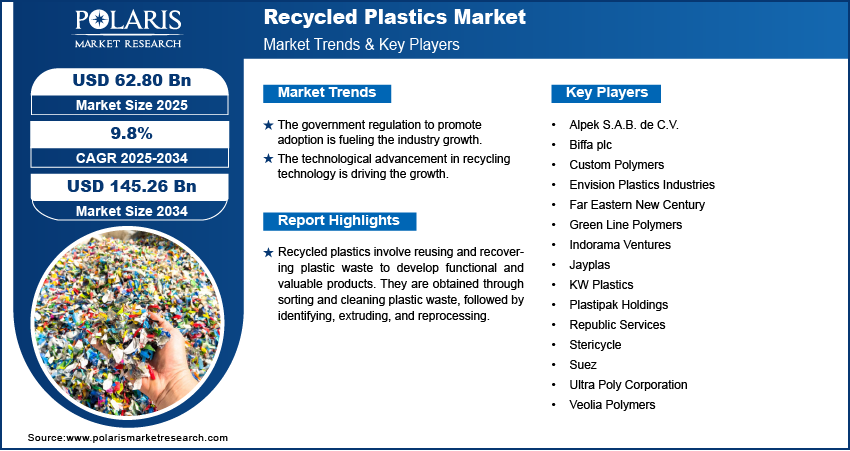
Report Segmentation
By Type Insights
Based on type, the recycled plastics market has been segmented into polyethylene (PE), polyvinyl chloride (PVC), polyethylene terephthalate (PET), polypropylene (PP), polystyrene (PS), and others. The polyethylene terephthalate segment is expected to grow significantly during the forecast period due to its use in food packaging and bottles. PET is transparent, durable, light, and completely recyclable. Growth is strongly supported by bottle-to-bottle rPET schemes and recycled-content strategies. This is driving the expansion of recycled PET packaging in the drinks and FMCG sectors. In food contact applications, pure food-grade materials demand higher standards of quality and traceability. This has led to increased interest in sophisticated decontamination processes and high-grade rPET materials.
By Source Insights
By source, the market is segmented into foams, films, bottles, fibers, and others. The bottles segment accounts for a major market share owing to its easy availability and efficient collection network. Bottles are widely used in the packaging of water, carbonated drinks, medicines, and pharmaceuticals, among others, making it easier to sort and recycle. Bottles allow for a higher-value recycling process because the raw materials used to manufacture PET and HDPE bottles are standardized. Recycling of plastic films has tremendous growth potential. However, it requires advanced collection and sorting infrastructure to be cost-effective.
By Processing Technology Insights
By processing technology, The mechanical recycling segment dominated the market with 70.74% revenue share in 2025. Mechanical recycling is the most common and affordable method. It includes sorting, cleaning, shredding, melting, and re-extrusion. It is most effective for relatively clean, single-polymer waste streams, such as PET and HDPE. However, processing the material several times can lower its quality. This limitation affects its use in high-performance applications
The chemical recycling segment is expected to register a significant CAGR of 8.9% during the forecast period. Chemical recycling technology breaks down plastic waste into monomers or basic chemicals. It uses processes like pyrolysis, depolymerization, and gasification. This method works well for mixed, contaminated, or hard-to-recycle plastics. These include multilayer packaging and certain types of PP, PS, and PVC. Chemical recycling allows for the production of materials that are nearly as good as new. Thus, it is more expensive and energy-intensive. The segment reports limited large-scale commercialization compared to mechanical recycling
By End-Use Insights
Based on end-use, the global recycled plastics market is segmented into packaging, automotive, construction, textile, electrical & electronics, and others. The packaging segment led the market in 2025 because it remains a significant driver of demand, particularly in the food and beverage, FMCG, and e-commerce packaging industries. The packaging segment maintains its market leadership because recycled-content regulations and brand sustainability objectives drive customers to choose rPET and recycled polyolefins as their preferred materials. In May 2022, Trioworld partnered with Lidl Sweden to introduce post-consumer recycled (PCR) plastic film for frozen food packaging. Such initiatives show how retailers have started adopting post-consumer recycled content through initiatives that reduce the environmental impact of packaging.
Source: Polaris Market Research Analysis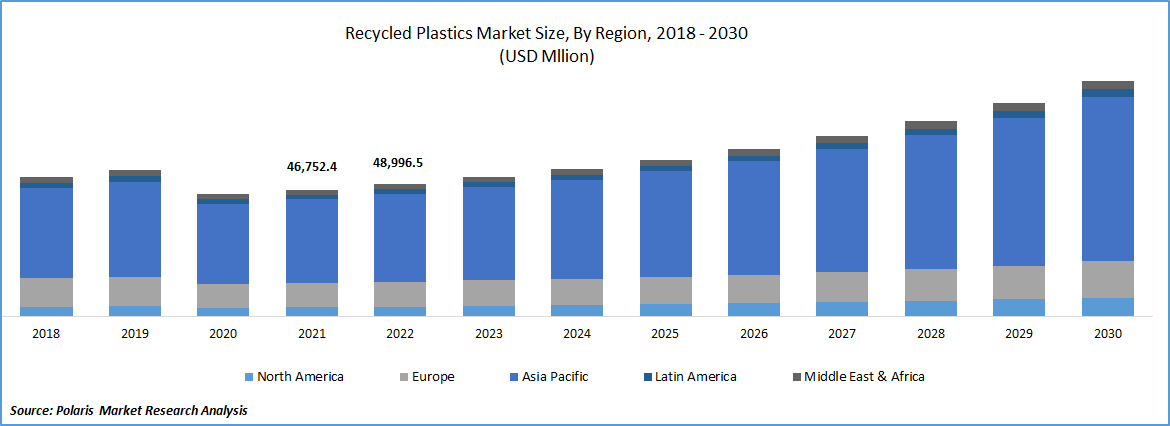
Regional Insights
The Asia Pacific recycled plastics market dominated the global market in 2025, driven by economic growth, industrialization, and support from urbanization. The increased use of plastics in the manufacturing industry, automotive penetration, and growing adoption in construction and developmental activities are factors that are boosting the industry in the Asia Pacific. The construction of residential & commercial projects, coupled with infrastructural developments, is another factor that is enhancing the growth of the industry in the Asia Pacific region. Environmental concerns and developmental efforts to promote sustainable practices have enhanced the market development in the region. In September 2021, India introduced a "plastics pact." This is an initiative undertaken by the country to encourage businesses to contribute to a circular plastics economy. The scale of the region is further supported by higher collection volumes, expanded capacity for recycling, and supportive policies across major markets. All these, taken together, enhance feedstock availability and increase downstream recycled polymers demand.
North America is expected to experience significant growth during the forecast period, driven by increasing government incentives and initiatives. The government in the region has implemented laws such as Extended Producer Responsibility (EPR) in some U.S. states. This law offers incentives for plastic recycling. Moreover, investment in recycling facilities is rising. This investment is mainly through government bodies and private capital. Furthermore, the region has one of the most mature industrial bases for the automotive, packaging, and construction sectors. This large industrial base fuels demand for recycled plastics across a wide range of applications, thereby driving regional growth. Growth is also fueled by higher private-sector investment in recycling facilities and by demand from the packaging and durable goods sectors seeking to fulfill their recycled-content commitments.
Source: Polaris Market Research Analysis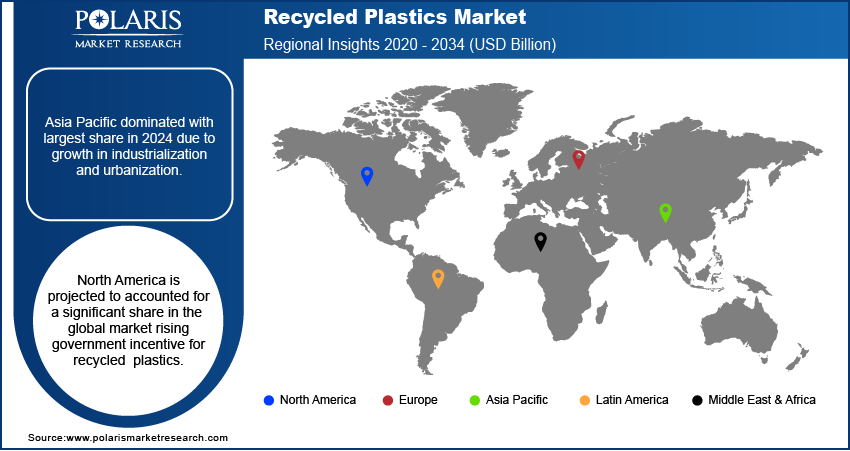
Which Country is Expected to Register the Highest CAGR?
The India recycled plastics market is expected to record the highest CAGR during 2026–2034. Rapid urbanization and the growing demand for packaged goods are boosting industry growth. Government incentives and support schemes, such as subsidies and grants, for recycling infrastructure also fuel the adoption of recycled plastics. Increasing awareness of plastic pollution drives the demand for plastic recycling. Further, rising plastic waste prompts market players to invest in innovating collection and sorting methods. They also focus on setting up recycling units across the country. The following tables list the investments required to set up PET and polyolefin recycling units. (These investments exclude maintenance and operational costs):
Cost of setting up recycling unit (PET Washing) (10TPD)
| Particulars | Cost (USD) | Assumptions |
| Land (leased) | 49,000 | 50,000 sq. ft. |
| Shed | 153,000 | 15,000 sq. ft. |
| Machinery | 245,000 | Indian make |
| Electricity | 37,000 | Lease line (Private transformer) |
| Effluent Treatment Plant | 31,000 | 20 kl |
Source: Polaris Market Research Analysis
*Land cost varies according to location and region
Cost of setting up recycling unit (Polyolefins) (10TPD)
| Particulars | Cost (USD) | Assumptions |
| Land (leased) | 12,000 | 10,000 sq. ft. |
| Shed | 37,000 | 10,000 sq. ft. |
| Machinery | 85,000 | Indian make |
| Electricity | 2,400 | Private transformer |
| ETP | 1,200 | Direct line to CETP |
Source: Polaris Market Research Analysis
(Source of both tables: Landscape Assessment of Plastic Recycling in India, India Plastics Pact)
Competitive Insights
Major players in the recycled plastics market are Alpek S.A.B. de C.V., Biffa plc, Custom Polymers, Envision Plastics Industries, Far Eastern New Century, Green Line Polymers, Indorama Ventures, Jayplas, KW Plastics, Plastipak Holdings, Republic Services, Stericycle, Suez, Ultra Poly Corporation, and Veolia Polymers. These prominent market players are launching new products to address growing environmental concerns. Collaboration with private and public organizations enables entering new markets and exploring advanced technologies.
List of Key Companies
- Alpek S.A.B. de C.V.
- Biffa plc
- Custom Polymers
- Envision Plastics Industries
- Far Eastern New Century
- Green Line Polymers
- Indorama Ventures
- Jayplas
- KW Plastics
- Plastipak Holdings
- Republic Services
- Stericycle
- Suez
- Ultra Poly Corporation
- Veolia Polymers
Recent Developments
In June 2025, Ineos Olefins & Polymers Europe launched recycled plastic production at its Lavera site, using pyrolysis oil derived from plastic waste, enabling the manufacture of virgin-quality recycled polymers that meet stringent EU packaging and sustainability requirements. (Source: ineos.com)
In March 2025, Versalis, Eni's chemical subsidiary, opened a new plant in Porto Marghera, which produces plastics derived from mechanically recycled materials, in line with the group's circular economy and recycling program. (Source: eni.com)
In February 2025, AZEK Company acquired Northwest Polymers to further enhance recycling capacity in the Pacific Northwest and extend the company's FULL-CIRCLE PVC Recycling program. (Source: azekco.com)
Market Segmentation
By Type Outlook (Revenue, USD Billion, 2021–2034)
- Polyethylene (PE)
- Polyvinyl Chloride (PVC)
- Polyethylene Terephthalate (PET)
- Polypropylene (PP)
- Polystyrene (PS)
- Others
By Source Outlook (Revenue, USD Billion, 2021–2034)
- Foams
- Films
- Bottles
- Fibers
- Others
By Processing Technology Outlook (Revenue, USD Billion, 2021–2034)
- Mechanical Recycling
- Chemical Recycling
- Thermal Recycling
By End-Use Outlook (Revenue, USD Billion, 2021–2034)
- Packaging
- Automotive
- Construction
- Textile
- Electrical & Electronics
- Others
By Regional Outlook (Revenue, USD Billion, 2021–2034)
- North America
- US
- Canada
- Europe
- Germany
- France
- UK
- Italy
- Spain
- Netherlands
- Russia
- Rest of Europe
- Asia Pacific
- China
- Japan
- India
- Malaysia
- South Korea
- Indonesia
- Australia
- Vietnam
- Rest of Asia Pacific
- Middle East & Africa
- Saudi Arabia
- UAE
- Israel
- South Africa
- Rest of Middle East & Africa
- Latin America
- Mexico
- Brazil
- Argentina
- Rest of Latin America
Recycled Plastics Market Report Scope
| Report Attributes | Details |
| Market Size in 2025 | USD 62.80 billion |
| Market Size in 2026 | USD 68.81 billion |
| Revenue Forecast by 2034 | USD 145.26 billion |
| CAGR | 9.8% |
| Base Year | 2025 |
| Historical Data | 2021–2024 |
| Forecast Period | 2026–2034 |
| Quantitative Units | Revenue in USD billion, and CAGR from 2026 to 2034 |
| Report Coverage | Revenue Forecast, Market Competitive Landscape, Growth Factors, and Trends |
| Segments Covered |
|
| Regional Scope |
|
| Competitive Landscape | Recycled Plastics Industry Trend Analysis (2025) Company profiles/industry participants profiling include company overview, financial information, product/service benchmarking, and recent developments |
| Report Format | PDF + Excel |
| Customization | Report customization as per your requirements with respect to countries, regions, and segmentation. |
Source: Polaris Market Research Analysis
Recycled Plastics Market FAQ's
The market for recycled plastics stood at USD 62.80 billion in 2025. The market is projected to reach USD 145.26 billion by 2034.
The recycled plastics industry is projected to account for a CAGR of 9.8% between 2026 and 2034.
A few of the key companies in the market include Alpek S.A.B. de C.V., Biffa plc, Custom Polymers, Envision Plastics Industries, Far Eastern New Century, Green Line Polymers, Indorama Ventures, Jayplas, KW Plastics, Plastipak Holdings, Republic Services, Stericycle, Suez, Ultra Poly Corporation, and Veolia Polymer,
The bottles segment led the recycled plastics market in 2025. This is due to their easy availability and the presence of an efficient collection network.
The polyethylene terephthalate segment is expected to record significant growth. This is due to its use in food packaging and bottles.
Packaging is the largest end-user segment. Food and beverage applications, consumer goods, and growing environmental awareness drive the segment’s dominance.
The most common technologies include mechanical recycling (sorting, cleaning, reprocessing) and advanced chemical recycling methods like pyrolysis.
The automotive industry is increasingly adopting recycled plastics for lightweight components to improve fuel efficiency and meet sustainability regulations.
Download Sample Report of Recycled Plastics Market
Please fill out the form to request a customized copy of the research report.


