
Small Hydropower Market Growth, Size, Demand & Global Report, 2026-2034
REPORT DETAILS
Small Hydropower Market
The global small hydropower market size was valued at USD 2.18 billion in 2025. The market is projected to grow from USD 2.24 billion in 2025 to USD 2.79 billion by 2034, exhibiting a CAGR of 2.82% during 2026–2034.
Market Statistics
Key Takeaways
- Asia Pacific dominated the small hydropower market with 40.0% share in 2025. Growth was supported by strong renewable energy investments and rural electrification programs.
- Europe is expected to witness the fastest growth at a CAGR of 1.49% during 2026–2034. Carbon neutrality goals and favorable renewable energy policies are driving market expansion.
- The micro hydropower segment held the largest market share of 45.0% in 2025. Rising demand for decentralized and off-grid power solutions supported its dominance.
- The up to 1 MW segment accounted for 57.0% share in 2025. Its cost-effectiveness and suitability for rural energy projects increased adoption.
- Micro hydropower remained the dominant type segment with 55.0% market share in 2025. Government funding and technological advancements contributed to segment growth.
Note: Figures and projections outlined in this report are the result of Polaris Market Research’s proprietary analytical processes, grounded in the latest available datasets and market observations.
Industry Dynamics
- Government subsidies, tax incentives, grants, and feed-in tariffs are increasing investments in small hydropower projects globally.
- Supportive renewable energy policies and simplified regulations are encouraging faster development of small hydropower installations.
- Improvements in turbine designs and control systems are increasing efficiency in low-head and low-flow conditions.
- Smart grid integration and digital monitoring technologies are improving energy management and grid stability capabilities.
- High upfront project costs and complex site development requirements remain major challenges for market growth.
What are Small Hydropowers?
Small hydropower refers to the generation of electricity from flowing water on a smaller scale, usually defined as projects with a capacity of up to 50 megawatts (MW). Small hydropower systems harness the kinetic energy of water in rivers, streams, or existing water storage systems, converting it into usable electrical energy with minimal environmental impact. These systems are particularly beneficial in remote or rural areas where access to a national electricity grid may be limited or non-existent. They provide a reliable source of renewable energy, contributing to local energy needs while promoting sustainable development. The installation of small hydropower systems typically involves less civil construction work and utilizes existing structures such as dams or irrigation canals, which reduces costs and environmental disruption.
Increasing investments in renewable energy is propelling the small hydropower market growth. As per the data published by the International Energy Agency, USD 2 trillion was invested in renewable energy technologies and infrastructure in 2024. Increased funding drives governments and businesses to prioritize clean and sustainable energy sources such as on-shore and off-shore wind energy, solar energy, and small hydropower. Small hydropower, with its lower carbon footprint, offers a consistent and scalable option, making it attractive for rural electrification, industrial applications, and grid stability. The increased investment also reduces the capital barriers for small hydropower projects, making them more accessible. Furthermore, advancements in technology and infrastructure, fueled by increased investment, enhance the efficiency and feasibility of small hydropower, making them more appealing to energy planners.
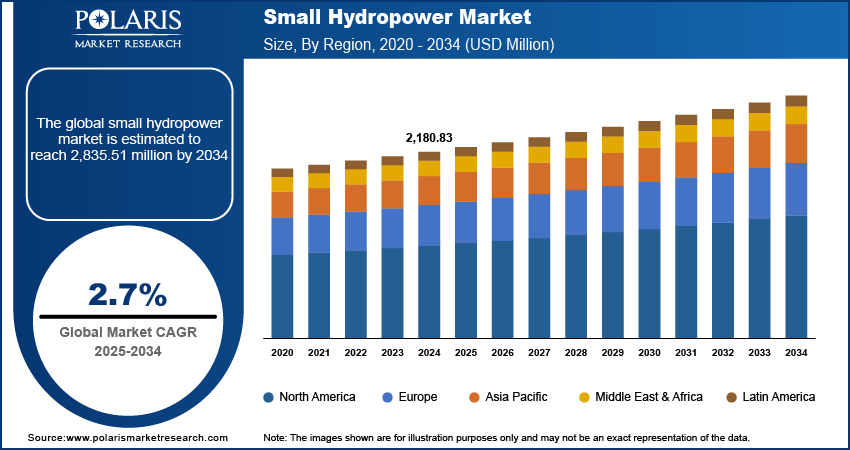
Source: Polaris Market Research Analysis
The small hydropower market demand is driven by the rising rural electrification initiatives. Many rural areas, particularly in developing countries, lack connection to centralized power grids, making decentralized energy solutions such as small hydropower highly attractive. In addition, small hydropower projects are cost-effective in comparison to wind and solar energy, which encourages governments, municipal corporations, and local bodies to invest in these projects to generate reliable and sustainable electricity for rural communities.
Small Hydropower vs Solar vs Wind Energy
| Parameter | Small Hydropower | Solar Energy | Wind Energy |
| Reliability | High with continuous water flow availability | Depends on sunlight availability | Depends on wind conditions |
| Energy Generation Consistency | More consistent and stable power output | Power generation varies during day and weather changes | Power generation fluctuates with wind speed |
| Storage Requirements | Lower need for energy storage in many applications | Often requires battery storage for continuous supply | Frequently requires storage or backup systems |
| Environmental Impact | Low emissions but may affect local water ecosystems | Very low emissions and minimal operational impact | Low emissions but may impact birds and local habitats |
| Operational Cost | Low operating and maintenance costs after installation | Low operating costs with limited maintenance | Moderate maintenance due to moving components |
| Suitability for Remote Areas | Highly suitable where water resources are available | Suitable in areas with adequate sunlight | Suitable in areas with sufficient wind resources |
| Infrastructure Requirement | Requires access to flowing water sources | Requires solar panels and installation area | Requires wind turbines and open land |
| Project Lifespan | Long operational lifespan with proper maintenance | Long lifespan with gradual panel degradation | Long lifespan but turbine components require replacement over time |
Market Dynamics
Growing Supportive Policies Worldwide
Governments and regulatory bodies worldwide are introducing policies such as energy community policy guidelines, UNIDO initiatives for sustainable development, tax incentives, subsidies, grants, and feed-in tariffs to promote renewable energy, including small hydropower. These policies reduce the upfront costs and risks associated with small hydropower projects, making them more attractive to investors and developers. Supportive policies also prioritize the integration of small hydropower into national energy strategies, recognizing its role in achieving renewable energy targets and reducing carbon emissions. Additionally, streamlined approval processes and clear regulatory frameworks help overcome bureaucratic hurdles, accelerating the adoption of small hydropower projects. Therefore, the growing government-supportive policies are fueling the small hydropower market expansion.
Increasing Advancements in Technology
Innovations in turbine design, materials, and control systems have made small hydropower systems more efficient at converting water flow into electricity, even in low-head or low-flow conditions. These improvements allow small hydropower to operate in a wider range of locations, including remote and rural areas, where traditional hydropower systems may not be feasible. Smart power grid integration and digital monitoring technologies further increase the appeal of small hydropower by enabling better management of energy output and grid stability. These technologies allow small hydropower systems to seamlessly integrate with other renewable energy sources, enhancing their reliability and contribution to energy mixes. Additionally, advancements in modular and prefabricated small hydropower systems reduce installation time and costs, making them more attractive to energy planners, municipal corporations, and local bodies.
Emerging Innovations in Small Hydropower
Small hydropower technologies are becoming more efficient and easier to deploy. Fish-friendly turbines help reduce the impact on aquatic life. AI-powered monitoring systems support real-time performance tracking and operation management. Modular hydropower systems lower installation costs and simplify project development. Hybrid hydro-solar projects improve renewable energy generation and power reliability. Predictive maintenance technologies help detect equipment issues early and reduce downtime.
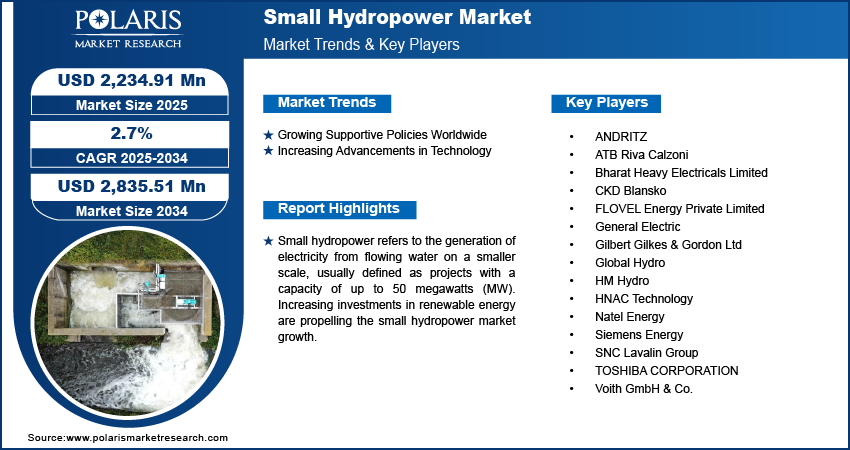
Source: Polaris Market Research Analysis
Segment Insights
Market Evaluation by Type Insights
Based on type, the small hydropower market is divided into micro hydropower and mini hydropower. The micro hydropower segment dominated the small hydropower market share of 45.0% in 2025 due to the rising demand for decentralized and low-cost renewable energy solutions. Rural electrification initiatives, particularly in developing nations, have increased the adoption of micro hydropower due to its suitability for small rural communities and agricultural applications. Many governments and international organizations continue to fund micro hydropower projects to provide reliable electricity in off-grid locations. Technological innovations, including compact and modular turbine designs, have made installation and maintenance of micro hydropower more affordable and efficient. Growing environmental concerns also contribute to rising demand, as micro hydropower projects have minimal ecological impact and require fewer infrastructure modifications.
Market Assessment by Capacity Insights
In terms of capacity, the small hydropower market is segregated into up to 1 MW and 1- 10 MW. The upto 1MW segment dominated the market with 57.0% share in 2025 due to its versatility, cost-effectiveness, and suitability for decentralized energy systems. The ability of 1 MW small hydropower systems to cater to small communities, rural electrification projects, and industrial applications without requiring extensive infrastructure or large water resources has contributed to its wide adoption. The 1 MW systems are particularly attractive in developing regions, where they provide a reliable and sustainable energy solution for off-grid and remote areas. Additionally, governments and organizations have prioritized these smaller-scale projects due to their lower environmental impact, shorter development timelines, and ability to leverage local water resources efficiently. Supportive policies, such as subsidies and feed-in tariffs, have further accelerated the adoption of 1 MW systems.
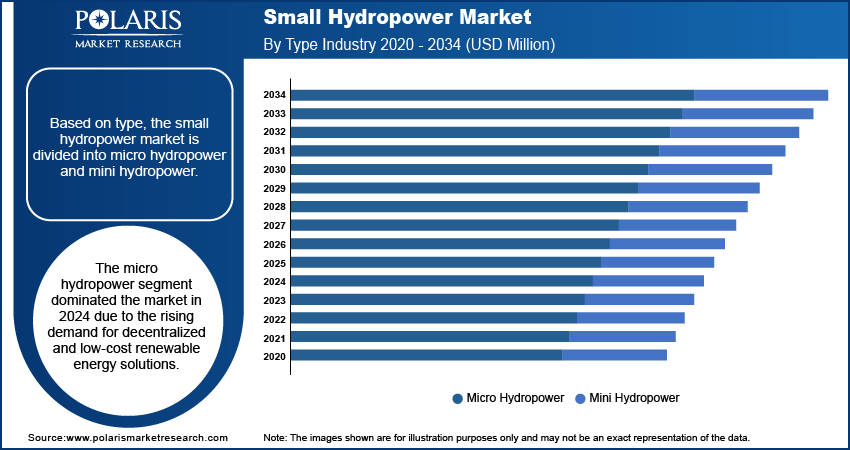
Source: Polaris Market Research Analysis
Regional Analysis
By region, the report provides the small hydropower market insights into North America, Europe, Asia Pacific, Latin America, and the Middle East & Africa. Asia Pacific dominated the small hydropower market share of 40.0% in 2025 due to its vast untapped water resources, rapid urbanization, and strong government support for renewable energy. Countries such as China and India dominate the region owing to their extensive investments in clean energy infrastructure and renewable energy. The region’s focus on rural electrification and energy access in remote areas has fueled the adoption of small-scale hydropower systems, particularly in hilly and mountainous regions where water resources are abundant. Additionally, favorable policies, such as subsidies, tax incentives, and streamlined regulatory approvals, have encouraged both public and private sector participation, making Asia Pacific the dominant region in the small hydropower market.
The market in Europe is estimated to grow at a rapid pace of 1.49% during the forecast period, owing to its commitment to achieving carbon neutrality and reducing reliance on fossil fuels. The European Union’s stringent renewable energy targets and supportive regulatory frameworks, such as the Green Deal and national renewable energy action plans, are accelerating the deployment of small-scale hydropower projects. Norway is estimated to hold the largest market share within Europe due to its extensive expertise in hydropower technology and its focus on modernizing existing infrastructure to improve efficiency. The region’s emphasis on sustainability, coupled with advancements in turbine technology and environmental monitoring, drives demand for small hydropower projects, thereby contributing to the Europe small hydropower market expansion.
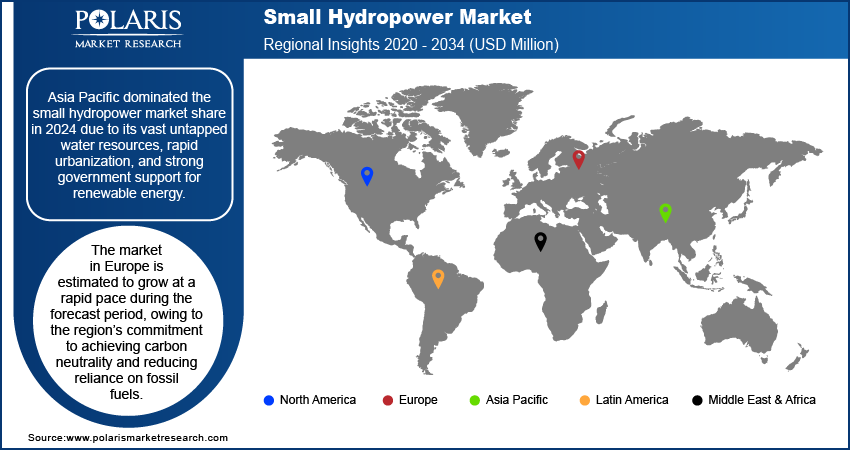
Source: Polaris Market Research Analysis
Key Players and Competitive Insights
Major market players are investing heavily in research and development in order to expand their offerings, which will help the small hydropower market grow even more. These market participants are also undertaking a variety of strategic activities to expand their global footprint, with important market developments including innovative launches, international collaborations, higher investments, and mergers and acquisitions between organizations.
The small hydropower market is fragmented, with the presence of numerous global and regional market players. Major players in the market include ANDRITZ, ATB Riva Calzoni, Bharat Heavy Electricals Limited, CKD Blansko, FLOVEL Energy Private Limited, General Electric, Gilbert Gilkes & Gordon Ltd, Global Hydro, HM Hydro, HNAC Technology, Natel Energy, Siemens Energy, SNC Lavalin Group, TOSHIBA CORPORATION, and Voith GmbH & Co.
ANDRITZ is a global supplier of plants, equipment, and services for hydropower stations, the pulp and paper industry, metalworking and steel industries, and solid/liquid separation in municipal and industrial sectors. ANDRITZ Hydro provides electromechanical equipment and services for hydropower plants. The company has a global presence with over 250 production locations. The company also provides services for small hydropower projects, which include project management, engineering, manufacturing, quality control, installation, and commissioning, and training and site measurement.
Bharat Heavy Electricals Limited, established in 1964, is a premier public sector enterprise in India, primarily engaged in the engineering and manufacturing of equipment for various sectors, including power generation, transmission, and renewable energy. The company has a diverse portfolio that includes thermal, hydro, gas, nuclear, and solar power generation technologies. BHEL's small hydropower offerings include a variety of turbine and micro turbine types, such as Pelton, Francis, and Kaplan turbines, which are suitable for different site conditions and water flow rates. BHEL also provides services for the modernization and upgrading of existing small hydro plants to enhance their efficiency and output.
List of Key Companies
- ANDRITZ
- ATB Riva Calzoni
- Bharat Heavy Electricals Limited
- CKD Blansko
- FLOVEL Energy Private Limited
- General Electric
- Gilbert Gilkes & Gordon Ltd
- Global Hydro
- HM Hydro
- HNAC Technology
- Natel Energy
- Siemens Energy
- SNC Lavalin Group
- TOSHIBA CORPORATION
- Voith GmbH & Co.
Small Hydropower Industry Developments
- May 2026: India's Ministry of New and Renewable Energy approved the Small Hydro Power Development Scheme with a target to add 1,500 MW of small hydropower capacity over five years. (Source: pib.gov.in)
- April 2026: DIVE-Turbine and Natel Energy announced a new fish-friendly small hydropower project in France using advanced DIVE–Natel turbine technology. (Source: dive-turbine.de)
-
March 2026: Natel Energy released new research validating its FishSafe™ turbine technology for environmentally sustainable hydropower generation. (Source: natelenergy.com)
Small Hydropower Market Segmentation
By Type Outlook (Revenue, USD Billion, 2021–2034)
- Micro Hydropower
- Mini Hydropower
By Capacity Outlook (Revenue, USD Billion, 2021–2034)
- Up to 1 MW
- 10 MW
By Component Outlook (Revenue, USD Billion, 2021–2034)
- Turbine
- Generator
- Electric Infrastructure
- Intake Valves and Penstock
- Others
By Regional Outlook (Revenue, USD Billion, 2021–2034)
- North America
- US
- Canada
- Europe
- Germany
- France
- UK
- Italy
- Spain
- Netherlands
- Russia
- Rest of Europe
- Asia Pacific
- China
- Japan
- India
- Malaysia
- South Korea
- Indonesia
- Australia
- Vietnam
- Rest of Asia Pacific
- Middle East & Africa
- Saudi Arabia
- UAE
- Israel
- South Africa
- Rest of Middle East & Africa
- Latin America
- Mexico
- Brazil
- Argentina
- Rest of Latin America
Small Hydropower Market Report Scope
| Report Attributes | Details |
| Market Size Value in 2024 | USD 2.18 Billion |
| Revenue Forecast in 2026 | USD 2.24 Billion |
| Revenue Forecast by 2034 | USD 2.79 Billion |
| CAGR | 2.82% from 2026 to 2034 |
| Base Year | 2025 |
| Historical Data | 2021– 2024 |
| Forecast Period | 2026 – 2034 |
| Quantitative Units | Revenue in USD Billion and CAGR from 2026 to 2034 |
| Report Coverage | Revenue Forecast, Market Competitive Landscape, Growth Factors, and Trends |
| Segments Covered |
|
| Regional Scope |
|
| Competitive Landscape |
|
| Report Format |
|
| Customization | Report customization as per your requirements with respect to countries, regions, and segmentation. |
Source: Polaris Market Research Analysis
Small Hydropower Market FAQ's
The global small hydropower market size was valued at USD 2.18 billion in 2025 and is projected to grow to USD 2.79 billion by 2034.
The global market is projected to register a CAGR of 2.82% during the forecast period.
Asia Pacific dominated the small hydropower market with 40.0% share in 2025.
Some of the key players in the market are ANDRITZ, ATB Riva Calzoni, Bharat Heavy Electricals Limited, CKD Blansko, FLOVEL Energy Private Limited, General Electric, Gilbert Gilkes & Gordon Ltd, Global Hydro, HM Hydro, HNAC Technology, Natel Energy, Siemens Energy, SNC Lavalin Group, TOSHIBA CORPORATION, and Voith GmbH & Co.
The micro hydropower segment held the largest market share of 45.0% in 2025.
Electricity generation from flowing water at smaller scale, typically up to 50 MW capacity, harnessing kinetic energy from rivers or streams with minimal environmental impact, ideal for remote and rural electrification.
Rising renewable energy investments, growing rural electrification initiatives, increasing supportive government policies, advancements in turbine technology, smart grid integration, and expanding modular hydropower systems driving global market growth steadily.
Download Sample Report of Small Hydropower Market
Please fill out the form to request a customized copy of the research report.


