
Wearable AI Market Size, Share, Trends & Forecast, 2026-2034
REPORT DETAILS
Wearable AI Market Summary
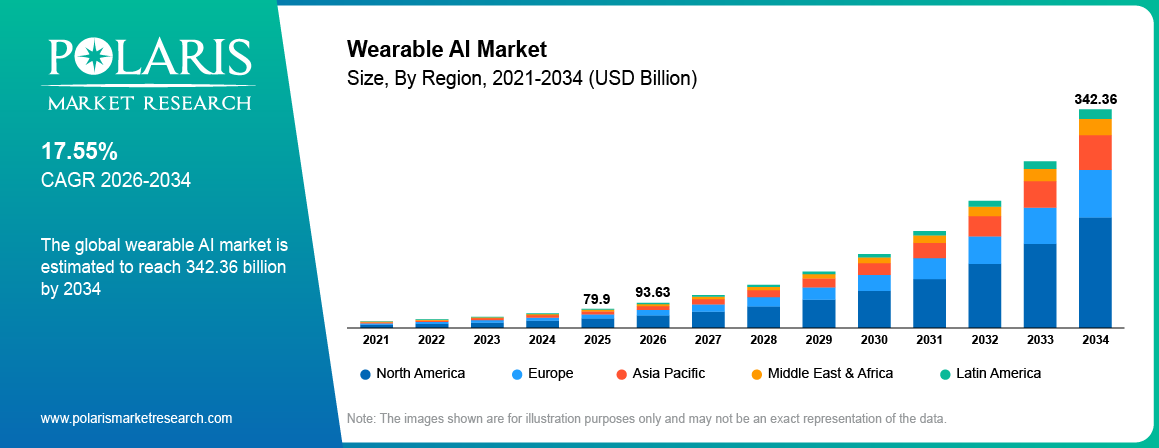
Wearable AI Market size was valued at USD 79.9 billion in 2025. The market is anticipated to grow from USD 93.63 billion in 2026 to USD 342.36 billion by 2034, exhibiting the CAGR of 17.55% during the forecast period.
Market Statistics
Wearable AI Market Key Takeaways
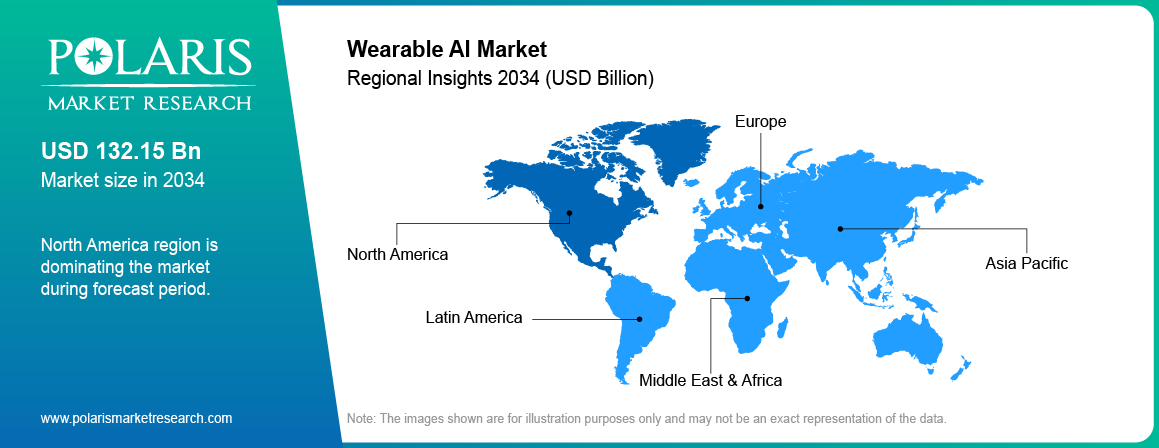
- North America held the largest market share of 38.6% in 2025 and is expected to dominate over the forecast period. The dominance is attributed to increasing adoption of technology in the region.
- Asia Pacific is projected to grow at a CAGR of 18.9% from 2026 to 2034. The growth is attributed to increasing digital healthcare and electronics manufacturing industry.
- The smartwatch segment dominated the market with 46.3% market share in 2025. The growth of the segment is driven by increasing demand for health and fitness tracking. It remained the leading product segment.
- The smart earwear segment is projected to grow at a CAGR of 20.4% from 2026 to 2034. Growth is attributed to increasing adoption of AI-enabled audio devices.
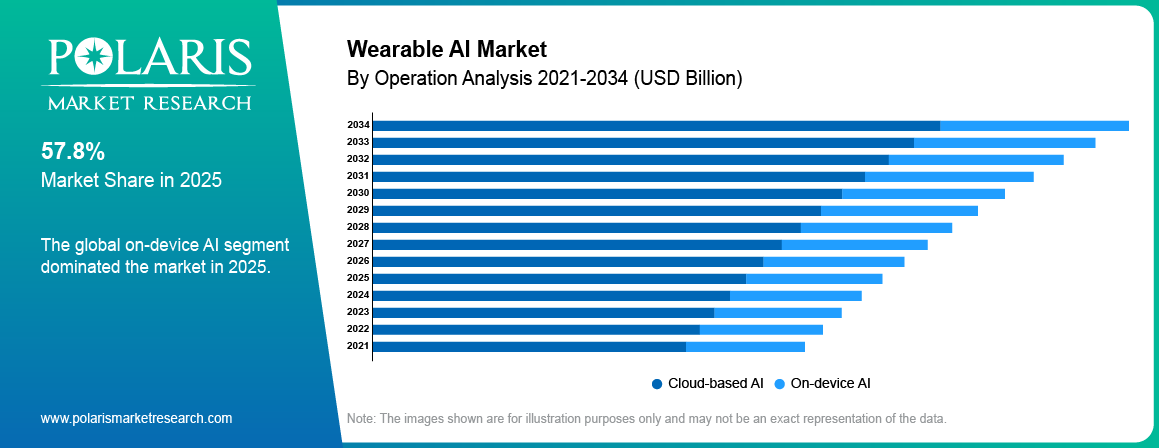
- On-device AI segment captured 57.8% market share in 2025, due to better privacy and faster processing. It remained the leading operation segment.
- The consumer electronics segment is projected to register a CAGR of 19.6% during 2026 to 2034. Rising demand for AI enabled wearables supports its growth.
Note: Figures and projections outlined in this report are the result of Polaris Market Research’s proprietary analytical processes, grounded in the latest available datasets and market observations.
Industry Dynamics
- Growing demand for health and fitness monitoring is increasing the use of AI-powered wearable devices.
- Ongoing improvements in AI, sensors, and compact device design are supporting market growth.
- The increasing adoption of wearable AI in healthcare is boosting the growth of remote patient monitoring and daily health monitoring.
- The rising demand for smart wearable devices with advanced features is driving the adoption of products.
- The growth of the market is hampered by privacy and data security concerns due to the risks associated with personal and health data.
Generative AI in Wearables: Personal Assistants, Health Coaching, Multimodal Sensing & On-Device Intelligence
- Enables personalized digital assistants to recognize user habits and daily routines.
- Improves voice interactions through natural and more accurate conversations.
- Based on user activity, location, and preferences AI provides smart recommendations.
- AI boosts productivity and helps keep users engaged with timely reminders and helpful suggestions.
Source: Polaris Market Research Analysis
To Understand More About this Research: Download Sample Report
What Is Wearable AI? Devices, AI Processing, Sensors & Applications
The wearable AI market refers to the industry focused on devices equipped with artificial intelligence that can collect and analyze real-time user data. These devices, including smartwatches, smart glasses, fitness trackers, hearing devices, and healthcare wearables. To improve everyday convenience and user experience they provide personalized insights, health monitoring, communication, automation, and decision support.
How Does Wearable AI Work? Sensors, Edge AI, Cloud Models & Personalized Insights
With the help of built-in sensors wearable AI devices collect real-time data that monitor metrics such as heart rate, movement, sleep, and physical activity. The collected information is processed using AI and machine learning to identify patterns and generate meaningful insights.
Based on this analysis the device provides tailored suggestions, health warnings and activity news. The data can be synchronized to smart phones or cloud services for easy reference and long-term monitoring. Ongoing data collection helps in increasing precision and improves the general functioning of the device as time goes on.
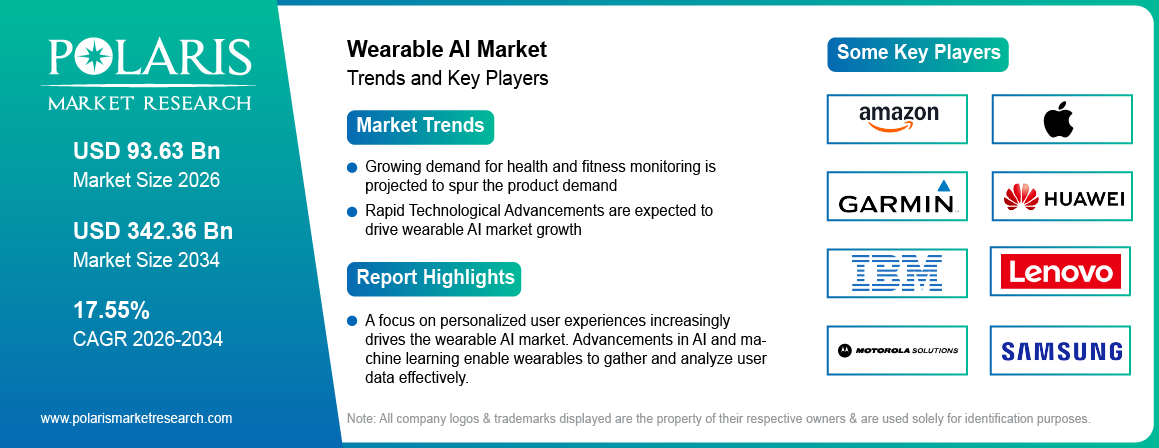
A focus on personalized user experiences increasingly drives the wearable AI market. Advancements in AI and machine learning enable wearables to gather and analyze user data effectively. By understanding user behavior and preferences, these devices provide tailored recommendations and insights. Whether for fitness tracking, health monitoring, or virtual assistance, users expect personalized solutions to meet their specific needs and goals. This emphasis on personalization enhances user satisfaction, driving greater engagement and loyalty. Manufacturers are investing in research and development to create innovative wearable AI solutions that deliver customized experiences to each user, catering to the growing demand for personalized interactions.
In addition, companies operating in the market are introducing new products to expand market reach and strengthen their presence.
- For instance, in November 2023, Humane Inc. introduced its AI Pin, marking the debut of a wearable device and software platform designed to maximize artificial intelligence (AI) capabilities. The AI Pin aims to elevate personal consumer technology, granting users unprecedented access to AI in a novel, conversational, and screen-free design.
Integration with smartphones and IoT ecosystems is further driving growth in the wearable AI market. Wearable devices seamlessly connect with smartphones, providing users with easy access to health data and personalized insights through dedicated mobile apps. Moreover, wearables play a vital role in the broader IoT ecosystem, enabling interoperability with other smart devices like smartwatches and fitness trackers. This interconnectedness allows for holistic health management, where data from various sources can be analyzed to provide comprehensive insights. As consumers increasingly embrace connected technologies for health monitoring and lifestyle management, the integration with smartphones and IoT ecosystems fuels innovation and adoption in the wearable AI market.
Traditional Wearables vs. AI Wearables
| Feature | Traditional Wearables | AI Wearables |
| Data | Collects basic health data | Collects and studies data |
| Personalization | Offers limited customization | Adjusts features and recommendations based on user habits |
| Insights | Shows recorded information | Gives useful suggestions |
| Automation | Performs basic functions like tracking and alerts | Handles more tasks automatically with less user effort |
| User Experience | Responds after user input | Responds based on user activity |
Source: Polaris Market Research Analysis
Market Dynamics
Growing demand for health and fitness monitoring is projected to spur the product demand.
The wearable AI market is growing due to the growing demand for health and fitness monitoring solutions. Consumers increasingly rely on wearable devices with AI capabilities to track vital health metrics like heart rate, sleep patterns, and activity levels in real time. These devices offer personalized insights and recommendations, empowering users to improve their overall well-being. Advancements in sensor technology and connectivity have made wearable AI devices more accessible and user-friendly. With a focus on personal health and wellness, the wearable AI market is poised for substantial growth as consumers seek innovative solutions to monitor and optimize their fitness goals and lifestyle habits.
Rapid Technological Advancements are expected to drive wearable AI market growth.
Rapid technological advancements are driving growth in the wearable AI market. These advancements encompass hardware miniaturization, increased computing power, enhanced sensor capabilities, and advanced machine-learning algorithms. Miniaturization enables sleeker and more comfortable wearable designs, boosting consumer adoption. Improved computing power allows wearables to perform complex tasks and real-time analyses across diverse applications like healthcare, fitness tracking, and augmented reality. Enhanced sensors collect a wider range of data with greater accuracy, providing valuable insights. Advanced machine learning algorithms personalize wearables, adapting to users' preferences over time.
Wearable AI Supporting Elderly Care
In improving elderly care by supporting continuous health monitoring and independent living wearable AI is playing an important role. According to the World Health Organization (WHO), 28–35% of people aged 65 years and older experience a fall each year. This will increase the need for wearable devices with fall detection and emergency alert features. The devices also give medication reminders and allow caregivers to monitor health remotely. Real-time monitoring can identify health changes early and provide timely medical attention. Wearable AI is emerging as an important solution to improve safety as the world’s aging population continues to grow (Source: www.who.int).
Industrial and Workplace Safety Applications
By helping companies monitor worker health and job site conditions in real time wearable AI is improving workplace safety. These devices can detect worker fatigue, identify workplace hazards, and monitor environmental conditions such as temperature and air quality. They also help companies to monitor workforce productivity and support occupational health management. Around 3 million workers die every year from occupational accidents and diseases as per the International Labour Organization (ILO) reports. This shows the importance of safe workplaces. Wearable AI reduces such risks, allows for worker safety and helps create safer work environments (Source: www.ilo.org).
Source: Polaris Market Research Analysis
Industry Challenges
Privacy and data security concerns are likely to impede wearable AI market growth.
Privacy and data security concerns present obstacles to the growth of the wearable AI market. These devices collect sensitive user data, including health information and location data, raising fears of breaches and misuse. Dependence on cloud-based platforms further heightens security risks. Additionally, worries about data privacy and ownership deter some users from adopting wearable AI technologies. Manufacturers must implement robust security measures like encryption and user consent mechanisms to address these concerns. Compliance with data protection regulations, such as GDPR, is also crucial for gaining consumer trust.
Wearable AI Market Segmentation Analysis
The wearable AI market analysis is primarily segmented based on product, operation, application, and region.
| By Product | By Operation | By Application | By Region |
|
|
|
|
Source: Polaris Market Research Analysis
By Product Analysis
The smartwatch segment dominated the market with 46.3% market share in 2025. Smartwatches offer diverse functionalities like fitness tracking and mobile payments. Their compact design enables convenient access to AI-powered features directly from the wrist. Additionally, smartwatches are popular for health and fitness tracking, integrating heart rate monitoring and activity tracking. Seamless integration with smartphones, coupled with stylish designs, broadens their consumer base. Continuous technological advancements, such as improved sensors and longer battery life, further drive adoption and consumer interest in smartwatches.
By Operation Analysis
The On-device AI segment captured 57.8% market share in 2025. It enables real-time data processing directly on the device, eliminating the need for constant internet connectivity and reducing latency. This is crucial for applications like health monitoring and gesture recognition, demanding immediate feedback. On-device AI enhances privacy and security by minimizing data transmission over networks, appealing to privacy-conscious consumers and enterprises. It improves user experience by ensuring consistent functionality even in areas with limited connectivity. Additionally, local processing consumes less power, extending battery life. Reduced dependence on cloud services makes wearable devices more versatile and independent, appealing to users seeking standalone functionality.
By Application Analysis
The consumer electronics segment is projected to register a CAGR of 19.6% during 2026 to 2034.High consumer demand for wearable AI devices like smartwatches and fitness trackers, driven by their functionality and convenience, contributes to this dominance. Continuous technological advancements, including miniaturization and improved sensors, enhance the appeal and accessibility of these devices. Health and fitness tracking features, stylish designs, and seamless integration with smartphones further attract consumers. Effective marketing strategies and branding efforts by leading companies in the consumer electronics industry also play a crucial role in driving sales and market share.
Wearable AI Use Cases: Health Monitoring, Fitness Coaching, Navigation, Hearing, Safety & Remote Care
| Use | Examples |
| Heart rate monitoring | Smartwatches check heart rate during daily activities and exercise. |
| Sleep tracking | Wearables record sleep duration and sleep quality. |
| Fitness coaching | AI recommends workouts based on activity levels. |
| Glucose monitoring | Continuous glucose monitors (CGMs) track blood sugar levels in real time. |
| Fall detection | Smartwatches detect falls and send alerts to family members or caregivers. |
| AI-powered hearing assistance | Smart hearing aids make speech clearer by reducing background noise. |
| Smart navigation | AI glasses provide directions while walking or traveling. |
| Workplace safety monitoring | Wearables monitor worker fatigue and unsafe conditions. |
| Athlete performance tracking | Sports wearables track heart rate, speed, and recovery. |
| Remote patient monitoring | Wearables share health data with healthcare providers for regular monitoring. |
Source: Polaris Market Research Analysis
Source: Polaris Market Research Analysis
Wearable AI Market by Region
North America held the largest market share of 38.6% in 2025. The region serves as a hub for technological innovation, fostering the development of cutting-edge wearable AI devices. Consumers in North America are early adopters of new technologies, driving widespread adoption of wearable AI devices. Additionally, the region's robust healthcare sector promotes the use of wearable AI devices for health monitoring and remote patient care. A supportive regulatory environment encourages innovation and market growth. Moreover, high disposable income levels enable consumers to invest in premium wearable AI devices. The presence of key market players headquartered in North America further strengthens the region's position in the wearable AI market.
Asia Pacific is projected to grow at a CAGR of 18.9% from 2026 to 2034. The region's emerging markets, coupled with rising disposable incomes, create a conducive environment for adoption. Asia-Pacific boasts a thriving technology sector, particularly in countries like China, Japan, and South Korea, which fosters innovation and manufacturing. Rapid urbanization leads to lifestyle changes, driving demand for wearable AI devices for health and fitness tracking. Increasing healthcare expenditures and government initiatives promoting digital healthcare further fuel market growth.
Source: Polaris Market Research Analysis
Wearable AI Competitive Landscape & Leading Device, Platform and AI-Wearable Companies
The wearable AI market encompasses various players, and the anticipated entry of newcomers is set to heighten competition. Market leaders consistently innovate their technologies, focusing on efficiency, reliability, and safety to maintain a competitive edge. They prioritize strategic initiatives such as forming alliances, enhancing product portfolios, and engaging in collaborations. Their objective is to surpass rivals in the sector and secure a notable wearable AI market share.
Some of the major players operating in the global wearable AI market include:
- Amazon.com, Inc.
- Apple
- Garmin Ltd.
- Huawei Technologies Co., Ltd.
- IBM
- Lenovo
- Motorola Solutions, Inc.
- OPPO
- Samsung Electronics Co., Ltd.
- Sony Corporation
- TomTom International B.V.
- Xiaomi Corporation
Challenges in Wearable AI Market
The wearable AI market faces a few key challenges. Wearable devices collect sensitive personal and health data this become privacy and cybersecurity concern. Limited battery life can limit continuous use and data accuracy may depend on the device and user activity. Regulatory approval can slow down product launches in healthcare. In price sensitive markets the high costs of devices can limit adoption. Some users are still worried about data privacy, reliability and trust in AI powered devices.
Wearable AI Market Future Outlook: Smart Glasses, Smart Rings, Edge AI, GenAI & Digital Health
The wearable AI market is expected to grow steadily as artificial intelligence, sensor technology, and digital health solutions continue to improve. Increasing demand for customized healthcare, fitness tracking, and smart wearable devices will drive market growth. Further, advancements in smart glasses, biosensors, and on-device AI will also drive the adoption of wearable AI in health care, consumer electronics, and workplaces. With more and more connected devices, wearable AI will be more and more integrated in our daily life and health management.
Wearable AI Market Developments: AI Glasses, Smartwatches, Smart Rings, Enterprise Wearables & Edge AI
- July 2026: Samsung launched the Galaxy Glasses and Galaxy Watch 9 series at Galaxy Unpacked 2026. The new devices include Gemini AI integration, next-level health monitoring and expanded wearable AI. (Source: news.samsung.com)
- May 2026: Google unveiled its Gemini-powered AI smart glasses at Google I/O 2026. The glasses are powered by an Android XR platform and provide live translation, navigation, messaging and hands-free AI assistance. (Source: blog.google)
- In July 2025, Sony released the WF-C710N true wireless earbuds with active noise cancellation, AI voice pickup for calls, and up to 40 hours of battery life.
- In June 2025, Xiaomi launched the Smart Band with AI fitness tracking, heart rate sharing, 150+ workout modes, personalized recovery, and strong Xiaomi ecosystem support.
- In April 2025, Vuzix acquired a waveguide R&D facility in Milpitas, California, boosting its ability to create lightweight optical solutions for next-gen AI smart glasses for ODM/OEM partners.
- In January 2025, Motorola Solutions signed an agreement to acquire Theatro Labs, Inc., a Texas-based company that makes AI and voice-powered communication and workflow software for frontline workers.
- In January 2025, at CES 2025, 1MORE unveiled its new AI-powered wearables, combining advanced technology with stylish design. The AI Smart Glasses with Camera G70 won a 2025 CES Picks Award. These glasses have HD cameras for easy photo and video capture, plus an AI translator for real-time language translation. The AI Open Earbuds S70 provide real-time multi-language translation, meeting transcription, and AI-enhanced local playback.
Wearable AI Market Report Coverage: Product, Processing Mode, Applications, Regions & Competitive Landscape
The wearable AI market report emphasizes key regions across the globe to provide a better understanding of the product to the users. Also, the report provides market insights into recent developments and trends and analyzes the technologies that are gaining traction around the globe. Furthermore, the report covers an in-depth qualitative analysis pertaining to various paradigm shifts associated with the transformation of these solutions.
The report provides a detailed analysis of the market while focusing on various key aspects such as competitive analysis, products, operations, applications, and their futuristic growth opportunities.
Wearable AI Market Report Scope: Segmentation, Forecast Period & Coverage
| Report Attributes | Details |
| Market size value in 2025 | USD 79.9 billion |
| Market size value in 2026 | USD 93.63 billion |
| Revenue Forecast in 2034 | USD 342.36 billion |
| CAGR | 17.55% from 2026 – 2034 |
| Base year | 2025 |
| Historical data | 2021 – 2024 |
| Forecast period | 2026 – 2034 |
| Quantitative units | Revenue in USD billion and CAGR from 2026 to 2034 |
| Segments Covered |
|
| Regional scope |
|
| Competitive Landscape |
|
| Report Format |
|
| Customization | Report customization as per your requirements with respect to countries, regions, and segmentation. |
Source: Polaris Market Research Analysis
Wearable AI Market FAQ's
The global wearable AI market size is expected to reach USD 342.36 billion by 2034
Key players in the market are Amazon.com, Inc., Apple, Garmin Ltd., Huawei Technologies Co., Ltd., IBM, Lenovo, Motorola Solutions, Inc
North America contributed notably to the global Wearable AI Market, accounting for a 38.6% market share
Wearable AI Market exhibiting the CAGR of 17.55% during the forecast period.
The Wearable AI Market report covering key segments are product, operation, application, and region.
Wearable AI are smart devices which use Artificial Intelligence. They help in tracking health and fitness and daily activities.
Wearable AI collects data via sensors. It analyses the data and provides alerts or useful information.
These include smart watches, fitness bands, smart glasses, AI hearing aids, glucose monitors and are used for health, fitness and general day to day use.
Smartwatches can monitor heart rate, sleep and activity, health alerts, and fitness recommendations using AI.
Wearable AI helps people stay on top of their health and stay active. It also provides useful information and makes everyday tasks easier.
Download Sample Report of Wearable AI Market
Please fill out the form to request a customized copy of the research report.


