
AI in Drone Market Size, Share, Trends and Forecast, 2026–2034
REPORT DETAILS
AI in Drone Market Summary
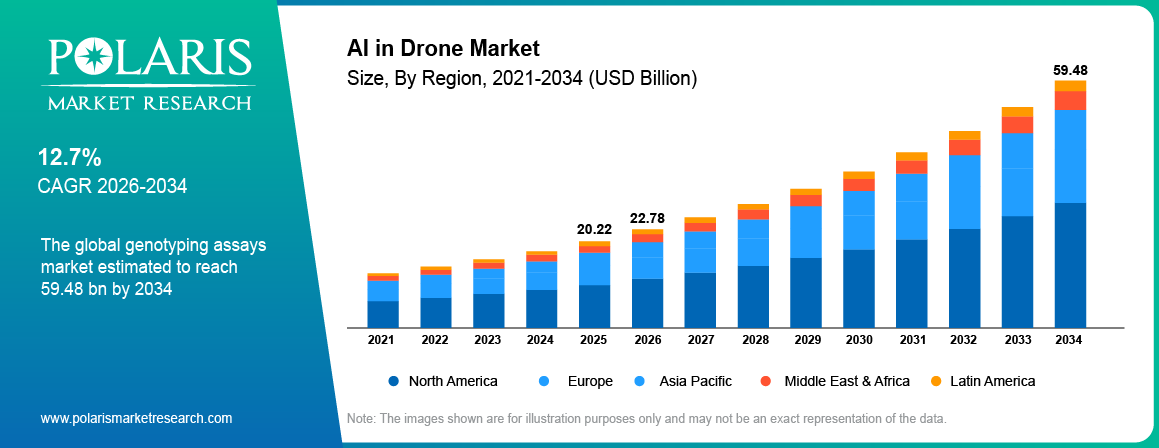
AI in drone market size was valued at USD 20.22 billion in 2025. The market is expected to grow at a CAGR of 12.7% from 2026 to 2034. Market growth is driven by rising adoption of AI-powered drones for defense, industrial inspection, autonomous delivery, and public safety.
Market Statistics
Key Takeaways
- North America accounted for 39.60% of the global AI in Drone Market share in 2025, driven by defense procurement, industrial inspection, and commercial adoption of AI-powered drones.
- Asia Pacific is projected to record the fastest growth, with an 15.82% CAGR, driven by investments in autonomous drone systems and artificial intelligence in UAVs across defense, manufacturing, and logistics.
- Hardware accounted for 46.40% of the market share in 2025, driven by demand for onboard processors and edge AI processing technologies that improve computer vision and flight intelligence.
- The Onboard Edge AI segment is expected to witness a CAGR of 10.98%, based on the need for drone AI software and real-time data processing.
- Industrial and infrastructure inspection captured 22.60% of the total market share in 2025, due to the increasing need for automated data capturing and analysis. These applications create opportunities for autonomous UAV market analysis and a broader drone AI industry forecast.
Note: Figures and projections outlined in this report are the result of Polaris Market Research’s proprietary analytical processes, grounded in the latest available datasets and market observations.
What is the AI in Drone Market?
The AI in Drone Market comprises unmanned aircraft, software, and related services that use artificial intelligence to perform flight operations, interpret sensor information, and make selected decisions. These systems use artificial intelligence in UAVs to improve navigation, object recognition, mission execution, and aerial data processing. The market includes AI-ready aircraft hardware, embedded computing platforms, autonomous navigation software, mission management systems, intelligent analytics, and integration services. It covers AI-powered drones that use onboard intelligence to modify selected actions based on environmental information. Conventional remotely operated drones without meaningful AI capabilities fall outside the market. Standalone ground-based counter-UAS equipment and unrelated robotic systems are also excluded.
Drone AI software and advanced computing are used in autonomous drone systems to interpret their surroundings and perform the tasks assigned to them. These systems use information from cameras, motion sensors and other onboard gear to improve flight decisions. The capacity to navigate without GPS is a crucial capability for operations in areas where satellite signals are weak or unavailable. Vision and motion information help an aircraft to estimate its position and movement. Autonomous mission planning enables drones to follow assigned routes, react to selected changes and complete repeatable operations within defined limits. The amount of autonomy varies from aircraft to aircraft and from application to application. Some systems assist remote pilots, whereas others perform selected mission activities under human supervision. The market assessment considers the actual AI functions integrated into aircraft and related software rather than relying only on product descriptions or marketing claims.
Market development is linked to demand for automated inspection, defense intelligence, public safety, agriculture monitoring, mapping, and autonomous delivery operations. Improvements in onboard computing and intelligent data processing are expanding the use of AI-enabled aircraft across commercial and government applications. Developments in computer vision, sensor processing, flight autonomy and operational permissions will also influence the drone AI industry forecast. Defense organizations require aircraft that can interpret information and function in challenging communication environments. Industrial customers are using autonomous systems to gather repeatable inspection data and reduce the need for manual field work. Some delivery activities are seeing logistics operators build drone networks. However, commercial adoption depends on flight authorization, system reliability, cybersecurity, manufacturing costs, and performance under different environmental conditions. The ability to integrate AI functions into practical operations remains an important factor in evaluating the AI in Drone Market.
Market Dynamics
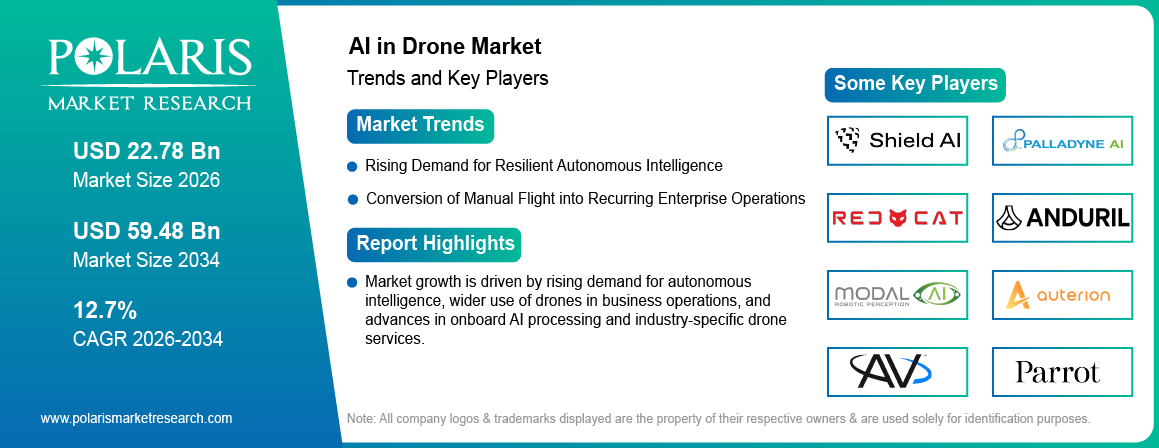
Driver: Rising Demand for Resilient Autonomous Intelligence
The AI in Drone Market is gaining opportunities from rising demand for autonomous intelligence across defense, security, and critical operations. Organizations require aircraft that collect and interpret information under changing operating conditions. Autonomous systems employ onboard sensors and smart software to process the mission data and make selected flight decisions. These capabilities reduce dependence on constant remote control and improve operational flexibility. AI also helps operators to handle complex missions and to interpret the information collected. The need for reliable autonomous operations is creating opportunities for advanced drone AI software and smart drone analytics, across various end-use applications. In November 2026, Kakao Mobility signed an agreement with South Korea’s Army to build an AI platform that would coordinate drones and unmanned ground vehicles.
Driver: Conversion of Manual Flight into Recurring Enterprise Operations
The AI in Drone Market is getting opportunities from a shift from manual drone operations to recurring enterprise services. Industrial and commercial users need inspections, monitoring and data collection on a regular basis over large operating areas. Autonomous aircraft offer repeated missions and consistent information. AI software improves route planning, object recognition and inspection activities and reduces manual work. Drone fleet management also helps organizations to coordinate aircraft, assign missions and review operational records. BVLOS operations are increasing, offering more opportunities for long-range inspections and commercial services. These requirements are driving the demand for AI-enabled enterprise drone solutions.
Restraint: Operational Permissions, Security Requirements, and Safe Performance
The AI in Drone Market is limited by aviation permissions, security requirements, and demonstrating safe operating performance. When operating the autonomous aircraft, flight rules for aircraft and defined operating limits for the aircraft must be followed. AI capabilities do not replace human supervision or operational risk controls. Drone operators also have sensitive images, location data and mission records requiring appropriate cyber security and data protection measures. Environmental changes such as poor visibility, dust and unfamiliar environments can impact system accuracy. All these factors add to the complexity of deployment and add to the requirements for testing, training and operational management.
Opportunity: Development of Edge Inference and Modular Autonomy Systems
The AI in Drone Market offers a lot of opportunities in the development of edge inference and modular autonomy systems. Onboard computing allows aircraft to process sensor information while in flight and respond to selected changes without continuous cloud communication. This enhances local decision-making and enables operation in areas of limited connectivity. Modular systems also allow OEMs to mix and match processors, navigation functions and autonomy software across different airframes. This in turn creates opportunities for specialist technology suppliers and system integrators. Continued work on onboard inference and flexible software architecture is increasing the number of AI-enabled drone applications.
Opportunity: Expansion of Vertical Analytics and Managed Autonomous Services
The AI in drone market offers opportunities by expanding industry-specific analytics and managed autonomous services. Commercial users require useful operational results, not just aerial images. Utilities need inspection records, agriculture operators need field information and logistics providers need to ensure reliable delivery operations. Intelligent drone analytics convert the collected sensor data into information that is relevant for these activities. Service providers can conduct inspections, monitoring, mapping and delivery operations without customers having to manage entire drone fleets. This model creates opportunities for recurring service revenue and specialized solutions in multiple industries.
Driver and Opportunities Impact Analysis
| Driver or Opportunity | Type | Impact Level | Time Horizon | Supporting Evidence |
| Rising Demand for Resilient Autonomous Intelligence | Driver | High | Short to Medium Term | Army AI platform agreement with Kakao Mobility, November 2026 |
| Conversion of Manual Flight into Recurring Enterprise Operations | Driver | High | Medium Term | Growth of BVLOS operations and drone fleet management |
| Development of Edge Inference and Modular Autonomy Systems | Opportunity | Medium | Short Term | Onboard processing without constant cloud links |
| Expansion of Vertical Analytics and Managed Autonomous Services | Opportunity | High | Medium to Long Term | Recurring service revenue from managed inspections |
Source: Polaris Market Research Analysis
AI in Drone Market Segmentation Analysis
The AI in drone market is segmented by component, AI technology, deployment architecture, autonomy level, application, end user, and region to identify key market segments and emerging growth opportunities.
Component Insights
Hardware accounted for 46.40% of the AI in Drone Market share in 2025. This segment includes AI-ready airframes, onboard processors, cameras, depth sensors, and compatible control modules. The demand comes from the need for aircraft to collect and process in-flight information. Drones with advanced sensors can sense objects and monitor their environment. The onboard processors also help with navigation and flight decisions. Industrial users require reliable imaging equipment to carry out inspections on a routine basis. Defense users require rugged aircraft with protected computing systems. Hardware demand is driven by processing power, battery life, payload requirements, sensor quality and the ability to work with different aircraft designs.
In 2025, Software accounted for 36.20% of the AI in Drone Market. This segment encompasses embedded autonomy, mission management, navigation and data analytics platforms. The AI software inside a drone receives information from sensors and cameras. It helps the operator to plan routes, to manage missions, and to review flight data. Smart drone analytics converts aerial data into actionable operational insights. These tools are used by industrial users to monitor their equipment and infrastructure. Defense users need software for mission planning and information processing. The demand drivers are operation across different aircraft platforms, system compatibility, data accuracy and cybersecurity.
Services accounted for 17.40% of the AI in Drone Market in 2025. This part covers system integration, model adaptation, maintenance, training and managed drone operations. Organizations require technical services to link aircraft to existing operating systems. Service providers’ software configuration and equipment maintenance minimize operational interruptions. With managed services, customers can buy inspections, monitoring and other drone operations without having to manage whole fleets. The demand is fueled by the complexity of drone deployment and the need for technical assistance. Service providers also provide software updates, equipment maintenance and operational training for various applications for customers.
AI Technology Insights
Computer Vision and Perception accounted for 32.10% of the AI in Drone Market share in 2025. This section includes technologies that allow drones to recognize objects and interpret images. Cameras capture visual data and AI models analyze the data to identify specific features. These functions improve the detection of obstacles, the tracking of objects and the inspection of the infrastructure. Computer vision also assists operators in reviewing large volumes of aerial images. Industrial users use these capabilities for equipment monitoring and visible change detection. Image quality, model accuracy, sensor performance and reliable operation in different lighting and weather conditions drive demand.
In 2025, Autonomous Navigation and Planning held 30.40% of the AI in Drone Market share. This part covers technologies that help drones decide routes and modify flight actions. They use data from the sensors to estimate the motion of the aircraft and to detect obstacles. GPS-denied navigation is important in areas where satellite signals are weak or not available. Visual inertial odometry estimates the movement of an aircraft using camera and motion information. Autonomous mission planning allows drones to fly on predefined routes and to react to chosen changes. The demand depends on the accuracy of navigation, the reliability of the system, the computing capacity and the operational safety requirements.
Data Analytics and Predictive Intelligence held 22.00% of the AI in Drone Market share in 2025. This section discusses software for processing aerial images, sensor data, and historical data. AI models can detect visible changes and abnormal conditions in monitored sites. These tools are used by industrial operators to check the health of equipment and to plan maintenance activities. Agriculture companies monitor the condition of their fields using aerial data. Intelligent drone analytics also turns the collected data into operational reports. Demand is driven by data quality, model accuracy, processing power and integration with existing business systems.
Fleet and Mission Optimization held 15.50% of the AI in Drone Market share in 2025. This software takes care of aircraft, plans missions and checks on operational activity. Operators use drone fleet management systems to track aircraft availability, maintenance needs and mission history. These tools are helpful for organizations that have multiple drones in multiple locations. Automated planning enhances resource allocation and mission coordination. These systems are used by logistics operators to manage deliveries. Demand depends on the availability of communication networks, software compatibility, aircraft and the ability to manage operations under applicable aviation rules.
Deployment Architecture Insights
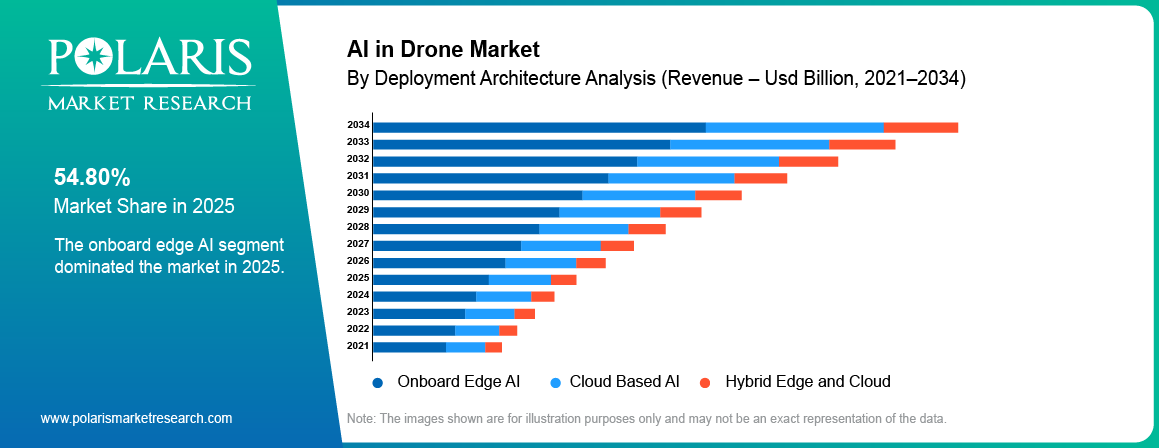
Onboard Edge AI had an 54.80% share of the AI in Drone Market in 2025. This section concerns artificial intelligence systems that work on computing hardware placed on the aircraft. The processing onboard allows drones to detect objects and react to changes in flight. It also reduces the need for constant communication with servers located remotely. It is useful in remote locations and areas with limited network access. Industry and defense users require fast data processing for selected operations. The demand depends on processor performance, battery capacity, equipment weight and the need for real-time decisions during the flight.
In 2025, the Cloud Based AI segment accounted for 18.60% of the AI in Drone Market. This part includes the systems that transmit the data from drones to remote computing platforms for processing and storage. Cloud systems help organizations to analyze large image collections and to maintain historical records. They also allow inspection results to be shared across different departments through a common platform. This architecture is useful for data-heavy applications that require in-depth analysis. Industrial users use cloud tools to review information collected from multiple sites. The demand depends on the availability of internet connectivity, data transfer capacity, storage requirements and cybersecurity controls.
In 2025, Hybrid Edge and Cloud accounted for 26.60% of the AI in Drone Market. This part combines processing on the aircraft and data analysis in the cloud. Drones use onboard computing to make instant decisions about flight, and to pass on selected information for further review. This way, operators can handle time-critical tasks and big data. Industrial users process flight information locally and large volumes of data are stored in cloud systems. The architecture also allows operators to blend sensor information from multiple sources. The demand depends upon the availability of communication, system integration, data security and computing requirements in various drone applications.
Autonomy Level Insights
AI Assisted Remote Operation accounted for 43.80% of the AI in Drone Market in 2025. This section deals with drones that are still controlled by humans but have AI functions that assist the pilots. These functions can help you identify obstacles, track objects and increase your flight awareness. The operator is still responsible for mission control and flight decisions. AI helps to reduce selected manual tasks and assist pilots in dealing with complex operations. These systems are used for inspection and monitoring by commercial and industrial users. Demand is a function of system reliability, operator training, navigation assistance and the usefulness of onboard support features.
Supervised Autonomous Operation held the significant share of the AI in Drone Market in 2025. This section represents drones that can execute selected tasks with limited human intervention. Operators establish and track mission requirements and aircraft actions. The drone follows routes, identifies obstacles and adjusts selected actions with the onboard software. This is useful for recurring inspections, mapping and monitoring activities. It lessens the need for continuous manual control, and enhances the consistency of the mission. Demand is dependent on reliable autonomous functions, clear operator controls, appropriate flight permissions and the ability to manage unexpected operating conditions.
High Autonomy within a Defined Operating Envelope held 19.00% of the AI in Drone Market share in 2025. This section considers drones that make some flight decisions autonomously within an operational envelope. These aircraft have sensors, navigation systems and mission software that react to changes in their environment. High autonomy is relevant for defense, inspection and logistics activities with limited manual intervention. Operators set the limits of the mission and safety procedures. Demand depends on navigational accuracy, system reliability, secure controls and authorization for intended operations in different environments.
Application Insights
Industrial and Infrastructure Inspection accounted for 22.60% of the AI in Drone Market share in 2025. This chapter deals with the use of drones on power networks, industrial facilities, transport assets and other infrastructure. The AI-enabled aircraft is used by operators to inspect equipment and collect repeatable images. Computer vision helps to detect visible changes and selected conditions of equipment. Drone inspection analytics converts aerial images to actionable maintenance intelligence. Regular inspections also help operators monitor large and hard to reach locations. Demand is driven by inspection accuracy, operating costs, data quality and the need to reduce manual fieldwork in industrial sites.
Agriculture and Environmental Monitoring held 15.40% of the AI in Drone Market share in 2025. This segment includes land observation and environmental data collection, and crop monitoring. Drones capture aerial images of large areas. AI software analyzes these images to identify changes in vegetation and field conditions. This information helps farmers find places that require further inspection. Environmental groups also employ drones to monitor land and vegetation. Such applications reduce the work of manual observation and improve access to information in the field. The accuracy of the images, the completeness of the survey, operating costs and the usefulness of the data collected will affect demand.
Mapping and Surveying held 13.30% of the AI in Drone Market share in 2025. This part is about collecting aerial data for land measurement, infrastructure planning, and geographical analysis. Drones take pictures and location information in selected areas. The AI software takes the data collected and determines which features are relevant. Automated routes provide consistency in repeat surveys. Surveying firms use these systems to collect information from large or hard-to-access locations. Demand is dependent on the accuracy of measurement, sensor performance, project requirements and data processing capacity. Reliable navigation also contributes to improving the quality of the mapping results.
Public Safety and Emergency Response held 11.70% of the AI in Drone Market share in 2025. This section covers emergency services and public agencies’ use of drones. Drones collect aerial information during incidents and help personnel to view hard-to-see locations. AI functions can help with object detection and image review. These capabilities improve access to information in emergency operations. Public agencies also use aerial systems for some monitoring and response functions. Demand is based on flight permission, reliability of equipment, operator training, secure data handling and ability to gather useful information within required response times.
Logistics and Delivery held 12.20% of the AI in Drone Market share in 2025. This section covers unmanned aircraft used to carry selected goods. Delivery operators conduct operations using route planning, fleet coordination and automated flight systems. AI helps drones complete their selected flight tasks and adapt to changes in the mission. BVLOS operations open up the potential for delivery services over larger operating areas. The commercial use will depend on approved flight routes, the reliability of the aircraft, delivery costs, ground infrastructure and availability of service. Operators need efficient fleet management to coordinate aircraft and maintain their delivery schedules.
The Defense and Security Intelligence segment held an 24.80% share of the AI in Drone Market in 2025. This section deals with applications for reconnaissance, surveillance and mission intelligence. Defense organizations are using AI-enabled drones to collect data and operate in difficult environments. Autonomous navigation helps an aircraft react to obstacles and changing mission requirements. The AI software also interprets sensor data and assists the operator in reviewing mission information. The capabilities reduce selected manual tasks and improve mission flexibility. Demand is a function of mission requirements, system security, aircraft reliability and compatibility with fielded defense equipment.
End User Insights
Commercial and Industrial held 37.40% of the AI in Drone Market share in 2025. The segment consists of utilities, infrastructure operators, agricultural businesses, logistics companies and industrial service providers. These users are using drones for inspection, monitoring and routine data collection. Artificial intelligence can reduce the level of manual work and increase the consistency of the information collected. Drone fleet management also assists companies in managing aircraft in multiple locations. The industrial users need strong software integration and precise inspection results. The demand is driven by operating costs, data quality, system reliability, maintenance needs and the ability to use drone information in business operations.
In 2025, Government and Public Safety held an 24.40% share of the AI in Drone Market. This segment includes public agencies and emergency services that use drones for monitoring and response. AI functions help personnel to collect aerial information and identify selected objects. Such systems improve information access of emergency operations and infrastructure monitoring. Government buyers also want to see safe data management, and reliable equipment. Demand is dependent on public procurement needs, aviation permissions, staff training, system performance and capability to handle sensitive operational information.
Defense held 38.20% of the AI in Drone Market share in 2025. This segment comprises military organizations that procure drones for reconnaissance, surveillance, and autonomous mission operations. The aircraft uses artificial intelligence to interpret data from its sensors and determine how to fly. These capabilities enhance the flexibility of the mission in challenging operational environments. Defense customers require reliable aircraft and secure mission software. They also look at the integration with existing equipment and communications systems. Demand depends on mission performance, cybersecurity, procurement requirements, aircraft reliability, and the ability to operate under defined mission conditions.
Regional Insights
The AI in Drone Market covers North America, Europe, Asia Pacific, Latin America, and the Middle East and Africa. Regional development depends on defense procurement, industrial inspection, drone manufacturing, aviation regulations, and demand for autonomous services. Drones with artificial intelligence are finding applications in infrastructure monitoring, agriculture, public safety and logistics. Progress in onboard inference and swarm autonomy is also enabling opportunities for advanced drone operations. Adoption of the technology on a regional basis is dependent on investment in technology, regulatory operating licenses, availability of infrastructure and access to skilled service providers. These factors influence the regional outlook and global forecast of the drone AI industry.
North America AI in Drone Market Trends
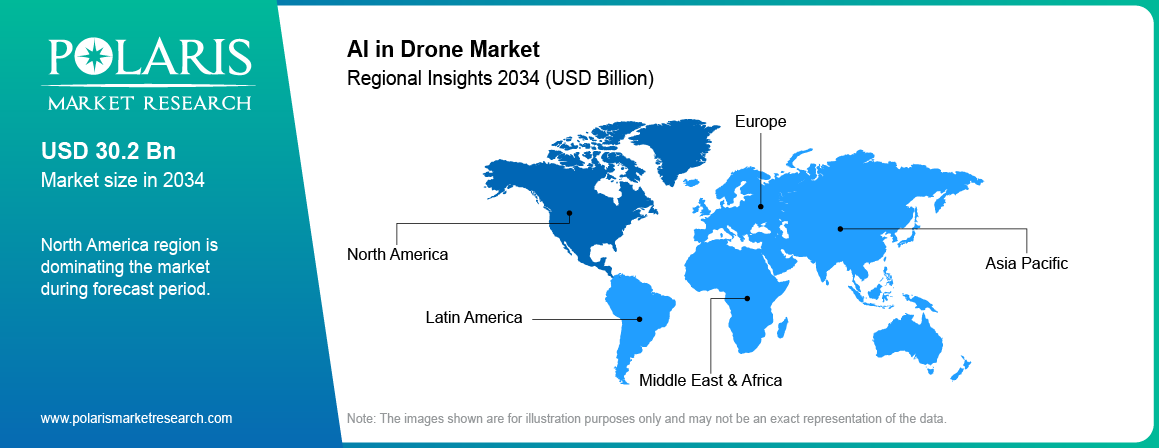
North America dominated the AI in Drone Market, accounting for 39.60% of the global market share in 2025. Demand comes from regional defense, industrial inspection, public safety and commercial delivery applications. Defense agencies need autonomous drone systems to conduct surveillance and gather mission intelligence. AI-powered drones are used by industrial operators to inspect infrastructure and gather aerial data. There are also opportunities for aircraft manufacturers and software developers in the region. Onboard inference allows drones to analyze information while in flight and to make some decisions without having to communicate with a remote source constantly. In October 2026, Palladyne AI partnered with Federal Ammunition and Mossberg to develop SwarmShot, an autonomous counter-drone system using IntelliSwarm software for coordinated drone interception.
Asia Pacific AI in Drone Market Trends
Asia Pacific is projected to record the fastest growth in the AI in Drone Market, with an 15.82% CAGR during 2026–2034. Growth opportunities are linked to drone manufacturing, defense procurement, agriculture, and autonomous delivery services. Industrial operators use drones for infrastructure monitoring and data collection. Logistics providers are also building up autonomous delivery operations. Onboard inference and swarm autonomy enable coordinated operations of aircraft. AI software also assists operators in managing flight operations and processing collected information. Advantech released the ASR-D501 AI companion computer for autonomous drone applications in September 2026. The platform, powered by Qualcomm’s QCS6490 processor, offers up to 12 TOPS of AI performance and supports object detection, visual localization, sensor fusion and onboard inference.
Europe AI in Drone Market Trends
Europe held 25.00% of the AI in Drone Market share in 2025. Regional demand is driven by industrial inspection, infrastructure monitoring, mapping and regulated drone operations. Drones powered by AI are used by energy and infrastructure companies for asset inspections and aerial data collection. Operators use computer vision and intelligent software to review images and identify visible changes. The region also offers opportunities for autonomous aircraft for both commercial and government applications. Market development depends on aviation permissions, data protection rules, manufacturing capabilities, and access to technical services. In September 2026, the UK Ministry of Defence opened access to Ukraine's battlefield drone data to up to 12 British companies to develop AI models for autonomous drone swarms and coordinated missions.
Latin America AI in Drone Market Trends
Latin America accounted for 5.40% of the AI in Drone Market share in 2025. Regional opportunities are linked to agriculture, mining, energy, and infrastructure inspection. Agricultural operators are deploying AI-enabled aircraft to monitor large fields and collect information about crop conditions. Mining and energy companies employ drones to inspect remote sites and to monitor equipment. The AI software analyzes the aerial images and points out areas that need a closer look. These applications reduce the manual inspection work and provide access to difficult locations. Market development depends on operating permissions, connectivity, equipment costs, and access to trained service providers.
Middle East and Africa AI in Drone Market Trends
The Middle East and Africa accounted for 4.30% of the AI in Drone Market share in 2025. Regional demand comes from energy inspection, power infrastructure monitoring, logistics, and defense applications. Oil and gas operators use drones to monitor facilities and equipment in remote locations. Aircraft used by defense organizations for surveillance and mission intelligence need to be dependable. Autonomous drone systems also offer opportunities for infrastructure monitoring and specialized delivery services. The development of the market is dependent on aviation permissions, security requirements, investment in infrastructure and availability of technical service. Access to reliable equipment and trained personnel also affects commercial adoption.
AI in Drone Market Competitive Landscape
AI in Drone Market comprises companies developing smart aircraft, autonomous flight software, onboard computing platforms and commercial drone services. Skydio and Shield AI are developing autonomous aircraft and mission technologies. DJI and Quantum Systems develop unmanned aircraft for commercial and niche applications. Auterion and ModalAI focus on flight software and onboard computing. Zipline and Wing run autonomous delivery networks. These companies are involved in the development of autonomous drone systems and artificial intelligence in UAVs for different market applications. AeroVironment, Anduril Industries and Red Cat Holdings supply AI enabled tactical and defense aircraft, while Parrot and Teledyne FLIR provide compact aircraft and thermal imaging payloads.
There is also competition in edge AI processing, computer vision, and autonomous navigation technologies. Skydio is building AI-enabled aircraft for inspection and monitoring. Shield AI uses its Hivemind platform to develop autonomy software. The AI drone market report covers these companies across aircraft manufacturing, software development, computing, and service operations.
Vendor Landscape Snapshot
| Vendor | Core Offering | AI Focus | Market Position |
| SZ DJI Technology Co., Ltd. | Commercial and industrial aircraft | Onboard object recognition | Leader |
| Skydio, Inc. | Autonomous enterprise aircraft | Obstacle avoidance, navigation without GPS | Leader |
| Shield AI, Inc. | Tactical aircraft, Hivemind software | Mission autonomy | Leader |
| Zipline International Inc. | Autonomous delivery network | Route and fleet autonomy | Leader |
| Wing Aviation LLC | Autonomous delivery network | Route and fleet autonomy | Challenger |
| Auterion | AuterionOS, Skynode, Nemyx | Flight software, swarm control | Challenger |
| Anduril Industries, Inc. | Lattice software, Fury aircraft | Mission autonomy | Challenger |
| AeroVironment, Inc. | Tactical aircraft | Autonomous platforms | Challenger |
| Quantum Systems GmbH | Vector AI aircraft | AI mission planning | Challenger |
| ModalAI, Inc. | VOXL 2 computers, reference drones | Onboard AI computing | Niche Player |
| Parrot Drones SAS | ANAFI UKR aircraft | Compact autonomy | Niche Player |
| Red Cat Holdings, Inc. | Black Widow aircraft | Tactical autonomy | Niche Player |
| Teledyne Technologies Incorporated | Thermal sensors, payloads | Imaging payloads | Niche Player |
| Palladyne AI Corp. | IntelliSwarm autonomy software | Collaborative autonomy | Emerging Player |
Source: Polaris Market Research Analysis
AI in Drone Market Technology and Innovation Landscape
Onboard Inference and Sensor Fusion
ModalAI VOXL 2 combines AI computing, image processing, and flight control functions within a compact onboard platform. It processes camera, inertial, and depth sensor data to assist drone navigation when external positioning signals weaken. These capabilities help with visual inertial odometry, real-time perception and obstacle avoidance. However, deployment is constrained by thermal management, battery capacity and model performance in flight. This technology is an important area of artificial intelligence in UAVs, especially for autonomous operations in complex environments.
Perception and Scene Understanding
DJI documents AI object recognition across select Matrice 400, H30 and Manifold 3 configurations. These functions illustrate how the AI software of the drone can detect objects and show the results of detection on the operational interfaces. Computer vision assists operators to interpret visual data during inspection and monitoring activities. However, model performance depends on the target, operating conditions, and detection accuracy. False positive and false negative rates remain important measures when applying AI-enabled perception to industrial and infrastructure inspection tasks.
Mission Autonomy and Operator Control
Shield AI Hivemind provides mission autonomy software for different aircraft classes. The platform shows how AI allows autonomous drone systems to select actions within defined operational limits, not just follow pre-programmed routes. This approach broadens the role of intelligent drone analytics in mission execution and decision making. Operators still need clear boundaries of control, auditable handovers and safe recovery procedures. These functions continue to be important for defense and other applications where the behavior of aircraft needs to be traceable and manageable.
Connected Operations and Managed Fleets
The FAA’s Unmanned Aircraft System Traffic Management (UTM) guidance addresses coordinated flight planning, authorization, surveillance, and conflict management. These functions, in addition to traditional air traffic control, are part of the overall operating framework for autonomous drone fleets. Autonomous mission planning must account for airspace information and coordination requirements rather than rely only on onboard intelligence. This creates a need for communication between aircraft, fleet operators, and traffic management systems. Such integration remains relevant to the commercial deployment of artificial intelligence in UAVs.
Technology and Innovation Landscape Snapshot
| Technology Area | Representative Examples | Maturity | Key Constraint |
| Onboard Inference | ModalAI VOXL 2, Advantech 12 TOPS computer | Commercial | Heat, battery, weight |
| Perception and Scene Understanding | DJI Matrice payloads, Skydio X10D | Commercial | Accuracy outside training data |
| Navigation Without GPS | Parrot ANAFI UKR, Quantum Systems Vector AI | Commercial | Sensor and compute load |
| Mission Autonomy | Shield AI Hivemind, Palladyne IntelliSwarm | Early Commercial | Control and auditability |
| Swarm and Collective Autonomy | Auterion Nemyx, Dstl swarm test bed | Pilot | Communications, operator ratio |
| Fleet and Airspace Integration | FAA UTM guidance, proposed Part 108 | Early | Rule finalization |
Source: Polaris Market Research Analysis
Use Case Analysis
Utility Asset Inspection
Utility operators use AI-enabled drones to inspect towers, substations, and transmission corridors. Autonomous routes, obstacle avoidance, and defect-focused imaging help collect consistent asset data. GPS-denied navigation is also significant in areas with weak positioning signals. Engineers review the detected anomalies and decide on the maintenance requirements. Intelligent drone analytics turn collected imagery into actionable asset intelligence. Buyers will examine completed missions, image quality, incident rates, personnel exposure and inspection turnaround as metrics for the operational value of drone AI software.
Agriculture and Environmental Field Monitoring
AI-powered drones are employed by agricultural operators to monitor crop conditions, irrigation patterns and vegetation changes across large fields. Image processing and classification models identify areas to be inspected in the field. Agronomists will review these findings, the crop stage and ground observations before deciding on treatments. Autonomous mission planning helps to organize repeat surveys and, where permitted, BVLOS operations, to extend coverage across remote areas. Buyers assess intelligent drone analytics value using survey coverage, usable data, mission completion, and field verification to inform the drone AI industry forecast.
Public Safety and Emergency Response
Fire and emergency services use aerial thermal and visual imaging to improve incident awareness. Object detection, map overlays and remote image access help to identify areas of concern. Artificial intelligence in UAVs offers image interpretation in emergency operations, but the decisions are still made by incident commanders. Buyers assess mission accomplishment, image quality, response time and level of operator supervision. Drone AI software assists with processing visual information and relaying relevant findings to response teams via dispatch and incident management systems.
Autonomous Delivery Networks
Commercial delivery providers operate recurring logistics services through autonomous aircraft, dispatch platforms, and fleet coordination systems. In January 2026, Zipline completed more than two million commercial deliveries, reflecting the scale of its operations. Performance of the network is affected by route planning, landing infrastructure, maintenance, procedures for weather, and coordination of airspace. Swarm autonomy and fleet-level coordination also make possible large delivery networks. Buyers evaluate the commercial performance of AI-powered drones based on completed deliveries, route reliability, fleet uptime, safety incidents and cost per delivery.
Premium Insights and Forward Outlook
Software Portability Separates the Airframe from Mission Intelligence
Shield AI’s January 2026 Indian Army program and Auterion’s Nemyx swarm demonstration with drones from multiple manufacturers highlight the use of autonomy software across different aircraft platforms. This approach creates opportunities for reusable mission intelligence and autonomous drone systems. Software portability depends on compatible interfaces across flight controls, sensors, and safety functions. The commercial opportunity also extends beyond aircraft sales to onboard computing, mission software, model adaptation, and integration services. By fusing sensor inputs, data from several onboard devices can be interpreted more accurately, opening up new possibilities for autonomous UAV market analysis for defense, infrastructure inspection and industrial applications.
Measured Operational Assurance Becomes a Competitive Product
The FAA’s proposed shift to routine BVLOS operations places more emphasis on safety outcomes, airspace information, and exception management. Buyers need full mission histories, operator intervention logs and configuration controls to assess field performance. These requirements affect the procurement of artificial intelligence in UAVs in commercial and industrial applications. Data rights also play a role in the supplier selection, as the infrastructure operators may possess ownership of inspection records and derived operational data. Operational records are protected by clear contractual terms on access, retention, re-use and transfer. Onboard inference also gives buyers the option of handling data processing and transfer locally.
Key Players in the AI in Drone Market
Some of the key players in the market include:
- AeroVironment, Inc.
- Anduril Industries, Inc.
- Auterion
- ModalAI, Inc.
- Palladyne AI Corp.
- Parrot Drones SAS
- Quantum Systems GmbH
- Red Cat Holdings, Inc.
- Shield AI, Inc.
- Skydio, Inc.
- SZ DJI Technology Co., Ltd.
- Teledyne Technologies Incorporated
- Wing Aviation LLC
- Zipline International Inc.
Industry Developments
- October 2026: Maris-Tech introduced Uranus-Drones-V2, a compact video and AI processing platform for UAVs. It can accommodate up to eight camera inputs and offers processing power in excess of 30 TOPS.
- September 2026: The UK’s Defence Science and Technology Laboratory has conducted an eight-drone swarm test with the British Army. The Software Defined Swarms Concept Demonstrator integrated AI and autonomy technologies to experiment with coordinated operations of multiple uncrewed aircraft. (Source: UK Government)
- September 2026: ACSL and Preferred Networks have successfully reached the demonstration stage of the AI-based automatic flight route generation under the K Program of Japan’s NEDO. The project focuses on autonomous path planning, dynamic re-planning, object recognition, and coordinated operation of multiple small UAVs.
- April 2026: Under a USD 15.3 million contract, Quantum Systems said its Vector AI small uncrewed aircraft system was selected for the US Army’s Company-Level sUAS Directed Requirement 2 initiative. The platform features AI-assisted mission planning, electro-optical sensing and GPS-denied navigation.
- March 2026: Shield AI raised USD 2 billion at a valuation of USD 12.7 billion in a round led by Advent International and agreed to acquire the simulation firm Aechelon Technology, in order to scale its Hivemind autonomy software.
- March 2026: The US Army placed an order worth more than USD 52 million with Skydio for over 2,500 X10D small unmanned aircraft, which Skydio described as the largest single vendor small drone procurement in Army history. The X10D can operate autonomously without GPS. (Source: Army Technology)
AI in Drone Market Report Segmentation
By Component (Revenue, USD Billion, 2021–2034)
- Hardware
- AI Ready Airframes
- Processors
- Cameras
- Depth Sensors and Compatible Control Modules
- Software
- Embedded Autonomy
- Mission Management and Analytics
- Services
- Systems Integration
- Model Adaptation
- Maintenance and Managed Operations
By AI Technology (Revenue, USD Billion, 2021–2034)
- Computer Vision and Perception
- Autonomous Navigation and Planning
- Data Analytics and Predictive Intelligence
- Fleet and Mission Optimization
By Deployment Architecture (Revenue, USD Billion, 2021–2034)
- Onboard Edge AI
- Cloud Based AI
- Hybrid Edge and Cloud
By Autonomy Level (Revenue, USD Billion, 2021–2034)
- AI Assisted Remote Operation
- Supervised Autonomous Operation
- High Autonomy within a Defined Operating Envelope
By Application (Revenue, USD Billion, 2021–2034)
- Industrial and Infrastructure Inspection
- Agriculture and Environmental Monitoring
- Mapping and Surveying
- Public Safety and Emergency Response
- Logistics and Delivery
- Defense and Security Intelligence
By End User (Revenue, USD Billion, 2021–2034)
- Commercial and Industrial
- Government and Public Safety
- Defense
By Regional Outlook (Revenue, USD Billion, 2021-2034)
- North America
- US
- Canada
- Europe
- Germany
- France
- UK
- Italy
- Spain
- Netherlands
- Russia
- Rest of Europe
- Asia Pacific
- China
- Japan
- India
- Malaysia
- South Korea
- Indonesia
- Australia
- Vietnam
- Rest of Asia Pacific
- Middle East & Africa
- Saudi Arabia
- UAE
- Israel
- South Africa
- Rest of Middle East & Africa
- Latin America
- Mexico
- Brazil
- Argentina
- Rest of Latin America
Report Scope
| Report Attributes | Details |
| Market Size in 2025 | USD 20.22 Billion |
| Market Size in 2026 | USD 22.78 Billion |
| Revenue Forecast by 2034 | USD 59.48 Billion |
| CAGR | 12.7% from 2026 to 2034 |
| Base Year | 2025 |
| Historical Data | 2021–2024 |
| Forecast Period | 2026–2034 |
| Quantitative Units | Revenue in USD Billion and CAGR from 2026 to 2034 |
| Report Coverage | Revenue Forecast, Competitive Landscape, Growth Factors, and Industry Trends |
| Segments Covered |
|
| Regional Scope |
|
| Competitive Landscape |
|
| Report Format |
|
| Customization | Report customization as per your requirements with respect to countries, regions, and segmentation. |
Source: Polaris Market Research Analysis
Why Choose Polaris Market Research
Polaris Market Research & Consulting, Inc. provides detailed research on the AI in Drone Market, covering market definition, technology development, component categories, deployment architectures, applications, regional trends, and industry developments. The study examines drone AI software, intelligent drone analytics, computer vision, onboard computing and autonomous navigation. It evaluates technologies like obstacle avoidance and visual inertial odometry for use in commercial, industrial, public safety, and defense applications. This analysis helps clients understand the structure of the AI drone industry and find opportunities across different use cases.
Clients can also commission bespoke research on a component, standard artificial intelligence technology, deployment architecture, autonomy level, application, end user, or region basis. The study can address specific requirements for technology assessment, competitive analysis, market sizing, pricing benchmarks and demand at the application level. It allows customers to test GPS-denied navigation, autonomous mission planning and other advances in technology. The analysis also provides inputs for autonomous UAV market analysis and the drone AI industry forecast, helping clients evaluate commercial opportunities and adoption factors.
Research Methodology
Polaris Market Research & Consulting, Inc. follows a structured research process to examine the AI in Drone Market. The study begins with market definition and scope control. It covers unmanned aircraft that use AI for perception, navigation, flight decisions, mission execution, or sensor data interpretation. The scope includes AI-enabled hardware, embedded software, autonomous mission subscriptions, analytics, and related implementation services. It is also worth noting that the study excludes ordinary camera drones with no meaningful AI capabilities, terrestrial robotics, stand-alone counter drone systems, and conventional autopilots that only follow pre-programmed commands.
The subsequent steps are: primary interviews, secondary research, market segmentation, estimation, data triangulation and analyst review. Secondary research involves looking at company releases, product information, technical articles, industry patterns, regulatory changes and technology releases. Primary interviews with drone manufacturers, software providers, system integrators and end users are combined with secondary research to validate market definitions, segment assumptions and company level estimates. Market assessment includes components, artificial intelligence (AI) technologies, deployment architectures, autonomy levels, applications, end users and regional coverage. The estimation process looks at AI-attributable revenue in hardware, software and services to maintain a consistent market boundary. The data review is based on the source reliability, segment classification, and commercial relevance. The final review checks scope consistency, segment coverage, and factual accuracy across the AI drone market report.
Research Methodology Phases
| Phase | Research activity |
| 1. Boundary design | Specify included AI capabilities, aircraft classes, service categories, transaction points and exclusions. |
| 2. Primary evidence | Conduct primary interviews with drone manufacturers, software providers, integrators and end users, and review aviation agency policy, company product documentation, formal announcements and technical material. |
| 3. Market classification | Tag companies and products by technology, component, customer segment and region with transaction controls. |
| 4. Quantitative triangulation | Reconcile shipments, commercial operations, revenue disclosures and customer activity against Polaris internal sizing. |
| 5. Editorial and analyst review | Check terminology, data references, outlier values, source traceability and publication readiness. |
Source: Polaris Market Research Analysis
AI in Drone Market FAQ's
The AI in drone market size is estimated at USD 20.22 Billion in 2025. The market forecast covers 2026–2034.
The AI in drone market is projected to register a CAGR of 12.7% during 2026–2034.
North America dominated the AI in drone market in 2025, driven by defense applications, industrial inspection, and commercial drone deployment.
The market covers hardware, software, and services. The hardware component held the largest market share in 2025.
AI drones use cameras, inertial sensors, visual inertial odometry, and sensor fusion to estimate position and detect surrounding objects when GPS signals are unavailable.
An automated drone follows predefined instructions or routes. An autonomous drone uses AI to interpret environmental data and modify its actions within defined operating limits.
Edge AI processes data directly onboard the aircraft. It reduces dependence on cloud connectivity and enables faster decisions for navigation, object detection, and obstacle avoidance.
Yes, subject to applicable aviation regulations and operational authorization. AI capabilities do not automatically grant permission for BVLOS operations.
AI processes aerial images and sensor data to identify defects, detect objects, monitor asset conditions, and prioritize maintenance reviews across infrastructure and industrial sites.
Companies active in drone autonomy include Skydio, Shield AI, Auterion, ModalAI, DJI, Quantum Systems, Anduril Industries, and AeroVironment. Zipline and Wing operate autonomous delivery networks.
Key barriers include airspace authorization, cybersecurity, data governance, model accuracy, enterprise integration, maintenance costs, and the need for trained operators.
Publicly listed prices for selected AI drone computing platforms range from approximately USD 1,349.99 to USD 4,199.99. Complete system costs vary by configuration, sensors, integration, and support.
Not entirely. On 22 December 2025, the US Federal Communications Commission added DJI, Autel and other foreign made drones to its Covered List, which prevents new models from receiving equipment authorization. Models authorized earlier remain legal to sell, own and fly. (Source: FCC)
No. The final Part 108 rule has been under White House review since 10 July 2026 and had not been published as of 18 October 2026, so operators continue to use the existing Part 107 waiver process.
The main applications are infrastructure and industrial inspection, agriculture monitoring, mapping and surveying, public safety, logistics and delivery, and defense surveillance. AI supports object recognition, route planning and mission autonomy in each of these uses.

Download Sample Report of AI in Drone Market
Please fill out the form to request a customized copy of the research report.


