
AI in Life Science Analytics Market Size, Share, Trends and Forecast, 2026-2034
REPORT DETAILS
AI In Life Science Analytics Market Summary
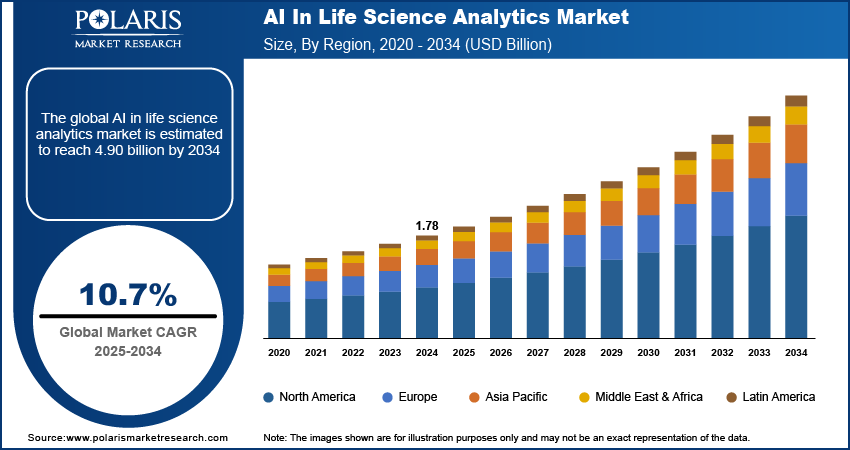
The global AI in life science analytics market was valued at USD 1.96 billion in 2025. The market is expected to grow at a CAGR of 10.70% from 2026 to 2034. AI analytics is being increasingly used by several pharmaceutical, biotechnological, and medical device companies. It helps overcome data integration issues and improve operational efficiency.
Market Statistics
Key Takeaways
- North America held a 41.2% market share in 2025. This is due to the advanced life sciences ecosystem in the region.
- Asia Pacific is projected to grow at a 24.8% CAGR. This is due to increased expenditures by various research firms on AI software and hardware.
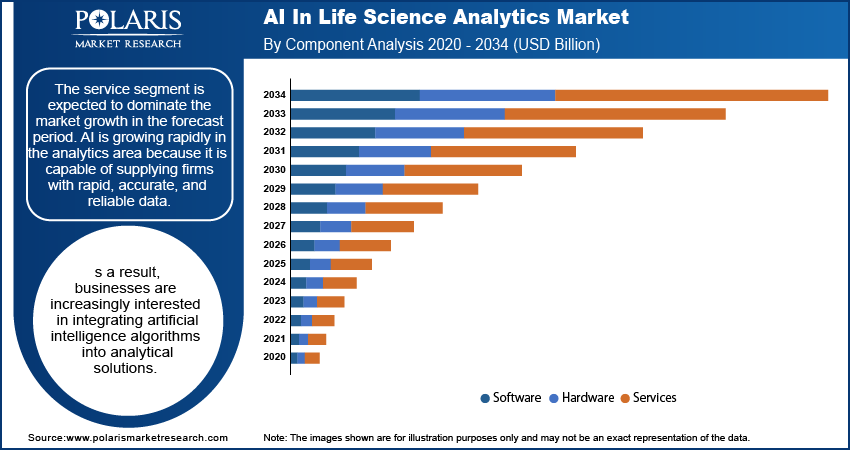
- The Service segment held the largest share of 57.6% in 2025. This is because it’s the foundational layer for developing and running AI algorithms and platforms.
- The Cloud deployment model held the largest share of 63.9% in 2025. The high scalability of cloud platforms contributes to the segment’s leading position.
- The Research and Development segment held the largest share of 38.5% in 2025. This is owing to the capability of AI to accelerate target identification and efficacy prediction.
Note: Figures and projections outlined in this report are the result of Polaris Market Research’s proprietary analytical processes, grounded in the latest available datasets and market observations.
Industry Dynamics
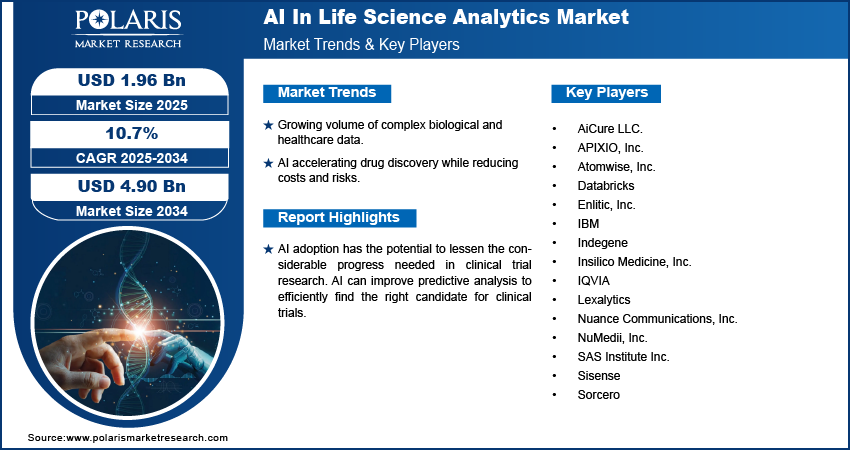
- The increasing volume of complex biological and healthcare data, such as genomics and clinical records, is a primary factor.
- AI substantially accelerates the drug discovery and development timeline, lowering the significant costs and risks typically associated with bringing a new therapy to the market.
- The growing demand for personalized medicine is a powerful factor driving AI adoption.
Source: Polaris Market Research Analysis
To Understand More About this Research: Download Sample Report
Impact of AI on Market
- AI is revolutionizing the research and development (R&D) segment by drastically accelerating the drug discovery process.
- AI allows companies to analyze complex genomic and clinical data to develop highly tailored treatments and diagnostics.
- AI is creating operational efficiencies throughout the value chain, from manufacturing to supply chain and clinical trials.
The increasing use of AI in the analysis of tiny systems-of-interest particular datasets is greatly improving drug discovery and development, as well as the production of tailored treatments. Additionally, the drug discovery process is becoming increasingly inefficient as a result of numerous issues such as high development costs, poor clinical trial success rates, falling return on investments, and an increased focus on uncommon disorders.
AI adoption has the potential to lessen the considerable progress needed in clinical trial research. AI can improve predictive analysis to efficiently find the right candidate for clinical trials. AI in analytics is widely used in the life science analytics business to assess risk, evaluate clinical trial efficacy, deliver tailored treatment, establish a quicker and more productive research and development pipeline, estimate profits and budget, regulate product pricing, and anticipate viral evolution.
Many market participants in the life science business are rapidly investing in the adoption of AI-based technologies, which drives demand for AI Analytics in the life sciences area. For instance, in October 2021, Ever Fortune.AI and Medexprim announced their strategic alliance to advance medical AI research and healthcare analytics.
The COVID-19 pandemic's sudden outbreak has disrupted the operations, sales, and marketing of many different businesses, including automotive, manufacturing, and many more. Despite the devastating effect of COVID-19 on the rest of the businesses, some, such as healthcare and pharmacy, develop at an exponential rate during the period. Healthcare spending and investment in research and development of appropriate drugs for the rapid and early recovery from COVID-19 virus infection has also benefited the drug development and research department in the healthcare industry. Even, life science research, which is related to medicine development, was likewise the least affected by the COVID-19 epidemic. As a result, the market for Artificial Intelligence (AI) in life science analytics has shown significant development throughout the pandemic era and is projected to continue in the upcoming years.
What Is AI in Life Science Analytics?
AI in life sciences analytics refers to the use of artificial intelligence to analyze large datasets in health care, biology, and pharmaceuticals. This includes finding patterns, discovering drugs, enhancing clinical trials, predicting disease outcomes, and making decisions easier for both researchers and healthcare providers through the use of such technologies.
How Does AI in Life Science Analytics Work?
Data collection: This stage involves gathering appropriate data from clinical trials, patient records, genomics databases, laboratory studies, and pharmaceutical research.
Data cleansing and integration: Then, the data gathered is sorted, cleansed, and combined into one unified dataset in order to make it easier to proceed with its further use.
AI training: AI algorithms, machine learning models, and other types of artificial intelligence are trained using huge datasets.
Pattern recognition: AI studies gathered and cleansed data to find patterns and useful information such as treatment effectiveness, disease patterns, and disease progression.
Predictive analysis: Based on found patterns, AI makes predictions such as disease progression, drug effectiveness, and results of clinical trials.
Research and clinical insights: Insights gained during this process are used to improve the drug discovery and development process, clinical research, and treatment, among others.
Faster decision making: All these insights gained due to the work of AI make it possible to make decisions faster and more easily.
Source: Polaris Market Research Analysis
Traditional Life Science Analytics vs AI-Based Analytics
| Factor | Conventional Analytics for Life Sciences | AI Analytics for Life Sciences |
| Data Processing | Highly manual and takes longer time | Automated, fast data processing |
| Complex Data Processing | Cannot process complicated data effectively | Effectively processes complex data |
| Predictive Ability | Predominantly relies on historical information | Proactive prediction of events |
| Support for Research | Slower research process and decision making | Faster research process and improved decision making |
Source: Polaris Market Research Analysis
AI in Life Science Analytics Market Dynamics
AI in Life Science Analytics Market Drivers and Opportunities
Key Growth Drivers
AI adoption is growing in clinical trials. Clinical trials are a time-consuming procedure that can be aided by artificial intelligence. To deal with such operations, pharma firms have been aggressively investing in the development of AI solutions that assist to read or scan big datasets faster and more precisely. As a result, the expansion of AI in life science analytics has been dramatic.
Also, the rising need for pharmaceuticals to treat complicated diseases such as cancer is driving the growth of the AI In Life Science Analytics market. The drug discovery process is getting increasingly inefficient as a result of numerous issues such as high development costs, poor clinical trial success rates, declining return on investments, and a growing emphasis on uncommon disorders.
Additionally, various governments throughout the world are launching programs to promote AI and its influence on the healthcare and life science industries. For example, in early January 2021, the White House formed the National Artificial Intelligence Initiative Office to review and implement the United States' national AI policy. As a result of the Trump Administration's policies have kept the United States as the international leader in artificial intelligence.
Role of AI in Drug Discovery
The advancement of AI technology has greatly impacted the field of drug discovery by allowing researchers to analyze large quantities of biological and chemical information in an improved manner. AI drug discovery technology helps in target identification, molecule screening, prediction of potential drugs, and molecular modeling. In this manner, pharmaceutical companies have been able to identify potential molecules for further development. Besides, the application of AI technology enables the analysis of scientific data in order to identify patterns that are hard to discern otherwise. This way, scientists can make better-informed decisions during the process of drug discovery.
Healthcare Data Analytics Transformation
The use of AI-powered healthcare solutions is transforming healthcare data analytics through the provision of support to organizations in analyzing huge volumes of patient and clinical data. AI technology can be used in analyzing electronic health records, predicting patient outcomes, supporting clinical decision-making, and optimizing healthcare processes. AI can also help in integrating data from various sources, providing healthcare professionals with a more comprehensive perspective on the health of the patient. Such capabilities will help healthcare organizations understand emerging trends and make better-informed decisions regarding patients.
Generative AI in Life Science Analytics
Generative AI is emerging as a vital technology in life science analytics through its capability to enhance efficiency in processing scientific data. This technology can be used for developing research overviews, analyzing scientific literature, conducting drug discovery research, mining data, and documenting scientific research. All of these abilities help in saving time on repetitive research activities and enable scientists to concentrate more on innovations and discoveries. The potential of generative AI to grow and revolutionize research in the future looks promising.
Report Segmentation
The market is primarily segmented based on form, product, application, and region.
| By Component | By Deployment | By Application | By End User | By Region |
|
|
|
|
|
Source: Polaris Market Research Analysis
The service segment is expected to witness the fastest growth
The service segment is expected to dominate the market growth in the forecast period. AI is growing rapidly in the analytics area because it is capable of supplying firms with rapid, accurate, and reliable data. As a result, businesses are increasingly interested in integrating artificial intelligence algorithms into analytical solutions. The development of data analytics firms' services and rising technical partnerships are boosting the segment's growth.
For example, in September 2020, Pharmaspectra and IBM Watson Health announced a strategic agreement. The new partnership between the two firms aims to simplify IBM Watson Health's product portfolio by boosting its emphasis on innovations and new tactics that enable and support IBM's life science clients through digital transformation.
Source: Polaris Market Research Analysis
The cloud segment accounted for the largest market share in 2025
The cloud segment will lead the worldwide AI in the life sciences analytics market during the forecast period. Growing internet penetration, the creation of innovative cloud-based services, rising expenditures in the growth of IT and telecommunications infrastructure, and the simplicity of operation associated with cloud-based servers are the primary drivers driving the growth of the cloud sector in the market. Furthermore, cloud-based AI services are excellent for many enterprises because they reduce the need for massive data centers, which demand a major investment. As a result, cloud-based AI is less expensive, resulting in profitable growth.
The sales & Marketing sector is expected to hold the significant revenue share
Sales & Marketing segment is expected to show the highest growth in the forecast period. AI benefits such as marketing automation, improved personalization, decreased mistakes, and smarter and faster decision-making skills, are driving the market growth. To compete, large organizations that supply solutions are adopting AI in the sales and marketing departments. Using powerful algorithms, AI successfully analyzes consumer data and automates repetitive operations.
The research and development section is predicted to increase at the fastest rate throughout the forecast period due to the increasing use of AI-based analytical solutions in drug research and clinical trials. Leading firms are continually investing in the creation of new creative pharmaceuticals for the treatment of serious diseases such as cancer, diabetes, and other infectious diseases that demand substantial research and development. As a result, the market is likely to grow rapidly in the future years.
Use Cases of AI in Life Science Analytics
| Use Case | Applications of AI in Life Science Analytics |
| AI for Drug Discovery | AI is used to analyze life science data to discover drugs quickly. |
| Clinical Trials Optimization | AI is used to find potential patients, monitor their progress in trials, and optimize clinical studies. |
| Analysis of Patient Data | AI is used to examine patient data in order to detect certain health trends. |
| Models of Disease Prediction | AI is used to predict diseases based on clinical, genetic, and other information about patients' lifestyles. |
| AI for Genomics | AI is used to process complex genomic data to detect genetic variations. |
| Personalized Medicine Development | AI is used in developing personalized treatment programs according to the patient's needs and previous medical history. |
| Optimization of Pharmaceutical Supply Chain Operations | AI is used to optimize inventory and logistics in pharmaceutical sector. |
Source: Polaris Market Research Analysis
The pharmaceutical sector is expected to hold the significant revenue share
In 2025, the pharmaceutical category is expected to have considerable shares during the forecast period. Some of the drivers fueling the segment's growth include the increased use of AI technologies in manufacturing, clinical trials, and drug development processes. The application of these techniques can expedite the identification of novel compounds, significantly cut cycle times and costs, and improve clinical results. Furthermore, pharmaceutical producers may utilize AI technologies to discover quality control concerns and foresee established bottlenecks, which is predicted to encourage wider usage of this technology.
The biotechnology segment is expected to increase rapidly throughout the forecast period due to the benefits of using this technology, such as quicker R&D, effective decision-making, homogeneous database analysis, and cost-effectiveness. Furthermore, by integrating these solutions, biotechnology companies may optimize their organizational workflows and obtain a competitive edge. Furthermore, machine learning is employed to comprehend massive genomic data sequences and genomic data sets, which is likely to fuel segment growth throughout the projection period.
AI in Life Science Analytics Market Regional Analysis
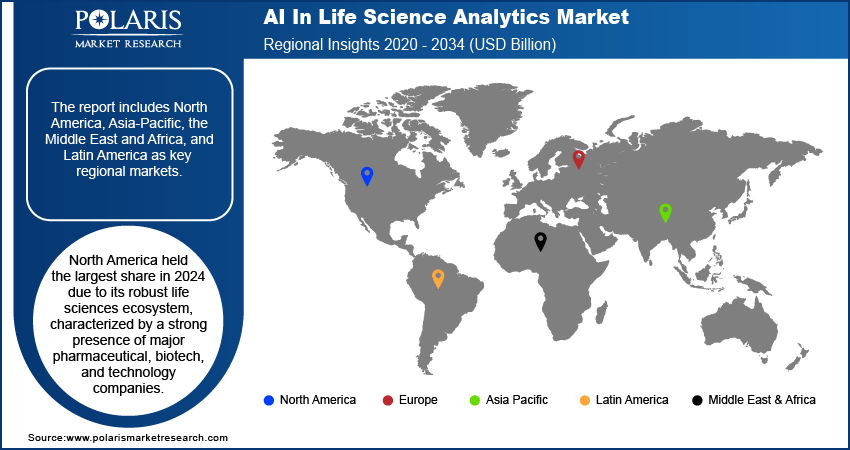
North America led the AI In Life Science Analytics Market due to higher demand for AI technologies, improved digital literacy, and breakthroughs in life science analytics in the area all contributed to this expansion. Furthermore, the United States has several major pharmaceutical and biotech firms. The massive expenditures made by US-based pharmaceutical corporations in drug research and clinical trials have resulted in a large demand for AI analytics.
Asia Pacific is predicted to develop at the fastest rate throughout the forecast period, owing to increased expenditures by various research firms in the use of AI software and hardware to improve operational efficiency. Major businesses in Asia Pacific are focusing more on the implementation of AI-based analytical tools to improve operational efficiency, which is also important for market growth.
Source: Polaris Market Research Analysis
Competitive Insight
AI in Life Science Analytics Market Competitive Landscape
Some of the major players operating in the global market include Indegene, IBM, IQVIA, SAS Institute, Databricks, Lexalytics, Sisense, and Sorcero. Atomwise, NuMedii, AiCure LLC., Nuance Communications, APIXIO, Inc., Insilico Medicine, Enlitic, Inc.
The competitive landscape of the AI in life science analytics market is characterized by the presence of tech companies, healthcare analytics vendors, and AI companies specializing in life sciences. The players are developing AI platforms, machine learning technologies, cloud analytics, and partnerships in order to boost their competitiveness in the market and increase the number of products offered. Innovation revolves around the improvement of drug discovery, clinical trial analytics, precision medicine analytics, and healthcare data management. With the increasing demand for AI-based analytics, the players are making efforts to increase their presence in the international market and improve data integration abilities and scalability of solutions.
List Of Key Companies:
- Indegene
- IBM
- IQVIA
- SAS Institute
- Databricks
- Lexalytics
- Sisense
- Sorcero
- Atomwise
- NuMedii
- AiCure LLC.
- Nuance Communications
- APIXIO, Inc.
- Insilico Medicine
- Enlitic, Inc.
Future Outlook
The future of the AI in life science analytics market is projected to be highly promising, as companies in the pharmaceutical, biotechnology, and healthcare sectors are adopting AI solutions for improving their research, development processes, and patient care services. As technology advances in areas like generative artificial intelligence, machine learning in life sciences, cloud computing, and genomics analytics, it is expected that the rate of accuracy and speed of data analysis will improve, enabling the rise of personalized healthcare and medicine development. More funding in digital health technologies and real-world data will enhance the uptake of AI-based analytics platforms.
Recent Developments
- June 2026: Microsoft revealed its partnership with Ginkgo Bioworks to connect agentic AI with autonomous experimentation. The partnership aims to help researchers move more seamlessly from hypothesis to execution. It intends to bring greater speed and scale to biological discovery.(source: microsoft.com)
- January 2026: NVIDIA and Eli Lilly and Company announced a first-of-its-kind AI co-innovation lab. The development intends to use AI to help tackle some of the most pressing challenges in the pharmaceutical sector.(source: lilly.com)
AI In Life Science Analytics Market Report Scope
| Report Attributes | Details |
| Market size value in 2025 | USD 1.96 billion |
| Market size value in 2026 | USD 2.17 billion |
| Revenue forecast in 2034 | USD 4.90 billion |
| CAGR | 10.70% from 2026 - 2034 |
| Base year | 2025 |
| Historical data | 2021 - 2024 |
| Forecast period | 2026 - 2034 |
| Quantitative units | Revenue in USD billion and CAGR from 2026 to 2034 |
| Segments covered | By Component, By Deployment, By Application, By End-user, By Region |
| Regional scope | North America, Europe, Asia Pacific, Latin America; Middle East & Africa |
| Key companies | Indegene, IBM, IQVIA, SAS Institute Inc., Databricks, Lexalytics, Sisense, Sorcero. Atomwise, Inc., NuMedii, Inc., AiCure LLC., Nuance Communications, Inc., APIXIO, Inc., Insilico Medicine, Inc., Enlitic, Inc. |
Source: Polaris Market Research Analysis
AI in Life Science Analytics Market Frequently Asked Questions
The global ai in life science analytics market size is expected to reach USD 4.90 billion by 2034.
Top market players in the market are Indegene, IBM, IQVIA, SAS Institute, Databricks, Lexalytics, Sisense, and Sorcero. Atomwise, NuMedii, AiCure LLC., Nuance Communications, APIXIO, Inc.
North America contribute notably towards the global ai in life science analytics market.
The global ai in life science analytics market expected to grow at a CAGR of 10.70% during the forecast period.
The ai in life science analytics market report covering key segments are form, product, application, and region.
The utilization of AI technology assists in clinical trials because of the ability of AI to select the right participant, analyze the trial data, track the progress of the clinical study, and predict its results. AI can help scientists conduct their research in a more efficient manner.
The industries that make use of artificial intelligence for life sciences analytics are the pharmaceutical industry, biotech firms, health care providers, medical device companies, and different kinds of research firms.
Artificial intelligence analytics allows rapid analysis of large datasets. It has helped to enhance drug discovery, clinical research, and personalized medicine.
Download Sample Report of AI In Life Science Analytics Market
Please fill out the form to request a customized copy of the research report.


