
Corn Market Size, Share, Global Analysis Report, 2026-2034
REPORT DETAILS
Corn Market Summary
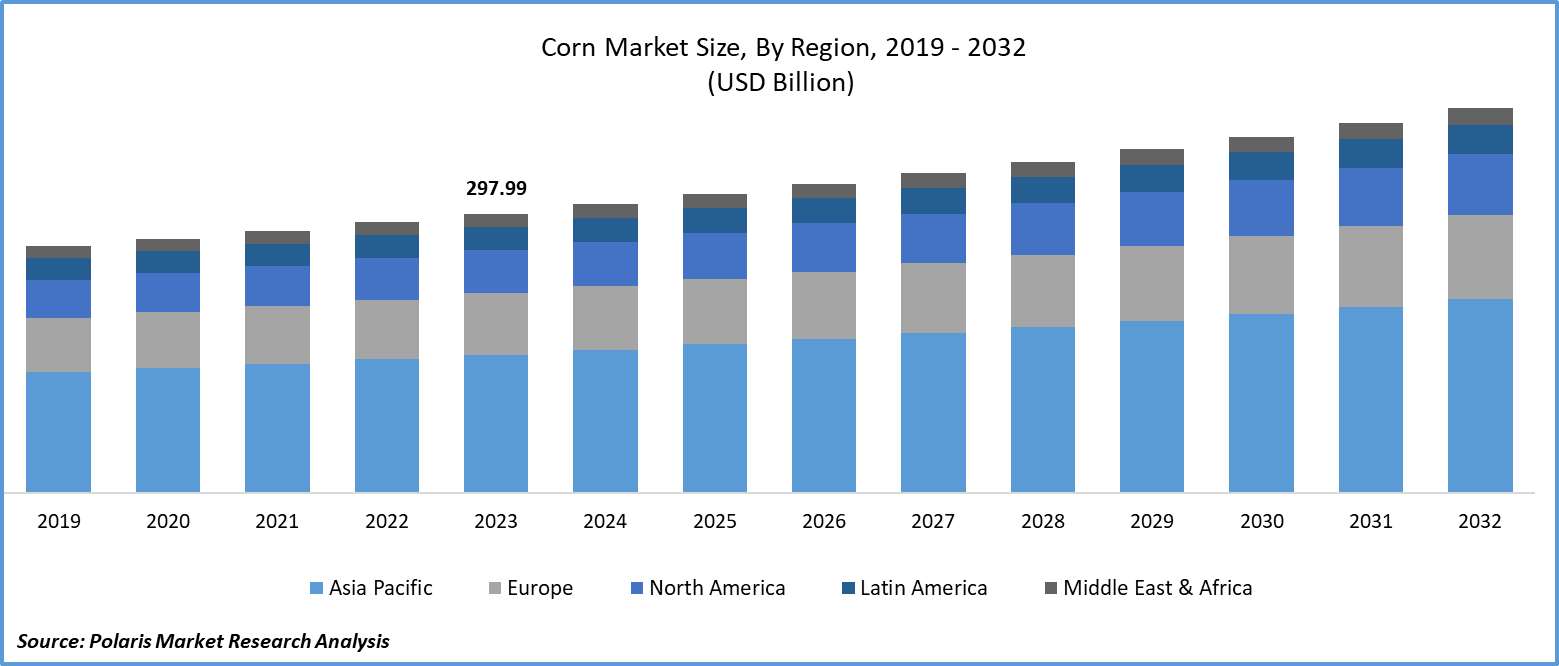
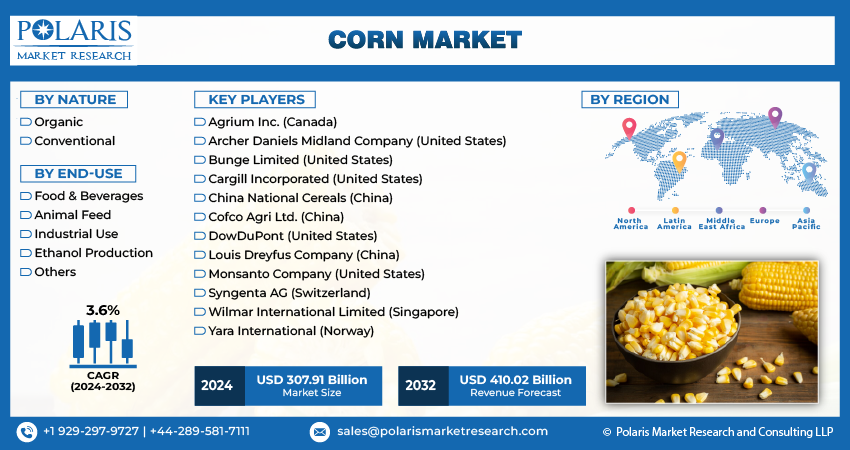
Corn market size and share was valued at USD 317.61 billion in 2025. The market is anticipated to grow from USD 327.90 billion in 2026 to USD 436.64 billion by 2034, exhibiting a CAGR of 3.6% during the forecast period. The surging corn demand across various end-user industries, such as food processing, pharmaceuticals, ethanol production, cosmetics, and animal feed, is a major factor propelling the market’s growth. Also, the robust increase in ethanol production worldwide fuels the demand for corn as a primary source of production because corn is rich in starch and carbohydrates, further likely to bode well for global market growth.
Market Statistics
Key Takeaways
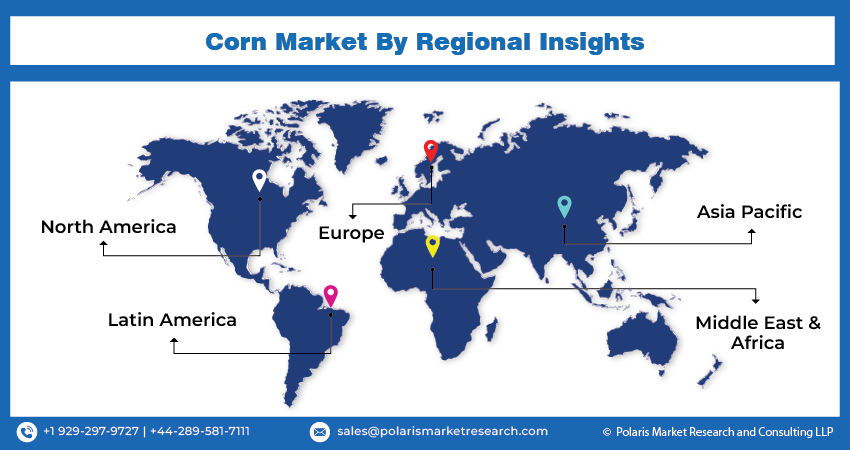
- Asia Pacific held the largest share accounting for 39.0% share in 2025. This was because densely populated countries used a lot of corn for food, animal feed, and industrial purposes.
- North America is expected to witness the fastest with a CAGR of 4.18% during the forecast period. This was due to large-scale production, advanced farming technologies, and strong exports from the United States.
- By nature, the conventional segment led with around 91.0% share in 2025. This is because it has a higher yield, lower production costs, and is more widely used than organic corn.
- The animal feed segment captured the largest share of the corn market, about 36.0% in 2025. Because corn is a cheap, high-energy feed ingredient that is widely used in raising livestock and poultry, thanks to rising global demand for meat and dairy.
Industry Dynamics
- Increasing population across the world propels the requirement for food products, including corn and corn-based products.
- High demand for corn from animal feed industry also contributes to the corn industry growth.
- Rising production of ethanol propels the demand for corn. Corn is a primary source of ethanol production as it contain high amount of starch and carbohydrates.
- Growing technological advancements in agriculture are expected to create lucrative opportunities in the market during the forecast period.
- Surging demand for biodegradable materials in industries such as bioplastics, adhesives and chemicals, and pharmaceuticals and cosmetics is driving corn-based industrial usage.
For instance, according to a report by the Energy Information Administration, the U.S. ethanol production increased from about 13.6 billion gallons per year in 2011 to approx. 17.5 billion gallons per year in 2021. Also, fuel ethanol production increased each year for the last 40 years.
As cornmeal is a kind of versatile ingredient used in numerous dishes and is also a major component in several traditional recipes of different regions, contributing to its demand and growth globally. In order to cater to this growing corn demand in food applications, companies are extensively focusing on the creation of new products with innovative presentations and trendy ways to enjoy corn.
For instance, in September 2023, ANUGA announced the launch of its new product, ‘Corn Ribs,’ which offers a unique way to present corn and has a richer flavor experience. Unlike conventional or traditional corn, which could be messy to eat, these corn ribs offer a highly manageable and innovative way to enjoy corn.
Corn, also referred to as maize, is one of the most popular cereal grains in the world. First cultivated by farmers in southern Mexico about 10,000 years ago, corn comes as kernels on a cob, wrapped by a husk. Corn is a healthy grain that’s a rich source of several vitamins and minerals, including manganese, phosphorus, magnesium, zinc, and copper. Also, it contains a number of bioactive plant compounds, such as lutein, ferulic acid, zeaxanthin, and phytic acid.
There are several varieties of corn grown worldwide, with the four main types being sweet corn, flint corn, popcorn, and dent corn. Sweet corn usually comes in yellow and has a mildly sugary taste, with flint corn being harder than sweet corn and having black, blue, white, or red color. Popcorn is a type of flint corn that comes with a starchy center, with dent corn having a dent in the top of each kernel. Advances in genetic engineering have led to the development of several innovative corn varieties, impacting the corn market demand favorably.
Corn Nutritional Profile & Benefits
Corn is a nutrient-rich cereal grain. It provides energy (96 kcal/100g) and dietary fiber (~2.4g). It also contain essential minerals such as magnesium and potassium. Corn supports digestion, heart health, and sustained energy. These benefits make it valuable in food, feed, and industrial applications.
| Nutrient / Component | Key Benefits | Market-Relevant Insight |
| Energy (Calories) | Provides quick and sustained energy due to high carbohydrate (starch) content | Makes corn a staple in food security & feed markets |
| Carbohydrates | Primary energy source; supports metabolic activity | Drives demand in processed foods & biofuel (ethanol) |
| Dietary Fiber | Improves digestion, gut health, and satiety | Supports positioning of corn in functional foods & healthy diets |
| Protein | Supports muscle repair and basic body functions | Adds value in animal feed and human nutrition |
| Magnesium | Supports heart health and muscle function | Important for nutrient-enriched food products |
| Phosphorus | Essential for bone health and energy metabolism | Key in dietary supplements & fortified foods |
| Potassium | Helps regulate blood pressure and fluid balance | Enhances corn’s role in heart-healthy diets |
| B Vitamins (B1, B3, B6, Folate) | Supports brain function, metabolism, and cell growth | Important for nutritional labeling & health claims |
| Antioxidants (Lutein, Zeaxanthin) | Promotes eye health and reduces oxidative stress | Drives demand in functional & fortified food segments |
Source: Polaris Market Research Analysis
Growth Factors
Growing Technological Advancements in Agriculture Driving the Global Market
Advancements in genetic engineering gained huge traction that led to the development of several corn varieties that are highly resistant to pests, diseases, and harsh or adverse weather conditions. Also, various other techniques like CRISPR gene editing are gaining popularity worldwide as they enable precise modifications for enhancing traits such as nutrient efficiency, drought tolerance, and growth rates, which, in turn, positively influence the market’s growth.
For instance, in March 2023, Corteva Agriscience announced a new gene editing technology, which will bring added protection to the elite corn hybrids. It uses dedicated for packaging the multiple disease-resistant traits into a single location of the gene.
Rising Population That Results in Increased Demand for Corn and Corn-Based Products to Drive Market’s Growth
As the world population continues to increase significantly, the demand for corn products and by-products from various industry verticals is growing at a substantial pace. Increasing population results in greater demand for corn for both direct human consumption and indirect human consumption through dairy and meat products. For instance, as per a report by the United Nations, the global population reached 8 billion in November 2022, an increase of 1 billion people since 2010 and 2 billion since 1998. It is estimated that the world’s population will reach 9.7 billion by 2050.
Restraining Factors
Unfavorable Trade Policies & Tariffs and Weather Volatility Likely to Hamper the Market
The presence of unfavorable trade policies and constant changes in trade regulations disrupt the global supply chains and affect product availability in the international market. Also, the production of corn is highly unpredictable due to weather volatility and conditions like droughts and floods, which, in turn, negatively impact the market.
Report Segmentation
The market is primarily segmented based on nature, end-use, and region.
| By Nature | By End-Use | By Region |
|
|
|
Source: Polaris Market Research Analysis
To Understand the Scope of this Report: Request Customization
By Nature Insights
Conventional Segment Accounted for the Largest Market Share in 2025
The conventional segment accounted for the largest share accounting for 91.0%. Segment’s dominance is attributed to the significant use of various highly innovative agricultural technologies, machinery, and synthetic inputs like pesticides and fertilizers that led to higher crop yields and improved efficiency. Additionally, the conventional corn production approach is largely adopted because of its economic feasibility and greater flexibility in management practices.
The organic segment is expected to grow at a CAGR of 6.96%. This growth is accelerated by an increasing number of consumers inclining towards organically produced food products because of its numerous health benefits and ability to reduce environmental pollution, improve soil health, and enhance crop diversity. In addition, the rising number of favorable government initiatives and programs supporting sustainable agricultural practices is further likely to fuel demand for organic corn worldwide.
By End-Use Insights
Food & Beverages Segment Held a Significant Share in 2025
The food & beverage segment captured 24.5% share in 2025. This dominance is accelerated by a rapid increase in the global population that led to increased demand for food products and continuous change in consumer dietary preferences towards conventional foods that use corn as a versatile crop. Growing technological advancements in food processing that enable the development or creation of new corn-based products are also fostering product applications in the food industry.
The animal feed segment will grow at a CAGR of 2.94% over the forecast period. Segment’s growth is attributable to a substantial rise in global livestock production and the growing consumption of meat products worldwide. The product is widely adopted as a key ingredient for animal feed because it provides essential nutrients for livestock growth, resulting in increased demand in the segment. For instance, in March 2023, the total meat production in India was about 9.29 million tonnes, with an increase of 5.62% compared to the previous year.
Regional Insights
Asia Pacific Region Dominated the Global Market in 2025
The Asia Pacific region dominated the global market with the largest market revenue share of 39.0%. The region’s dominance is driven by growing human consumption of various corn-based products and the rising livestock industry across the region. Also, the availability of favorable weather patterns and climate conditions for the production of corn and supportive policies and trade regulations for corn farmers boost the overall production. For instance, In May 2022, India’s maize consumption is growing at a steady pace and is estimated to reach around 33.8 million metric tonnes in 2030, with a major contribution to industrial usage.
North America region is anticipated to emerge as the fastest growing region. The region’s growth is attributed to a rapid increase in the number of fuel ethanol production facilities in the United States and growing advances in biotechnology that include the development of genetically modified corn varieties. For instance, according to the Ethanol Producer Magazine published in September 2023, the U.S. total ethanol production capacity increased by 18 MMgy during the period of January 2022 to January 2023.
Major Corn Producing Countries
| Country | Global Share | Key Characteristics | Market Role |
| U.S. | ~30–32% | Advanced mechanization, high yields, strong ethanol industry | Largest producer & exporter; price benchmark globally |
| China | ~24% | Large domestic consumption, mainly for animal feed | Major producer but limited exports; drives global demand |
| Brazil | ~10–11% | Double cropping (safrinha), expanding exports | Fastest-growing exporter; strong competitor to U.S. |
| Argentina | ~4% | Export-oriented production, favorable climate | Key global supplier; major exporter to Asia & Latin America |
Source: Polaris Market Research Analysis
Key Market Players & Competitive Insights
Increasing Product Applications and Quality Driving the Market’s Competition
The corn market is moderately fragmented and is expected to witness competition due to several players' presence. Key companies are extensively focusing on several growth strategies, including partnerships, collaborations, acquisitions, and new product launches. Also, companies are competing on factors like improving product quality, enhancing supply chain efficiency, adopting sustainable practices, and offering competitive prices to establish a strong market presence. For instance, in May 2023, Reliance Consumer Products announced the launch of popular corn chips Alan's Bugles in India. These chips are likely to be available at a pocket-friendly price and in different flavors, including Salted, Tomato, and Cheese.
Some of the major players operating in the global market include:
- Agrium Inc. (Canada)
- Archer Daniels Midland Company (United States)
- Bunge Limited (United States)
- Cargill Incorporated (United States)
- China National Cereals (China)
- Cofco Agri Ltd. (China)
- DowDuPont (United States)
- Louis Dreyfus Company (China)
- Monsanto Company (United States)
- Syngenta AG (Switzerland)
- Wilmar International Limited (Singapore)
- Yara International (Norway)
Recent Developments in the Industry
- April 2026: Kalshi opened a commodities hub with trading markets linked to corn. This made it easier to find prices, increased trading activity, and got more investors involved in the corn market. (Source: kalshi.com)
- March 2025: Cargill announced the inauguration of its corn milling plant in Gwalior, Madhya Pradesh, India. In partnership with Saatvik Agro Processors, the plant will serve dairy and infant formula makers with a reliable, local supply. (Source: cargill.com)
- December 2025: Maizex Seeds invested in a new seed corn facility in Canada. This made the corn market stronger by increasing the amount of corn that could be grown, the quality of the seeds, and the amount of food that could be grown. (Source: maizex.com/)
Report Coverage
The corn market report emphasizes key regions across the globe to provide better understanding of the product to the users. Also, the report provides market insights into recent developments, and trends and analyzes the technologies that are gaining traction around the globe. Furthermore, the report covers an in-depth qualitative analysis pertaining to various paradigm shifts associated with the transformation of these solutions.
The report provides a detailed analysis of the market while focusing on various key aspects such as competitive analysis, nature, end-use, and futuristic growth opportunities.
Corn Market Report Scope
| Report Attributes | Details |
| Market size value in 2025 | USD 317.61 billion |
| Market size value in 2026 | USD 327.90 billion |
| Revenue Forecast in 2034 | USD 436.64 billion |
| CAGR | 3.6% from 2026 – 2034 |
| Base year | 2025 |
| Historical data | 2021 – 2024 |
| Forecast period | 2026 – 2034 |
| Quantitative units | Revenue in USD billion and CAGR from 2026 to 2034 |
| Segments Covered |
|
| Regional scope |
|
| Competitive Landscape |
|
| Report Format |
|
| Customization | Report customization as per your requirements with respect to countries, regions, and segmentation. |
Source: Polaris Market Research Analysis
Browse Our Top Selling Reports
Real-time PCR, Digital PCR, And End-point PCR Market
Veterinary Active Pharmaceutical Ingredients Manufacturing Market
Delve into the intricacies of Non-Invasive Prenatal Testing in 2025 through the meticulously compiled market share, size, and revenue growth rate statistics by Polaris Market Research Industry Reports. Uncover a comprehensive analysis that not only projects market trends up to 2034 but also provides valuable insights into the historical landscape. Immerse yourself in the depth of this industry analysis by acquiring a Download Sample Report.
Corn Market FAQ's
The global corn market size is expected to reach USD 317.61 billion by 2034.
Key players in the market are Konica Minolta Sensing Europe, Solaris Technology Industry, Tata Power Solar Systems, SunPower Corporation
Asia Pacific dominated the global Corn Market accounting for 39.0%.
Corn market exhibiting the CAGR of 3.6% during the forecast period.
The Corn Market report covering key segments are nature, end-use, and region.
Download Sample Report of Corn Market
Please fill out the form to request a customized copy of the research report.


