
Drone Package Delivery Market Size, Share, Trends & Forecast, 2026–2034
REPORT DETAILS
Drone Package Delivery Market Summary
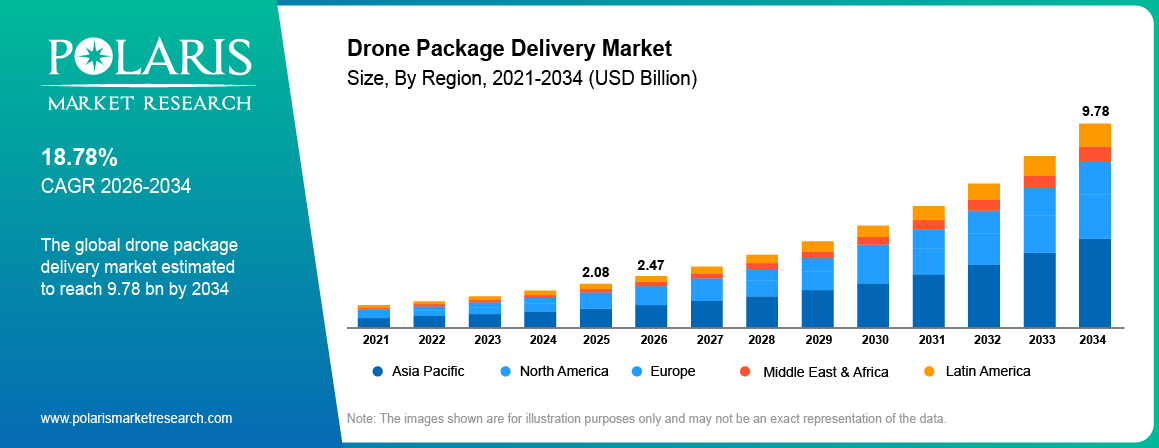
Global drone package delivery market size was valued at USD 2.08 Billion in 2025. The drone package delivery industry is projected to grow from USD 2.47 Billion in 2026 to USD 9.78 Billion by 2034, exhibiting a compound annual growth rate (CAGR) of 18.78% during the forecast period.
Market Statistics
Drone Package Delivery Market Key Takeaways
- North America held the largest share of the drone package delivery market at 36.8% in 2025. Growing FAA approvals and the presence of major service providers are supporting regional adoption.
- Asia Pacific is expected to grow at a CAGR of 21.4% during 2026–2034. Rising e-commerce activity, traffic congestion, and adoption of advanced drone technology are driving demand.
- Short-range (<25 km) drones accounted for 61.5% of market revenue in 2025. Their growing use for food, medicine, and e-commerce deliveries is supporting faster instant and same-day delivery services.
- Medical aid accounted for 28.7% of market revenue in 2025. The need for rapid delivery of medical supplies to remote and inaccessible areas is driving segment growth.
- Medium-range (25–50 km) drones are expected to grow at a CAGR of 20.6% during 2026–2034. Their ability to support deliveries across longer urban and suburban routes is creating new opportunities.
- Food delivery is expected to grow at a CAGR of 19.8% during 2026–2034. Increasing use of drones for quick food and grocery deliveries is supporting adoption in urban and suburban areas.
Note: Figures and projections outlined in this report are the result of Polaris Market Research’s proprietary analytical processes, grounded in the latest available datasets and market observations.
What Is Drone Package Delivery?
Drone package delivery uses unmanned aerial vehicles (UAVs) to transport goods from one location to another. It offers a faster and more flexible option for last-mile logistics, especially where road-based delivery can be slow or difficult. Drones are used to transport food, medicines, retail products, and other goods.
The market is growing as improvements in battery technology increase drone power efficiency and payload capacity. Regulatory support is also helping expand the use of delivery drones. By reducing the need for large delivery vehicles, drones can help ease traffic congestion and support more efficient delivery operations.
How Drone Package Delivery Works
Drone package delivery follows a series of steps to move goods from a fulfillment point to the customer. The process combines order processing, package preparation, route planning, drone navigation, and delivery systems.
Order Placement
The process begins when a customer places an order and selects drone delivery, where the service is available. The delivery system receives the order details, including the delivery location, package size, and required delivery time.
Package Preparation
The package is prepared at a fulfillment center or designated delivery location. It is checked for weight and size to ensure that it meets the drone's carrying capacity and delivery requirements.
Route Planning
The delivery system identifies a suitable flight route between the starting point and the delivery location. The route is planned based on distance, operating conditions, airspace requirements, and other safety factors.
Drone Selection
A suitable drone is selected based on the package weight, delivery distance, and operating requirements. The system assigns a drone with the required payload capacity and battery range for the delivery.
Flight and Navigation
The drone takes off after the delivery is approved and follows the planned route to the destination. GPS, sensors, cameras, and navigation systems help the drone maintain its route and respond to obstacles or changes during the flight.
Package Delivery
The drone reaches the designated delivery location and releases or hands over the package using its delivery mechanism. Depending on the service model, the package may be delivered to a specific location or collected by the customer.
Return or Next Delivery
After completing the delivery, the drone may return to its base for recharging and further assignments. In some operations, the drone can continue to another delivery if sufficient battery power and operational capacity are available.
Market Dynamics
Market Driver- Rising Demand for Fast Deliveries
Demand for faster deliveries is encouraging retailers to expand drone services for everyday orders. In May 2026, Walmart reported more than 1 Million drone deliveries to hundreds of thousands of customers, with an average delivery time of 23 minutes. This growing use of drone delivery shows the rising demand for quick access to food, medicines, and other everyday products (Source: corporate.walmart.com).
Market Driver- Growing Adoption in Logistics
Drone delivery is moving beyond small pilot programs as logistics providers expand commercial operations. In January 2026, Zipline reported more than 2 Billion commercial deliveries and announced plans to expand its service to Houston and Phoenix. The company also raised more than $600 Billion to support its next stage of growth and autonomous delivery expansion (Source: zipline.com).
Market Opportunity- Expansion of Autonomous Delivery Networks
The expansion of autonomous delivery networks is creating opportunities for retailers to reach more customers through automated fleets. In January 2026, Wing and Walmart announced plans to add 150 Walmart stores to their drone delivery network. The expansion is expected to bring the service to more than 40 Billion Americans, showing the potential for wider residential drone delivery (Source: wing.com).
Market Opportunity- Increasing Commercial Drone Operations
The expansion of approved commercial drone operations is creating new opportunities for the drone package delivery market. As regulatory frameworks become clearer, more operators can expand beyond pilot projects and develop regular delivery services. Greater approval for commercial flights can support wider service coverage, longer delivery routes, and increased use of BVLOS drone delivery. In April 2025, Drone Express became the seventh U.S. drone operator to receive FAA Part 135 authority for small-package delivery, highlighting the progress toward larger-scale commercial drone operations (Source: faa.gov).
Market Restraint- Regulatory and Airspace Limitations
Regulatory requirements remain a key challenge for market expansion. In the U.S., Part 135 is the regulatory path for commercial BVLOS package delivery, while operators also need airspace authorizations and other approvals. These requirements can increase the time and resources needed to launch and scale drone delivery services.
Benefits of Drone Package Delivery
Drone package delivery offers several benefits for businesses and customers. It can reduce delivery times by avoiding road traffic and using direct flight routes. This is useful for time-sensitive products such as medicines, food, and other essential goods.
Drones can also help improve access to areas where road-based delivery is difficult or slow. They can support last-mile logistics without requiring large delivery vehicles for every shipment. This can help reduce traffic on roads and improve delivery efficiency.
Drone delivery may also support sustainability goals when it replaces suitable road trips. Electrical small drones can reduce the need for fuel-powered vehicles for certain short-distance deliveries. However, the environmental benefit depends on factors such as drone type, battery use, delivery distance, and the transportation method being replaced.
Drone Delivery in E-Commerce
Drone delivery is becoming an important option for e-commerce companies looking to improve last-mile fulfillment. Drones can transport small packages directly from nearby stores, fulfillment centers, or local delivery hubs to customers. This can help reduce delivery times and support same-day or on-demand delivery.
For e-commerce businesses, drone delivery can also improve access to customers in congested urban areas and locations where road-based delivery takes longer. Retailers can use local inventory to fulfill orders quickly, while drone fleets can handle selected short-distance deliveries. As e-commerce continues to grow, drone delivery can support faster and more flexible fulfillment operations.
Autonomous Delivery Drone Technology
Autonomous delivery drones are using advanced technologies to improve the speed, safety, and efficiency of package delivery. AI, computer vision, sensors, and fleet management systems allow drones to operate with less manual control. These technologies also support route planning, obstacle detection, real-time tracking, and coordination across multiple drones. Different drone designs, including multirotor, fixed-wing, and hybrid models, are used based on delivery distance and operating requirements.
AI-Based Navigation and Route Optimization
AI-based navigation helps autonomous delivery drones select efficient flight paths based on distance, weather, airspace conditions, and delivery locations. AI systems can process this information and adjust routes when conditions change during a flight. Route optimization can reduce travel time and battery use while helping operators manage multiple deliveries more efficiently.
Computer Vision and Obstacle Avoidance
Computer vision helps delivery drones understand their surroundings during flight. Cameras and onboard sensors can identify buildings, trees, vehicles, and other objects along the route. The drone can use this information to detect potential obstacles and adjust its path when needed. This technology supports safer autonomous delivery and reduces the need for continuous manual control.
Fleet Management and Real-Time Tracking
Fleet management systems allow operators to monitor multiple delivery drones from a central platform. These systems provide real-time information on drone location, battery status, delivery progress, and operating conditions. Operators can use this information to coordinate flights, manage delivery schedules, and respond quickly when a drone requires assistance or a route needs to be changed.
Technology Comparison: Delivery Drone Architectures
| Architecture | Strengths | Trade-offs | Best-Fit Package Delivery Use Cases |
| Multirotor / Rotary Wing | Can take off and land vertically. Easy to operate in small or crowded areas. | Has shorter range and flight time. Payload capacity can also limit range. | Urban deliveries, food, small retail packages, and short-distance medical deliveries. |
| Fixed Wing | Can fly longer distances and stay in the air for longer periods. | Needs a suitable area for takeoff and landing. | Long-distance, rural, remote, and medical deliveries. |
| Hybrid / VTOL | Can take off and land vertically and fly efficiently over longer distances. | Has a more complex design and operating system. | Urban and rural deliveries and longer routes with limited landing space. |
Source: Polaris Market Research Analysis
Beyond Visual Line of Sight (BVLOS) Drone Operations
Beyond Visual Line of Sight (BVLOS) operations allow delivery drones to fly beyond the direct visual range of a remote pilot. This capability is important for scaling drone package delivery because operators can serve customers across longer distances without keeping a pilot in constant visual contact with the drone.
Regulatory approval is a key factor in expanding BVLOS operations. Aviation authorities set requirements related to airspace, safety, navigation, communication, and remote monitoring before allowing commercial BVLOS flights. Meeting these requirements can take time and increase operating costs for delivery companies. However, clearer BVLOS rules and approvals can support larger delivery networks and make autonomous drone operations more practical.
Drone Delivery vs. Traditional Delivery
Drone package delivery and traditional delivery differ in speed, routing, infrastructure, and human involvement. Drones can use direct flight paths and avoid road traffic, which can support faster deliveries over short distances. Traditional delivery relies on roads and delivery vehicles but can handle larger packages and longer routes. The choice depends on package size, delivery distance, location, and operating conditions.
| Feature | Drone Package Delivery | Traditional Ground Delivery |
| Routing | Uses direct aerial routes where permitted. | Uses road-based routes. |
| Traffic Exposure | Can avoid road traffic and congestion. | Directly affected by road traffic and congestion. |
| Human Involvement | Can be highly automated with remote oversight. | Usually requires driver or courier involvement. |
| Access | Can reach some difficult-to-access locations. | Depends on road and access infrastructure. |
| Payload | Usually limited by drone payload capacity and safety requirements. | Generally supports higher payload capacity. |
| Weather Sensitivity | Can be more affected by wind, rain, and other flight conditions. | Can also be affected by weather but uses established road infrastructure. |
| Infrastructure | Requires launch or landing areas, charging facilities, and digital fleet systems. | Requires roads, delivery hubs, vehicles, and local delivery facilities. |
Source: Polaris Market Research Analysis
Environmental Benefits and Sustainability Considerations
Drone package delivery can support sustainability by reducing the need for some road-based delivery trips. Electric drones do not use fuel during flight, which can help lower direct emissions when they replace suitable vehicle journeys.
Drones can also help reduce traffic and improve delivery efficiency, especially for short-distance routes. However, their environmental benefits are not the same for every delivery. Battery production, charging requirements, drone manufacturing, payload capacity, and the type of vehicle being replaced can affect the overall environmental impact.
Drone Package Delivery Market Segmentation
By Solution
The global drone package delivery market segmentation, based on solution, includes platform, infrastructure, software, and services. The platform segment accounted for 64.2% of market revenue in 2025. This was supported by the growing use of UAV platforms, onboard electronics, communication systems, and payload mechanisms for package delivery.
The software segment is expected to grow at a CAGR of 21.3% during 2026–2034. Software supports route planning, fleet management, live tracking, and autonomous navigation, helping operators manage drone deliveries more efficiently.
By Drone Type
The global drone package delivery market segmentation, based on drone type, includes multirotor, fixed-wing, and hybrid drones. The multirotor segment accounted for 68.7% of market revenue in 2025. Its vertical takeoff and landing capability makes it suitable for urban areas, residential locations, and short-distance package delivery.
The hybrid drone segment is expected to grow at a CAGR of 22.1% during 2026–2034. Hybrid drones combine vertical takeoff and landing with efficient forward flight. This design allows them to cover longer routes while maintaining flexibility in areas with limited landing space. They can support deliveries across both urban and rural locations.
Drone Package Delivery Range Insights
The global drone package delivery market segmentation, based on range, includes long (>50 km), medium (25–50 km), and short (<25 km). In 2025, the short (<25 km) segment accounted for 61.5% of market revenue. Its growth is supported by the increasing use of drones for food, medicine, and e-commerce deliveries in urban and suburban areas, where shorter routes enable faster and same-day delivery.
The medium (25–50 km) segment is expected to grow at a CAGR of 20.6% during 2026–2034. The segment is gaining demand for deliveries between urban and suburban locations, where drones can cover longer distances while reducing dependence on road-based transportation.
By Operation Mode
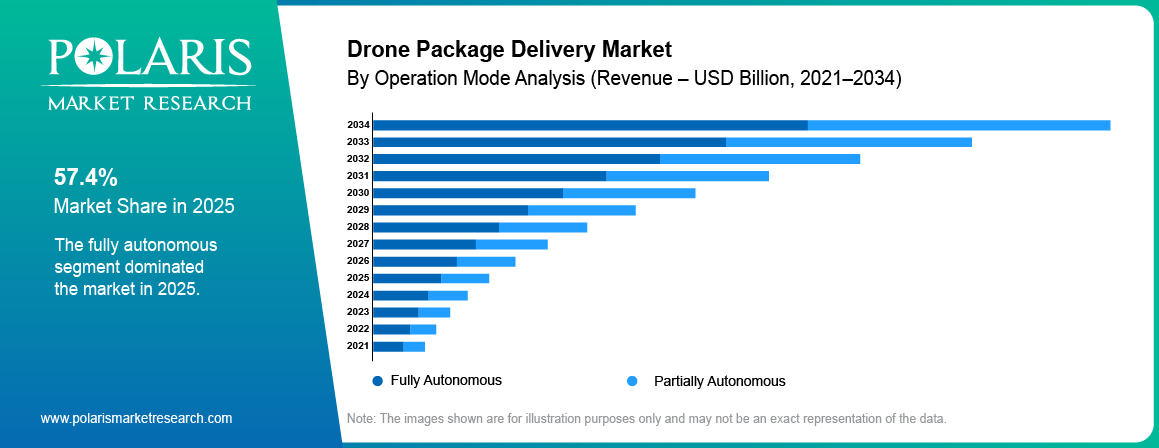
The global drone package delivery market segmentation, based on operation mode and duration, includes fully autonomous and partially autonomous operations. The fully autonomous segment accounted for 57.4% of market revenue in 2025. These systems can complete delivery tasks with limited human involvement and use automated navigation, flight control, and route planning.
The partially autonomous segment is expected to grow at a CAGR of 19.6% during 2026–2034. These drones perform several flight and delivery tasks automatically but can still be monitored or controlled remotely when needed. This approach can help operators maintain greater control while increasing the use of autonomous delivery technology.
By Package Size
The global drone package delivery market segmentation, based on package size, includes >5 kg, 2–5 kg, and <2 kg packages. The <2 kg segment accounted for 59.8% of market revenue in 2025. Its growth is supported by the increasing use of delivery drones for lightweight products, including food, medicines, groceries, and small retail orders. These packages require lower payload capacity and are suitable for short-distance deliveries in urban and suburban areas.
The 2–5 kg segment is expected to grow at a CAGR of 20.4% during 2026–2034. This segment can support a wider range of deliveries, including larger food orders, household products, medical supplies, and retail packages. As drone technology improves, higher payload capacity can help delivery operators serve more customers and expand drone-based last-mile delivery services.
By Delivery Duration
The global drone package delivery market segmentation, based on delivery duration, includes long duration (>30 min) and short duration (<30 min). The short duration (<30 min) segment accounted for 62.9% of market revenue in 2025. Its growth is supported by the increasing use of delivery drones for quick transportation of food, medicines, groceries, and small retail packages. Shorter delivery times can improve customer convenience and support faster last-mile delivery in urban and suburban areas.
The long duration (>30 min) segment is expected to grow at a CAGR of 22.5% during 2026–2034. This segment supports deliveries that require longer flight times and can be useful for reaching remote locations or covering greater distances. Improvements in battery technology, drone range, and flight efficiency can help expand the use of longer-duration drone delivery services.
By End-Use
The global drone package delivery market segmentation, based on end-use, includes food delivery, retail goods delivery, postal delivery, medical aid, precision agriculture, industrial delivery, weapons & ammunition, and maritime delivery. The medical aid segment accounted for 28.7% of market revenue in 2025. The segment continues to benefit from the growing use of drones to transport medicines, diagnostic samples, vaccines, and other essential healthcare supplies to remote and difficult-to-access locations.
The food delivery segment is expected to grow at a CAGR of 19.8% during 2026–2034. Demand is increasing as restaurants, retailers, and delivery providers explore drones for faster transportation of food and other time-sensitive orders. In 2026, the use of drone delivery for food is expanding as companies test and scale autonomous delivery services in urban and suburban areas.
Regional Market Trends
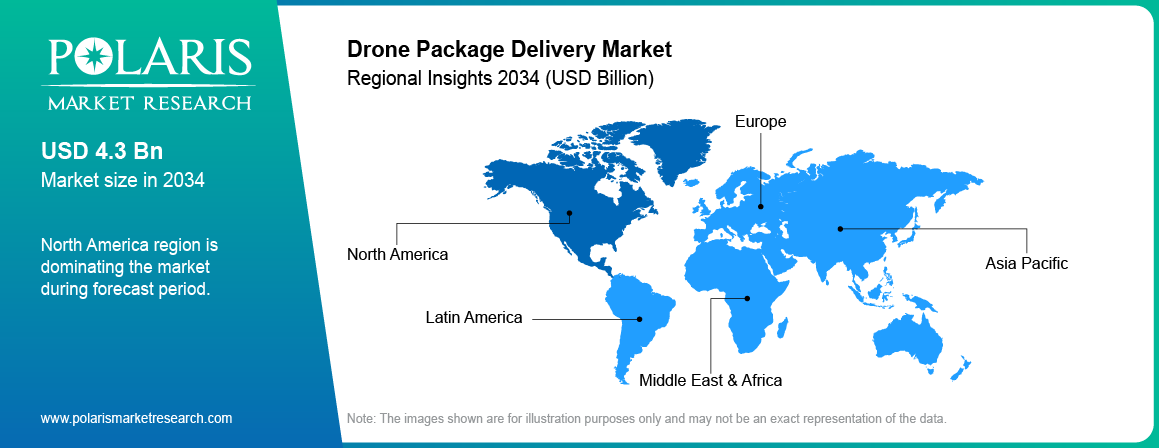
The global drone package delivery market is studied across North America, Europe, Asia Pacific, Latin America, and the Middle East & Africa. Regional growth is influenced by regulatory support, e-commerce activity, technology adoption, infrastructure development, and the need for faster last-mile delivery. North America has a strong position due to the presence of major drone delivery providers and regulatory progress, while Asia Pacific is seeing growing demand from e-commerce and urban delivery applications.
North America
North America accounted for 36.8% of market revenue in 2025, making it one of the leading regional markets for drone package delivery. The region benefits from the presence of major drone delivery providers, growing commercial applications, and continued regulatory progress. Increasing use of autonomous delivery drones for food, retail products, and medical supplies is also supporting market growth. The expansion of BVLOS operations and improvements in drone navigation and fleet management are expected to further support regional adoption.
Asia Pacific
Asia Pacific is expected to register the fastest CAGR of 21.4% during 2026–2034. Growth is supported by expanding e-commerce activity, high urban population density, traffic congestion, and increasing adoption of drone delivery technology. Countries such as China, Japan, India, and South Korea are exploring delivery drones for food, groceries, healthcare supplies, and other time-sensitive packages. The region's large consumer base and growing demand for quick deliveries are creating opportunities for last-mile drone delivery services.
Europe
Europe is witnessing increasing adoption of drone package delivery as businesses explore faster and more flexible last-mile logistics solutions. Regulatory developments, investments in drone technology, and growing interest in autonomous delivery are supporting regional expansion. Delivery drones are being evaluated for applications such as food delivery, healthcare logistics, retail orders, and deliveries to remote locations. Improvements in airspace management and autonomous flight capabilities can further support the development of commercial drone delivery networks.
Latin America
Latin America is an emerging market for drone package delivery. Adoption is supported by the need to improve access to remote areas and strengthen last-mile logistics. Drones can help transport medicines, food, and essential goods to locations where limited road infrastructure or long travel distances make conventional delivery more difficult.
Middle East & Africa
The Middle East & Africa region is also witnessing growing interest in drone package delivery. Drones can support the transportation of medical supplies, food, and other essential goods to remote or difficult-to-access locations. Growing investment in drone technology and improvements in connectivity can further support the development of commercial delivery applications across the region.
Key Market Players & Competitive Insights
Leading companies in the drone package delivery market are investing in autonomous flight technology, fleet management, navigation systems, and delivery infrastructure to expand commercial operations. Companies are also using partnerships, regulatory approvals, new drone platforms, and in-house delivery systems to strengthen their market position. As competition increases, providers are focusing on improving delivery speed, payload capacity, safety, and operational efficiency.
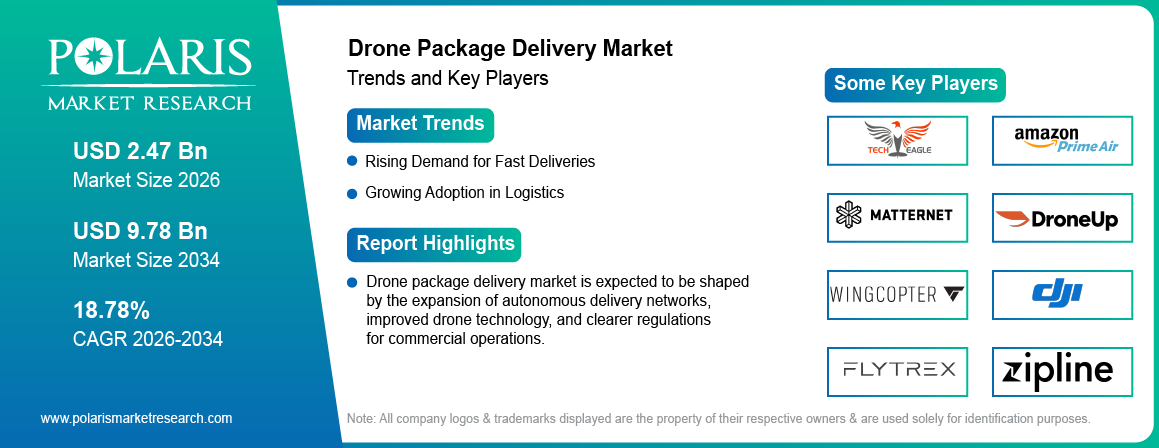
The market is also seeing greater integration between drone operators, retailers, restaurants, healthcare providers, and logistics companies. Recent developments include the expansion of commercial delivery networks, FAA certifications, new autonomous aircraft, and partnerships designed to support large-scale last-mile delivery. Key companies in the market include Amazon Prime Air, SZ DJI Technology Co., Ltd., DoorDash Air, DroneUp LLC, Flytrex Aviation Ltd., Matternet, Inc., TechEagle Innovations Pvt. Ltd., Wing Aviation LLC, Wingcopter GmbH, and Zipline International Inc.
Amazon Prime Air is Amazon's drone delivery service, providing rapid delivery of eligible products such as groceries, medicines, electronics, and household items. In August 2026, Amazon announced plans to expand Prime Air to nearly 500 cities and towns in the U.S. by the end of 2026. The company stated that Prime Air had already delivered hundreds of thousands of packages during 2026 and was operating from multiple locations across the country (Source: aboutamazon.com).
DoorDash Air is another major recent development in the market. In July 2026, DoorDash received FAA Part 135 air carrier certification and launched its in-house drone delivery program. In September 2026, the company unveiled a purpose-built autonomous aircraft for DoorDash Air, with pilot deliveries planned in Northern California. The system combines the aircraft with loading infrastructure and DoorDash's delivery platform to support local food delivery (Source: about.doordash.com).
Key companies in the drone package delivery market include:
- Amazon Prime Air
- SZ DJI Technology Co., Ltd.
- DoorDash Air
- DroneUp LLC
- Flytrex Aviation Ltd.
- Matternet, Inc.
- TechEagle Innovations Pvt. Ltd.
- Wing Aviation LLC
- Wingcopter GmbH
- Zipline International Inc.
Vendor Positioning
| Company / Operator | Positioning Relevant to Package Delivery | Key Delivery Applications | Key Strengths |
| Amazon Prime Air | Retail-led drone delivery service integrated with Amazon’s e-commerce and fulfillment network. | E-commerce, retail products, groceries, and household items | Large fulfillment network and established customer base |
| DJI | Drone technology supplier offering cargo-capable aircraft for logistics and delivery applications. | Cargo transport, logistics, industrial delivery, and remote-area transport | Advanced drone hardware, payload capacity, and flight technology |
| DoorDash Air | Local-commerce drone delivery service designed to support fast food and other local deliveries. | Food delivery and local retail orders | Integration with a large delivery platform and local merchant network |
| DroneUp LLC | U.S.-based drone delivery and logistics operator serving commercial delivery applications. | Retail, food, healthcare, and local deliveries | U.S. delivery operations and autonomous drone technology |
| Flytrex Aviation Ltd. | Autonomous drone delivery company focused on food and local deliveries. | Restaurant and food delivery | Fast local delivery and autonomous flight capabilities |
| Matternet, Inc. | Drone delivery technology company serving healthcare, logistics, and urban delivery applications. | Medical supplies, healthcare logistics, and urban deliveries | Autonomous delivery systems and healthcare logistics experience |
| TechEagle Innovations Pvt. Ltd. | Indian drone technology company focused on autonomous delivery and logistics applications. | Healthcare, e-commerce, food, and essential goods | BVLOS operations and delivery experience in India |
| Wing Aviation LLC | Autonomous drone delivery operator serving residential and retail customers through commercial delivery networks. | Food, retail products, groceries, and household items | Autonomous delivery network and retail partnerships |
| Wingcopter GmbH | Drone manufacturer and logistics technology company focused on delivery and transport applications. | Healthcare, parcel delivery, and logistics | Long-range aircraft and vertical takeoff and landing capability |
| Zipline International Inc. | Autonomous delivery company providing healthcare and consumer delivery services through drone networks. | Medical supplies, prescriptions, food, and retail products | Large-scale autonomous delivery network and long-range operations |
Source: Polaris Market Research Analysis
Innovations in Drone Package Delivery
Innovation in drone package delivery is focused on improving autonomous navigation, delivery efficiency, safety, and fleet operations. Advances in artificial intelligence, computer vision, sensors, and real-time data processing are helping drones operate with less human intervention. These technologies support route planning, obstacle detection, package tracking, and safer flight operations.
Another area of innovation is the development of more efficient drone designs and delivery systems. Hybrid VTOL drones can combine vertical takeoff and landing with longer-distance flight, while improved batteries can support greater flight time and payload capacity. Fleet management platforms also allow operators to monitor multiple drones, track deliveries, manage battery levels, and adjust routes when conditions change. Charging stations and automated launch systems are further supporting the development of larger drone delivery networks.
Recent Developments
- August 2026: Amazon announced plans for Prime Air to reach nearly 500 U.S. cities and towns by the end of 2026, highlighting the continued expansion of commercial drone delivery networks. (Source: aboutamazon.com)
- August 2026: Zipline announced a partnership with Uber to expand drone delivery services across the U.S., supporting the integration of autonomous drone delivery with a major consumer delivery platform. (Source: investor.uber.com)
- August 2026: The FAA announced Phase 2 expansion of the BEYOND program, supporting the development of advanced drone operations and greater integration of drones into the national airspace. (Source: faa.gov)
- July 2026: DoorDash received FAA Part 135 air-carrier certification for DoorDash Air, marking an important regulatory and commercial milestone for its drone delivery operations. (Source: about.doordash.com)
- June 2026: Wing and Walmart announced expansion into seven additional markets, with plans to build a drone delivery network covering more than 270 locations by 2027. (Source: wing.com)
- March 2026: Zipline reported more than two Billion commercial deliveries and continued work on reducing drone noise, supporting the company's growing delivery scale and efforts to improve public acceptance. (Source: zipline.com)
- February 2026: Rwanda expanded nationwide autonomous delivery coverage with Zipline, demonstrating the use of drone delivery networks for healthcare and other essential deliveries across a national market. (Source: zipline.com)
- June 2025: DoorDash and Flytrex launched drone delivery services across the Dallas–Fort Worth metropolitan area, enabling rapid deliveries from a range of local and national restaurant partners. (Source: about.doordash.com)
Future of the Drone Package Delivery Market
The future of the drone package delivery market is expected to be shaped by the expansion of autonomous delivery networks, improved drone technology, and clearer regulations for commercial operations. Advances in AI-based navigation, obstacle detection, fleet management, and battery technology can help drones operate more efficiently and support larger delivery networks.
The use of drones is also expected to expand across e-commerce, food delivery, healthcare, retail, and emergency logistics. As companies move from pilot programs to commercial operations, drone delivery can become a more practical option for selected last-mile routes. Greater adoption of BVLOS operations, improved airspace management, and partnerships between drone companies, retailers, and delivery platforms are likely to support market growth through 2034.
Research Methodology
The drone package delivery market study uses a structured research approach that combines primary and secondary research to assess market size, growth trends, competitive developments, and regional opportunities. Secondary research includes company reports, government publications, regulatory updates, industry databases, and other reliable sources related to drone delivery, UAV technology, logistics, and last-mile transportation.
Primary research involves gathering information from industry participants, technology providers, logistics companies, and other relevant stakeholders. The collected information is reviewed and cross-checked to improve accuracy and consistency. Market estimates are developed by analyzing historical data, current market conditions, industry trends, technology adoption, and regional developments.
The study also examines market segmentation by range, solution, drone type, operation mode and duration, package size, delivery duration, and end-use. Competitive analysis considers key companies, their market activities, product and technology developments, partnerships, and expansion strategies. Regional analysis covers North America, Europe, Asia Pacific, Latin America, and the Middle East & Africa.
Market Segmentation:
Drone Package Delivery Solution Outlook (Revenue, USD Billion, 2021-2034)
- Platform
- Software
- Service
- Infrastructure
Drone Package Delivery Type Outlook (Revenue, USD Billion, 2021-2034)
- Fixed Wing
- Multirotor
- Hybrid
Drone Package Delivery Range Outlook (Revenue, USD Billion, 2021-2034)
- Long (>50 km)
- Medium (25-50 km)
- Short (<25 km)
Drone Package Delivery Package Size Outlook (Revenue, USD Billion, 2021-2034)
- >5 kg
- 2-5 kg
- <2 kg
Drone Package Delivery Operation Mode Outlook (Revenue, USD Billion, 2021-2034)
- Fully Autonomous
- Partially Autonomous
Drone Package Delivery Duration Outlook (Revenue, USD Billion, 2021-2034)
- Long Duration (>30 min)
- Short Duration (<30 min)
Drone Package Delivery End-Use Outlook (Revenue, USD Billion, 2021-2034)
- Medical Aid
- Precision Agriculture
- Food Delivery
- Industrial Delivery
- Weapons & Ammunition
- Retail Goods Delivery
- Postal Delivery
- Maritime Delivery
By Regional Outlook (Revenue, USD Billion, 2021-2034)
- North America
- United States
- Canada
- Europe
- Germany
- France
- United Kingdom
- Italy
- Spain
- Netherlands
- Russia
- Rest of Europe
- Asia Pacific
- China
- Japan
- India
- Malaysia
- South Korea
- Indonesia
- Australia
- Vietnam
- Rest of Asia Pacific
- Middle East & Africa
- Saudi Arabia
- United Arab Emirates
- Israel
- South Africa
- Rest of Middle East & Africa
- Latin America
- Mexico
- Brazil
- Argentina
- Rest of Latin America
Report Scope
| Report Attributes | Details |
| Market Size Value in 2025 | USD 2.08 billion |
| Market Size Value in 2026 | USD 2.47 Billion |
| Revenue Forecast in 2034 | USD 9.78 Billion |
| CAGR | 18.78% from 2026 – 2034 |
| Base Year | 2025 |
| Historical Data | 2021 – 2024 |
| Forecast Period | 2026 – 2034 |
| Quantitative Units | Revenue in USD Billion and CAGR from 2026 to 2034 |
| Report Coverage | Revenue Forecast, Market Competitive Landscape, Growth Factors, and Trends |
| Segments Covered |
|
| Regional Scope |
|
| Competitive Landscape |
|
| Report Format |
|
| Customization | Report customization as per your requirements with respect to countries, region, and segmentation. |
Source: Polaris Market Research Analysis
Drone Package Delivery Market FAQ's
The market was valued at USD 2.08 Billion in 2025 and is projected to reach USD 9.78 Billion by 2034, growing at a CAGR of 18.78%.
Drones transport packages from fulfillment centers, stores, or hubs to customers using automated navigation, route planning, and delivery systems.
Multirotor, fixed-wing, and hybrid drones are used based on delivery distance, payload, and operating requirements.
Drone delivery can reduce delivery times, avoid road traffic, improve access to remote areas, and support faster last-mile logistics.
Key companies include Amazon Prime Air, DJI, DoorDash Air, DroneUp, Flytrex, Matternet, TechEagle, Wing, Wingcopter, and Zipline.
AI supports route optimization, autonomous navigation, obstacle detection, real-time tracking, and fleet management.
The <2 kg package size segment accounted for 59.8% of market revenue in 2025.
Major trends include autonomous delivery, AI-based navigation, BVLOS operations, improved batteries, fleet management, and expanding e-commerce and healthcare applications.
BVLOS allows drones to operate beyond the direct visual range of a remote pilot, supporting longer-distance and larger-scale delivery networks.
Growing autonomy, improved drone technology, regulatory progress, and wider use across e-commerce, food delivery, and healthcare are expected to support market growth.
Download Sample Report of Drone Package Delivery Market
Please fill out the form to request a customized copy of the research report.


