
Epoxy Adhesives Market Share, Size, Trends, Growth Analysis Report, 2026-2034
REPORT DETAILS
Epoxy Adhesives Market Summary
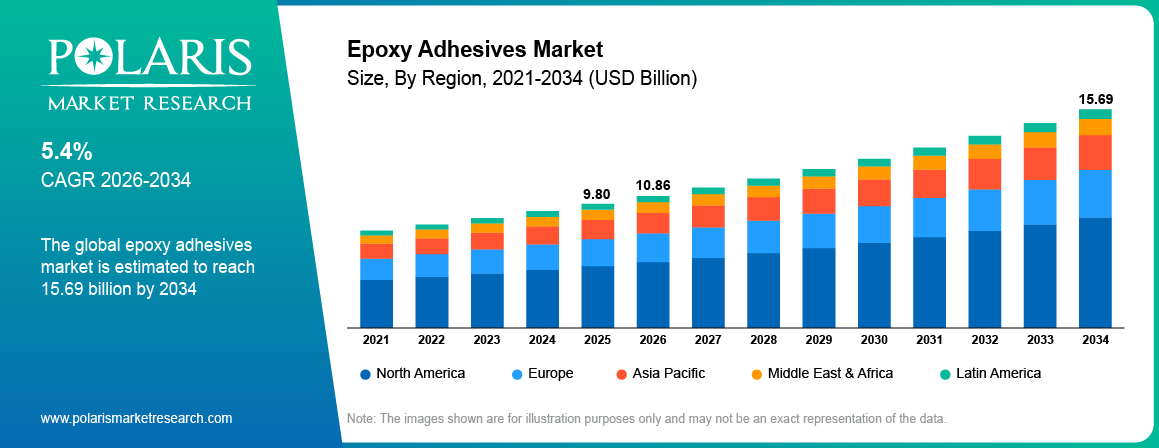
The epoxy adhesives market size was valued at USD 9.80 billion in 2025, growing at a CAGR of 5.4% during the forecast period. The development of sustainable and high-performance formulations and the rising demand for high-strength bonding solutions in the construction sector are the key factors driving market development.
Market Statistics
Epoxy Adhesives Market Key Takeaways
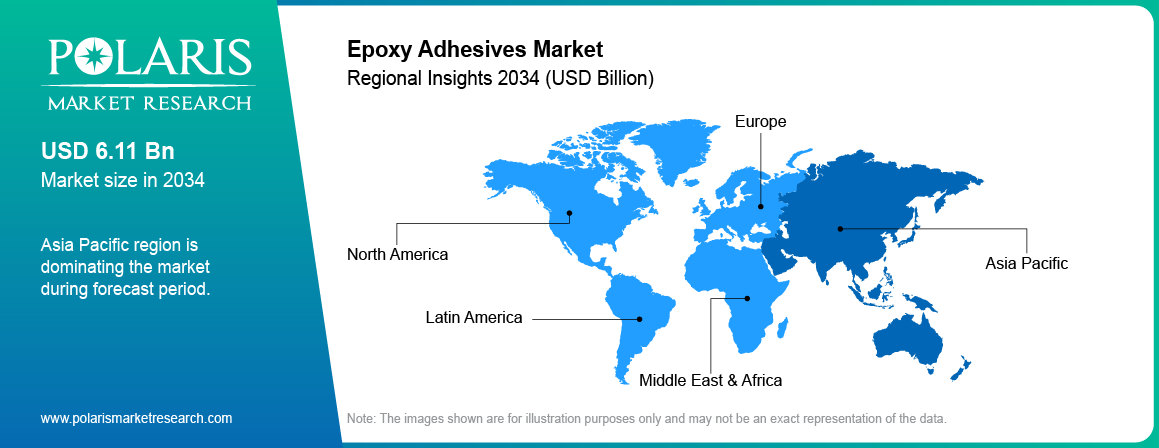
- Asia Pacific led the global market with 39.0% share in 2025, owing to rapid industrialization and robust demand from end use industries such as construction, automotive, and electronics.
- North America is witnessing the fastest growth at a CAGR of 4.70% during the forecast period. The regional market growth is driven by its advanced technological infrastructure and robust government support for innovation.
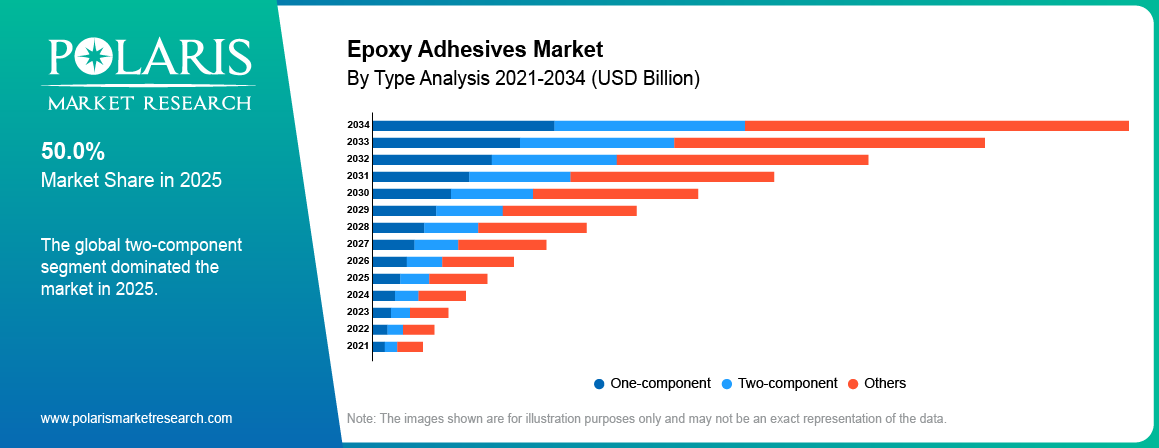
- The two-component segment dominated the market with 50.0% share in 2025. The segment’s dominance is primarily attributed to is superior performance in applications needing durability and resistance to heat and chemicals.
- The wind energy segment is projected to register the fastest growth of 6.70% during the projection period, driven by rising demand for renewable energy sources and growing use of epoxy adhesives in manufacturing wind blade turbines.
Note: Figures and projections outlined in this report are the result of Polaris Market Research’s proprietary analytical processes, grounded in the latest available datasets and market observations.
What are Epoxy Adhesives?
Epoxy adhesives are high-performance bonding agents composed of epoxy resins and curing agents, known for their strong adhesion, durability, and resistance to chemicals, heat, and environmental factors.
The epoxy adhesives are widely utilized in industries such as automotive, construction, aerospace, electronics, and healthcare due to their superior resistance to heat, chemicals, and environmental factors. Advancements in material science have led to the development of sustainable and high-performance formulations, addressing increasing demand for lightweight materials and environmentally friendly solutions. For instance, in September 2024, Bostik, a leader in adhesives and part of Arkema, launched Fast Glue Ultra+, an innovative adhesive developed with 60% bio-based materials. This product highlights a focus on sustainability while maintaining high performance. Innovations in application techniques and strategic partnerships between manufacturers and end use industries further fuel the epoxy adhesives market expansion.
There is a growing demand for high-strength bonding solutions that offer superior adhesion, chemical resistance, and load-bearing capacity, with increasing investments in residential, commercial, and industrial construction projects. Epoxy adhesives provide excellent bonding for various substrates, such as concrete, metal, and composites, making them essential for applications such as bridge construction, flooring, and structural repairs. Additionally, their resistance to extreme environmental conditions and mechanical stress improves the longevity of infrastructure, aligning with the industry's focus on sustainability and cost efficiency, as these adhesives play a crucial role in assuring structural durability and long-term performance. For instance, in March 2023, Westlake Epoxy introduced its AZURES product range at the European Coatings Show. These SVHC- and CMR-free epoxy resins, modifiers, and curing agents offer sustainable alternatives for coatings, adhesives, and building and construction while maintaining performance standards. Therefore, as modern construction techniques continue to evolve, the need for reliable and high-performance adhesives further accelerates the adoption of epoxy-based bonding solutions.
Source: Polaris Market Research Analysis
To Understand More About this Research: Download Sample Report
Epoxy Adhesives vs Polyurethane Adhesives
| Parameter | Epoxy Adhesives | Polyurethane Adhesives |
| Bonding Strength | Provides very high structural bonding strength and load-bearing capability | Offers strong bonding with better elasticity and impact absorption |
| Curing Time | Generally slower curing, especially for two-component systems | Faster curing and quicker handling time in many applications |
| Flexibility | More rigid after curing with limited flexibility | Highly flexible and suitable for dynamic or vibrating surfaces |
| Chemical Resistance | Excellent resistance to chemicals, solvents, and harsh environments | Good chemical resistance but generally lower than epoxy systems |
| Temperature Resistance | Superior high-temperature performance and thermal stability | Performs well in moderate temperatures with better cold flexibility |
| Durability | High mechanical strength and long-term durability | Strong resistance to abrasion, weathering, and moisture exposure |
| Adhesion to Substrates | Excellent adhesion to metals, composites, concrete, and plastics | Strong adhesion to wood, plastics, glass, and flexible materials |
| Moisture Resistance | Good moisture resistance but may become brittle over time | Excellent moisture and water resistance for outdoor applications |
| Application Complexity | Often requires precise mixing and surface preparation | Easier application with better gap-filling properties |
| Industrial Applications | Widely used in aerospace, automotive, electronics, construction, and industrial assembly | Common in construction, footwear, packaging, automotive interiors, and flexible bonding applications |
| Cost Consideration | Higher performance-oriented cost structure | Often more cost-effective for flexible and general-purpose bonding |
| Typical End-Use Preference | Preferred for rigid structural and high-strength applications | Preferred for flexible, vibration-resistant, and moisture-prone applications |
Source: Polaris Market Research Analysis
Epoxy Adhesives Market Dynamics
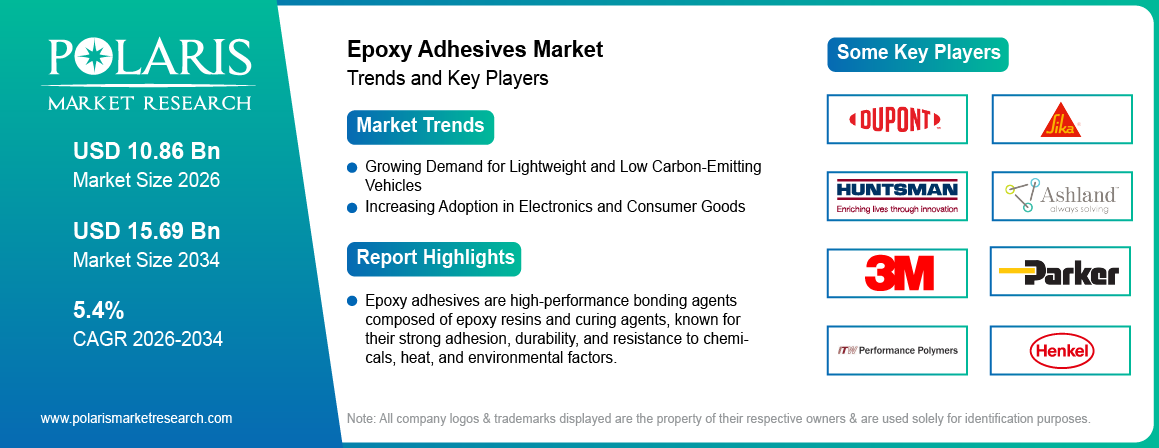
Driver: Growing Demand for Lightweight and Low Carbon-Emitting Vehicles
Epoxy adhesives play a critical role in reducing vehicle weight while maintaining strength, enhancing fuel efficiency, and lowering emissions, as these vehicles require advanced bonding solutions for materials such as composites, aluminum, and plastics. For instance, In September 2024, researchers at Nagoya University developed a next-generation structural adhesive using hydrogen-bonded styrenic thermoplastic elastomers. It offers 22 times higher impact strength than traditional epoxy adhesives, enabling lighter, carbon-efficient vehicles by bonding materials, such as aluminum and fiber-reinforced plastics more effectively. These adhesives ensure the body structure is not only strong and durable but also lightweight. Their ability to provide strong, durable bonds with minimal weight is essential in meeting the automotive industry's sustainability goals. Additionally, the increasing focus on electric vehicles (EVs) further drives the demand for epoxy adhesives, as these vehicles rely on lightweight designs to optimize battery performance and efficiency.
Driver: Increasing Adoption in Electronics and Consumer Goods
Epoxy adhesives are ideal for assembling and enclosing components in electronics, providing strong bonds that can withstand high temperatures, vibrations, and electrical stresses as they are driven by their superior bonding capabilities, precision, and reliability. Epoxy adhesives are essential in applications such as smartphones, tablets, and other consumer devices, where durability and performance are crucial. For instance, in August 2024, DELO launched the DELO DUALBOND LT2221 adhesive, designed specifically for bonding voice coil motors (VCMs) in smartphone camera assemblies. This universal adhesive can be used for over 50 different bonding tasks in VCM manufacturing. It fully cures at a relatively low temperature of 60°C, requiring less energy than competing products and minimizing the impact on the temperature-sensitive substrates commonly used in VCMs. Additionally, the trend towards miniaturization and the need for lightweight material, high-performance composites in electronics are driving the demand for epoxy adhesives, as they enable the efficient bonding of small, delicate components without compromising strength or reliability.
Source: Polaris Market Research Analysis
Epoxy Adhesives Market Segment Analysis
Assessment by Type Outlook
The global epoxy adhesives market segmentation, based on type, includes one-component, two-component, and others. In 2025, two-component sector dominated the market with 50.0% share, due to their superior performance in applications requiring high strength, durability, and resistance to heat and chemicals. These adhesives are highly versatile, as they can be tailored to meet specific bonding needs by adjusting the mix ratio of resin and hardener. Their ability to form strong, reliable bonds with minimal shrinkage, alongside excellent curing properties across various temperatures, makes them particularly suitable for industries such as automotive, aerospace, and electronics. Moreover, the growing adoption of these adhesives in the electronics industry, where precise and durable bonding is critical, has further reinforced their market leadership.
Difference Between One-Component and Two-Component Epoxy Adhesives
| Parameter | One-Component Epoxy Adhesives | Two-Component Epoxy Adhesives |
| Composition | Pre-mixed formulation containing resin and latent hardener in a single package | Separate resin and hardener mixed before application |
| Curing Mechanism | Heat-activated or moisture-cured | Chemical reaction begins immediately after mixing |
| Ease of Use | Easy to apply with no mixing required | Requires accurate mixing ratio and preparation |
| Processing Time | Longer shelf stability and controlled curing | Limited pot life after mixing |
| Bond Strength | Provides consistent bonding for standard industrial applications | Offers very high structural strength and durability |
| Temperature Resistance | Good thermal resistance for electronics and automotive uses | Excellent resistance to extreme temperatures and chemicals |
| Application Areas | Widely used in electronics, automotive assembly, and consumer goods | Common in aerospace, construction, marine, and heavy industrial bonding |
| Production Efficiency | Suitable for automated high-volume manufacturing | Better suited for customized or heavy-duty applications |
| Storage Requirements | Requires refrigerated or controlled storage in some formulations | Easier storage of separate components before mixing |
| Cost Consideration | Lower labor cost due to simplified handling | Higher labor and processing cost due to mixing requirements |
| Flexibility & Customization | Limited formulation flexibility | Greater customization of curing speed and mechanical properties |
| Market Preference | Preferred for fast and automated production lines | Preferred for high-performance structural bonding applications |
Source: Polaris Market Research Analysis
Evaluation by End Use Outlook
The global epoxy adhesives market segmentation, based on end use, includes building & construction, transportation, marine, automotive, wind energy, electrical & electronics, and others. The wind energy segment is expected to grow fastest at a CAGR of 6.70% in the epoxy adhesives market. This growth is attributed to the rising demand for renewable energy sources and the increasing use of epoxy adhesives in manufacturing wind turbine blades and other components. The wind energy sector benefits from the strong adhesive properties of epoxy resins, which provide durability and resistance to extreme weather conditions, crucial for the longevity of wind turbines. The ongoing global shift towards sustainability and renewable energy is driving the expansion of this segment.
Source: Polaris Market Research Analysis
Regional Insights
By region, the study provides epoxy adhesives market insights into North America, Europe, Asia Pacific, Latin America, and the Middle East & Africa. Asia Pacific dominated the market with 39.0% share in 2025 due to rapid industrialization, strong demand from end use industries such as automotive, construction, and electronics, and investments in infrastructure development. Countries such as China and India have been at the forefront of driving this demand, supported by increasing manufacturing activities and the adoption of advanced technologies. For instance, in July 2024, Henkel India completed Phase III of its manufacturing facility in Kurkumbh, Maharashtra. Initially launched in 2020, the facility addresses the growing demand for adhesives, sealants, and surface treatment products in Indian industries. The expansion includes a new Loctite plant to enhance production capacity for Henkel's high-performance solutions. The region also benefits from cost-effective production and a growing focus on renewable energy, particularly in the wind energy sector. Furthermore, the rise of e-commerce and consumer electronics in Asia Pacific has boosted the demand for epoxy adhesives in electronics manufacturing.
North America is the fastest growing region at a CAGR of 4.70% during the forecast period in various industries due to its advanced technological infrastructure, robust investment in research and development, and strong government support for innovation. The region benefits from a well-established market with a high demand for advanced solutions across sectors such as healthcare, automotive, and renewable energy. Additionally, the presence of leading global companies and a highly skilled workforce drive continuous advancements. Favorable regulatory frameworks and increasing adoption of emerging technologies further support the region's growth trajectory. These factors collectively position North America as a hub for innovation and economic expansion.
Source: Polaris Market Research Analysis
Key Players and Competitive Analysis Report
The competitive landscape of the epoxy adhesives market features a mix of global leaders and regional players competing to gain market share through innovation, strategic alliances, and regional expansion. Global players such as Henkel AG & Co. KGaA, H.B. Fuller Company, and 3M leverage strong R&D capabilities and extensive distribution networks to deliver advanced epoxy adhesive solutions tailored for industries such as automotive, construction, electronics, and aerospace. Market trends highlight growing demand for high-performance adhesives with properties such as thermal resistance, low VOC emissions, and enhanced bonding capabilities, reflecting advancements in material science and application techniques. The epoxy adhesive industry is projected to grow, driven by increasing demand for lightweight materials, infrastructural development, and advancements in electronics manufacturing. Regional companies focus on localized needs by offering cost-effective and tailored products, especially in emerging markets such as Asia Pacific, which is anticipated to exhibit the fastest growth rate. Competitive strategies include mergers and acquisitions, partnerships with end use industries, and the introduction of sustainable and innovative adhesive formulations. These developments emphasize the importance of technological advancements, market adaptability, and regional investments in driving the epoxy adhesive market expansion. A few key major players are DuPont; Sika AG; Huntsman International LLC.; Ashland; 3M; Parker Hannifin Corp; ITW Performance Polymers; Henkel AG & Co. KGaA; H.B. Fuller Company; Benson Polymers Pvt Ltd.; DELO Industrie Klebstoffe GmbH & Co. KGaA
3M offers a wide range of epoxy adhesives under the Scotch-Weld brand, designed to cater to diverse industrial applications. These adhesives are primarily two-component systems, consisting of an epoxy resin and a hardener, which polymerize at room temperature to form strong bonds. The portfolio comprises rigid, flexible, and toughened formulations, each tailored for specific performance characteristics. Rigid epoxy adhesives, such as the 3M Scotch-Weld Epoxy Adhesive DP100, provide high shear strength and are ideal for bonding similar substrates, such as metals, offering excellent static load-holding capabilities. Flexible epoxy adhesives, such as the 3M Scotch-Weld Epoxy Adhesive 2216NS, are designed for applications involving dissimilar materials or where thermal expansion and vibration are concerns, offering high peel strength and flexibility. The use of 3M dispensing equipment provides accurate metering and mixing, improving the efficiency and reliability of the bonding process.
DuPont is renowned for its diverse range of products, such as adhesives. Among its offerings, epoxy adhesives play a substantial role, particularly in the electronics and industrial sectors. DuPont's epoxy adhesive solutions, such as Pyralux HP, are designed to provide superior peel strength, chemical resistance, and heat resistance, making them ideal for applications in the military, telecommunications, automotive, and medical industries. These adhesives are optimized for use in multi-layer flex and rigid-flex printed circuit boards (PCBs), offering low loss and high reliability. Additionally, DuPont offers other epoxy-based products, such as Betamate 1044-6/20S, which is used in automotive applications for bonding and sealing, improving vehicle durability and crash performance. DuPont's commitment to quality and innovation assures that its epoxy adhesives meet the strict requirements of various industries, providing reliable and efficient solutions for complex applications. Overall, DuPont's epoxy adhesives are a testament to the company's expertise in developing high-performance materials that serve to diverse industrial needs.
List of Key Companies
- DuPont
- Sika AG
- Huntsman International LLC.
- Ashland
- 3M
- Parker Hannifin Corp
- ITW Performance Polymers
- Henkel AG & Co. KGaA
- H.B. Fuller Company.
- Benson Polymers Pvt Ltd.
- DELO Industrie Klebstoffe GmbH & Co. KGaA
Epoxy Adhesives Market Developments
- February 2026: Westlake Corporation announced a long‑standing distribution relationship of Westlake Epoxy with Brenntag in South and West India. With this collaboration, Brenntag is expected to distribute Westlake Epoxy’s epoxy solutions for coatings, adhesives, and construction applications. (Source: investors.westlake.com)
Epoxy Adhesives Market Segmentation
By Type Outlook (Volume, Kilotons; Revenue, USD Billion, 2021–2034)
- One-component
- Two-component
- Others
By End Use Outlook (Volume, Kilotons; Revenue, USD Billion, 2021–2034)
- Building & Construction
- Transportation
- Marine
- Automotive
- Wind Energy
- Electricals & Electronics
- Others
By Regional Outlook (Volume, Kilotons; Revenue, USD Billion, 2021–2034)
- North America
- US
- Canada
- Europe
- Germany
- France
- UK
- Italy
- Spain
- Netherlands
- Russia
- Rest of Europe
- Asia Pacific
- China
- Japan
- India
- Malaysia
- South Korea
- Indonesia
- Australia
- Vietnam
- Rest of Asia Pacific
- Middle East & Africa
- Saudi Arabia
- UAE
- Israel
- South Africa
- Rest of Middle East & Africa
- Latin America
- Mexico
- Brazil
- Argentina
- Rest of Latin America
Epoxy Adhesives Report Scope
| Report Attributes | Details |
| Market Size Value in 2025 | USD 9.80 billion |
| Market Size Value in 2026 | USD 10.86 billion |
| Revenue Forecast by 2034 | USD 15.69 billion |
| CAGR | 5.4% from 2026 to 2034 |
| Base Year | 2025 |
| Historical Data | 2021–2024 |
| Forecast Period | 2026–2034 |
| Quantitative Units | Volume, Kilotons; Revenue in USD billion and CAGR from 2026 to 2034 |
| Report Coverage | Revenue Forecast, Market Competitive Landscape, Growth Factors, and Industry Trends |
| Segments Covered |
|
| Regional Scope |
|
| Competitive Landscape |
|
| Report Format |
|
| Customization | Report customization as per your requirements with respect to countries, regions, and segmentation. |
Source: Polaris Market Research Analysis
Epoxy Adhesives Market FAQ's
• The global epoxy adhesives market size was valued at USD 9.80 billion in 2025 and is projected to grow to USD 15.69 billion by 2034.
• The global market is projected to register a CAGR of 5.4% during the forecast period.
• Asia Pacific led the global market with 39.0% share in 2025.
• A few key players in the market are DuPont; Sika AG; Huntsman International LLC.; Ashland; 3M; Parker Hannifin Corp; ITW Performance Polymers; Henkel AG & Co. KGaA; H.B. Fuller Company; Benson Polymers Pvt Ltd.; DELO Industrie Klebstoffe GmbH & Co. KGaA
• The two-component segment dominated the market with 50.0% share in 2025.
• The wind energy segment is projected to register the fastest growth of 6.70% during the projection period.
Download Sample Report of Epoxy Adhesives Market
Please fill out the form to request a customized copy of the research report.


