
Heat Transfer Fluids Market Size & Share Global Analysis Report, 2026-2034
REPORT DETAILS
Heat Transfer Fluids Market Summary
The global heat transfer fluids market was valued at USD 11.59 billion in 2025 and is anticipated to grow at a CAGR of 4.9% from 2026 to 2034. Growth factors include the increasing need for energy-efficient systems and the expansion of chemical and oil & gas industries.
Market Statistics
Key Takeaways
- Asia Pacific accounted for the largest market share of 38.21% in 2025. Rapid industrialization and rising infrastructure development contributed to the dominance.
- China held the largest share of 44.78% of the Asia Pacific market in 2025. It is driven by increasing supportive government policies and rising investments in renewable energy projects.
- The North America heat transfer fluids market is predicted to register the highest CAGR of 3.6% over the forecast period. Growing demand to develop excess warmth in important industries and the expanding chemical processing industries boost the growth.
- In 2025, glycol-based heat transfer fluids segment dominated with 35.63% revenue share. This is due to their excellent thermal properties and stability across different applications. These fluids exhibit high thermal conductivity, ensuring efficient heat transfer in various industrial processes.
- The oil and gas segment led the market with 26.87% share in 2025. It is fueled by the global dependence on fossil fuels, driving increased activities and rising investments in this sector.
Note: Figures and projections outlined in this report are the result of Polaris Market Research’s proprietary analytical processes, grounded in the latest available datasets and market observations.
Industry Dynamics
- Rapid industrialization across emerging economies propels demand for heat transfer fluids. The adoption of fluids in high in manufacturing, processing, and heavy industrial applications.
- Growing adoption of renewable energy, especially concentrated solar power (CSP) plants, fuels the need for high-performance thermal fluids.
- Increasing emphasis on energy-efficient heating and cooling systems to reduce operational costs and improve process sustainability.
- Expansion of chemical processing and oil & gas industries supports strong consumption of heat transfer fluids for temperature control applications.
- Stricter environmental regulations and sustainability goals drive the adoption of bio-based and environmentally friendly heat transfer fluids.
- The fluctuating raw material prices impede market growth.
- Technological advancements are improving fluid stability, thermal efficiency, and longer service life. Emphasis on innovation would create lucrative opportunities.
AI Impact on the Heat Transfer Fluids Market
- AI helps optimize thermal system performance. AI systems monitor temperature, pressure, and fluid conditions in real time for better efficiency.
- Predictive maintenance powered by AI reduces equipment downtime. It identifies fluid degradation and system failures before major breakdowns occur.
- AI-driven analytics improve energy consumption management. This helps industries reduce heat loss and enhance overall process sustainability.
- In solar power plants, AI supports better heat transfer fluid management. The technology is used to optimize thermal storage and improve plant performance.
- Smart manufacturing systems use AI to automate fluid monitoring. It is improving operational safety and reducing maintenance costs
What are Heat Transfer Fluids?
Heat transfer fluids are specialized liquids or gases used to transfer thermal energy from one system to another. The fluids enable efficient heating or cooling in industrial operations. They play a key role in chemical processing, oil & gas, HVAC systems, and food processing. Their use is rising in renewable energy applications such as concentrated solar power plants
The eutectic mixtures that comprise heat transfer fluids are composed of two stable components. To handle the mixture or composition as a single compound, these products essentially have the same vapor pressure. These kinds of fluids are mainly utilized in systems that use heating in the liquid-vapor phase. Its typical use ranges from 60°F to 750°F (15°C to 400°C), with an ambient pressure range of 152.5 psi (10.6 bar). At elevated temperatures, these products exhibit stability and rapidly do not decompose. These liquids work well in systems with either a liquid phase or a vapor phase. Their consistent low viscosity across the whole working range finally leads to an effective heat transfer. These fluids do not corrode the typical alloys and metals; thus, the demand is anticipated to increase due to the qualities of these items.
A liquid or a gas that converts heat from one constituent to another is known as heat transfer fluid. These fluids are utilized in the procedure where cooling or warming is needed to acquire and sustain a specific temperature. The allocation that is advisable in heat transfer fluids are consistency when the temperature is low, excessive thermal potential and particular heat, eco-friendliness, minimum or nontoxicity, escalated flash point, and economical.
In the plastic industry, heat transfer fluids are required for polycondensation and polymerization of polyester, clarifying nylon, making man-made fibers, and PET molding functions. Heat transfer fluids are also crucial for an aggregate of chemical manufacturing procedures involving phthalic anhydride (PA), linear alkyl benzene (LAB), dimethyl terephthalate (DMT), plasticizers, spirits, olefins, and many other petrochemicals. The heat transfer fluids market demand is on the rise as they have many benefits in varying freezing and defrosting applications. Wineries, fruit processors, and dairies can utilize these fluids to maintain the cool of products while processing.
Source: Polaris Market Research Analysis
There is increasing demand from diverse end-use industries such as chemical, oil and gas, manufacturing, and solar power. The rising need for efficient heat transfer solutions in industrial processes, coupled with the emphasis on energy efficiency, has propelled the adoption of advanced heat transfer fluids.
- For instance, the Department of Chemical Engineering, IIT Guwahati, produced a novel heat transfer fluid based on nanofluids, which can efficiently transfer heat generated using solar power to desalination systems.
Along with this, the growing focus on renewable energy sources has fueled the demand for heat transfer fluids in concentrated solar power plants and geothermal applications. The market has also witnessed innovations in fluid formulations, including bio-based and synthetic heat transfer fluids, contributing to environmental safety.
Despite this, several factors affected the market growth, such as fluctuating raw material prices, regulatory challenges associated with the use of certain types of heat transfer fluids, and the high initial cost of installation and maintenance. In addition, the impact of the COVID-19 pandemic on global supply chains and economic uncertainties has influenced the market dynamics.
The research study provides a comprehensive analysis of the industry, assessing the market based on various segments and sub-segments. It sheds light on the competitive landscape and introduces heat transfer fluids Market key players from the perspective of market share, concentration ratio, etc. The study is a vital resource for understanding the growth drivers, opportunities, and challenges in the industry.
Source: Polaris Market Research Analysis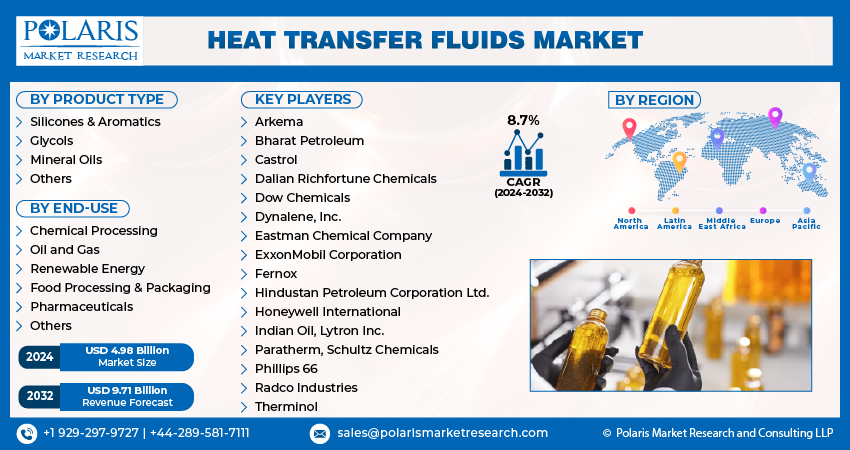
Real-World Examples of Heat Transfer Fluids Usage
| Application Area | xEnd Users | Role of Heat Transfer Fluids |
| Solar Power Plants | Concentrated Solar Power (CSP) Plants | Absorb and transfer solar heat for steam generation and electricity production |
| Chemical Reactors | Chemical Processing Units | Maintain precise reaction temperatures for better product quality and process safety |
| HVAC Systems | Commercial and Residential Buildings | Enable efficient heating and cooling for temperature regulation |
| Refrigeration Systems | Food Storage and Cold Chain Facilities | Transfer heat away to support continuous cooling and preservation |
| Oil Refining Processes | Petroleum Refineries | Support distillation, cracking, and other high-temperature thermal operations |
Source: Polaris Market Research Analysis
Industry Dynamics
Growth Drivers
The rapid industrialization and supportive renewable energy policies fuel the demand for heat transfer fluids.
As industries around the world undergo significant expansion and technological advancements, there is an increased demand for efficient and sustainable heat transfer solutions. Heat transfer fluids play an important role in various industrial processes, ensuring the effective transfer of thermal energy and contributing to the overall efficiency of operations.
The adoption of these fluids is further accelerated by governmental initiatives promoting the use of renewable energy sources. Supportive policies, such as incentives and subsidies for renewable energy projects, have incentivized industries to integrate heat transfer fluids into their operations, particularly in concentrated solar power plants and other renewable energy applications. The emphasis on reducing carbon footprints and transitioning towards cleaner energy alternatives has further increased the significance of heat transfer fluids in the global market.
As industries seek to comply with stringent environmental regulations and meet sustainability goals, the demand for innovative and eco-friendly heat transfer fluids, including bio-based and synthetic variants, is on the rise. Owing to these factors, the market is growing and will continue to grow in the forecast period.
Report Segmentation
The market is primarily segmented based on product type, end-user, and region.
| By Product Type | By End-use | By Region |
|
|
|
Source: Polaris Market Research Analysis
By Product Type Analysis
Glycol-based heat transfer fluids led the market with 35.63% share in 2025.
In 2025, glycol-based heat transfer fluids emerged as the leading choice in the heat transfer fluids market for several reasons, as glycol-based fluids, specifically ethylene and propylene glycols, have gained prominence due to their excellent thermal properties and stability across a wide range of applications. These fluids exhibit high thermal conductivity, ensuring efficient heat transfer in various industrial processes.
Also, glycol-based heat transfer fluids possess unique temperature stability, allowing them to operate effectively across both high and low temperatures. The factor driving the dominance of glycol-based fluids is their ability to prevent freezing and corrosion, making them particularly well-suited for applications in cold climates and various industrial establishments. This characteristic enhances the reliability and longevity of the systems in which they are employed. Along with this, glycol-based fluids are known for their low toxicity compared to other alternatives, contributing to their widespread acceptance in industries where safety and environmental considerations are important. As industries continue to seek reliable and efficient heat transfer solutions, glycol-based fluids are likely to maintain their dominance in the global market.
By End-use Analysis
Oil and Gas segment dominated the market with 26.87% share in 2025
In the oil and gas industry, heat transfer fluids play an important role in various processes, including exploration, extraction, refining, and transportation. These fluids are utilized in applications such as heating, cooling, and maintaining optimal temperatures in equipment and pipelines. The dominance of the oil and gas segment is further fueled by the global dependence on fossil fuels, driving increased activities and investments in this sector. The continuous expansion of oil and gas exploration and production activities, coupled with the increasing extraction techniques, has led to a growing dependence on advanced heat transfer fluids to ensure the reliability and efficiency of important equipment. Along with this, as the industry faces increased environmental safety, there is a growing emphasis on adopting heat transfer fluids that align with sustainability goals, further contributing to market growth.
Source: Polaris Market Research Analysis
Regional Insights
Asia Pacific region accounted for the largest market with 38.21% share in 2025
The Asia Pacific region emerged as the dominant region, accounting for the largest market share in the heat transfer fluids market in 2025, and this dominance is due to the factors driving industrialization, infrastructure development, and the adoption of advanced technologies in the region. As countries in the Asia Pacific continue to experience rapid economic growth, there is a rising demand for energy across various industries, ranging from manufacturing and construction to automotive and electronics. This increased industrial activity has propelled the need for efficient heat transfer solutions, positioning heat transfer fluids as integral components in several applications.
Also, supportive government policies and investments in renewable energy projects have further propelled the adoption of heat transfer fluids, particularly in solar power generation, which is gaining traction in the region. The Asia Pacific region has been visionary in implementing sustainable practices and technologies to address environmental concerns, making heat transfer fluids crucial for enhancing energy efficiency in industrial processes.
North America is predicted to grow at a CAGR of 3.6% over the forecast period due to increased energy released during processes and growing demand to develop excess warmth in important industries like concentrated solar power plants, chemicals, and HVAC (Heating, Ventilation, and Air Conditioning). The market for heat transfer fluids is expanding due to the chemical processing industries.
Source: Polaris Market Research Analysis
Key Market Players & Competitive Insights
The heat transfer fluids market exhibits a diverse landscape, with several key players contributing to its dynamic growth. Established industry participants such as Dow Chemicals, Eastman Chemical Company, and ExxonMobil Corporation continue to have a significant influence, offering their extensive product portfolios and global presence. These market leaders are actively engaged in research and development efforts to introduce advanced formulations, catering to the evolving demands for improved thermal performance and environmental sustainability.
Some of the major players operating in the global heat transfer fluids market include:
- Arkema
- Bharat Petroleum
- Castrol
- Dalian Richfortune Chemicals
- Dow Chemicals
- Dynalene, Inc.
- Eastman Chemical Company
- ExxonMobil Corporation
- Fernox
- Hindustan Petroleum Corporation Ltd.
- Honeywell International
- Indian Oil
- Lytron Inc.
- Paratherm, Schultz Chemicals
- Phillips 66
- Radco Industries
- Therminol
Recent Developments
-
January 2026: FRAGOL lubricants and heat transfer fluids had once again received Kosher certification. (Source: fragol.com)
-
April 2026: Dober’s COOLWAVE™ DC-25 obtained Open Compute Project ‘OCP Inspired’ Recognition for Data Center Liquid Cooling. COOLWAVE DC-25 is a high-performance, inhibited USP-grade propylene glycol-based heat transfer fluid. It is engineered specifically for data center liquid cooling applications. (Source: BUSINESS WIRE)
- January 2025, Global Heat Transfer launched Globaltherm® Q, a high-performance synthetic organic heat transfer fluid engineered for wide industrial use, offering exceptional thermal stability, efficient heat transfer, and reliable low-pressure operation across extreme temperature ranges. (Source: manufacturingchemist.com)
Future of Heat Transfer Fluids Market
The market is expected to grow at the rapid pace. The expansion of renewable energy projects, especially concentrated solar power and industrial energy storage systems, will boost the market growth. Increasing demand for sustainable and low-emission fluids is encouraging the adoption of bio-based and environmentally friendly alternatives. Industries are focusing more on energy efficiency and process optimization. This would fuel the use of advanced thermal management solutions. Continuous innovations in synthetic and high-performance fluids are improving thermal stability, safety, and service life. Rising global energy demand and industrial growth will strengthen long-term market expansion in the coming years
Heat Transfer Fluids Market Report Scope
| Report Attributes | Details |
| The market size value in 2025 | USD 11.59 billion |
| The market size value in 2026 | USD 11.91 billion |
| Revenue Forecast in 2034 | USD 16.06 billion |
| CAGR | 4.90% from 2026 – 2034 |
| Base year | 2025 |
| Historical data | 2021 – 2024 |
| Forecast period | 2026 – 2034 |
| Quantitative units | Revenue in USD billion and CAGR from 2026 to 2034 |
| Segments Covered | By Product Type, By End-use, and By Region |
| Regional scope | North America, Europe, Asia Pacific, Latin America; Middle East & Africa |
| Customization | Report customization as per your requirements concerning countries, regions, and segmentation. |
Source: Polaris Market Research Analysis
Heat Transfer Fluids Market FAQ's
Arkema, Bharat Petroleum, Castrol, Dalian Richfortune Chemicals, Dow Chemicals, Dynalene, Inc., Eastman Chemical Company, ExxonMobil Corporation, Fernox, are the key companies in Heat Transfer Fluids Market
The global heat transfer fluids market is projected to grow at a CAGR of 4.90% during the forecast period.
The Heat Transfer Fluids Market report covering key segments are product type, end-user, and region.
The rapid industrialization and supportive renewable energy policies fuel the demand for heat transfer fluids are the key driving factors in Heat Transfer Fluids Market
The global heat transfer fluids market size is expected to reach USD 16.06 billion by 2034
Download Sample Report of Heat Transfer Fluids Market
Please fill out the form to request a customized copy of the research report.


