
Melamine Market Size, Forecast, Global Analysis Report, 2026–2034
REPORT DETAILS
Melamine Market Summary
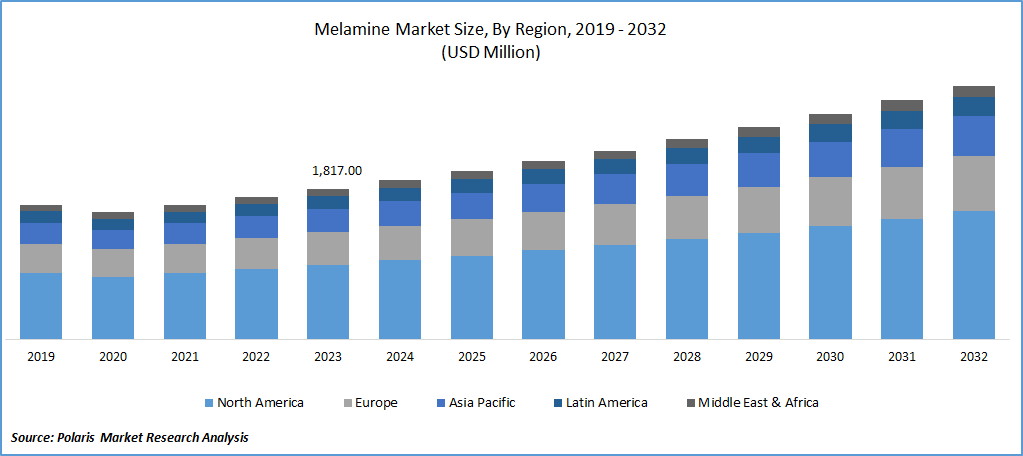
The global melamine market was valued at USD 10.28 billion in 2025 is anticipated to grow at a CAGR of 5.3% from 2026 to 2034. The market is driven by extensive use of melamine in laminates, adhesives, and coatings in various end-use industries such as construction, automotive, wood adhesive, paints and coatings, and packaging. Moreover, the rising preference for sustainable products is expected to create lucrative growth opportunities for the market as consumers.
Market Statistics
Key Takeaways
- Asia Pacific had about 50% of the market in 2025 and will likely keep its lead because cities are growing quickly and industries are expanding.
- Within the APAC, China leads with nearly 35% share, because of its strong construction sector, large furniture industry, and high melamine production capacity.
- The melamine resins segment is expected to grow at a CAGR of 7.7%, because there is a lot of demand for laminates and uses in the construction and automotive industries.
- The laminate segment led the market in 2025 with around 42% share, supported by its durability, low cost, and wide usage.
- The wood adhesives segment is projected to grow steadily at a CAGR of 6.2%, owing to the rising demand in construction and furniture.
Note: Figures and projections outlined in this report are the result of Polaris Market Research’s proprietary analytical processes, grounded in the latest available datasets and market observations.
Industry Dynamics
- Rising demand for melamine resins in furniture, construction, and automotive sectors is driving the melamine market, supported by their durability, heat resistance, and suitability for decorative surfaces and laminates.
- Expanding applications in laminates, adhesives, coatings, and molding compounds are creating new growth avenues, driven by consumer preference for cost-effective, high-performance materials across residential, commercial, and industrial sectors.
- Challenges such as fluctuating raw material prices, environmental regulations, and health concerns related to formaldehyde emissions may limit market growth and require innovation in eco-friendly melamine-based products.
- Technological advancements in production processes and increased use of melamine in engineered wood and sustainable construction materials are boosting efficiency, performance, and demand in both developed and developing regions.
AI Impact on Melamine Market
- AI can contribute to increased melamine production through optimization of manufacturing processes and minimizing wastage of energy and raw materials.
- It assists in improving quality control and identifying any inconsistencies to ensure the purity of products.
- The ability of AI to perform predictive maintenance through detecting possible issues in machines and stopping machine downtime is another advantage.
- Better logistics management and efficiency through AI is another advantage for manufacturers.
Source: Polaris Market Research Analysis
To Understand More About this Research: Download Sample Report
Melamine is a versatile molecule that finds applications across various industries. It is synthesized and utilized in producing plastics, paints, laminates, fire retardants, textiles, paper coatings, and more.
Additionally, it is used in manufacturing automotive interior components, coatings, and adhesives, capitalizing on the growing automotive industry's need for lightweight and durable materials. The furniture industry also extensively utilizes melamine, particularly in producing decorative laminates and veneers, driven by urbanization and evolving lifestyle trends.
Furthermore, melamine-based resins play a significant role in creating food packaging materials, including melamine foam, due to the increasing emphasis on food safety and sustainable packaging solutions. The demand for melamine in these sectors is expected to rise as industries prioritize quality, performance, and environmental considerations.
The rise in demand from the automotive industry is a key driver as manufacturers seek melamine for applications such as automotive coatings and adhesives. The increasing demand for wood adhesives and laminates also contributes to market growth. Factors like higher disposable income and changing consumer preferences and lifestyles drive the market forward.
The increasing utilization of melamine as a strong and lightweight material in the automotive industry and rising demand from the packaging sector will drive market growth. Melamine is commonly used to produce food packaging materials such as plates, bowls, and cups due to its excellent resilience and heat and chemical tolerance.
Government regulations to reduce formaldehyde emissions from wood-based products will also grow market revenue. Melamine resins produce wood-based goods like MDF, particleboard, and plywood. Melamine is an ideal choice for complying with these regulations as it can effectively lower formaldehyde emissions from these products, ensuring compliance with government laws.
The increasing use of melamine in the automotive industry, demand from the packaging sector, and the need to comply with formaldehyde emission regulations in wood-based products are key drivers of market revenue growth.
Melamine vs Traditional Wood & Plastic Materials
| Factors | Melamine Materials | Traditional Wood & Plastics Materials |
| Surface Strength | Highly resistant to scratching and staining | Less durable and more susceptible to damage |
| Water Resistance | High water resistance | Untreated wood highly susceptible to water |
| Heat Resistance | High heat resistance | Conventional plastics susceptible to deformation by heat |
| Maintenance | Relatively easy to maintain | More effort needed for maintenance |
| Aesthetic Value | Aesthetically pleasing with decorative coatings | Lesser longevity of decorative finishes |
| Economical Advantage | Economical alternative surface solution | More costly solid wood solution |
Source: Polaris Market Research Analysis
Source: Polaris Market Research Analysis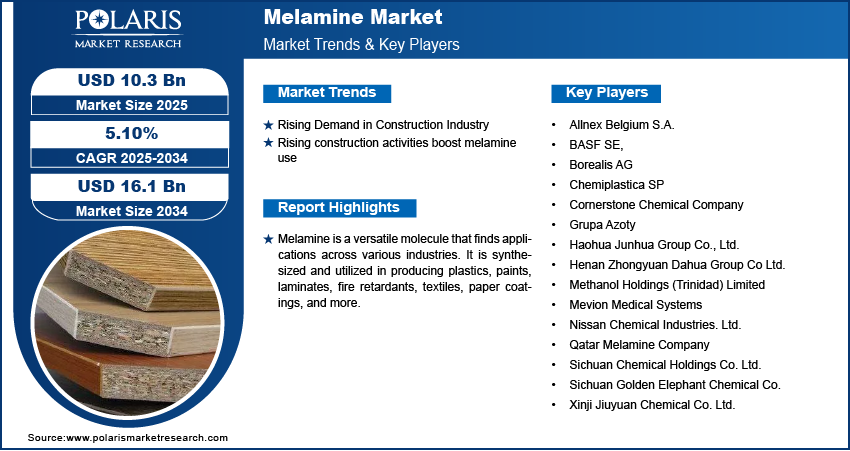
Market Dynamics
Rising Demand in Construction Industry
The demand for melamine is expected to increase in construction manufacturing, driven by its use in wood adhesives, interior designing, floor coatings, and laminating wooden panels. In the construction sector, melamine in concrete, specifically Superplasticizers (SMF), enhances workability and fluidity while reducing water requirements during handling and pouring. Melamine-based insulation foams are also utilized in commercial spaces like offices, restaurants, and educational institutions to provide acoustic solutions for room dividers, hanging baffles, ceiling tiles, and wall-mounted absorbers.
Melamine, as a thermosetting plastic, finds applications in the manufacturing of various products such as kitchenware, laminates, specialized paints, flame-retardant textiles and apparel, particleboards, floor tiles, and flexible urethane foam used for insulation in the construction industry. The growing adoption of lightweight plastic crockery items, driven by increasing disposable income, is expected to fuel the demand for melamine further.
The market growth may need to be revised due to stringent government regulations imposed by authorities. For example, the Food Safety and Standards Authority of India (FSSAI) changed its rules to include melamine level standards in baby formula and other food products, reflecting the concern for consumer safety and product quality. Compliance with such regulations may challenge the melamine market during the forecast period.
Melamine Foam and Acoustic Insulation Trends
Increasing demand for melamine foam is being observed across various industries owing to its excellent acoustic insulation, thermal resistance, and low weight. It is increasingly being utilized in acoustic panels, HVAC systems for insulation purposes, automotive parts, recording studios, and commercial constructions where acoustic insulation and efficient energy are needed. Open-cell foam provides sound absorption and thermal resistance, making melamine foam a great material for insulation across various construction and industrial applications. Moreover, melamine foam is commonly used in various detergents and other domestic or industrial cleaning products that work by removing dirt and other marks without using harmful chemicals. An increasing concern about building insulation and acoustic properties is contributing to the increased use of melamine foam.
Report Segmentation
The melamine market is primarily segmented based on type, application, end-use, and region.
| By Type | By Application | By End-Use | By Region |
|
|
|
|
Source: Polaris Market Research Analysis
To Understand the Scope of this Report: Request Customization
By Type Analysis
The melamine resins segment is expected to witness the highest CAGR during the forecast period, driven by the growing demand for laminated furniture and its wide-ranging applications in industries such as construction and automotive. Melamine resins are extensively used to produce various items, including kitchenware, laminates, tile floors, overlay materials, and particleboards.
Additionally, these resins can be altered into rigid foam structures with specific porous configurations. They find utility as insulators, soundproofing materials, and cleaning abrasives. The increasing awareness of these diverse applications of melamine resins is expected to further boost the growth of this segment during the forecast period.
By Application Analysis
In 2025, the laminate segment held the largest share of the melamine market, driven by its favorable properties such as affordability, low maintenance, high performance, and wide design choices. Melamine resin provides a durable and visually appealing finish to these typically lower-quality materials, contributing to increased laminate demand.
The wood adhesives segment is anticipated to experience steady growth over the forecast period. Melamine adhesives are known for creating strong bonds without causing damage to the surfaces being joined. By dispersing the bond's tension evenly across the surface, additives in melamine adhesives reduce the risk of pressure fractures induced by screws and other fasteners, further enhancing the appeal of these adhesives in the cabinet and woodworking industry.
Source: Polaris Market Research Analysis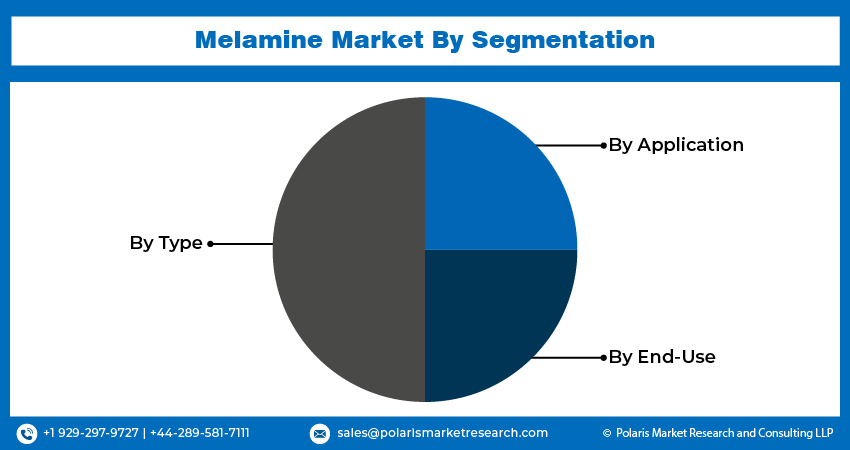
Regional Analysis
In 2025, Asia Pacific accounted for the largest market share and maintained its dominance during the forecast period, primarily driven by the presence of key developing economies and the rapid urbanization witnessed in countries such as China and India. The region's thriving construction industry, fueled by rising disposable incomes and an improved standard of living, is also expected to contribute to the Asia Pacific melamine market expansion during the forecast period. Additionally, China, one of the major consumers and manufacturers of industrial products, is projected to hold a significant market share throughout the forecast period.
North America is expected to account for a 17.18% revenue share. This is owing to the huge demand for high-quality laminates, engineered wood products, and eco-friendly building materials. The developments in construction, furniture manufacturing, and interior designing industry have boosted the usage of melamine coatings and adhesives. Furthermore, increasing emphasis on green building codes and the need for environmentally friendly materials has driven manufacturers to develop melamine resins that emit low levels of formaldehyde. Increasing demand for modern interior décor, modular furniture, and engineered wood products among consumers has further aided the growth of the melamine market in North America.
Source: Polaris Market Research Analysis
Key Players and Competitive Insights
The melamine market is a dynamic and competitive industry characterized by a range of players contributing to the production, distribution, and innovation of melamine-based products. Melamine, a versatile chemical compound, is widely used in the production of resins, laminates, coatings, and flame retardants, among other applications. The market players in the melamine industry are engaged in continuous research and development, strategic collaborations, and expansion initiatives to gain a competitive edge.
A few major players operating in the global melamine market include
- Allnex Belgium S.A.
- BASF SE,
- Borealis AG
- Chemiplastica SP
- Cornerstone Chemical Company
- Grupa Azoty
- Haohua Junhua Group Co., Ltd.
- Henan Zhongyuan Dahua Group Co Ltd.
- Methanol Holdings (Trinidad) Limited
- Mevion Medical Systems
- Nissan Chemical Industries. Ltd.
- Qatar Melamine Company
- Sichuan Chemical Holdings Co. Ltd.
- Sichuan Golden Elephant Chemical Co.
- Xinji Jiuyuan Chemical Co. Ltd.
Recent Developments
April 2026, Indonesia has commenced construction of its first melamine production plant in the Gresik Special Economic Zone, with an investment of approximately USD 600 million. (Source: en.vietnamplus.vn)
May 2025, Cornerstone Chemical Company announced a price increase of USD 0.15 per pound for melamine, effective July 1, 2025, driven by rising urea feedstock costs. (Source: cornerstonechemco.com)
Melamine Market Report Scope
| Report Attributes | Details |
| Market size value in 2025 | USD 10.28 billion |
| Market size value in 2026 | USD 10.78 billion |
| Revenue forecast in 2034 | USD 16.35 billion |
| CAGR | 5.3% from 2026 to 2034 |
| Base year | 2025 |
| Historical data | 2021–2024 |
| Forecast period | 2026–2034 |
| Quantitative units | Revenue in USD billion and CAGR from 2026 to 2034 |
| Segments Covered | By Type, By Application, By End-Use, By Region |
| Regional scope | North America, Europe, Asia Pacific, Latin America; Middle East & Africa |
| Customization | Report customization as per your requirements with respect to countries, regions, and segmentation. |
Source: Polaris Market Research Analysis
Melamine Market FAQ's
A few global key market players are Qatar Melamine Company, Borealis AG, Cornerstone Chemical Company, and Nissan Chemical Industries.
The global melamine market is expected to grow at a CAGR of 5.3% during the forecast period.
The melamine market report covers key segments such as type, application, end-use, and region.
Increasing demand for melamine in the construction industry drives the market growth.
The global melamine market size is expected to reach USD 16.35 billion by 2034.
Download Sample Report of Melamine Market
Please fill out the form to request a customized copy of the research report.


