
Micro Turbine Market Opportunity, Demand & Growth Analysis, 2026-2034
REPORT DETAILS
Micro Turbine Market Summary
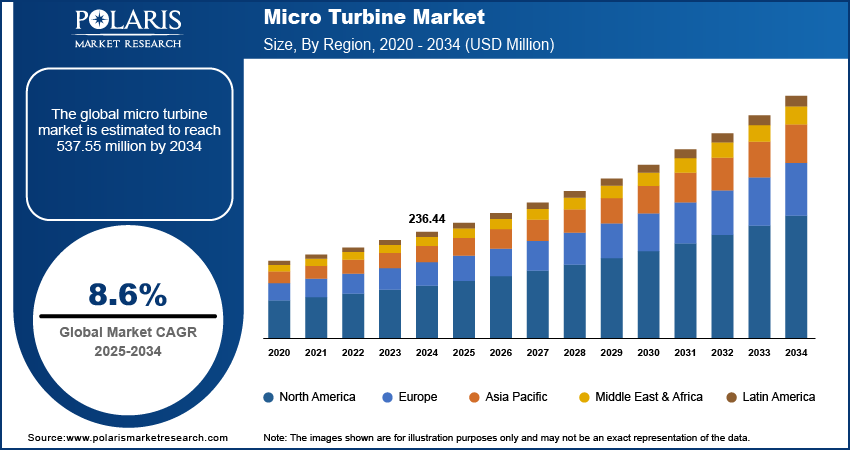
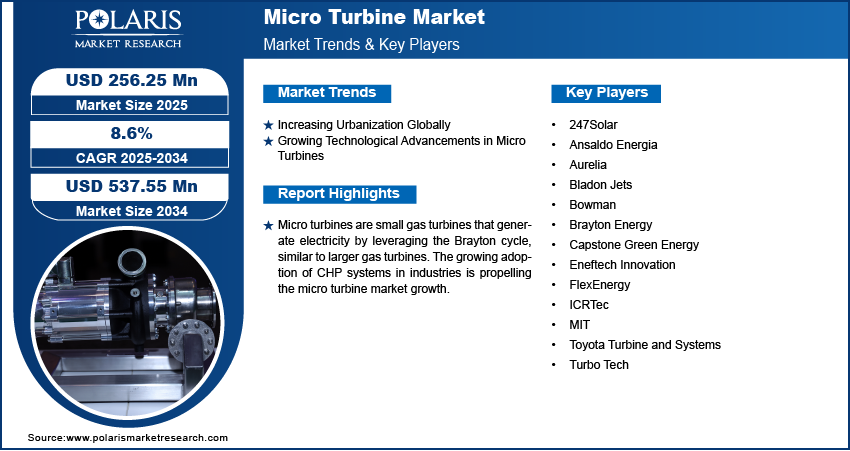
The global micro turbine market size was valued at USD 256.25 million in 2025. The market is projected to grow at a CAGR of 8.6% from 2026 to 2034. The market growth is primarily fueled by the increasing adoption of combined heat and power (CHP) systems across industries and the rising imposition of stringent emission standards.
Market Statistics
Key Takeaways
- North America dominated the market with a 39.8% revenue share in 2025. The presence of well-established industrial sectors and high demand for decentralized power solutions contribute to the regional market dominance.
- Asia Pacific is projected to witness rapid growth at a 9.4% CAGR. Rapid industrialization and growing energy demand drive the regional market growth.
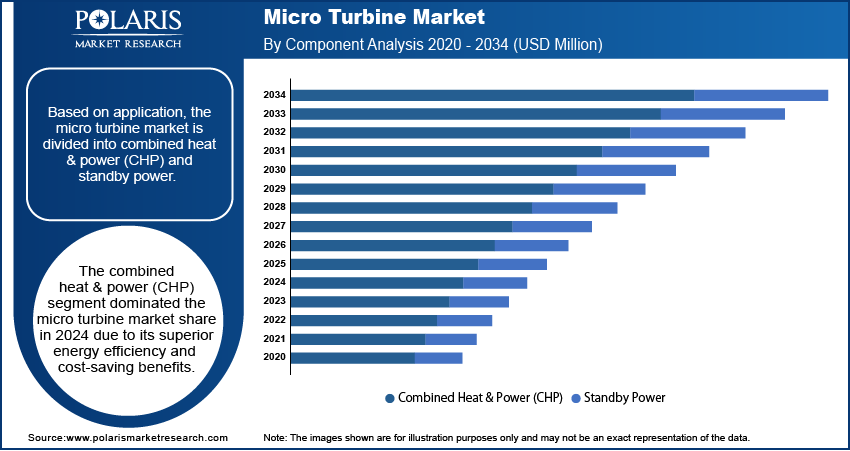
- The combined heat & power (CHP) segment led the market with a 58.2% share in 2025. The segment’s dominance is primarily driven by its enhanced energy efficiency and cost-effectiveness.
- The industrial segment accounted for the largest market share of 46.5% in 2025. This is owing to increased demand for reliable and efficient on-site power generation.
- The 50 kW–250 kW segment led with a 37.9% market share in 2025. This is owing to the high versatility and efficiency of this power rating segment.
Note: Figures and projections outlined in this report are the result of Polaris Market Research’s proprietary analytical processes, grounded in the latest available datasets and market observations.
Industry Dynamics
- The increased global energy demand due to rising urbanization has led to the adoption of reliable, on-site power generation solutions, such as micro turbines.
- The development of advanced materials and more efficient combustion processes is shaping the market landscape.
- Rising demand for reliable backup power solutions to safeguard against natural disasters and severe weather events presents several market opportunities.
- High costs associated with micro turbines may present market challenges.
AI Impact on Micro Turbine Market
- AI enables improved micro turbine performance by optimizing real-time fuel efficiency, power output, and operation.
- It provides support for predictive maintenance by examining operational data for faults.
- AI provides optimized energy management through predicting loads, load balancing, and better interaction with distributed energy generation.
- It assists manufacturers and operators in reducing operational costs and extending the life of systems.
Source: Polaris Market Research Analysis
To Understand More About this Research: Download Sample Report
What are Micro Turbines?
Micro turbines are small gas turbines that generate electricity by leveraging the Brayton cycle, similar to larger gas turbines. These turbines are compact, typically the size of a refrigerator, and produce power outputs ranging from 25 kW to 500 kW. They are designed for distributed power generation, offering advantages such as low emissions, high efficiency, and the ability to operate on various fuels such as natural gas, diesel, and biogas.
The growing adoption of combined heat and power (CHP) systems in industries is propelling the micro turbine market growth. Micro turbines play a crucial role in CHP systems by offering high efficiency, low emissions, and the ability to run on various fuels such as natural gas and biogas, which increases their adoption. Several industries, including manufacturing, food processing, and chemical production, prefer to integrate micro turbines in CHP systems as they provide reliable on-site power while reducing energy costs. Therefore, as more industries adopt CHP systems due to their economic and environmental benefits, they invest in micro turbines to enhance energy efficiency and sustainability.
The micro turbine market demand is driven by the rising imposition of stringent emission standards and carbon reduction targets. Organizations are seeking low-emission technologies to comply with government regulations and avoid penalties. Micro turbines offer a reliable solution by producing lower emissions than traditional combustion engines and supporting the use of cleaner fuels such as natural gas and biogas. Organizations worldwide are investing in microturbines to meet sustainability goals while maintaining operational efficiency. Additionally, micro turbines provide high efficiency in CHP applications, reducing overall energy waste and supporting sustainability goals. Thus, as governments and organizations prioritize carbon reduction, the demand for micro turbines grows.
Micro Turbines vs Diesel Generators
| Factor | Micro Turbines | Diesel Generators |
| Emissions | Lower emission | Higher emission |
| Fuel adaptability | More alternative fuels | Diesel fuel used mainly |
| Maintenance | Fewest moving components, maintenance cost is lower | Frequent maintenance is needed |
| Noise | Low operation noise | High operation noise |
| Efficiency | High at CHP system | Low efficiency |
| Environmental aspects | Better environmental performance | Greater effect of environment |
Market Dynamics
Increasing Urbanization Globally
Rapid urban expansion increases energy consumption, putting pressure on existing power grids and creating the need for reliable, on-site energy generation, making micro turbines an attractive solution. The United Nations Published a report stating that 55% of the world's population lives in urban areas and is expected to increase to 68% by 2050. Businesses, residential complexes, and commercial buildings in urban areas are investing in micro turbines to ensure continuous power supply while reducing reliance on centralized grids. These systems provide efficient combined heat and power (CHP) solutions, allowing urban facilities to generate electricity and useful thermal energy from a single fuel source. Urban areas focus on sustainable energy generation, which micro turbines provide by reducing emissions through integrating with renewable energy sources such as biogas and hydrogen. Moreover, the compact size and ability of micro turbines to operate in space-constrained environments make them ideal for dense urban areas. Therefore, with the growing urbanization worldwide, the demand for micro turbines is also increasing.
Growing Technological Advancements in Mirco Turbines
Companies operating in the micro turbine market are continuously developing advanced materials, better aerodynamics, and more efficient combustion processes, allowing micro turbines to achieve higher power output with lower fuel consumption. Innovations in digital controls and smart grid integration are enhancing their performance, enabling real-time monitoring, predictive maintenance, and remote operation. Businesses and industries are investing in these advanced micro turbines to improve durability, reduce operational costs, and extend service life. The development of cleaner fuel options, such as hydrogen and synthetic gases, expands their applications in low-emission energy systems. Many companies are seeking micro turbines to complement renewable energy sources such as solar and wind, ensuring a stable power supply even during fluctuations. As technology continues to evolve, microturbines become more versatile, cost-effective, and environmentally friendly, making them attractive for industries, commercial buildings, and distributed energy networks. Thus, rising technological advancements in micro turbines are expected to offer lucrative micro turbine market opportunities during the forecast period.
Waste Heat Recovery and Energy Efficiency Trends
The major advantage of micro turbines is that the waste heat produced during power production can be captured, which otherwise would be wasted. Utilization of waste heat from power production can be used for heating, cooling, steam production, and other industrial applications, which leads to higher energy efficiency and lowers fuel consumption. Due to continuous emphasis on energy efficiency and cost savings across industries, the implementation of waste heat recovery systems is gaining ever more popularity.
Rise of Hydrogen and Alternative Fuel Micro Turbines
Manufacturers are developing micro turbines for use with hydrogen, biogas, renewable natural gas, and other alternative fuels. These alternative fuel systems allow businesses to cut carbon emissions while also providing constant electricity. With the continuing demand for cleaner ways to produce energy, this microturbine technology is likely to be an important part of organizations’ decarbonization strategies.
Source: Polaris Market Research Analysis
Segmental Insights
Evaluation by Application
Based on application, the micro turbine market is divided into combined heat & power (CHP) and standby power. The combined heat & power (CHP) segment dominated the micro turbine market with 58.2% share in 2025 due to its superior energy efficiency and cost-saving benefits. Many industries, commercial facilities, and residential complexes invested in CHP systems to generate both electricity and useful thermal energy from a single fuel source. Rising energy prices and stringent emission regulations further pushed businesses to adopt CHP solutions, which offer higher efficiency compared to traditional power generation methods. The ability of CHP systems to utilize various fuels, including natural gas and biogas, further contributed to the segment's dominance. Governments and regulatory bodies provided incentives for CHP adoption, accelerating adoption across multiple sectors. Moreover, rapid urbanization and increased demand for decentralized power also drove CHP installations, particularly in areas with unreliable grid infrastructure.
Assessment by End User
In terms of end user, the micro turbine market is segregated into industrial, commercial, and residential. The industrial segment dominated the market in 2025 with 46.5% due to the rising demand for efficient and reliable on-site power generation. Many manufacturing plants, oil and gas facilities, and chemical processing units integrated micro turbines to reduce energy costs and ensure uninterrupted operations. High electricity consumption in industrial processes created a strong need for decentralized power solutions, particularly in regions with unstable grids or high utility rates. Stricter environmental regulations also pushed industries to adopt cleaner and more fuel-flexible technologies that lower emissions while maintaining productivity. The ability of micro turbines to use multiple fuel sources, such as natural gas and biogas, provided additional advantages, making these turbines a preferred choice for industrial applications.
Source: Polaris Market Research Analysis
Regional Analysis
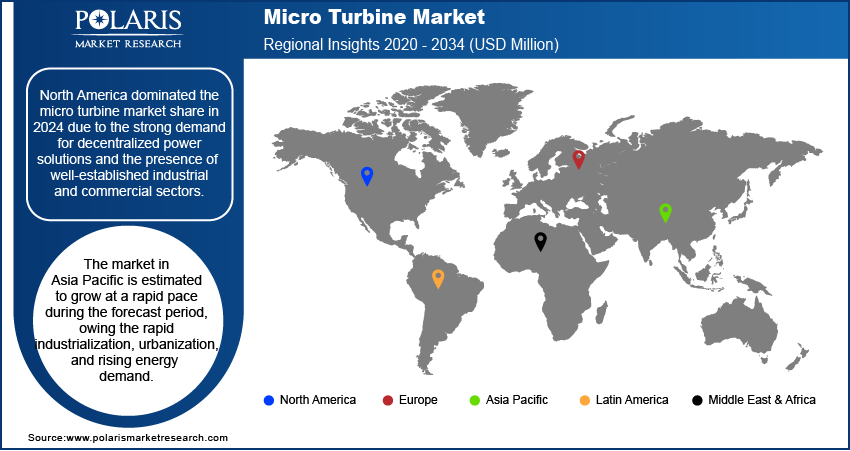
By region, the report provides micro turbine market insight into North America, Europe, Asia Pacific, Latin America, and the Middle East & Africa. North America dominated the micro turbine market revenue with 39.8% share in 2025 due to the strong demand for decentralized power solutions and the presence of well-established industrial and commercial sectors. The region’s stringent emission regulations and commitment to carbon reduction drove the adoption of cleaner and more efficient energy technologies, including micro turbines. The growing popularity of combined heat and power (CHP) systems further contributed to market dominance by enhancing energy efficiency in manufacturing plants, hospitals, and data centers. The availability of abundant natural gas resources provided a cost-effective fuel option, accelerating the adoption of micro turbines across multiple sectors. The US led the regional market, driven by supportive government policies, incentives for sustainable energy projects, and continuous advancements in power generation technology.
The micro turbine market in Asia Pacific is estimated to grow at a rapid pace of CAGR 9.4% during the forecast period, owing the rapid industrialization, urbanization, and rising energy demand. Many countries in the region face challenges related to grid stability, power shortages, and increasing electricity costs, prompting industries and businesses to seek reliable on-site generation solutions such as micro turbines. The growing emphasis on reducing carbon emissions and enhancing energy efficiency has encouraged governments to promote cleaner technologies through incentives and policy support, thereby boosting demand for micro turbines. Expanding manufacturing activities in China, India, and Southeast Asian nations drive the need for efficient power generation, particularly in industrial zones and commercial hubs. China dominates the regional market due to its massive industrial base, strong focus on energy security, and increasing investments in sustainable energy infrastructure. The country’s push toward cleaner fuel alternatives and distributed energy solutions strengthens micro turbine market expansion.
Source: Polaris Market Research Analysis
Key Players & Competitive Analysis Report
The competitive landscape of the micro turbine market is shaped by leading players making significant investments in research and development to enhance their product offerings and gain a competitive edge. Companies are actively pursuing strategic initiatives such as product innovation, international collaborations, increased capital investments, and mergers and acquisitions to expand their global footprint. By developing advanced solutions, forging strategic partnerships, and strengthening manufacturing capabilities, these market participants are driving industry growth and positioning themselves for long-term success. The micro turbine market comprises numerous global and regional market players. A few major players in the market include 247Solar, Ansaldo Energia, Aurelia, Bladon Jets, Bowman, Brayton Energy, Capstone Green Energy, Eneftech Innovation, FlexEnergy, ICRTec, Toyota Turbine and Systems, and Turbo Tech.
Capstone Green Energy is a pioneering company in the field of microturbine technology. Founded in 1988 as NoMac Energy Systems, it was later renamed Capstone and has since become a major provider of micro turbine systems for clean and continuous energy management. These micro turbines are versatile, fuel-flexible, and scalable, capable of generating power from 30 kW to 1,000 kW. They are ideal for commercial and industrial applications, offering advantages such as low emissions, high efficiency, and the ability to operate on various fuels, including natural gas, diesel, and biogas. Capstone's micro turbines integrate advanced technologies such as aero-based turbine engines, magnetic generators, and patented air bearing systems. This design ensures maintenance-free operation with a single moving part, eliminating the need for cooling systems.
Brayton Energy is an innovative research and development firm specializing in sustainable and efficient energy production. Founded in 2004 by a team of engineers passionate about advancing energy technologies, the company is headquartered in Hampton, New Hampshire. Brayton Energy focuses on the design, prototyping, and testing of turbomachinery and gas turbine systems, with a strong emphasis on alternative energy solutions such as concentrated solar power, biomass power, and hybrid vehicles. One of the key areas of expertise for Brayton Energy is in the development of micro turbines. These compact turbines are designed to operate efficiently in various applications, including power generation and propulsion systems for vehicles and aircraft. Brayton's micro turbine designs incorporate advanced technologies such as recuperated cycles, which enhance efficiency by reusing heat from the exhaust gases. This approach allows for higher thermal efficiency and reduced emissions, making them suitable for environmentally responsible energy production.
List of Key Companies
- 247Solar
- Ansaldo Energia
- Aurelia
- Bladon Jets
- Bowman
- Brayton Energy
- Capstone Green Energy
- Eneftech Innovation
- FlexEnergy
- ICRTec
- Toyota Turbine and Systems
- Turbo Tech
Micro Turbine Industry Developments
- January 2026: Capstone Green Energy Holdings, Inc. and its subsidiaries announced the completion of the installation of a 6.6-megawatt combined heat and power (CHP) microturbine system. The company stated that the system was installed at the landmark renewable energy site in North Carolina. The project monetizes swine waste through its conversion into renewable biogas using a proprietary pyrolysis process. (source: businesswire.com).
Micro Turbine Market Segmentation
By Application Outlook (Revenue, USD Million, 2021–2034)
- Combined Heat & Power (CHP)
- Standby Power
By Power Rating Outlook (Revenue, USD Million, 2021–2034)
- 12 kW–50 kW
- 50 kW–250 kW
- 250 kW–500 kW
By End User Outlook (Revenue, USD Million, 2021–2034)
- Industrial
- Commercial
- Residential
By Regional Outlook (Revenue, USD Million, 2021–2034)
- North America
- US
- Canada
- Europe
- Germany
- France
- UK
- Italy
- Spain
- Netherlands
- Russia
- Rest of Europe
- Asia Pacific
- China
- Japan
- India
- Malaysia
- South Korea
- Indonesia
- Australia
- Vietnam
- Rest of Asia Pacific
- Middle East & Africa
- Saudi Arabia
- UAE
- Israel
- South Africa
- Rest of Middle East & Africa
- Latin America
- Mexico
- Brazil
- Argentina
- Rest of Latin America
Report Scope
| Report Attributes | Details |
| Market Size Value in 2025 | USD 256.25 Million |
| Revenue Forecast in 2026 | USD 278.21 Million |
| Revenue Forecast by 2034 | USD 537.55 Million |
| CAGR | 8.6% from 2026 to 2034 |
| Base Year | 2025 |
| Historical Data | 2021–2024 |
| Forecast Period | 2026–2034 |
| Quantitative Units | Revenue in USD Million and CAGR from 2026 to 2034 |
| Report Coverage | Revenue Forecast, Market Competitive Landscape, Growth Factors, and Trends |
| Segments Covered |
|
| Regional Scope |
|
| Competitive Landscape |
|
| Report Format |
|
| Customization | Report customization as per your requirements with respect to countries, regions, and segmentation. |
Source: Polaris Market Research Analysis
Micro Turbine Market FAQ's
The global micro turbine market size was valued at USD 256.25 million in 2025 and is projected to grow to USD 537.55 million by 2034.
The global market is projected to register a CAGR of 8.6% during the forecast period.
North America had the largest share of 39.8% in 2025.
A few of the key players in the market are 247Solar, Ansaldo Energia, Aurelia, Bladon Jets, Bowman, Brayton Energy, Capstone Green Energy, Eneftech Innovation, FlexEnergy, ICRTec, Toyota Turbine and Systems, and Turbo Tech.
The combined heat & power (CHP) segment dominated the market in 2025 with 58.2% share.
The industrial segment dominated the market in 2025 with 46.5%.
Download Sample Report of Micro Turbine Market
Please fill out the form to request a customized copy of the research report.


