
Plastic Waste Management Market Trends & Growth Analysis Report, 2026 - 2034
REPORT DETAILS
Plastic Waste Management Market Summary
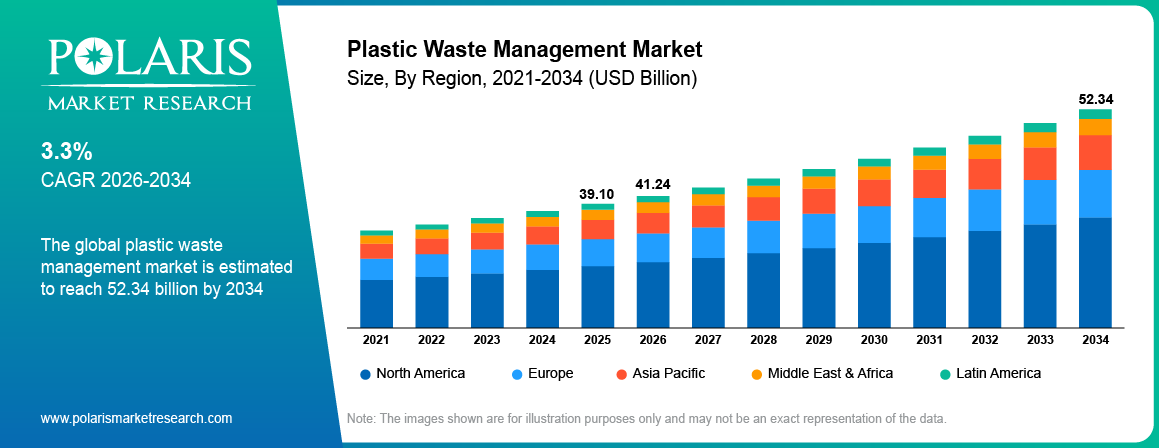
The global plastic waste management market size was valued at USD 39.10 billion in 2025. The market is projected to grow at a CAGR of 3.3% from 2026 to 2034. Rapid urbanization and strict government regulations are a few of the key factors driving the plastic waste management market demand.
Market Statistics
Plastic Waste Management Market Key Takeaways
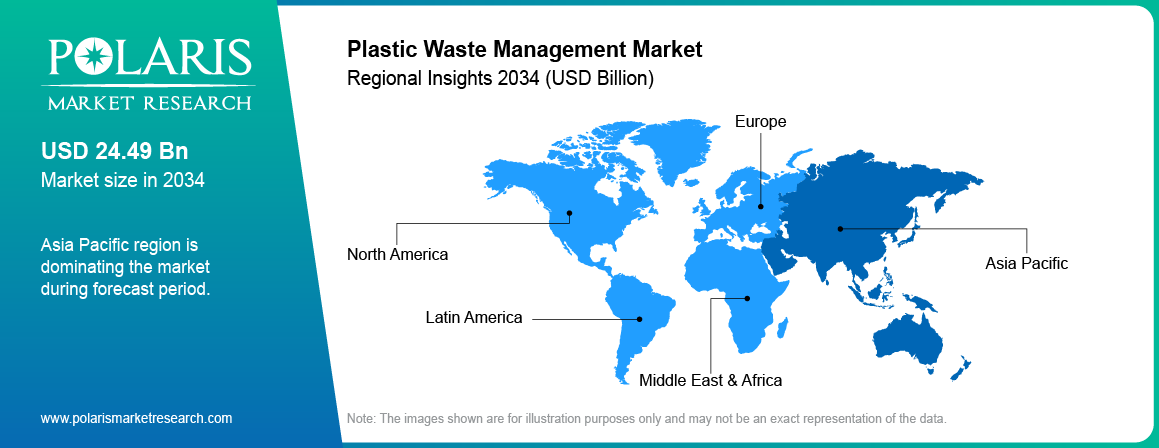
- Asia Pacific led with a 46.8% market share in 2025. This is owing to rising urbanization and the presence of strict regulations in the region.
- North America is projected to account for a 3.8% CAGR. Stringent environmental regulations drive the need for effective plastic waste management.
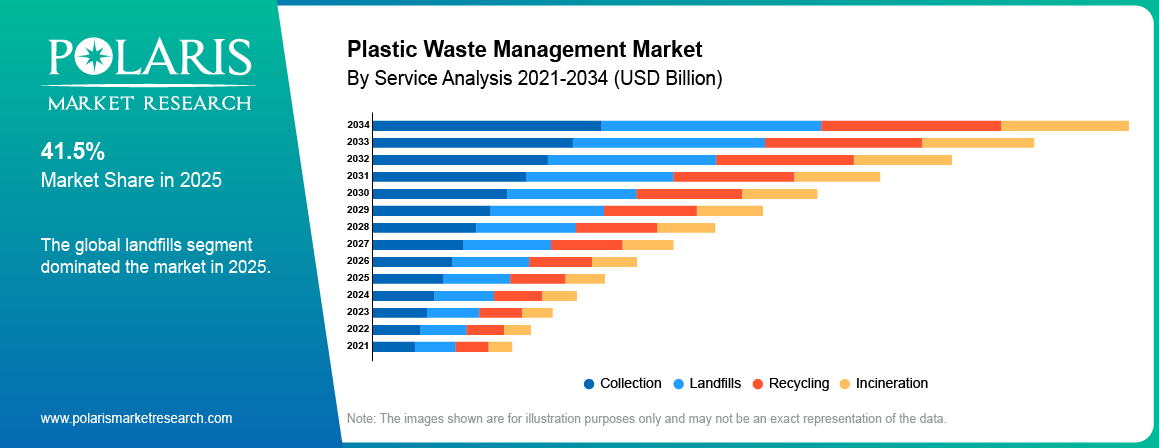
- The landfills segment led with a 41.5% market share in 2025, owing to the limited number of recycling and incineration plants.
- The plastic bags segment dominated with a 34.7% share in 2025. The widespread usage of plastic bags leads to massive production and a significant amount of plastic waste.
- The polypropylene (PP) segment led with a 29.6% share in 2025. This is due to its high availability and low production costs.
AI Impact on Plastic Waste Management Market
- AI helps to enhance the sorting of plastic waste as it detects different types of plastics and segregates them.
- It enhances the efficiency of the process of recycling by reducing contamination.
- It facilitates intelligent waste management through real-time analysis of the process.
- It helps businesses and governments optimize the process of recycling to reduce waste going to landfills.
Plastic waste management is the process of collecting, processing, and disposing of plastic waste. It is a complex task that involves a variety of stakeholders, including businesses, governments, and individuals. Reprocessing plastics, sorting plastic waste, and segregating recyclable plastic are the key steps in managing plastic waste. Among these, recycling plastic waste is the most effective method of controlling plastic pollution. It helps reduce the production of additional plastic while also maintaining a low carbon footprint on the planet. Due to its versatility, recycled plastic can be used in the production of clothes, storage containers, films, garbage bags, and more. The effective implementation of a comprehensive plastic waste management system can reduce risks to public health and the economy and foster ecological preservation.
Source: Polaris Market Research Analysis
To Understand More About this Research: Download Sample Report
Improved economic conditions, demographic and socio-economic changes, and environmental concerns are among the key factors influencing the plastic waste management market growth. Rising industrialization, growing urbanization, and increasing population in developed countries are other factors influencing the adoption of plastic waste management systems.
The shift toward the use of recyclable plastics, especially in food and beverage packaging, is a key trend anticipated to drive the implementation of plastic waste management systems. The introduction of stringent regulations by governments worldwide and rising initiatives to promote sustainable waste management practices are expected to provide numerous plastic waste management market opportunities during the forecast period.
Plastic Waste Management vs Traditional Waste Disposal
| Plastic Waste Management | Conventional Waste Disposal |
| Recycling & Recovery oriented | Landfill disposal is dominant mode |
| Cuts down pollution rates | Causes significant environmental pollution |
| In line with circular economy concepts | No material recovery from waste |
| Facilitates reuse of waste items | Less sustainable |
| Incorporates modern sorting techniques | Sorting of waste not emphasized |
Source: Polaris Market Research Analysis
Market Dynamics
Driver: Rising Importance of Circular Economy Strategies
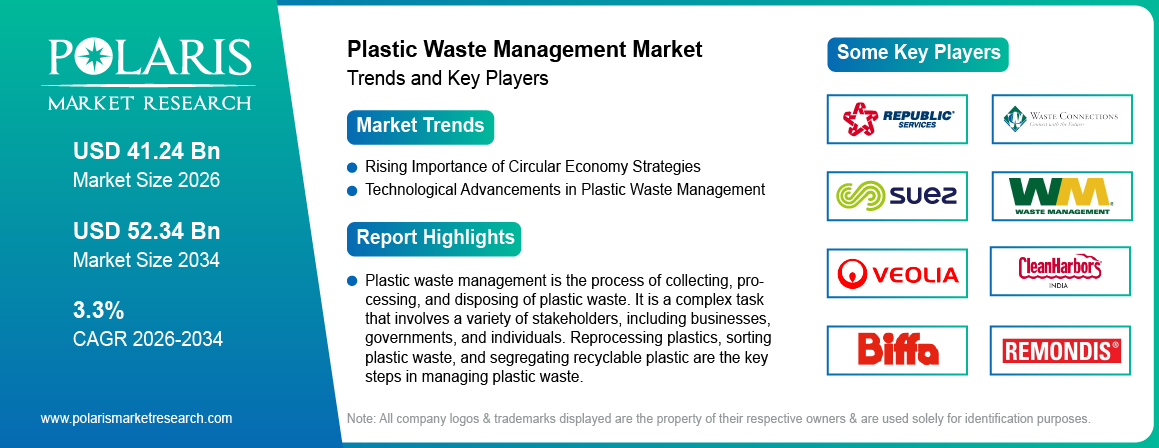
The circular economy system, which is based on the reuse and regeneration of products or materials, focuses on recycling and repurposing plastics. Globally, organizations are embracing circular economy models and making significant investments in recycling technologies for efficiently reclaiming, categorizing, and processing plastic waste. The shift toward the circular economy model is fueled by the need to reduce the dependence on nonrenewable resources and the incorporation of sustainability goals, which creates a sustainable value chain for recycled plastic. Thus, the growing emphasis on circular economy drives the plastic waste management market expansion.
Driver: Technological Advancements in Plastic Waste Management
In recent, there have been significant advancements in plastic waste management technologies. Advances in chemical recycling technologies, including pyrolysis and depolymerization, have enabled the recycling of complex plastics such as contaminated materials and multi-layered packaging. The use of artificial intelligence (AI) and machine learning (ML) in plastic waste management enables the segregation of plastics that were previously difficult to separate. Also, emerging waste-to-energy technologies for plastics are contributing to the digital circular economy. Thus, advances in plastic waste management technology are propelling the plastic waste management market development.
Driver: Landfill Management and Waste Disposal Trends
Landfill usage has been the most widely used means of getting rid of plastic waste in the world, particularly in developing countries, due to the limited technologies used to process waste. Landfills are used by several towns owing to their affordable setup cost, coupled with having a large capacity to handle all types of waste. With the advancement of urbanization, increased plastic consumption, and inadequate segregation of waste, landfill usage is increasingly being embraced. However, increasing environmental challenges resulting from pollution of water sources and emission of greenhouse gases have pushed governments into enforcing strict waste-disposal regulations.
Opportunity: Incineration and Waste-to-Energy Technologies
There is increasing recognition of the benefits associated with using incineration and energy-from-waste techniques as viable means of disposing of non-recyclable plastics while generating energy. Modern energy-from-waste facilities use controlled combustion technology to convert plastic waste into electricity, steam, or heat, thereby reducing the need to dispose of waste in landfills. Such facilities have become increasingly important in urbanized locations where there is a shortage of landfill sites due to rapid increases in waste. Improvements in emission reduction technologies have further made modern incineration facilities more environmentally friendly than the traditional technique of burning waste. Moreover, apart from being another source of energy, the waste-to-energy technology will be important for promoting sustainability in both the energy and waste sectors.
Source: Polaris Market Research Analysis
Segment Insights
Outlook by Service Insights
The plastic waste management market, based on service, is segmented into collection, landfills, recycling, and incineration. The landfills segment dominated the market with a revenue share of 41.5% in 2025, owing to the limited number of recycling and incineration plants. The landfill, which contains waste in compacted layers, is the primary method used for waste management globally. Landfills are used for the disposal of all waste types, including household waste, commercial waste, and nonhazardous sludge. The widespread presence of landfills contributes to their dominance in the market.
Market Assessment by Source Insights
The plastic waste management market, based on source, is segmented into plastic bags, wrappers, plastic bottles, plastic containers & cutlery, industrial packaging, plastic caps and closures, and others. The plastic bags segment accounted for the largest market share in 2025. Plastic bags, being cost-effective and lightweight, are the preferred choice for carrying goods across several sectors, including food services, retail, and households. Their widespread usage leads to massive production and, consequently, to a significant amount of plastic waste.
Source: Polaris Market Research Analysis
Regional Analysis
By region, the plastic waste management market report offers market insights into North America, Europe, Asia Pacific, Latin America, and the Middle East & Africa. Asia Pacific led the global market with a revenue share of 46.8% in 2025, owing to rising industrialization and the presence of stringent regulations concerning plastic waste disposal and recycling. Continuous economic growth, along with the rising emphasis on reducing the ecological footprint of companies, further propels the adoption of plastic waste management solutions in the region.
The North America plastic waste management market is projected to grow at the fastest rate from 2026 to 2034. The region is characterized by the presence of stringent environmental regulations, which drive the need for effective plastic waste management. Also, rising environmental consciousness about the impact of plastic waste on the environment among businesses, governments, and consumers is contributing to the plastic waste management market development in the region.
Source: Polaris Market Research Analysis
Competitive Insights
The plastic waste management market research report encompasses a thorough vendor share research for all the major market players. The market for plastic waste management is highly competitive and has the presence of a large number of small and large vendors. The top market participants are introducing advanced solutions to cater to the growing customer needs. In addition, these companies are using strategic developments such as collaborations, partnerships, and mergers and acquisitions to enhance their offerings and expand their regional footprint.
To thrive in the competitive market environment, companies deliver plastic waste management solutions that are both efficient and cost-effective. A few of the key players in the plastic waste management market are Republic Services Inc.; Waste Connections Inc; SUEZ Environments Company; Waste Management, Inc.; Veolia Environments S.A.; Clean Harbors, Inc.; Biffa PLC; Remondis SE & Co. KG; ADS Waste Holdings, Inc.; Progressive Waste Solutions Ltd.; United Plastic Recycling, Inc.; Hawkvale Limited; Luxus Limited; Hahn Plastics Limited; Covanta Holding Corporation; and Stericycle Inc.
List of Key Players
- Republic Services Inc.
- Waste Connections Inc
- SUEZ Environments Company
- Waste Management, Inc.
- Veolia Environments S.A.
- Clean Harbors, Inc.
- Biffa PLC
- Remondis SE & Co. KG
- ADS Waste Holdings, Inc.
- Progressive Waste Solutions Ltd.
- United Plastic Recycling, Inc.
- Hawkvale Limited
- Luxus Limited
- Hahn Plastics Limited
- Covanta Holding Corporation
- Stericycle Inc.
Plastic Waste Management Industry Developments
May 2026: The European Union enacted stricter rules on plastic waste export. This is in response to the November 2026 ban on shipping plastic waste to non-OECD countries. It is expected to push companies to localize circular plastic supply chains. (source: environment.ec.europa.eu)
March 2026: The Indian Ministry of Environment amended the Plastic Waste Management Rules. It has reduced the penalties related to non-compliance with the extended producer responsibility targets immediately after their introduction. Companies can now rollover their unmet targets from 2025-26 over three years. (source: mpcb.gov.in).
Plastic Waste Management Market Segmentation
By Service Outlook
- Collection
- Landfills
- Recycling
- Incineration
By Source Outlook
- Plastic Bags
- Wrappers
- Plastic Bottles
- Plastic Containers & Cutlery
- Industrial Packaging
- Plastic Caps and Closures
- Others
By Polymer Outlook
- Polypropylene (PP)
- Polyvinyl Chloride (PVC)
- Low-density Polyethylene (LDPE)
- High-density Polyethylene (HDPE)
- Polyurethane (PUR)
- Terephthalate (PET)
- Polystyrene (PS)
- Others
By End-Use Industry Outlook
- Automotive
- Packaging
- Construction
- Wood and Furniture
- Textiles
- Others
By Regional Outlook
- North America
- US
- Canada
- Europe
- Germany
- France
- UK
- Italy
- Spain
- Netherlands
- Russia
- Rest of Europe
- Asia Pacific
- China
- Japan
- India
- Malaysia
- South Korea
- Indonesia
- Australia
- Rest of Asia Pacific
- Middle East & Africa
- Saudi Arabia
- UAE
- Israel
- South Africa
- Rest of Middle East & Africa
- Latin America
- Mexico
- Brazil
- Argentina
- Rest of Latin America
Plastic Waste Management Market Report Scope
| Report Attributes | Details |
| Market Size Value in 2025 | USD 39.10 billion |
| Market Size Value in 2026 | USD 41.24 billion |
| Revenue Forecast by 2034 | USD 52.34 billion |
| CAGR | 3.3% from 2026 to 2034 |
| Base Year | 2025 |
| Historical Data | 2021–2024 |
| Forecast Period | 2026–2034 |
| Quantitative Units | Revenue in USD billion and CAGR from 2026 to 2034 |
| Report Coverage | Revenue Forecast, Market Competitive Landscape, Growth Factors, and Trends |
| Segments Covered |
|
| Regional Scope |
|
| Competitive Landscape |
|
| Report Format |
|
| Customization | Report customization as per your requirements with respect to countries, regions, and segmentation. |
Source: Polaris Market Research Analysis
Plastic Waste Management Market FAQ's
The market was valued at USD 39.10 billion in 2025 and is projected to grow to USD 52.34 billion by 2034.
The market is projected to register a CAGR of 3.3% from 2026 to 2034.
Asia Pacific witnessed the largest market size in 2025, holding a 46.8% share, driven by rising urbanization and the presence of strict regulations in the region.
A few of the key players in the market are Republic Services Inc.; Waste Connections Inc; SUEZ Environments Company; Waste Management, Inc.; Veolia Environments S.A.; Clean Harbors, Inc.; Biffa PLC; Remondis SE & Co. KG; ADS Waste Holdings, Inc.; Progressive Waste Solutions Ltd.; United Plastic Recycling, Inc.; Hawkvale Limited; Luxus Limited; Hahn Plastics Limited; Covanta Holding Corporation; and Stericycle Inc.
Landfills held the largest share of the plastic waste management market revenue by service (disposal method) in 2025, at 41.5%, owing to the limited number of recycling and incineration plants.
Plastic bags dominated the plastic waste management market by source in 2025, holding a 34.7% share, due to the widespread usage of plastic bags leading to massive production and a significant amount of plastic waste.
Download Sample Report of Plastic Waste Management Market
Please fill out the form to request a customized copy of the research report.


