
Sodium-ion Battery Market Size, Analysis & Forecast 2026-2034
REPORT DETAILS
Sodium-ion Battery Market Summary
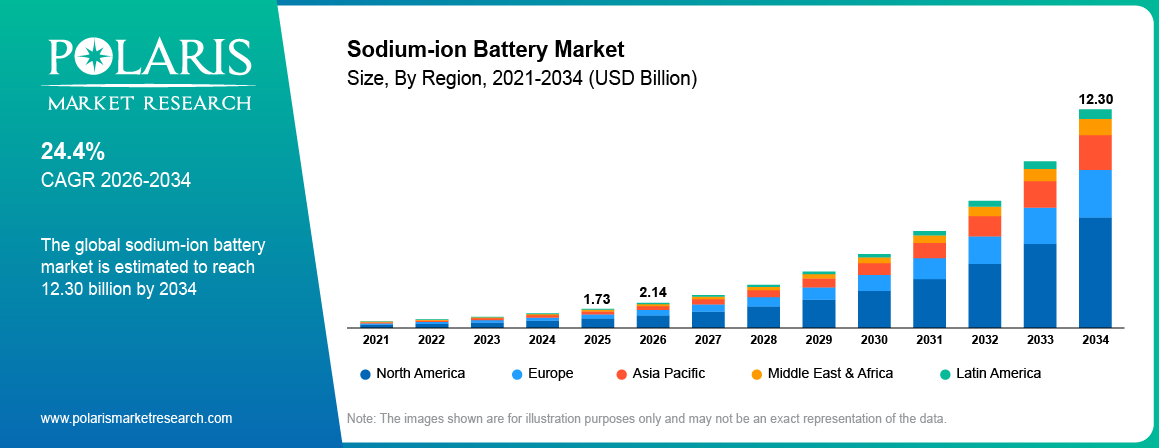
The global market of sodium-ion battery was valued at USD 1.73 billion in 2025 and is expected to reach USD 12.30 billion by 2034, growing at a CAGR of 24.4% during the forecast period. There is consistent growth in the market owing to rising investments in energy storage technology, supply chain diversification of batteries, and increasing requirement for more economical alternatives to lithium-ion batteries.
Market Statistics
Key Takeaways
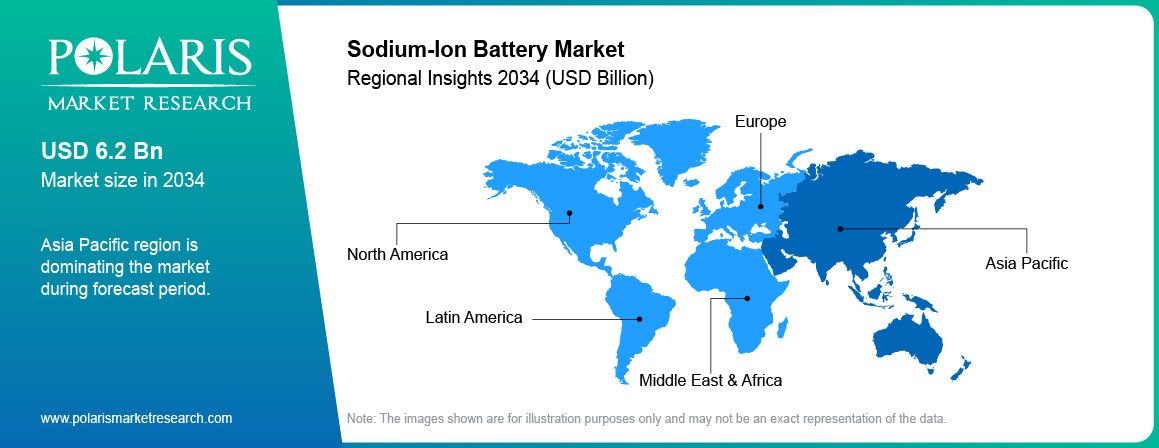
- Asia Pacific accounted for the highest regional share of 47.80% in 2025 owing to large-scale battery manufacturing capacity, supportive government policies, and increasing investments in clean energy technologies.
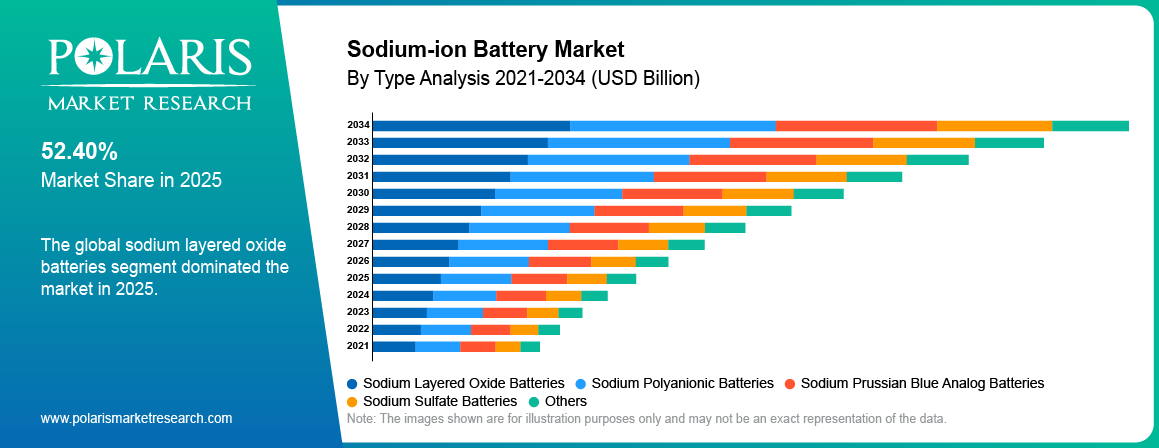
- The sodium layered oxide batteries segment led the market with a 52.40% share in 2025 due to their readiness for commercial use, cost savings, and appropriateness for large-scale energy storage applications.
- Stationary energy storage dominated the application segment with a 58.60% share in 2025, driven by the increasing adoption of renewable energy projects and investments in grid infrastructure.
- The utilities sector held the leading end-user segment with a 49.30% share in 2025, propelled by rising investments by electric utilities in reliable and economical energy storage systems.
Note: Figures and projections outlined in this report are the result of Polaris Market Research’s proprietary analytical processes, grounded in the latest available datasets and market observation
What is Sodium-Ion Battery?
Sodium-Ion Battery is a rechargeable energy storage technology that relies on the flow of sodium ions between the cathode and anode during charge and discharge processes for storage and release of electricity. The battery is regarded as a potential substitute for the lithium-ion battery because sodium is abundant, readily available, and affordable. There is increasing use of sodium-ion batteries in stationary energy storage, automotive, consumer electronics, and industrial sectors.
The sodium-ion battery supply chain comprises raw materials suppliers, manufacturers of cathodes and anodes materials, electrolytes suppliers, battery cells manufacturers, module and pack assemblers, system integrators, distributors, and end users. There is continued collaboration among raw materials suppliers, innovators, battery makers, and energy providers to facilitate commercialization and scale-up production.
Sodium-Ion Battery Market Driver Impact Analysis
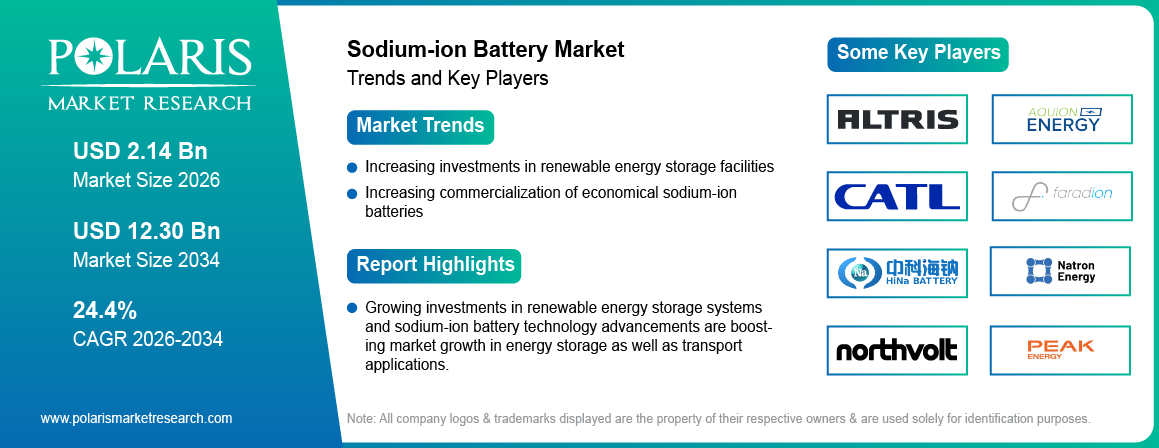
Market of sodium-ion batteries is forecasted to register steady growth over the projected period due to growing investments in renewable energy solutions, growing installation of stationary energy storage systems, and rising demand for economically-priced batteries. Growing capacity of battery production, ongoing technology innovations, and government initiatives encouraging the shift towards renewable energy sources are likely to present new opportunities for manufacturers of sodium-ion batteries in different sectors of the industry.
| Market Driver | Est. CAGR Impact | Geographic Relevance | Impact Timeline |
| Expansion of stationary energy storage infrastructure | 20.40% | Asia Pacific, Europe, North America | Short to medium term |
| Government support for domestic battery manufacturing | 19.20% | Global | Medium term |
| Increasing adoption of renewable energy systems | 21.10% | Global | Medium to long term |
| Advancements in sodium-ion battery technology | 22.30% | Global | Ongoing |
| Expansion of electric mobility applications | 18.80% | Asia Pacific, Europe | Long term |
* Indicative estimates based on market context and analyst judgment. Figures reflect relative driver weight, not additive CAGR contributions. Source: Polaris Market Research Analysis.
Industry Dynamics
- Growing investments in renewable energy storage systems are contributing to the demand for affordable and environmentally-friendly battery solutions.
- Ongoing innovations in chemistry of sodium-ion batteries are improving efficiency, safety, and market penetration of the batteries.
- Limited energy density in comparison to state-of-the-art lithium-ion batteries is a major limitation for various high-performance applications.
- Expansion of domestic battery manufacturing and supply chain localization is creating new opportunities for sodium-ion battery manufacturers.
Sodium-Ion Battery Market Drivers, Restraints and Opportunities
How Is Growing Demand for Renewable Energy Storage Driving the Market?
Increasing use of renewable energy projects has greatly enhanced the need for reliable and affordable energy storage systems. As per the International Energy Agency (IEA), the global investments in energy is estimated to reach around USD 3.4 trillion by 2026, registering a growth of about 5% from the previous year amid geopolitical conflicts and economic instability(Source: www.renewableinstitute.org).The batteries made up of sodium are becoming popular as they offer a cost-effective option for energy storage and reduce the dependency on lithium and other essential metals.
How Is Battery Technology Innovation Supporting Market Expansion?
Ongoing research and development have enhanced the viability of high-end batteries and encouraged companies to increase their manufacturing capacity. In line with this trend, Changhong Sanjie New Energy Co., Ltd. has obtained clearance for setting up its lithium battery manufacturing plant in Malaysia in June 2026 with an investment of around USD 1.3 billion. This is supporting the commercialization of next-generation battery technologies and strengthening regional manufacturing capacity.
What Challenges Limit Growth of the Market?
Lower Energy Density Compared to Lithium-ion Batteries
Despite advancements made, sodium-ion batteries typically have less energy density compared to traditional lithium-ion batteries. This is a constraint to their usage where batteries need to be as light as possible, with good driving ranges. Furthermore, the production of innovative battery technologies require considerable investments to develop manufacturing facilities, conduct testing and achieve high production levels, which limit market growth during the early stages of adoption.
What Opportunities Exist in the Sodium-ion Battery Market?
Expansion of Grid-Scale Energy Storage Projects
Grid scale energy storage installation is becoming a major opportunity for sodium-ion battery suppliers. Nuvve Japan has announced the start-up of a 2 MW / 8 MWh grid-scale battery energy storage system (BESS) project in January 2026, thereby augmenting its grid-scale energy storage system offering. This enhances the adoption of grid-scale energy storage installations through increased grid flexibility, renewables integration, and improved reliability of the power grid system with the help of AI energy management.
Segment and Regional Leaders at a Glance
According to Polaris Market Research, Asia Pacific leads the market while North America the fastest-growing region.
- Dominant Region: Asia Pacific
- Fastest Growing Region: North America
- Largest Type Segment: Sodium Layered Oxide Batteries
- Fastest Growing Type Segment: Sodium Polyanionic Batteries
- Largest Application Segment: Stationary Energy Storage
- Largest End User Segment: Utilities
Sodium-Ion Battery Market Segmentation Analysis
The report provides a comprehensive analysis of the sodium-ion battery market by type, application, and end user to identify major revenue-generating segments and emerging growth opportunities across the global battery industry.
Sodium-ion Battery Market by Type
Which Type Segment Dominates the Sodium-ion Battery Market?
Sodium layered oxide batteries accounted for the largest market share in 2025. The batteries have become popular commercially due to its efficient energy density, cost effectiveness, and capacity for large scale manufacturing. Further development in terms of cathode material, electrochemical stability, and application in stationary energy storage systems has been instrumental in solidifying the position of this sector.
Which Type Segment Is Expected to Register the Fastest Growth?
Sodium polyanionic batteries are projected to register the fastest CAGR during the forecast period. Rising research efforts focused on enhancing the safety, thermal stability, and lifespan of batteries are contributing to the growth of this sector. Increasing investments in next-generation battery technologies and rising commercialization efforts by manufacturers are expected to accelerate demand over the coming years.
Sodium-ion Battery Market by Application
Which Application Segment Holds the Largest Share of the Market?
Stationary energy storage represented the largest application segment in 2025. Development of more renewable energy projects, investments in grid modernization and demand for electricity storage solutions are the key factors driving the adoption of sodium ion batteries.
Which Application Segment Is Growing at the Fastest Rate?
Electric vehicles are projected to witness the fastest growth during the forecast period. Growing interest in affordable battery technologies, increasing production of electric mobility solutions, and continuous advancements in battery chemistry are encouraging manufacturers to evaluate sodium-ion batteries for selected electric vehicle applications. For instance, in January 2025, SEG Automotive launched an expanded portfolio of high-voltage and light electric mobility solutions, including 800 V e-drive systems for passenger cars, commercial vehicles, and two-, three-, and four-wheelers
Sodium-ion Battery Market by End User
Which End User Leads the Market?
Utilities accounted for the largest share of the sodium-ion battery market in 2025. Electricity grid operators are increasingly relying on battery energy storage systems in order to boost their reliability, incorporate renewable sources of energy and address changes in electricity demand. The rising trend towards the development of clean energy transition and long-duration energy storage is fueling the demand.
Which End User Segment Is Expected to Grow the Fastest?
Automotive manufacturers are expected to register the fastest CAGR during the forecast period. Growing investments into battery technology improvements, rise in electric vehicle manufacturing, and ongoing efforts to lower battery prices are encouraging automobile manufacturers to develop sodium-ion batteries.
Segment Summary Table
| Segment | Category | 2025 Status | Forecast CAGR | Key Driver |
| Sodium Layered Oxide Batteries | Type | Largest Share | 19.10% | Commercial maturity and cost-efficient production |
| Sodium Polyanionic Batteries | Type | Fastest Growing | 21.80% | Improvements in safety and battery performance |
| Stationary Energy Storage | Application | Largest Share | 19.60% | Expansion of renewable energy storage infrastructure |
| Electric Vehicles | Application | Fastest Growing | 22.50% | Rising electrification and battery technology development |
| Utilities | End User | Largest Share | 19.30% | Increasing investments in grid-scale energy storage |
| Automotive Manufacturers | End User | Fastest Growing | 21.90% | Growing adoption of alternative battery technologies |
Source: Polaris Market Research Analysis
Sodium-Ion Battery Market Regional Analysis
Asia Pacific Sodium-ion Battery Market Size and Share
Asia Pacific accounted for the largest share of the sodium-ion battery market in 2025. The region benefits from strong battery manufacturing capabilities, expanding renewable energy projects, and continuous investments in advanced energy storage technologies. According to the International Energy Agency (IEA) March 2025 report, China manufactures more than 75% of the batteries sold worldwide.The country has also produced over 70% of all electric vehicle batteries ever manufactured, reflecting its strong manufacturing expertise and leadership in the global Growing demand for affordable battery technologies is further supporting regional market expansion.
North America Sodium-ion Battery Market Analysis
North America is expected to witness significant growth during the forecast period owing to increasing investments in domestic battery manufacturing, expansion of clean energy infrastructure, and supportive government initiatives for energy storage technologies. In addition, the IIJA announced investment of USD 73 billion during the period 2021 through 2026 for the purpose of upgrading the country's electrical grids, transmission networks, and integration of renewable energy sources(Source: infrastructurereportcard.org).The US and Canada keep pushing innovations in batteries, development of supply chains, and renewables usage, which creates good conditions for application of sodium-ion batteries in several industrial areas.
Europe Sodium-ion Battery Growth Rate and Forecast
Europe is expected to witness steady growth due to the growing significance of sustainable mobility and increase in renewable energy production. According to the International Energy Agency (IEA), the European Union (EU) spent nearly USD 390 billion on clean energy in 2025, highlighting the region's continued focus on accelerating the energy transition(Source: www.iea.org).Countries including Germany, France, and the UK are supporting battery technology development through research funding and industrial partnerships.
Latin America Sodium-ion Battery Market
Latin American market is expected to experience gradual growth throughout the forecast period. Increasing renewable energy installations, improving electricity infrastructure, and growing investments in energy storage solutions are creating opportunities for sodium-ion battery manufacturers. Brazil and Chile have been making significant advances in clean energy development, meeting future demand in the market. In February 2026, 743 MW was added in Brazil as part of the growth in new renewable energy capacity additions, mainly due to solar and wind power projects. Growth in renewable energy installations is boosting Brazil’s move towards sustainability in electricity production.
Middle East & Africa Sodium-ion Battery Market
It is anticipated that the Middle East and Africa market to growth steadily driven by rising governments investments in projects related to renewable energy and grid modernization programs. The growing installations of solar energy solutions and utility-scale energy storage projects, coupled with attempts to diversify energy sources, are fueling the demand for sodium-ion batteries in this region.
Regulatory Heatmap
| Country | Policy Environment | Key Regulations | Market Implication | Trend |
| US | Favorable | Federal funding programs supporting battery manufacturing, clean energy deployment, and domestic supply chain development | Supports battery production, technology commercialization, and local manufacturing investments | Expanding |
| European Union | Favorable | Battery sustainability regulations, carbon reduction policies, and battery manufacturing initiatives | Encourages local battery production, technology innovation, and circular economy practices | Expanding |
| China | Favorable | National battery manufacturing policies and renewable energy development programs | Strengthens domestic battery production and large-scale commercialization | Expanding |
| Japan | Favorable | Energy transition policies and advanced battery research initiatives | Supports battery innovation and next-generation energy storage technologies | Stable |
| India | Developing | Battery manufacturing incentives and clean energy programs | Creates long-term opportunities for domestic battery manufacturers and technology providers | Developing |
| Middle East | Developing | Renewable energy diversification strategies and energy storage initiatives | Encourages deployment of grid-scale battery storage projects | Early Stage |
| Latin America | Neutral | Renewable energy expansion programs and electricity infrastructure modernization | Supports gradual investments in battery energy storage technologies | Developing |
Source: Polaris Market Research Analysis
Sodium-Ion Battery Market Competitive Landscape and Key Players
Sodium-ion battery market exhibits moderate competition with the inclusion of battery producers, technology firms, and material suppliers. Competition exists due to factors such as battery performance, production capacity, cost of production, innovations in technologies, and strategic partnerships.
Competitive Positioning Table
| Company | Est. Market Position | Primary Focus | Geographic Focus | In Report |
| Altris AB | Major Market Participant | Sodium-ion battery materials and cell technology | Europe | Yes |
| CATL | Top Market Participant | Advanced battery manufacturing | Global | Yes |
| Faradion Limited | Top Market Participant | Sodium-ion battery technology | Global | Yes |
| HiNa Battery Technology Co., Ltd. | Major Market Participant | Commercial sodium-ion batteries | Asia Pacific | Yes |
| Natron Energy Inc. | Major Market Participant | Sodium-ion batteries for industrial applications | North America | Yes |
Source: Polaris Market Research Analysis
Who are the Key Players in the Sodium-Ion Battery Market?
The key companies operating in the market include Altris AB, AMTE Power plc, Aquion Energy, CATL, Faradion Limited, HiNa Battery Technology Co., Ltd., Li-FUN Technology Corporation Limited, Natron Energy Inc., Northvolt AB, Peak Energy, TIAMAT SAS, and Zhejiang Natrium Energy Co., Ltd.
Technology and Innovation Landscape 2025–2026
Technological advancements continue to improve the commercial viability of sodium-ion batteries through better battery chemistry, higher energy efficiency, improved charging performance, and longer operational life. Battery manufacturers are paying attention to cathode materials, electrolyte solutions, battery management systems, and production technologies to improve their product performance.
| Technology | Adoption Stage | Key Development (2025–2026) | Market Impact |
| AI-enabled Battery Monitoring | Growing Deployment | Artificial intelligence supports battery health monitoring and predictive maintenance | Improves battery reliability and operational efficiency |
| Advanced Cathode Materials | Early Commercial Deployment | Development of high-performance sodium cathode materials | Improves energy density and battery lifespan |
| Modular Battery Manufacturing | Growing Deployment | Standardized battery production processes improve manufacturing efficiency | Reduces production cost and delivery time |
| Digital Twin Technology | Pilot to Early Commercial Stage | Virtual simulation of battery performance and manufacturing processes | Enhances product development and operational planning |
| Smart Battery Management Systems | Growing Deployment | Advanced monitoring and control systems optimize charging and battery safety | Improves battery performance and operational safety |
Source: Polaris Market Research Analysis
Increasing use of digital manufacturing techniques and production systems help producers to boost efficiency in production processes without compromising the quality of products. Future improvements in battery materials and cell designs are expected to bolster commercial viability of sodium-ion batteries in years ahead.
Buyer Use Cases and Market Entry Barriers
The demand for sodium-ion batteries is rising among utility firms, renewable energy companies, carmakers, industries, and energy storage systems companies. Typically, customers consider several factors before choosing battery manufacturers including performance of the batteries, quality of manufacturing, safety requirements, costs, manufacturing capacity, and reliability of supply.
| Buyer / Investor Type | Primary Use Case | Key Insight Sought | Decision Horizon |
| Utility Companies | Grid-scale energy storage | Battery reliability, lifecycle cost, operational efficiency | 5–15 years |
| Renewable Energy Developers | Renewable energy integration | Storage capacity and project economics | 3–10 years |
| Automotive Manufacturers | Electric vehicle battery sourcing | Performance, cost optimization, supply stability | 3–8 years |
| Industrial Companies | Backup power and industrial energy storage | Operational reliability and maintenance requirements | 3–7 years |
| Private Investors | Battery manufacturing investments | Commercial scalability and long-term market potential | 5–12 years |
Source: Polaris Market Research Analysis
What are the Barriers to Entering the Market?
- High cost of setting up factories to produce batteries.
- Ongoing need for research and development to enhance battery efficiency.
- The threat posed by already existing lithium-ion batteries.
- Requirements for qualification and certification.
- Inexperience in mass-producing sodium-ion batteries.
- Reliance on sources of batteries materials.
- Slow product development and commercialization process.
Manufacturers who overcome these challenges through innovation in technology, large-scale manufacturing, strategic alliances, and good customer relations will have a positive future in the market.
Premium Insights and Future Prospects of the Market
The market outlook of the sodium-ion battery market remains positive with the ongoing investments in sustainable and affordable energy storage solutions by government bodies, battery manufacturers, and energy companies. Rising number of renewable energy installations, growing capacity of energy storage systems, and increasing diversification of battery supplies contribute to the further development of the market.
Rapid commercialization of innovative sodium-ion batteries, increase in manufacturing capacity, and cooperation between battery manufacturers and end-users are likely to promote the adoption of the technology. Further improvements in battery performance and manufacturing are expected to provide new growth opportunities in the area of stationary energy storage, transportation, and industries.
Cost Benchmarking Table
| Product / Service Type | Est. Price Range (USD) | Key Cost Driver | Complexity Tier |
| Sodium Layered Oxide Batteries | USD 45–90 per kWh | Cathode materials, manufacturing process, battery capacity | Premium |
| Sodium Polyanionic Batteries | USD 55–110 per kWh | Material processing and technology development | Mid to Premium |
| Battery Modules and Packs | USD 1,000–50,000+ per system | System integration and battery configuration | Project Based |
| Battery Management Systems | USD 150–2,500 per unit | Software capability and monitoring features | Premium |
| Energy Storage System Integration | USD 50,000–5,000,000+ per project | Installation scope and project complexity | Project Based |
Source: Polaris Market Research Analysis.
Key Players
- Altris AB
- AMTE Power plc
- Aquion Energy
- CATL
- Faradion Limited
- HiNa Battery Technology Co., Ltd.
- Li-FUN Technology Corporation Limited
- Natron Energy Inc.
- Northvolt AB
- Peak Energy
- TIAMAT SAS
- Zhejiang Natrium Energy Co., Ltd.
Industry Developments
- February 2026: CATL and CHANGAN introduced the world’s first commercial sodium-ion passenger car, representing an important milestone towards the practical application of sodium-ion battery technology(source: www.catl.com).
- June 2026: CATL launched the world’s first commercially operational sodium-ion battery energy storage system (BESS). The launch advances sodium-ion battery deployment by enabling large-scale, reliable, and cost-efficient energy storage solutions(source: www.catl.com).
Market Segmentation
By Type Outlook (Revenue, USD Billion, 2021–2034)
- Sodium Layered Oxide Batteries
- Sodium Polyanionic Batteries
- Sodium Prussian Blue Analog Batteries
- Sodium Sulfate Batteries
- Others
By Application Outlook (Revenue, USD Billion, 2021–2034)
- Stationary Energy Storage
- Electric Vehicles
- Consumer Electronics
- Industrial Equipment
- Backup Power Systems
- Others
By End User Outlook (Revenue, USD Billion, 2021–2034)
- Utilities
- Automotive Manufacturers
- Industrial Companies
- Commercial Sector
- Residential Sector
- Others
By Regional Outlook (Revenue, USD Billion, 2021–2034)
- North America
- US
- Canada
- Europe
- Germany
- France
- UK
- Italy
- Spain
- Netherlands
- Russia
- Rest of Europe
- Asia Pacific
- China
- Japan
- India
- Malaysia
- South Korea
- Indonesia
- Australia
- Vietnam
- Rest of Asia Pacific
- Middle East & Africa
- Saudi Arabia
- UAE
- Israel
- South Africa
- Rest of Middle East & Africa
- Latin America
- Mexico
- Brazil
- Argentina
- Rest of Latin America
Report Scope
| Report Attributes | Details |
| Market Size in 2025 | USD 1.73 Billion |
| Market Size in 2026 | USD 2.14 Billion |
| Revenue Forecast by 2034 | USD 12.30 Billion |
| CAGR | 24.4% from 2026 to 2034 |
| Base Year | 2025 |
| Historical Data | 2021–2024 |
| Forecast Period | 2026–2034 |
| Quantitative Units | Revenue in USD Billion and CAGR from 2026 to 2034 |
| Report Coverage | Revenue Forecast, Competitive Landscape, Growth Factors, Clinical Pipeline, Technology, and Industry Trends |
| Segments Covered | By Type, By Application, By End User, and By Region |
| Regional Scope | North America, Europe, Asia Pacific, Latin America, Middle East & Africa; country detail for US, Canada, Germany, UK, France, China, Japan, India, South Korea, Australia |
| Competitive Landscape | Company Profiles including platform overview, clinical pipeline, partnerships, and recent developments |
| Report Format | PDF + Excel |
| Customization | Report customization available as per requirements with respect to countries, regions, modalities, and therapeutic area |
Sodium-ion Battery Market FAQ's
• The sodium-ion battery market was valued at USD 1.73 billion in 2025 and is projected to reach USD 12.30 billion by 2034.
• The market is expected to grow at a CAGR of approximately 24.4% during the forecast period from 2026 to 2034.
• Increasing investments in renewable energy storage solutions, expansions of battery manufacturing plants, innovations in sodium-ion battery technology, and growing demand for economical batteries compared to lithium-ion batteries are driving the market growth.
• The market was dominated by the sodium layered oxide batteries segment in 2025 due to their commercial viability, cost benefits, and rising adoption in stationary energy storage applications.
• Stationary energy storage emerged as the largest application segment in 2025 propelled by increasing use of renewable energy projects and rising investments in modernizing the grids.
• Asia Pacific dominated the market in 2025 due to the presence of robust battery manufacturing industry and significant investments made by countries in battery technologies.
Download Sample Report of Sodium-ion Battery Market
Please fill out the form to request a customized copy of the research report.


