
Sovereign Cloud Market Trends, Key Players and Growth Drivers, 2026–2034
REPORT DETAILS
Sovereign Cloud Market Summary
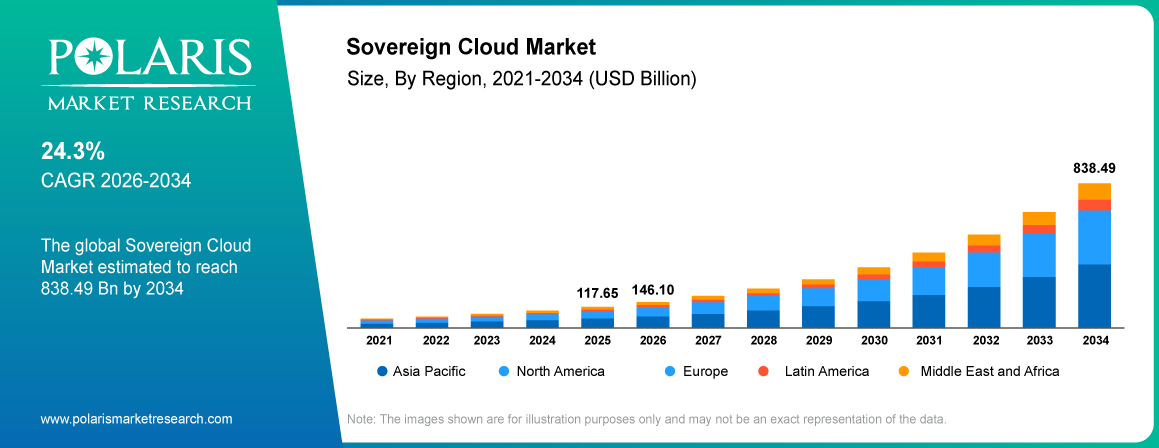
The global sovereign cloud market size was valued at USD 117.65 billion in 2025 and is projected to register a CAGR of 24.3% from 2026 to 2034. The rising number of cyberattacks propels the industry expansion. Also, increasing focus on digitalization in emerging economies is expected to boost the market growth during the forecast period.
Market Statistics
Sovereign Cloud Market Key Takeaways
- Europe held the largest revenue share of 38.6% in 2025, due to increasing cybersecurity concerns and government-led digital initiatives and regulations.
- North America is projected to witness growth at a 24.9% CAGR during the forecast period, driven by rising investments in secure cloud infrastructure and digital transformation.
- The industry in Asia Pacific is estimated to record a CAGR of 27.1% during the forecast period. The growth is attributed to rapid digital transformation and expanding cloud adoption across industries.
- The data sovereignty segment held the largest share of 42.8% in 2025. This is due to an increasing focus on sovereign cloud compliance requirements and adherence to data privacy regulations worldwide.
- The BFSI segment is expected to grow at a robust pace of 26.5% CAGR in the coming years. Stringent regulatory requirements and increasing concerns over financial data security boost segment growth.
Note: Figures and projections outlined in this report are the result of Polaris Market Research’s proprietary analytical processes, grounded in the latest available datasets and market observations.
What is a Sovereign Cloud?
A sovereign cloud is a cloud computing environment designed to meet the stringent requirements of digital sovereignty, ensuring that organizations maintain control over their data, applications, and infrastructure within specific geographical boundaries. Sovereign cloud is crucial for governments, enterprises, and institutions that need to comply with local regulations and laws on data privacy, residency, and security. This cloud infrastructure is typically hosted and managed within the borders of the country they serve. It ensures sensitive data remains under local control and complies with national laws. The primary purpose of a sovereign cloud is to address the challenges posed by traditional cloud services, which often operate across multiple jurisdictions, potentially compromising data sovereignty. Sovereign clouds encompass three key areas: data sovereignty, operational sovereignty, and technical sovereignty.
Data Sovereignty vs. Technical Sovereignty vs. Operational Sovereignty
| Aspect | Data Sovereignty | Technical Sovereignty | Operational Sovereignty |
| Meaning | Control over where data is stored and which laws apply to it. | Control over cloud technology, infrastructure, and software. | Control over the management and operation of cloud services. |
| Main Focus | Data location, privacy, and compliance. | Technology ownership and independence. | Day-to-day control and reduced dependence on external providers. |
| Key Benefit | Ensures regulatory compliance and data protection. | Reduces reliance on foreign or external technologies. | Enables independent operation and decision-making. |
Source: Polaris Market Research Analysis
The increasing incidence of cyber-attacks, such as phishing attacks across the globe, is propelling sovereign cloud market growth. For instance, the Anti-Phishing Working Group (APWG) published a report stating phishing attacks increased by 10.1% in Q2 2026. APWG reported 425,808 attacks in June 2026. It is the highest monthly number of attacks since April 2023. Cyberattacks, including phishing attacks, often bypass traditional security measures, making it essential for businesses to adopt more secure cloud infrastructures that comply with local data protection regulations. Sovereign cloud solutions provide a trusted environment where organizations store and process data with enhanced security measures, reducing exposure to cyber threats. Phishing attacks have further become more sophisticated, targeting employees through deceptive emails and fraudulent websites. Sovereign cloud solutions help mitigate these risks by offering region-specific security policies, encryption methods, and controlled access measures that align with regulatory requirements. Therefore, the demand for sovereign cloud is increasing with the rising incidence of cyberattacks (Source: apwg.org).
The sovereign cloud market demand is driven by increasing digitalization in emerging nations. Digitalization leads to growing concerns about data privacy, security, and compliance with regulations. Sovereign cloud addresses these issues by providing a secure and compliant environment for storing and processing data. The surge in digitalization also heightens cybersecurity threats and geopolitical tensions, further driving the need for sovereign cloud solutions. Organizations seek to protect their sensitive data from unauthorized access, especially from foreign governments or malicious actors. Sovereign cloud providers offer transparency and control over data management, which helps build trust. Moreover, the increasing digitalization of business processes and services necessitates robust data protection and compliance measures. Sovereign cloud solutions enable companies to meet compliance requirements, which increases their adoption. Therefore, with the increasing digitalization in emerging nations, the demand for sovereign cloud is also rising.
Sovereign Cloud vs Public Cloud
| Parameter | Sovereign Cloud | Public Cloud |
| Purpose | Data sovereignty and regulatory control | Scalability and flexible IT resources |
| Data Location | Restricted to defined jurisdictions | May span multiple regions/countries |
| Data Control | High control over data and access | Control shared between customer and provider |
| Infrastructure | Dedicated or sovereignty-controlled | Shared, multi-tenant infrastructure |
| Compliance | Designed for stringent local regulations | Supports standard regulatory requirements |
| Security | Enhanced jurisdictional and operational controls | Provider-managed security with customer controls |
| Scalability | Scalable within sovereignty boundaries | Highly scalable globally |
| Cost | Relatively higher | Generally more cost-efficient |
| Ideal Users | Governments and regulated industries | Businesses across industries |
| Geographic Flexibility | Limited by sovereignty requirements | High geographic flexibility |
| Core Advantage | Data and operational sovereignty | Speed, scalability, and flexibility |
Source: Polaris Market Research Analysis
Source: Polaris Market Research Analysis
AI Impact on Sovereign Cloud Market
- Sovereign AI-cloud infrastructure is becoming crucial for government and critical-sector applications.
- Rising adoption of artificial intelligence is propelling demand for locally controlled infrastructure and computing resources.
- Generative artificial intelligence (GenAI) enhances threat detection and response within sovereign environments.
- Sovereign AI cloud systems trained on local data support national priorities without risking data leakage.
- Governments of countries are emphasizing expanding sovereign AI infrastructure. It will help them make data-driven decisions and maintain control over citizen data.
Market Dynamics
Driver: Growing Healthcare Sector Globally
Healthcare organizations handle vast amounts of sensitive patient data, including medical records, personal information, and financial details. Sovereign cloud solutions ensure that this data remains within the borders of a specific country or region, adhering to strict data sovereignty laws and regulations. Governments and healthcare regulators further emphasize data sovereignty to safeguard patient privacy and national healthcare data. Many countries enforce strict laws, such as the Health Insurance Portability and Accountability Act (HIPAA) in the U.S. and the General Data Protection Regulation (GDPR) in Europe. These regulations ensure healthcare providers manage patient data securely and within national borders. Sovereign cloud solutions help healthcare organizations meet these regulatory demands while reducing risks associated with cross-border data transfers. The increasing adoption of telemedicine and digital healthcare services further drives the need for sovereign cloud infrastructure. As global healthcare spending increases, the demand for sovereign cloud solutions is also rising during the forecast period. For example, health spending in the U.S. grew by 7.3% in 2025 compared with 2024, reaching USD 5.7 trillion, according to the analysis by the Centers for Medicare & Medicaid Services published June 24 by Health Affairs. This rising investment in healthcare highlights the growing need for advanced data security solutions like sovereign cloud (Source: aha.org).
Driver: Rising Technological Advancements
Growing advancements in technology propel the growth of the sovereign cloud market. Technological advancements such as artificial intelligence (AI), machine learning (ML), the Internet of Things (IoT), and big data analytics generate and process massive amounts of data. Sovereign cloud platforms provide the necessary infrastructure to store and manage this data while ensuring it remains within specific geographic boundaries and complies with data sovereignty regulations. Moreover, the proliferation of IoT technology and devices across industries, from smart cities to industrial automation, generates continuous streams of data that need secure and efficient processing. Sovereign cloud solutions offer the scalability and low-latency capabilities required to handle IoT data while maintaining data sovereignty.
Restraint: High Infrastructure Cost
The high costs of constructing and maintaining sovereign cloud infrastructure are hindering the market growth. Organizations are required to invest significantly in local data centers, cyber security platforms, and other related technologies. They must spend on these technologies to ensure compliance with local data residency regulations. Such expenses can be challenging, especially for small and medium-sized enterprises. Increased sovereign cloud pricing may discourage them from adopting the technology. Thus, high sovereign cloud cost is hindering the market’s growth.
Restraint: Limited Skilled Professionals
Limited skilled professionals knowledgeable about the cloud technology, security, data governance, and local regulations present significant challenges to the global sovereign cloud market growth. A sovereign cloud involves hosting data on local data centers using highly sophisticated technology. Therefore, it requires skilled personnel to ensure its security and stability. However, the limited number of professionals with the expertise to handle such intricate systems increases the operational costs of employing and training these individuals, which may discourage organizations from using sovereign cloud, thereby restraining the industry growth.
Opportunity: Government Funding and Granting Sovereign Cloud
One of the key opportunities for the sovereign cloud market growth is government funding and the development of local digital infrastructure. Most governments have begun to provide substantial support for the creation of local data centers and cloud infrastructure. They are focusing on improving digital services to bolster the nation’s digital ecosystem and ensure data privacy and security. Such investment in the development and adoption of sovereign cloud will create significant demand, particularly in the public sector, as governments mandate that public data be stored on local servers rather than foreign cloud providers. Moreover, the investment will encourage local technology firms to participate in the production process of the national cloud data infrastructure. Thus, the increased demand from the public and private sectors for secure and reliable cloud services will propel the growth of the global sovereign cloud market.
Trend: Hyperscaler and Local-Provider Partnership Model
A significant trend in the sovereign cloud market is the rise of a partnership model between hyperscalers and local providers. Hyperscalers are cloud computing service providers that offer cloud services to enterprises worldwide. The partnership model is an excellent opportunity for expanding the market as it addresses the need for cloud service providers who understand local regulations and can operate within their data residency directives. Additionally, hyperscaler technology provides local providers with advanced cloud innovation and technology. These providers offer their expertise and existing data centers to meet the demands of local governments or businesses. This approach will be highly cost-effective, as it eliminates the need for businesses to build their own cloud infrastructure and instead lets them use the hyperscaler’s technology to adopt a sovereign cloud.
Source: Polaris Market Research Analysis
Segment Insights
Market Evaluation by Functionality
Based on functionality, the sovereign cloud market is divided into data sovereignty, technical sovereignty, and operational sovereignty. The data sovereignty segment held the largest sovereign cloud market share of 42.8% in 2025 due to increasing focus on data privacy regulations and compliance requirements worldwide. Governments and businesses have prioritized local data storage and processing to align with regulations such as the GDPR in Europe, the Cloud Act in the U.S., and similar data protection laws in Asia and the Middle East. Companies operating in highly regulated industries, including finance, healthcare, and government services, rely on data sovereignty to maintain strict control over sensitive information and prevent unauthorized cross-border data transfers. The rise in cyber threats, geopolitical tensions, and concerns over foreign surveillance further prompt organizations to implement data sovereign cloud solutions. The need for enhanced security, regulatory compliance, and risk mitigation have also played a crucial role in the widespread adoption of the data sovereignty segment.
Market Evaluation by Deployment Mode
Based on deployment mode, the sovereign cloud market is divided into fully managed sovereign cloud, hybrid sovereign cloud, and on-premises sovereign cloud. The hybrid sovereign cloud segment is expected to record a significant CAGR of 28.6% during the projected period. This segment represents the combination of private or local cloud and public cloud. The hybrid sovereign cloud provides specific isolation and control over data and applications that are hosted on the local cloud. Hybrid sovereign cloud infrastructure also provides the flexibility and scalability of the public cloud. Hybrid sovereign cloud is adopted by governments, financial institutions, health care organizations, and other regulated industries. It helps them ensure data privacy and comply with local regulations. Moreover, the need for data security, compliance, and flexibility is fueling the growth of the hybrid sovereign cloud segment.
Sovereign Cloud Deployment Mode Comparison
| Deployment Mode | Data Control Level | Typical Buyer | Key Trade-off |
| Fully Managed Sovereign Cloud | High, vendor-operated within national borders | Mid-market enterprises, agencies without in-house cloud teams | Faster deployment, less operational control than on-premises |
| Hybrid Sovereign Cloud | Variable, sensitive workloads on sovereign infrastructure, rest on public cloud | Large enterprises balancing cost with compliance | Best flexibility, but requires careful workload classification |
| On-Premises Sovereign Cloud | Maximum, fully self-managed, physically local infrastructure | Government, defense, critical infrastructure operators | Highest control and compliance assurance, highest capital cost |
Source: Polaris Market Research Analysis
Market Insight by Industry Vertical
By industry vertical, the sovereign cloud market is segmented into government & defense, healthcare, BFSI, telecommunications, energy & utilities, manufacturing, and others. The BFSI segment is expected to register a CAGR of 26.5% during the forecast period. This is owing to the stringent regulatory requirements and increasing concerns over financial data security. Financial institutions generate vast amounts of sensitive customer information. Thus, they require secure and compliant cloud solutions to prevent data breaches and fraud. Regulatory bodies across regions, including the European Banking Authority (EBA), the Monetary Authority of Singapore (MAS), and the US Securities and Exchange Commission (SEC), have introduced stringent guidelines mandating financial institutions to ensure data sovereignty and security. The rapid adoption of digital banking, fintech innovations, and AI-driven financial services boosts the need for resilient and compliant cloud infrastructure. Additionally, the growing reliance on real-time payment processing, blockchain-based transactions, and advanced fraud detection systems strengthens the demand for sovereign cloud solutions. These solutions provide data control, regulatory compliance, and enhanced cybersecurity measures.
Market Insight by Enterprise Size
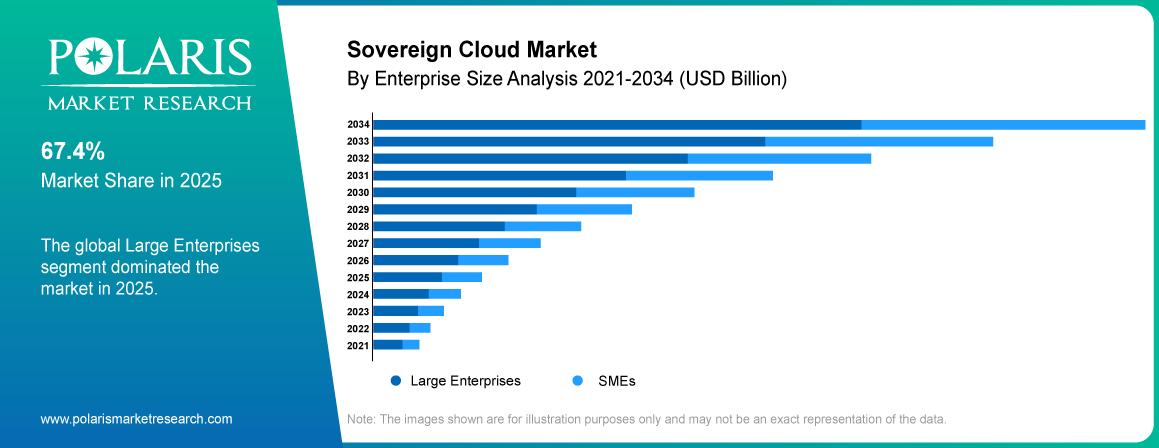
Segmentation of the sovereign cloud market by enterprise size includes large enterprises and SMEs. The large enterprise segment dominated with 67.4% share in 2025. Enterprises possess a large volume of data and critical applications that require security mechanisms and compliance with industry-specific regulations. Moreover, sectors such as banking, healthcare, telecom, and government-related services handle highly sensitive data and require enhanced security mechanisms. Sovereign cloud enables large enterprises to maintain greater control over their data, infrastructure, and governance to comply with local regulations. Additionally, large enterprises have higher financial capabilities to invest in implementing cloud solutions, cybersecurity mechanisms, and compliance management systems. Furthermore, continuous digital transformation and focus on reducing the reliance on foreign cloud infrastructure among large enterprises will propel the segment’s growth.
Segment Comparison: Large Enterprises vs SMEs
| Attribute | Large Enterprises | Small & Medium Enterprises (SMEs) |
| 2025 Market Position | Dominant share, larger data volumes, cross-border operations | Smaller current share, fastest-growing segment in both benchmarked competitor reports |
| Primary Driver | Stringent multi-jurisdiction compliance regimes, in-house IT/compliance teams | Growing access to consumption-based/pay-as-you-go sovereign offerings |
| Adoption Barrier | Complex migration across legacy multi-region systems | Cost of building compliant infrastructure without hyperscaler-level budgets |
| Best-Fit Deployment Mode | Hybrid or On-Premises Sovereign Cloud | Fully Managed Sovereign Cloud |
Source: Polaris Market Research Analysis
Source: Polaris Market Research Analysis
Regional Analysis
By region, the sovereign cloud market report provides insights into North America, Europe, Asia Pacific, Latin America, and the Middle East & Africa.
Europe
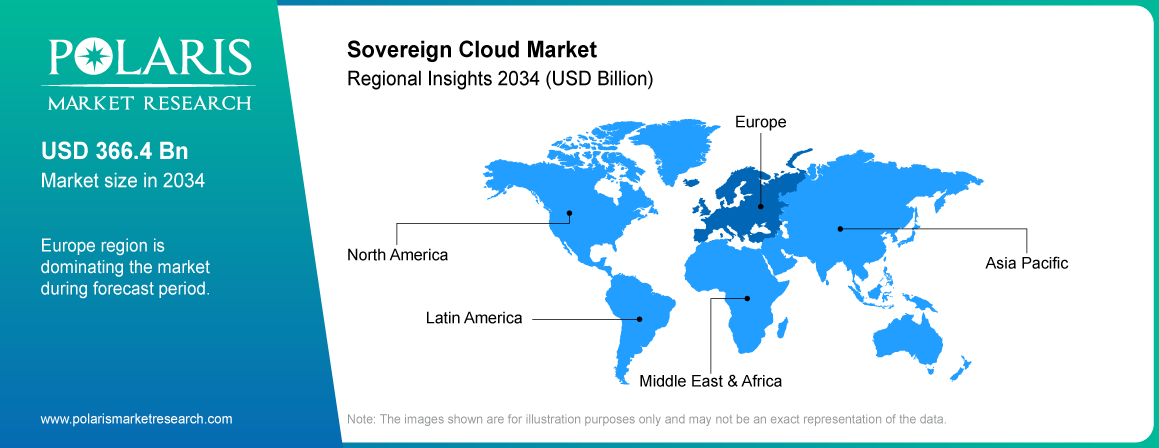
According to our sovereign cloud industry analysis, Europe held the largest share at 38.6% in 2025 due to strict data sovereignty regulations, rising cybersecurity concerns, and government-led digital initiatives. The European Union (EU) has enforced stringent laws such as the General Data Protection Regulation (GDPR) and the European Data Act, compelling organizations to store and process data within the region. Imposition of such laws boosts demand for sovereign cloud services across the region. The Gaia-X initiative is a collaborative project aimed at establishing a secure and federated data infrastructure for Europe. Gaia-X has further accelerated the adoption of sovereign cloud. Industries such as banking, healthcare, and government services have invested heavily in sovereign cloud platforms to protect sensitive data and mitigate risks associated with foreign access and cyber threats. Germany dominated the European market with 24.8% revenue share due to its proactive regulatory stance, strong industrial base, and significant investments in secure cloud infrastructure.
North America
The sovereign cloud market in North America is projected to record a CAGR of 24.9% during the forecast period. The region’s presence of a robust cloud computing ecosystem and numerous technology companies and hyperscale cloud providers is projected to propel the regional market growth. Sovereign cloud demand is growing due to rising concerns over data security, privacy, and regulatory compliance. Additionally, the need for control over data and cybersecurity risks and threats to strategic infrastructure is also driving the market expansion. Moreover, the high adoption rate of sovereign cloud across highly regulated sectors such as government, banking, healthcare, and defense drives the industry growth. Also, rising investments in digital infrastructure and cloud technologies are anticipated to augment the market growth in the region.
Asia Pacific
The market in Asia Pacific is estimated to exhibit a CAGR of 27.1% during the forecast period. This is owing to rapid digital transformation, expanding cloud adoption across industries, and increasing concerns over data storage. Governments in countries such as China, India, and Australia have implemented strict data protection laws that require businesses to store and manage data within national borders, driving demand for sovereign cloud. China held a major share of 44.6% within the region in 2025. This is due to its robust regulatory framework, including the cybersecurity law and data security law, which mandate stringent data sovereignty measures. The country’s focus on self-sufficiency in cloud technology, supported by state-backed cloud initiatives, strengthens its position in the market. Additionally, the rapid growth of financial services, e-commerce, and AI applications in the region further increases demand for sovereign cloud solutions that offer regulatory compliance, enhanced security, and localized data control.
Middle East and Africa
The Middle East and Africa market is expected to register a substantial CAGR of 25.7% during the forecast period. Numerous governments and organizations are focusing on digital transformation and data localization laws to increase control and security over data and critical infrastructure. As a result, the demand for sovereign cloud solutions is rising across the region. Additionally, government-led initiatives, including smart city projects and digital public services, are also projected to create new opportunities for sovereign cloud providers. Industries such as banking, energy, healthcare, and telecom increasingly need secure cloud-based infrastructures to comply with local data security regulations. This factor is also anticipated to drive the market growth in the future. Furthermore, the growing investments in the region’s digital infrastructure and technological advancements will drive the market expansion.
Latin America
Latin America is expected to witness a substantial CAGR of 23.6% during the forecast period. This is due to rising digitalization and increasing concerns about data privacy and security across the region. Various governments are emphasizing the need for improved data security and privacy regulations. Numerous organizations are interested in adopting sovereign cloud solutions to gain more control over their data and critical infrastructure. Moreover, the increasing adoption of cloud solutions across diverse end-use industries, including banking, healthcare, government, and telecom, is projected to elevate the demand for sovereign cloud solutions in the region. Additionally, the growing investment in the local data center market and digital infrastructure is also anticipated to drive the market growth in Latin America.
Source: Polaris Market Research Analysis
Real-World Sovereign Cloud Deployments
Real-world sovereign cloud deployments are increasing as governments and regulated industries seek control over their data and digital infrastructure. For instance, Microsoft’s Cloud for Sovereignty is a beneficial solution for governments and authorities to store their data securely and comply with local regulations. AWS European Sovereign Cloud is another example of cloud service providers adapting to the specific needs of governments and customers in the European Union nations. Similarly, Google Cloud is a strategic partner of local providers and governments in various countries interested in achieving sovereignty. For instance, Bleu is a leading project in France, supported by Orange and Capgemini, driven by the ambition to offer a cloud platform that meets the strict security needs of French government organizations and enterprises.
Competitive Insights
SAP Sovereign Cloud is a specialized cloud service designed to meet the stringent security, compliance, and data sovereignty requirements of organizations operating in regulated environments. It addresses the growing need for secure and localized cloud solutions, particularly for industries such as government, defense, and critical infrastructure. SAP’s approach to sovereign cloud emphasizes four dimensions: data sovereignty, operational sovereignty, legal sovereignty, and technical sovereignty. SAP’s sovereign cloud portfolio includes Infrastructure-as-a-Service (IaaS), Platform-as-a-Service (PaaS), and Software-as-a-Service (SaaS) offerings, with solutions such as SAP S/4HANA Cloud Private Edition, SAP SuccessFactors, and SAP Analytics Cloud. These services are designed to comply with country-specific standards for data residency, security accreditation, and regulatory compliance.
Vultr Sovereign Cloud and Private Cloud are innovative solutions that cater to governments, research institutions, and enterprises that require secure and localized cloud infrastructure to manage sensitive data within national borders. Vultr’s Sovereign Cloud ensures that critical data remains domestically stored and adheres to regional laws while also providing advanced features such as air-gapped deployments and dedicated control planes. Vultr aims to reduce reliance on large tech companies by deploying sovereign clouds on demand in collaboration with local telecommunications providers and government bodies.
Established Hyperscalers vs. Sovereign-Native Providers
| Provider Type | Representative Vendors | Competitive Edge | Key Weakness |
| Established Hyperscalers | AWS, Microsoft Azure, Google Cloud, Oracle, IBM | Global infrastructure scale, mature AI/analytics stacks, deep partner ecosystems, proven government-workload track record | Extraterritorial-jurisdiction concerns, complex pricing, slower localization for country-specific rules |
| European/Regional Sovereign Specialists | OVHcloud, T-Systems, SAP Sovereign Cloud | Deep regulatory alignment (GDPR, Gaia-X), strong government trust, faster country-specific customization | Smaller infrastructure footprint, fewer advanced AI/analytics services than global players |
| Emerging Sovereign-Native Providers | Civo, Vultr, STACKIT-type regional entrants | Purpose-built for sovereignty (air-gapped deployments, dedicated control planes), local partnerships with telecoms/governments | Limited geographic reach, thinner partner/marketplace ecosystem, harder to win multinational workloads |
| State-Aligned Non-Western Hyperscalers | Alibaba Cloud, Huawei Cloud | Full-stack infrastructure at hyperscale (chips, hardware, networking, cloud), dominant in China/APAC/Middle East/Africa, appeals to governments seeking sovereignty from US/EU jurisdiction, less reliant on Western supply chains | Barred or heavily restricted in US/EU/NATO-aligned markets over state-access concerns, exposed to US export controls limiting advanced chip access, seen as trading Western jurisdictional risk for Chinese state risk rather than removing it |
Source: Polaris Market Research Analysis
Sovereign Cloud Providers List
- Alibaba Cloud
- Atos
- AWS
- Civo
- Google Cloud
- Huawei Cloud
- IBM
- Microsoft
- Oracle
- OVHcloud
- Rackspace Technology
- SAP
- T-Systems
- Vultr
- VMware
Sovereign Cloud Industry Developments
- August 2026: Island Computing launched India’s first fully managed sovereign cloud. The platform, built and operated entirely within India, enabled enterprises, government bodies, and developers to run critical workloads with greater data control, security, compliance, and digital independence. (Source: islandcomputing.io)
- July 2026: Atos launched Atos Sovereign Cloud, providing governments and highly regulated organizations with a sovereign-by-design platform. Designed and engineered in the EU, it enabled greater control over data, applications, operations, compliance, cybersecurity, and digital resilience. (Source: atos.net)
- May 2026: TCS launched SovereignSecure Cloud in Europe, offering governments and regulated industries a secure cloud platform that combined hyperscaler capabilities, localized controls, and AI technologies to support data sovereignty, operational independence, regulatory compliance, and digital resilience. (Source: tcs.com)
- May 2026: Thales signed a strategic partnership with Google Cloud to establish a sovereign cloud solution in Germany. With this agreement, the companies aim to meet demand for sovereign solutions to protect sensitive data from extraterritorial laws. (Source: thalesgroup.com)
Future Outlook
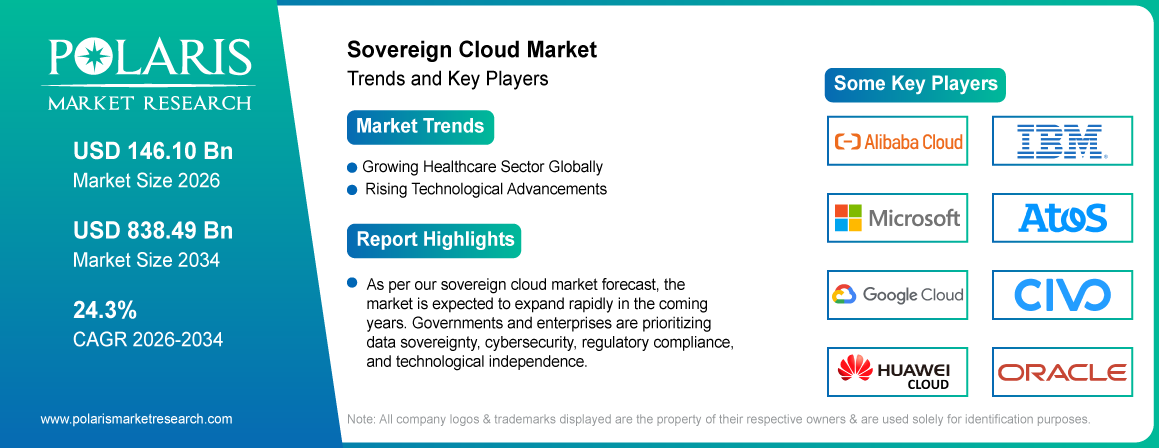
As per our sovereign cloud market forecast, the market is expected to expand rapidly in the coming years. Governments and enterprises are prioritizing data sovereignty, cybersecurity, regulatory compliance, and technological independence. Market players are focusing on integrating sovereign cloud with AI, edge computing, and confidential computing. Such initiatives would create additional opportunities. Further, regional regulations and sovereignty-focused procurement will accelerate adoption. Europe is likely to emerge as a key growth market as governments are strengthening digital autonomy and investing in locally controlled cloud infrastructure.
Research Methodology
- Market estimates derived using a blend of primary and secondary research, validated through weighted-average and combined top-down/bottom-up modeling approaches.
- Secondary research covers vendor filings, government data-localization regulations, cloud infrastructure investment data, industry journals, and paid third-party databases to build baseline estimates.
- Primary research includes interviews with key industry participants such as sovereign cloud providers, hyperscalers, systems integrators, and government IT procurement authorities to validate accuracy and capture forward-looking insights.
- The base year considered is 2025, with a forecast provided through 2034; revenues are expressed in USD billion.
- The parent market is identified as the global cloud infrastructure and public cloud services market; the addressable segment is narrowed using regional data, localization adoption, and regulatory compliance rates.
- The bottom-up model aggregates regional sovereign cloud demand across functionality, deployment mode, enterprise size, and industry vertical, validated against vendor revenue disclosures from AWS, Microsoft, Oracle, IBM, SAP, Huawei Cloud, and others.
- Regional coverage spans North America, Europe, Asia Pacific, the Middle East & Africa, and Latin America, further segmented by major countries.
- Projected 24.3% CAGR (2026–2034) reflects weighted analysis of tightening data-sovereignty regulations, geopolitical localization mandates, rising government, BFSI, and healthcare cloud adoption, and expanding hyperscaler sovereign-cloud investments.
- Findings are cross-validated across multiple estimation methods to ensure consistency, accuracy, and reliability of the final market sizing.
Sovereign Cloud Market Segmentation
By Functionality Outlook (Revenue, USD Billion, 2021–2034)
- Data Sovereignty
- Technical Sovereignty
- Operational Sovereignty
By Deployment Mode Outlook (Revenue, USD Billion, 2021–2034)
- Fully Managed Sovereign Cloud
- Hybrid Sovereign Cloud
- On-Premises Sovereign Cloud
By Enterprise Size Outlook (Revenue, USD Billion, 2021–2034)
- Large Enterprises
- SMEs
By Industry Vertical Outlook (Revenue, USD Billion, 2021–2034)
- Government & Defense
- Healthcare
- BFSI
- Telecommunications
- Energy & Utilities
- Manufacturing
- Others
By Regional Outlook (Revenue, USD Billion, 2021–2034)
- North America
- U.S.
- Canada
- Europe
- Germany
- France
- UK
- Italy
- Spain
- Netherlands
- Russia
- Rest of Europe
- Asia Pacific
- China
- Japan
- India
- Malaysia
- South Korea
- Indonesia
- Australia
- Vietnam
- Rest of Asia Pacific
- Middle East & Africa
- Saudi Arabia
- UAE
- Israel
- South Africa
- Rest of Middle East & Africa
- Latin America
- Mexico
- Brazil
- Argentina
- Rest of Latin America
Sovereign Cloud Market Report Scope
| Report Attributes | Details |
| Market Size in 2025 | USD 117.65 billion |
| Market Size in 2026 | USD 146.10 billion |
| Revenue Forecast by 2034 | USD 838.49 billion |
| CAGR | 24.3% from 2026 to 2034 |
| Base Year | 2025 |
| Historical Data | 2021–2024 |
| Forecast Period | 2026–2034 |
| Quantitative Units | Revenue in USD billion and CAGR from 2026 to 2034 |
| Report Coverage | Revenue Forecast, Market Competitive Landscape, Growth Factors, and Trends |
| Segments Covered |
|
| Regional Scope |
|
| Competitive Landscape |
|
| Report Format |
|
| Customization | Report customization as per your requirements with respect to countries, regions, and segmentation. |
Source: Polaris Market Research Analysis
Sovereign Cloud Market FAQ's
The global sovereign cloud market size was valued at USD 117.65 billion in 2025 and is projected to grow to USD 838.49 billion by 2034.
The global market is projected to grow at a CAGR of 24.3% during the forecast period.
Europe accounted for the largest market share of 38.6% in 2025, driven by increasing demand and adoption across the region.
Some of the key players in the market are Alibaba Cloud, Atos, AWS, Civo, Huawei Cloud, IBM, Microsoft, Oracle, OVHcloud, Rackspace Technology, SAP, T-Systems, Vult, and VMware.
The data sovereignty segment accounted for the largest market share of 42.8% in 2025, driven by increasing demand for data security and regulatory compliance.
The BFSI segment is expected to grow at the fastest pace in the coming years.
A sovereign cloud locally controls data, infrastructure, and operations. Public clouds, by contrast, use globally distributed, shared infrastructure.
The small and medium-size enterprises (SMEs) are expected to grow rapidly during the forecast period. Rising data privacy requirements and regulatory compliance will boost the segment growth.
Generative AI (GenAI) is increasing demand for sovereign cloud by requiring secure, compliant environments for sensitive data, AI models, workloads, and intellectual property.
Yes. Sovereign cloud can cost more than standard public cloud services. Its higher deployment and management expenses are attributed to dedicated infrastructure, localized operations, enhanced security controls, and compliance requirements.
GDPR, HIPAA, RBI data-localization requirements, and FedRAMP prompt organizations to adopt cloud environments offering stronger data residency, security, and compliance controls.
Download Sample Report of Sovereign Cloud Market
Please fill out the form to request a customized copy of the research report.


