
Tomato Powder Market Size, Share Global Analysis Report, 2026-2034
REPORT DETAILS
Tomato Powder Market Summary
The global tomato powder market size reached USD 1.34 billion in 2025. The market is expected to register a CAGR of 3.69% from 2026 to 2034. Increasing demand for shelf-stable, flavor-enhancing food ingredients across processed food, snack, and ready-to-eat product categories boosts the market growth. The growing global food processing industry and changing dietary habits also propel the market expansion.
Market Statistics
Key Takeaways
- As per our tomato powder market analysis, North America dominated the global market with 49.80% revenue share 2025. Rising demand for processed food products due to hectic consumer lifestyles and their higher disposable income propels the regional market growth.
- The Asia Pacific tomato powder market is projected to register the highest CAGR of 4.10% during the forecast period. The presence of large population and customer base with continuously changing lifestyles and dietary preferences drives the market expansion.
- The organic segment is projected to register the highest growth rate of 52.09% during 2026–2034. It is fueled by rapidly increasing preference for natural & healthy ingredients among health-conscious consumers globally.
- The spray dried segment held the largest share of 50.60% in 2025. This type of tomato can be produced and used throughout the year. It ensures a consistent supply of tomato flavor and nutrients, propelling the segment growth.
- The curries, gravies, and soups segment accounted for global market share of 40.10% in 2025. This is driven by the growing product use as a type of coloring, aromatic, and flavoring agent.
Industry Dynamics
- Busy lifestyles, urbanization, and changing dietary habits across the globe are boosting the demand for processed ingredients, such as tomato powder.
- Rising emphasis on food safety and quality among consumers propels the global market growth.
- Increasing the working-class population and their high disposable income lead to the demand for ready-to-make products. This factor drives the demand for tomato powder.
- Rising investments in R&D activities to innovate new products with more improved and enhanced properties is likely to boost the market development in the coming years.
- Price volatility of raw tomatoes and seasonal supply fluctuations hinder the market growth.
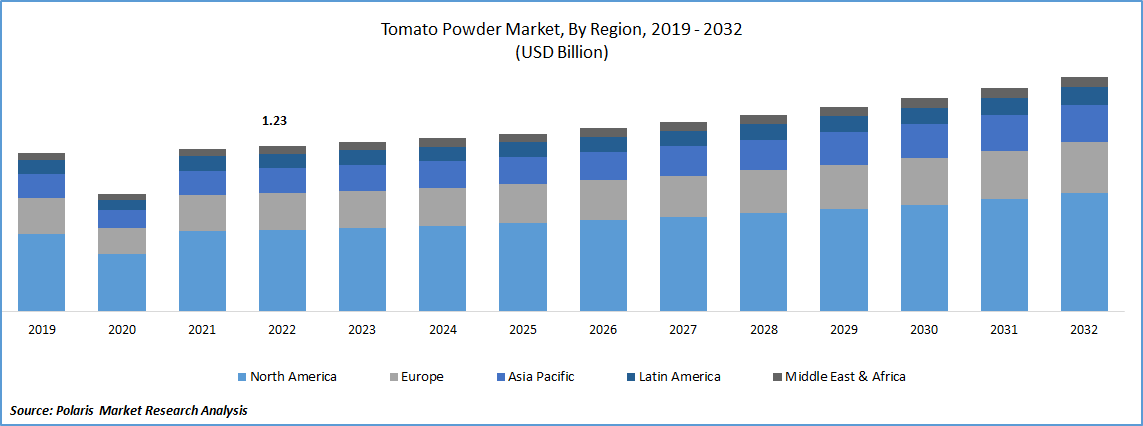
Source: Polaris Market Research Analysis
To Understand More About this Research:Download Sample Report
The tomato powder market focuses on the production, storage, and commercialization of tomato powder. The market is increasingly evolving from a traditional dehydration-based ingredient segment into a functional food ingredient category, where manufacturers prioritize flavor consistency, color retention, and clean-label formulation compatibility.
Rising working-class population and their hectic life schedules that lead to higher consumption of processed and ready-to-eat food products, which highly utilizes the tomato powder as a key flavoring ingredient and tastemaker along with the surge in number of health-conscious people who are moving towards organic food & beverages, are driving the global market growth. In addition, the exponential growth of food processing industries mainly in the emerging economies like China, India, and Brazil and rising investments on R&D activities to innovate new products with more improved and enhanced properties, is likely to have a positive impact on the product demand.
Major manufacturers across the globe are continuously innovating new applications and uses areas for tomato powders and are also focusing on the development on new product formulations such as flavored tomato powders with added herbs and spices, to cater to specific requirement of customers. Companies are also sourcing tomatoes from local farmers. They integrate efficient processing methods to reduce energy use. Market players are using sustainable food packaging materials. These actions help them gain traction and create new revenue opportunities worldwide.
Value Chain Analysis
The tomato powder market value chain is highly quality-driven. Raw material selection and processing techniques influence the taste, color, and shelf stability of tomato powder. Furthermore, safe packaging and efficient distribution ensure market competitiveness.
| Value Chain Stage | Key Activities | Value Addition/Insights |
| Raw Tomato Cultivation | Farming, irrigation, hybrid seed selection, and harvesting | Quality, variety, and yield of tomatoes directly influence powder color, flavor, and nutrient retention |
| Processing (Hot Break/Cold Break) | Crushing, heating, and pulp extraction | Hot break preserves color and viscosity. Cold break retains fresh flavor. Choice of processing type impacts end-product application |
| Drying (Spray/Freeze/Sun Drying) | Moisture removal using different techniques | Spray drying is cost-efficient. Freeze drying retains nutrients and flavor. However, sun drying is low-cost but less consistent |
| Powder Refinement & Blending | Grinding, sieving, standardization, and additive blending | Ensures uniform texture, enhances shelf life, and customizes taste/color for specific industrial applications |
| Packaging & Distribution | Bulk/retail packaging, storage, and logistics | Moisture-proof packaging is critical. Efficient distribution ensures product stability and longer shelf life |
| End-use (Food Processing, HoReCa, Retail) | Usage in sauces, soups, snacks, and ready meals | Demand driven by convenience foods, the foodservice industry, and retail consumption of instant ingredients |
Source: Polaris Market Research Analysis
Industry Dynamics
Growth Drivers
Increasing Demand for Ready to Eat & Convenience Foods: Rapid urbanization, changing lifestyles, and higher disposable incomes propel the demand for ready meal options. Tomato powder has a long shelf life, ease of storage, and quick reconstitution. Thus, it is used in instant food items such as soups, sauces, noodles, and snack seasonings. The powder maintains flavor consistency. Its use helps reduce preparation time. Food manufacturers favor tomato powder for its cost efficiency and reduced wastage. The expanding global convenience food sector significantly boosts the demand for tomato-based powdered ingredients. Therefore, the rising demand for ready-to-eat (RTE) and convenience foods propels the tomato powder market growth.
Rising importance of food safety and quality: Consumers and regulatory bodies seek hygienic, safe, and traceable food products. Tomato powder is produced under controlled processing conditions. It ensures consistent quality and reduces contamination risks. Tomato powder provides a standard flavor, color, and nutrient content. It is important for large-scale food production. Manufacturers prefer it due to its reduced spoilage and longer shelf life. Compliance with food safety standards and certifications makes it more appealing. It increases the use of tomato powder in different food-processing applications. The increased focus on food safety testing and quality drives the use of tomato powder in the food industry.
Challenges
Price Volatility of Raw Tomatoes and Seasonal Supply Fluctuations: Tomato production is highly dependent on climatic conditions. During peak harvest seasons, oversupply reduces prices. On the other side, off-season shortages increase tomato costs. Such cost fluctuations adversely impact procurement planning for tomato powder processors. This unpredictability affects profit margins and disrupts supply chains. Variations in tomato quality across seasons affect the consistency of tomato powder quality. Manufacturers struggle to keep prices stable and production ongoing. This situation raises operational risks in the tomato powder industry. As a result, fluctuating raw tomato prices and seasonal supply changes hinder market development.
Opportunities
Rising Demand for Natural Food Coloring: Consumers are becoming aware of the health risks associated with synthetic dyes. They prefer natural food ingredients. Thus, food manufacturers are adopting plant-based alternatives. Tomato powder is rich in lycopene. It provides a vibrant red color and nutritional benefits. These benefits bolster its use in snacks, sauces, beverages, and processed foods. Regulatory support for clean-label products increases the adoption of this powder in food and beverages. Global demand for natural and minimally processed ingredients is growing. Tomato powder is considered as a natural coloring agent. It enhances the color and flavor of food items. Hence, increasing demand for natural food coloring is expected to present a strong opportunity for the industry.
Expansion of Organic Food Ingredients: Consumers are preferring food and beverages made with chemical-free, sustainably sourced, and non-GMO ingredients. As a result, manufacturers are expanding their organic product portfolios. Organic tomato powder is widely used in baby foods, healthy snacks, and premium packaged foods, where ingredient transparency is critical. Increased awareness of environmental sustainability and clean-label trends propels the use of tomato powder. Food companies are investing more in certified organic supply chains. This helps them meet regulations and consumer expectations. This trend is especially strong in developed markets. However, emerging economies are slowly adopting organic consumption patterns. As a result, the rising demand for organic food products is expected to create significant opportunities for organic tomato powder producers.
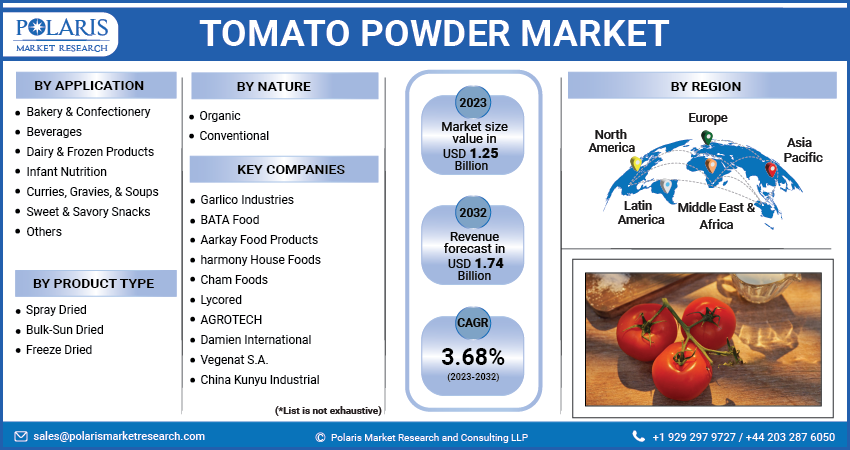
Source: Polaris Market Research Analysis
Segmentation Analysis
By Nature Analysis
The organic segment dominated the revenue share in 2025. It is driven by rapidly increasing preference for natural and healthy ingredients among health-conscious consumers globally. Rising demand for healthy food ingredients in the food & beverage industry bolsters the segment growth. Governments and regulatory bodies of many countries establish standards and certifications for organic products. These standards reassure consumers about the authenticity and quality of organic tomato powder.
The conventional segment led the market with a substantial revenue share in 2025. The segment growth is mainly accelerated due to its widespread use in numerous applications. Also, extended shelf life and convenience of conventional tomato powder contribute to its demand. Further, ease of incorporation into several formulations and cost-effectiveness propels the segment growth. The rapid expansion of the food processing industry across the globe is driven by changing consumer preferences, urbanization, and increasing consumer spending on healthier products. This has been positively influencing the segment.
By Product Type Analysis
The spray dried segment held the largest market revenue share in 2025. The dominance is highly attributable to its significant emergence as a highly convenient and easy to use product in various food applications. Spray-dried tomato powder is readily soluble in water. The powder can be easily incorporated into several types of recipes, sauces, soups, seasonings, and other food products. Further, this type of tomato powder can be produced and used throughout the year. This ensures a consistent supply of tomato flavor and nutrients. It addresses the concerns regarding the seasonal availability of fresh tomatoes. Thus, these spray dried tomato powder benefits are propelling the segment growth.
The freeze-dried segment is likely to exhibit rapid growth in the coming years. The growth is mainly driven by its ability to offer a unique and intense flavor profile. It enhances the taste of various food products. Easy availability of savory and umami-rich characteristics in freeze-dried products makes them a popular ingredient in snacks, seasonings, soups, sauces, and ready meals. These freeze dried tomato powder advantages are projected to boost the growth of the segment.
Processing Technology Analysis: Spray Drying vs Freeze Drying
| Aspect | Spray Drying | Freeze Drying |
| Cost | Cost-effective and suitable for large-scale production | Higher cost due to an energy-intensive process |
| Product Quality | Moderate flavor and nutrient retention | Better flavor, color, and nutrient retention |
| Solubility | Higher solubility. Ideal for instant applications | Good solubility but slightly slower than spray-dried |
| Application | Widely used in soups, sauces, seasonings, and processed foods | Used for premium products, nutraceuticals, and specialty foods |
| Shelf Life | Good shelf stability | Excellent shelf life with superior quality preservation |
| Processing Complexity | Simple and faster process | Complex and time-consuming process |
| Market Positioning | Mass-market and industrial use | Premium and high-value applications |
Source: Polaris Market Research Analysis
By Application Analysis
Curries, Gravies, and Soups Segment Accounted for the Largest Market Share in 2025
The curries, gravies, and soups segment accounted for the global market share in 2025. In the segment, tomato powder is increasingly used as a coloring, aromatic, and flavoring ingredient. Tomato powder has been adopted as a convenient alternative to fresh tomatoes. It eliminates the need for washing, chopping, and storing fresh tomatoes. Consumers across the world are becoming increasingly health-conscious. Thus, the inclusion of tomato powder in curries, gravies, and soups is gaining huge popularity. The powder can help enhance the nutritional value of the dishes. It makes them more appealing to health-conscious individuals.
Source: Polaris Market Research Analysis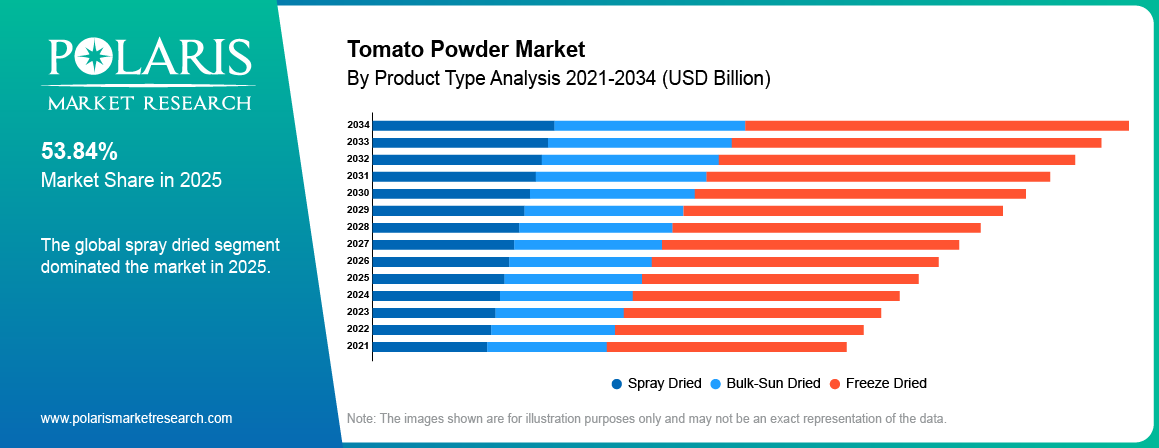
Regional Insights
North America dominated the global market in 2025. Hectic consumer lifestyles and their higher disposable income propel the demand for processed food products, such as tomato powder. Also, the presence of major manufacturers and producers in countries like the U.S. and Canada contributes to the regional market growth. There is a surging popularity of cuisines such as Mexican, Italian, and Mediterranean across the region. This has led to an increased demand for tomato-based dishes and products. Also, the presence of a strong processed food industry boosts the North America tomato powder market expansion.
The Asia Pacific tomato powder market is projected to register the highest CAGR during the forecast period. Large population and customer base with continuously changing food habits drives the regional market growth. Also, the growing emphasis on natural and clean label food products influences the demand for natural food ingredients. Thus, there is a growing demand for organic tomato powder, mainly in emerging economies such as India, China, and Indonesia, due to rapid urbanization.
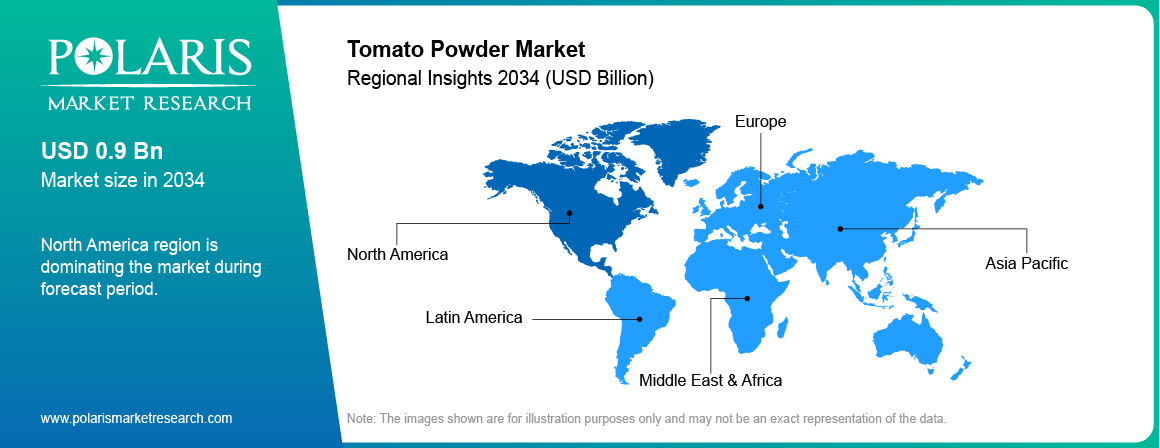
Source: Polaris Market Research Analysis
Competitive Insight & Key Players Analysis
The tomato powder market is witnessing intense competition due to the presence of various global and regional players operating worldwide. The players are constantly upgrading their product line to stay ahead of the competition. Companies are investing in sustainable sourcing, clean-label products, and new product formulations. It helps them meet the rising demand for natural and sustainable food ingredients. These players focus on partnerships, product upgrades, and collaboration to gain a competitive edge over their peers. It also helps them capture a significant market share.
List of Key Companies
- Aarkay Food Products
- Agraz
- Agrofusion
- AGROTECH
- BATA Food
- China Kunyu Industrial
- COFCO Tunhe Tomato Co. Ltd.
- Damien International
- Drytech
- Farmvilla
- Garlico Industries
- Hangzhou Qincheng Trade Co. Ltd.
- harmony House Foods, Cham Foods
- Lycored
- Vegenat S.A.
Tomato Powder Industry Recent Developments
- February 2025: Agrofusion introduced Inagro Tomato Powder at Gulfood 2025 in Dubai. Advanced Filtermat technology is used to make the powder. The company claims that it contains no anti-caking agents. The powder provides a clean-label solution for premium formulations. (Source: www.asianagrocommodities.com)
Pricing & Supply Chain
Multiple factors, including raw tomato availability, processing methods, and packaging types, influence the price of the tomato powder. Climate and environmental changes can lead to fluctuations in tomato harvests. It directly affects the cost and availability of tomatoes. Environmental factors influence tomato powder price trends. The use of innovative processing methods raises production costs. Transportation disruptions, labor shortages, and logistics issues adversely affect tomato powder supply chain. These challenges cause price instability and delivery delays. Therefore, efficient supply chain management is vital. It helps maintain competitive pricing and a steady market supply.
Tomato Powder Market Segmentation
By Nature Outlook (Revenue – USD Billion, 2021–2034)
- Organic
- Conventional
By Product Type Outlook (Revenue – USD Billion, 2021–2034)
- Spray Died
- Bulk-Sun Dried
- Freeze Dried
By Application Outlook (Revenue – USD Billion, 2021–2034)
- Bakery & Confectionery
- Beverages
- Dairy & Frozen Products
- Infant Nutrition
- Curries, Gravies, and Soups
- Sweet Savory
- Snacks
- Others
By Distribution Channel (Revenue – USD Billion, 2021–2034)
- Direct Sales
- Online Retailers
- Supermarkets & Hypermarkets
- Specialty Stores
- Convenience Stores
- Others
By Regional Outlook (Revenue – USD Billion, 2021–2034)
- North America
- U.S.
- Canada
- Rest of North America
- Europe
- Germany
- UK
- France
- Italy
- Spain
- Russia
- Netherlands
- Rest of Europe
- Asia Pacific
- China
- India
- Japan
- South Korea
- Indonesia
- Malaysia
- Rest of Asia Pacific
- Latin America
- Argentina
- Brazil
- Mexico
- Rest of Latin America
- Middle East & Africa
- UAE
- Saudi Arabia
- Israel
- South Africa
- Rest of Middle East & Africa
Tomato Powder Market Report Scope
| Report Attributes | Details |
| Market Size in 2025 | USD 1.34 billion |
| Market Size in 2026 | USD 1.39 billion |
| Revenue Forecast in 2034 | USD 1.85 billion |
| CAGR | 3.69% from 2026 to 2034 |
| Base Year | 2025 |
| Historical Data | 2022–2024 |
| Forecast Period | 2026–2034 |
| Quantitative Units | Revenue in USD billion, 2021–2034 and CAGR from 2026 to 2034 |
| Report Coverage | Revenue Forecast, Market Competitive Landscape, Growth Factors, and Trends |
| Segments Covered |
|
| Regional Scope |
|
| Competitive Landscape |
|
| Report Format |
|
| Customization | Report customization as per your requirements with respect to countries, regions, and segmentation. |
Source: Polaris Market Research Analysis
Tomato Powder Market FAQ's
The global market was valued at USD 1.34 billion in 2025. The market is projected to reach USD 1.85 billion by 2034, at a CAGR of 3.69% during 2026–2034.
Tomato powder is used in various food items such as soups, sauces, and snacks. Its demand in increasing in ready meals as a flavoring and coloring agent.
North America dominates the market, driven by high consumption of processed foods. Also, clean-label trends and strong distribution infrastructure propel the market expansion.
Organic tomato powder is free from synthetic pesticides and fertilizers. However, conventional tomato powder offers greater cost-effectiveness and dominates market share globally.
Tomato powder is widely used in bakery & confectionery; beverages; dairy & frozen products; infant nutrition; curries, gravies, and soups; and others. Its natural flavor, antioxidant content, and extended shelf life propel its use in these applications
Rising consumer preference for health-conscious products and expansion of e-commerce drive the market expansion. Growing demand for convenience and packaged foods also fuels the market growth.
Download Sample Report of Tomato Powder Market
Please fill out the form to request a customized copy of the research report.


