
Warehouse Management System Market Size, Share, Trends & Forecast, 2026–2034
REPORT DETAILS
Warehouse Management System Market Summary
Global warehouse management system market size was valued at USD 3.71 billion in 2025, exhibiting a CAGR of 21.8% during the forecast period. The growth of e-commerce, automation, cloud technology adoption, and the increasing need for frictionless omnichannel delivery drive the WMS market growth.
Market Statistics
Warehouse Management System Market Key Takeaways
- North America dominated the market in 2025 with a 39.6% share, primarily due to the U.S.'s rapid adoption of cloud-based WMS solutions.
- Asia Pacific is poised for the fastest growth at a 24.7% CAGR during the forecast period, driven by increased automation, economic growth, thriving e-commerce, and robust internet penetration.
- Europe is expected to record growth at a 20.9% CAGR during the projected period. The growth is attributed to e-commerce expansion and increasing demand for faster delivery.
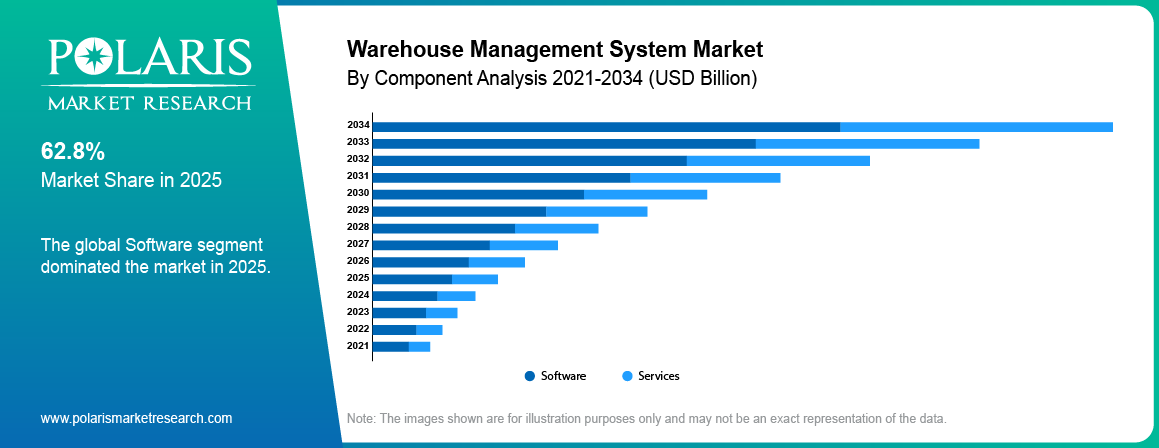
- The software segment dominated the warehouse management system market with a 62.8% share in 2025, driven by sustained advancements in technology integration and industrial automation.
- The on-premises segment is expected to grow at a 19.6% CAGR due to its high levels of local control, security, and performance, despite higher hardware, software, and maintenance costs.
Note: Figures and projections outlined in this report are the result of Polaris Market Research’s proprietary analytical processes, grounded in the latest available datasets and market observations.
What Is a Warehouse Management System?
The warehouse management system (WMS) provides software solutions and related services that optimize and manage the operations within warehouses and distribution centers. WMS software systems are used to control and manage the movement and storage of materials within a warehouse. It supports tasks such as receiving, put-away, picking, packing, and shipping goods.
WMS plays a pivotal role in helping companies manage inventory effectively, streamline order fulfillment, and optimize warehouse layouts. By leveraging advanced functionalities such as real-time inventory tracking, automated picking and packing, and integration with transportation management systems, WMS enhances operational efficiency and reduces fulfillment times.
The adoption of automation technologies in warehouses is driving the warehouse management system market growth. WMS software enhances operational efficiency by minimizing errors and streamlining critical processes such as inventory control, picking, and shipping.
The integration of advanced technologies such as artificial intelligence (AI), the Internet of Things (IoT), and cloud computing into WMS is transforming warehouse operations, making them more responsive, data-driven, and productive. Automated storage and retrieval systems (AS/RS), autonomous mobile robots (AMRs), voice picking, and wearables are some of the innovative automation solutions being adopted by warehouses to optimize workflows and improve accuracy, which drives the market growth.
WMS Vs ERP System
A warehouse management system and enterprise resource planning are both distinct systems that serve different purposes. Although these systems are used in different departments, they are interconnected and offer a variety of benefits to users. A warehouse management system primarily manages warehouse stock. However, it also provides end-to-end data management and control of warehouse processes such as inventory, receipt, storage of goods, picking, packing, and shipping. An enterprise resource planning system combines various software to help manage and monitor finance, human resource management, purchasing, selling, production, and other business functions.
Warehouse Management System vs ERP System
| Feature | Warehouse Management System | ERP System |
| Core focus | Warehouse operations: receiving, put-away, picking, packing, shipping | Enterprise-wide finance, HR, procurement, and planning |
| Inventory tracking | Real-time, bin/location-level | Ledger-level, less granular |
| Warehouse operations depth | Core function — built for it | Limited or add-on module |
| Order fulfillment features | Extensive (wave/batch picking, packing, dispatch) | Moderate, often needs WMS integration |
| Labor management | Included in most WMS | Limited |
| Supply chain visibility | High (real-time, warehouse-level) | Moderate (transactional, less operational) |
| Typical buyer | Warehouse/distribution/3PL operations teams | Finance, IT, and enterprise operations leadership |
Source: Polaris Market Research Analysis

Source: Polaris Market Research Analysis
Impact of AI in Warehouse Management System Market
- AI enhances demand forecasting by analyzing past trends and data, enabling warehouses to optimize their inventory levels.
- AI-powered warehouse management systems improve order picking speed and accuracy with intelligent routing and real-time decision-making.
- Artificial intelligence facilitates predictive maintenance of warehouse machinery, cutting downtime and enhancing efficiency.
- It facilitates labor management through workforce performance analysis and the recommendation of ideal job assignments.
- AI-powered analytics provide deeper operational insights, enabling smarter, data-driven decisions across warehouse operations.
Market Dynamics
Driver: E-commerce Industry Expansion
In the warehouse management system market, the rapid growth of e-commerce has transformed the landscape of retail and supply chain management, driving a surge in demand for efficient warehouse operations. Online shopping continues to thrive, and businesses increasingly turn to warehouse management systems (WMS) to meet the challenges posed by the volume and complexity of online orders. According to Eurostat, in 2025, 78% of EU internet users aged 16 to 74 preferred online shopping. With rising inclination toward online shopping, market players are offering solutions dedicated to e-commerce, thereby driving the growth of the market (Source: ec.europa.eu).
Driver: Rising Adoption of Cloud-Based Solutions
The adoption of cloud-based WMS solutions has surged due to their scalability, flexibility, and cost-effectiveness compared to traditional on-premises systems. This shift has been particularly pronounced among small and medium-sized enterprises (SMEs) seeking to minimize upfront IT infrastructure investments. Cloud-based WMS platforms allow businesses to scale operations more efficiently, adjust to fluctuating demands, and integrate seamlessly with other cloud-based applications and services. They also provide real-time data access, enabling better decision-making and operational agility across distributed warehouse networks.
Driver: Increasing Demand for Omnichannel Distribution
The demand for omnichannel distribution has reshaped retailers' and logistics providers' approaches to inventory management and order fulfillment. Consumers now expect seamless experiences, whether shopping online, in-store, or via mobile platforms. This shift requires WMS that can synchronize inventory across these diverse channels in real-time, ensuring that products are available where and when customers want them.
WMS solutions tailored for omnichannel distribution integrate inventory data across all sales channels, enabling businesses to optimize stock levels, reduce out-of-stock, and improve order accuracy. By centralizing operations and providing a unified view of inventory, these systems improve efficiency, reduce costs from excess inventory and missed sales opportunities, and ultimately deliver a superior customer experience across all touchpoints.
Restraint: High Implementation and Integration Costs
Implementing a warehouse management system involves high upfront costs that can be challenging for companies. Implementation costs include software, hardware, training, and expenses related to integrating the system into existing software infrastructure. Additionally, integrating with ERPs and other inventory software can be complicated and time-consuming. Therefore, small and medium-sized enterprises may find such expenditures difficult to justify. Moreover, software issues that require technical support and periodic maintenance and update costs are further high, which further limit the WMS implementation and adoption.
Restraint: Challenges of Limited WMS Expertise
The lack of skilled workers who can effectively operate and manage advanced warehouse systems is restraining market growth. Workers need training to use a WMS effectively. Moreover, some employees may be accustomed to a particular way of doing things and resist adopting new technologies and approaches. Technical problems may arise, requiring IT experts to intervene. This means that companies will incur additional costs by spending time and money on training and technical support. Small businesses do not have the necessary technical expertise to implement new solutions, thereby restraining industry growth.
Opportunity: Rising Emphasis on Automation & Smart Logistics Investments
Growing investment in automation and smart logistics creates an opportunity for the expansion of WMS market size. Many companies are adopting modern technologies, including robots, artificial intelligence, sensors, and automated storage, to digitize operations and ensure high performance. Thus, warehouses need integrated systems to control and organize technological processes. Companies are looking to optimize inventory, increase efficiency, and reduce costs by digitizing their operations. The demand for advanced WMS solutions is expected to grow in many industries as automation becomes more common.
Various organizations are adopting Warehouse automation technologies such as robots, conveyors, automated picking, and intelligent software in their warehouse to remain competitive within the market. These automated technologies help organizations reduce manual work and errors. Moreover, with the rise of e-commerce and growing customer demands, several organizations are forced to adopt automation to fulfill the demand. A warehouse management system can help such organizations in managing the automated resources to get accurate and efficient results.
Warehouse robotics and smart fulfillment centers are transforming the way products are stored, picked, packed, and delivered. The robotic system helps in removing monotonous work from humans. Furthermore, smart fulfillment centers help organizations in scaling their business by utilizing advanced technologies such as artificial intelligence, sensors, and other automated machinery. Such centers result in faster processing of customer orders while minimizing mistakes and workload. A warehouse management system can be used in such smart warehouses to record and monitor the data effectively. Additionally, the rising customer demands from e-commerce have prompted organizations to fulfill customer demands efficiently.
Real-Time Inventory and Supply Chain Visibility
Real-time inventory and supply chain visibility helps businesses track sales and purchases. Organizations use warehouse management systems to ensure that the right products are available in the warehouse at the right time while minimizing shortages and overstock at the same time. Additionally, it assists managers in making effective decisions and analyzing the important functions of the warehouse. Thus, with the adoption of WMS, organizations can improve the overall performance of the warehouse while also improving the supply chain management and distribution network, thereby driving the industry growth.

Source: Polaris Market Research Analysis
Segment Analysis
Market Assessment by Component
The global market segmentation, based on components, includes software and services. The software segment dominated the warehouse management system market share in 2025 with 62.8%. This is propelled by the continuous integration of new technologies and functionalities into WMS, driven by advancements in industrial automation. The increasing complexity of global supply chain networks underscores the necessity for advanced WMS software solutions. Factors such as increasing awareness of WMS software among small and medium-sized enterprises (SMEs), the expansion of global supply chain digitalization and operations, and the growing preference for cloud-based WMS platforms are pivotal in driving this demand. Furthermore, the escalating requirement for advanced warehousing and logistics infrastructure further amplifies the adoption of WMS-related software solutions.
The services segment is anticipated to witness significant growth with a CAGR of 23.9% during the forecast period. Firms require professional services such as consulting, implementation, training, and system integration to adopt WMS solutions. Moreover, it is crucial to maintain and update the software to keep up with competitors and gain an advantage. Additionally, the rising need for cloud-based and automated warehouse management systems is expected to propel the demand for services segment.
Market Evaluation by Deployment
The market segmentation, based on WMS deployment models, includes on-premises and cloud-based. The on-premises segment is anticipated to grow at CAGR of 19.6% during the forecast period. On-premise WMS software runs on servers located at warehouse facilities, providing robust local computing power. This setup offers advantages such as heightened control over server infrastructure, enhanced security, and optimized performance. However, the adoption of on-premise WMS entails substantial costs, including investments in hardware components and software licenses necessary for WMS operation. Additionally, there are ongoing expenses associated with IT personnel for maintenance and periodic data backups.
The cloud deployment segment dominated with the largest share of 58.7% in 2025. The cloud-based WMS software helps organizations manage their warehouse data through internet. The software provides advantages such as low-cost, high scalability, rapid deployment, and access to the latest features. Additionally, cloud-based WMS systems are easy to maintain and allow businesses to scale up or down as needed. Businesses also reduce their costs as they do not need to invest in expensive infrastructure. Moreover, the flexibility and remote accessibility of the cloud-based WMS solutions attract many small and medium enterprises, thereby driving the cloud WMS market growth.
Deployment Comparison: On-Premises vs Cloud-Based WMS
| Criteria | On-Premise Warehouse Management System | Cloud-Based Warehouse Management System |
| Upfront cost | High (hardware, licenses) | Low (subscription-based) |
| Implementation time | Longer | Faster |
| Scalability | Limited by on-site infrastructure | Elastic, scales with demand |
| Data control | Full local control | Managed by vendor, with SLA-backed security |
| Best fit | Large enterprises with heavy customization/compliance needs | SMEs and multi-site operators needing flexibility |
| Maintenance | In-house IT team required | Vendor-managed updates |
Source: Polaris Market Research Analysis
Market Evaluation by Function
The global warehouse management system market segmentation, based on function, includes labor management, analytics & optimization, systems integration & maintenance, yard/billing, consulting. The systems integration & maintenance segment dominated with largest share of 46.3% in 2025. The rising adoption of multiple digital technologies in warehouses is fueling the demand for systems integration and maintenance services. Warehouses are adopting WMS, ERP platforms, robotics, transportation systems, sensors, and automation technologies in their operations. These systems improve information flow across the supply chain network. Additionally, system maintenance is essential to ensure reliability of the systems and avoid downtime in operations. Demand for integration and maintenance services is growing with the rising need for technologically advanced warehouses and automated operations, thereby driving the segment growth.
The labor management segment is expected to record the highest CAGR of 24.6% during the forecast period. The rising labor cost and rising workforce shortage are driving the demand for labor management systems. Warehouse operators worldwide are focusing on improving employee productivity to control operating costs. The adoption of such systems enables the companies to monitor the performance of their employees, effectively manage their workforce, and assess productivity rates. Additionally, the proliferation of e-commerce has increased the order volume in warehouses, which in turn is driving the need for improved worker productivity. The growing competition and need for faster order processing encourage companies to invest in such systems, thereby driving the segment growth.
Market Evaluation by End Use
The global WMS market segmentation, based on end use, includes automotive, chemicals, e-commerce, electricals & electronics, food & beverages, healthcare, metals & machinery, third-party logistics (3PL), and others. The 3PL segment dominated with the largest share of 34.8% in 2025. The growing need for outsourced logistics services has increased the adoption of warehouse management systems among Third-Party Logistics (3PL) providers. The 3PL industry provides warehousing and inventory management services to other firms in addition to managing their own inventory. This needs the systems to make the inventory and transportation process efficient. Third-party logistics providers grow their business by handling more orders and managing a large inventory by using the warehouse management system. The growth of online retail platform combined with the rising need for international trade is expected to drive demand for warehouse management system for 3PL.
The automotive segment is expected to witness the growth of CAGR 22.9% during the forecast period. The increasing complexity of automotive supply chains is driving the WMS adoption in the automotive industry. Automotive companies manage thousands of parts and components that must be available at all times to ensure uninterrupted production. A WMS enables companies to optimize inventory, manage materials, and control warehousing activities effectively. Moreover, with the growing production of electric vehicles, the inventory of automotive manufacturers is witnessing an increase in the number of specialized parts. Companies are looking to reduce storage costs and optimize supply chains while ensuring uninterrupted production and proper management of parts and materials. Additionally, the need for uninterrupted production, proper management of parts and materials, and faster movement of materials is fueling the segment growth.
Segment Snapshot
| Segment | Categories | Typically Largest Share |
| Component | Software, Services | Software |
| Deployment | On-Premises, Cloud-Based | Cloud-based |
| Function | Labor Management, Analytics & Optimization, Systems Integration & Maintenance, Yard/Billing, Consulting | Systems Integration & Maintenance |
| End User | Automotive, Chemicals, E-commerce, Electricals & Electronics, Food & Beverage, Healthcare, Metals & Machinery, 3PL, Others | 3PL |
Source: Polaris Market Research Analysis
Real-World Use Cases
Warehouse management systems are widely used across industries to improve warehouse operations. In e-commerce, WMS is applied to ensure the tracking of high-order volumes, inventory stock levels, and quick order fulfillment. Retail stores use such systems to ensure sufficient stock control and avoid shortages at different warehouses. Third-party logistics companies utilize WMS to store and manage goods on behalf of other companies with minimal errors and increased efficiency. Automobile manufacturers apply WMS to ensure the tracking of large number of parts and keep the supply chain productive. Manufacturing firms use WMS to manage raw materials and products.
| Industry / Segment | Typical Use Case | How WMS Is Used? | Business Outcome |
| E‑commerce & D2C brands | High‑volume, small‑parcel order fulfillment | Barcode‑directed receiving, putaway, picking, packing; integration with Shopify/WooCommerce/marketplaces; automated label printing and tracking. | Faster order cycle times, fewer mis‑picks, lower infrastructure and labor costs, real‑time inventory sync across channels. |
| Omnichannel retail | Ship‑from‑store, BOPIS, store replenishment from shared inventory | Centralized inventory visibility across DCs and stores; rules‑based order routing; dynamic slotting and replenishment; returns management. | Reduced overselling, higher fill rates, shorter delivery times, lower safety stock, improved customer experience. |
| 3PL / Contract logistics | Multi‑client warehousing with SLAs and billing | Client‑specific inventory segregation, task management, KPI dashboards, EDI/API integrations for orders, ASNs, and shipments; client portals for visibility. | Ability to scale operations, meet SLAs, reduce manual reconciliation, and offer value‑added services (kitting, labeling, returns). |
| Wholesale distribution | Large‑SKU, multi‑location inventory with EDI orders | Directed putaway/picking, lot/serial tracking, cycle counting, EDI automation for POs/ASNs/invoices, margin analytics by order/line. | High inventory accuracy, fewer stockouts/overstocks, faster order processing, reduced manual data entry. |
| Manufacturing (discrete & process) | Raw material and finished goods coordination | Integration with production scheduling; WIP tracking; kitting for production lines; quality checks; traceability for lots/serials. | Shorter production lead times, better material availability, improved traceability and compliance, reduced WIP inventory. |
| Cold chain & food/beverage | Temperature‑controlled storage with expiry/FEFO | Lot/expiry tracking, FEFO picking, temperature monitoring integration, compliance reporting, recall management. | Lower spoilage, improved compliance, faster recalls, better shelf‑life management. |
| Automotive & industrial aftermarket | High‑SKU, small‑order fulfillment for service parts | High‑density automated storage (e.g., AutoStore) integrated with ERP/WMS; optimized pick paths; kitting for service orders. | Reduced labor per order, faster small‑order fulfillment, higher storage density, improved service levels. |
| Pharmaceuticals & healthcare | Regulated storage with strict traceability | Serial/lot tracking, temperature/humidity controls, audit trails, compliance reporting (e.g., GDP/GMP), quarantine workflows. | Regulatory compliance, reduced risk of errors, full traceability from receipt to shipment. |
| Fashion & apparel | Seasonal peaks, size/color variants, high returns | Size/color matrix management, cycle counting, returns inspection and disposition, integration with POS/e‑commerce. | Better inventory accuracy across variants, faster peak handling, improved returns processing and resale. |
| Spare parts & MRO | Low‑volume, high‑variety SKUs for aviation/industrial | Pocket/slot‑based storage for small parts, optimized picking for low‑velocity SKUs, integration with maintenance systems. | Higher pick rates, reduced mis‑picks, lower footprint for long‑tail SKUs, improved service to maintenance teams. |
| Cross‑dock & fast‑flow DCs | Minimal storage, rapid sortation and consolidation | Inbound/outbound synchronization, cross‑dock tasking, lane/door assignment, real‑time yard management, and dock management. | Reduced dwell time, higher throughput, lower handling costs, faster trailer turnarounds. |
| Reverse logistics & returns | High‑volume returns from e‑commerce/retail | Returns intake, inspection, grading, disposition (resell/refurbish/scrap), inventory updates across channels. | Faster return turnaround, higher recovery value, reduced manual processing, better visibility into return reasons. |
Source: Polaris Market Research Analysis
Source: Polaris Market Research Analysis
Regional Insights
The warehouse management software market shows varying growth across different regions due to differences in e-commerce development, industrial activity, technology adoption, and logistics infrastructure. Growing investments in warehouse automation and digital supply chains are driving demand across major global markets.
By region, the study provides market insights into North America, Europe, Asia Pacific, Latin America, and the Middle East & Africa. North America maintained the largest share of 39.6% in the warehouse management system market share in 2025, driven by rising adoption of cloud-based WMS solutions across the U.S. as companies are increasingly migrating their operations to the cloud. Key growth factors include the robust expansion of the e-commerce sector, a well-developed manufacturing ecosystem, and the presence of leading companies in automotive, pharmaceuticals, chemicals, and food & beverages. These industries are progressively embracing advanced WMS solutions over traditional legacy systems. Furthermore, the third-party logistics (3PL) sector plays a significant role in fueling the expansion of the warehouse management system market across North America.
The Asia Pacific market is poised to experience the highest CAGR of 24.7% during the forecast period. This acceleration is driven by increasing automation demands across businesses, expanding economic activities, and a burgeoning e-commerce landscape supported by high Internet penetration rates. In countries such as China and India, the market growth is further propelled by rising consumer purchasing power, leading to heightened demand for consumer goods and necessitating efficient WMS solutions for streamlined handling and delivery. Government initiatives in China emphasize advancing manufacturing capabilities through technology adoption and are pivotal in fostering the adoption of advanced technologies like WMS. Similarly, in India, initiatives like "Make in India" and efforts toward digital transformation are incentivizing businesses to invest in WMS technologies, aiming to optimize operations and enhance overall competitiveness.
The market in Europe is expected to exhibit a significant CAGR of 20.9% during the forecast period. This is due to increased e-commerce penetration and upsurged demand for faster delivery. Companies are adopting warehouse automation to remain competitive and reduce labor costs. Additionally, the strong logistics and transportation network in the region supports the adoption of warehouse management systems. Furthermore, the shortage of skilled labor is increasing the need for automated solutions such as WMS in the region. Moreover, regulatory norms for proper documentation and storage of goods are boosting the demand for WMS in Europe. The need for improved inventory visibility and control over the supply chains within firms is further propelling the demand for WMS in the region.
The Middle East and Africa is expected to witness significant CAGR of 20.4% during the projected period due to the increased investments in the logistics industry and digitization within the supply chains. Rapid e-commerce adoption is prompting companies to improve warehouse operations. Governments and private players are investing in the development of smart cities and industrial complexes in the region, which is driving the need for smart WMS solutions. Furthermore, the expansion of retail, manufacturing, and international trade activities is further fueling the need for warehouse management systems in the region, thereby driving the industry growth in the region.
The Latin American market is expected to exhibit a substantial CAGR of 19.8% during the forecast period. This is driven by the growing e-commerce activities and the expansion of the retail sector in the region. Companies are investing in digitizing their operations to improve the efficiency of their warehouse processes. The growing need for faster delivery of goods and improved inventory management in firms across the regions is driving the need for automated systems such as WMS. Additionally, the expansion of third-party logistics services in the region is boosting the market growth in Latin America. Companies operating in the region are focusing on reducing their operating expenses and improving their inventory management to remain competitive, which drives the growth of the industry.

Source: Polaris Market Research Analysis
Warehouse Management System Market Trends 2026
Warehouse Management and Industry 4.0
Industry 4.0 promotes the implementation of progressive ideas and new technologies in various fields, including warehousing. Many companies and organizations seek innovation and want to use artificial intelligence, robotics, and other modern technologies to optimize their operations. In warehouses, advanced technologies are managed and controlled via warehouse management system (WMS). It is designed to maximize the use of new equipment and make the work process less labor-intensive. A WMS also ensures goods are delivered in perfect condition and provides real-time information about the supermarket’s operations. Many modern organizations are considering implementing such systems to meet ever-increasing customer demands.
Need for Sustainable and Productive Warehouses
Many companies now recognize the need for sustainable, productive warehouses to maximize efficiency and reduce costs. Using a WMS makes it possible to reduce equipment needs and the size of the storage facility, resulting in greater benefits and cost savings for organizations. At the same time, these programs also reduce waste and support more environmentally friendly operations. Businesses are increasingly aware of the importance of sustainability, as well as the need to align their work with ecological and economic priorities. As a result, many companies are looking to optimize existing warehousing methods and introduce new solutions that help them become more productive, driving global demand for WMS.
Competitive Analysis
Leading warehouse management system vendors are investing heavily in research and development in order to expand their product lines, which will help the warehouse management system market grow even more. Market participants are also undertaking a variety of strategic activities to expand their global footprint, including new product launches, contractual agreements, mergers and acquisitions, increased investment, and collaboration with other organizations.
To expand and survive in a more competitive, growing market, the warehouse management system industry players must offer cost-effective solutions. Manufacturing locally to minimize operational costs is a key business strategy used by manufacturers in the global market to benefit clients and grow the sector. In recent years, the market has offered some technological advancements.
List of Top WMS Companies
- Blue Yonder Group, Inc.
- Datapel Systems
- Dematic
- Ehrhardt Partner Group
- Epicor Software Corporation
- Extensiv
- Fishbowl Inventory
- Generix Group
- IBM
- Infor
- Körber AG
- LuminX
- Made4net
- Manhattan Associates
- Mecalux, S.A.
- Microlistics
- Microsoft
- Oracle
- PSI Logistics
- PTC Inc.
- Realm Realtime (Oppi io)
- Reply
- SAP
- SnapFulfil
- Softeon
- SSI SCHAEFER Group
- Swisslog Holding AG
- Synergy Logistics Ltd.
- Tecsys Inc.
- Vinculum Solutions Pvt. Ltd.
Vendor Positioning / Competitive Benchmarking
| Tier | Representative Vendors | Competitive Edge | Watch-Out |
| Mature / Enterprise leaders | SAP, Oracle, Manhattan Associates, Blue Yonder, Infor | Broad ERP/SCM integration, global enterprise footprint, deep automation partnerships | Higher cost and longer implementation cycles for SMEs |
| Automation-focused challengers | Körber AG, Dematic, SSI Schaefer | Strong hardware + software bundling (AS/RS, robotics) | Narrower software-only flexibility |
| Cloud-native / mid-market | Made4net, Softeon, Extensiv, PSI Logistics | Fast deployment, modular pricing, SME/3PL focus | Smaller global footprint, fewer enterprise references |
| Emerging / specialist entrants | SnapFulfil, Realm Realtime, LuminX | Rapid product iteration, AI/vision-driven features | Limited track record at enterprise scale |
Source: Polaris Market Research Analysis
Warehouse Management System Industry Developments
- August 2026: Deposco launched a native extension for Shopify POS, bringing real-time inventory visibility, dynamic order routing, and omnichannel fulfillment workflows to store associates. The solution integrated warehouse-grade inventory management, purchase orders, transfers, and receiving capabilities directly within Shopify’s point-of-sale interface. (Source: globenewswire.com)
- August 2026: Kargo implemented its AI-powered automated receiving system at Lineage’s Decatur, Alabama facility, enabling real-time inventory capture and WMS integration. The deployment automated over 64,000 receipts, processed 500 pallets daily, improved accuracy and throughput, and reduced manual receiving efforts. (Source: app.dealroom.co)
- June 2026: Infios expanded its warehouse management solutions with AI-powered capabilities, including intelligent error resolution, a knowledge assistant, and warehouse associate coaching. The innovations used real-time data and automation to improve efficiency, accelerate decision-making, reduce manual work, and simplify daily warehouse operations. (Source: businesswire.com)
- May 2026, DispatchTrack launched DT WMS, a warehouse management system purpose-built for 3PLs, supporting multi-tenant operations, commingled inventory, cross-docking, and AI-driven billing and settlement. The platform integrated warehouse and delivery workflows, streamlining operations and reducing complexity across logistics processes. (Source: dispatchtrack.com)
- March 2026, Made4net announced that Acme Distribution selected its Synapse 3PLExpert WMS to modernize warehouse operations, improve customer onboarding, strengthen system integration, and expand high-volume e-commerce fulfillment capabilities across its multi-client logistics network. (Source: prnewswire.com)
Future Outlook
As per our warehouse management system market forecast, the market is expected to experience strong growth in the coming years. Rising e-commerce activities, growing demand for faster deliveries, and increasing warehouse automation will support market expansion. Cloud-based solutions will become more popular due to their flexibility and lower costs. Technologies such as artificial intelligence, robotics, and real-time data analytics will further improve warehouse operations. Companies will increasingly invest in smart and sustainable warehouses to improve efficiency, reduce costs, and meet changing customer expectations.
Research Methodology
- Market estimates are derived using a blend of primary and secondary research, validated through weighted-average and combined top-down/bottom-up modeling approaches.
- Secondary research covers vendor filings, warehouse automation and logistics investment data, e-commerce and supply chain digitization trends, industry journals, and paid third-party databases to build baseline estimates.
- Primary research includes interviews with key industry participants such as WMS software vendors, systems integrators, third-party logistics providers, and warehouse operations managers, to validate accuracy and capture forward-looking insights.
- Base year considered is 2025, with a forecast provided through 2034; revenues are expressed in USD Billion.
- Parent market is identified as the global supply chain management software market; the addressable segment is narrowed using warehouse automation adoption and inventory digitization rates.
- Bottom-up model aggregates regional WMS demand across component, deployment, function, and end-user industry, validated against vendor revenue disclosures from Blue Yonder, Manhattan Associates, Oracle, SAP, Infor, and others.
- Regional coverage spans North America, Europe, Asia Pacific, the Middle East & Africa, and Latin America, further segmented by major countries.
- Projected 21.8% CAGR reflects weighted analysis of rising e-commerce fulfillment volumes, growing adoption of cloud-based WMS, labor shortages driving automation, and expanding omnichannel retail and 3PL operations.
- Findings are cross-validated across multiple estimation methods to ensure consistency, accuracy, and reliability of the final market sizing.
Market Segmentation
By Component Outlook (Revenue – USD Billion, 2021-2034)
- Software
- Services
By Deployment Outlook (Revenue – USD Billion, 2021-2034)
- On-premises
- Cloud-based
By Function Outlook (Revenue – USD Billion, 2021-2034)
- Labor Management
- Analytics & Optimization
- Systems Integration & Maintenance
- Yard/Billing
- Consulting
By End User Outlook (Revenue – USD Billion, 2021-2034)
- Automotive
- Chemicals
- E-commerce
- Electricals & Electronics
- Food & Beverages
- Healthcare
- Metals & Machinery
- Third-party Logistics (3PL)
- Others
By Regional Outlook (Revenue – USD Billion, 2021-2034)
- North America
- U.S.
- Canada
- Europe
- Germany
- France
- UK
- Italy
- Spain
- Netherlands
- Russia
- Rest of Europe
- Asia Pacific
- China
- Japan
- India
- Malaysia
- South Korea
- Indonesia
- Australia
- Vietnam
- Rest of Asia Pacific
- Middle East & Africa
- Saudi Arabia
- UAE
- Israel
- South Africa
- Rest of Middle East & Africa
- Latin America
- Mexico
- Brazil
- Argentina
- Rest of Latin America
Warehouse Management System Market Report Scope
| Report Attributes | Details |
| Market Size in 2025 | USD 3.71 billion |
| Market Size in 2026 | USD 4.51 billion |
| Revenue Forecast by 2034 | USD 21.93 billion |
| CAGR | 21.8% from 2026 to 2034 |
| Base Year | 2025 |
| Historical Data | 2021 – 2024 |
| Forecast Period | 2026 – 2034 |
| Quantitative Units | Revenue in USD billion and CAGR from 2026 to 2034 |
| Report Coverage | Revenue Forecast, Market Competitive Landscape, Growth Factors, and Industry Trends |
| Segments Covered |
|
| Regional Scope |
|
| Competitive Landscape |
|
| Report Format |
|
| Customization | Report customization as per your requirements with respect to countries, regions, and segmentation. |
Source: Polaris Market Research Analysis
Warehouse Management System Market FAQ's
The global warehouse management system market size was valued at USD 3.71 billion in 2025 and is anticipated to reach USD 21.93 billion in 2034
The global market registers a CAGR of 21.8% during the forecast period, 2026-2034.
North America accounted for the largest market share of 39.6%, driven by strong market demand and favorable industry developments.
The key players in the market are Blue Yonder Group, Inc.; Datapel Systems; Dematic; ecovium Holding GmbH; Ehrhardt Partner Group; Epicor Software Corporation; Extensiv; Generix Group; IBM; Infor; Körber AG; Made4net; Manhattan Associates; Mecalux; S.A.; Microlistics; Microsoft; Oracle; PTC Inc.; Reply; SAP; Softeon; SSI SCHAEFER Group; Synergy Logistics Ltd.; Tecsys Inc.; Vinculum Solutions Pvt. Ltd.
The software category dominated the market in 2025.
The on-premises had the largest share of the global market.
A Warehouse Management System is software that helps businesses manage inventory, storage, picking, packing, shipping, and other daily warehouse operations efficiently and accurately.
A WMS collects and tracks warehouse data in real time. It helps businesses manage product movement, inventory levels, employee tasks, and order fulfillment processes.
A WMS focuses specifically on warehouse operations, while an ERP manages broader business functions such as finance, sales, purchasing, production, and human resources.
Cloud-based WMS operates through the internet with flexible access, while on-premise WMS is installed locally and requires greater infrastructure and maintenance investment.
An inventory management system mainly tracks stock levels, while a WMS provides broader control over storage, picking, packing, labor, and warehouse operations.
A WMS improves inventory accuracy, reduces operational errors, increases worker productivity, speeds up order fulfillment, optimizes warehouse space, and provides real-time operational visibility
Download Sample Report of Warehouse Management System Market
Please fill out the form to request a customized copy of the research report.


