
Cloud Migration Services Market Size, Share, Trends & Forecast, 2026–2034
REPORT DETAILS
Cloud Migration Services Market Summary
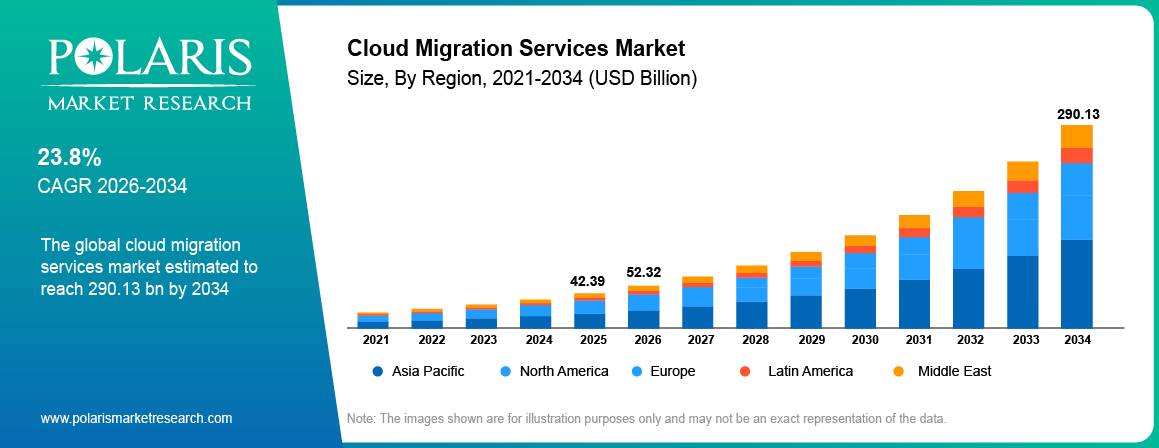
Cloud migration services market size was valued at USD 42.39 billion in 2025. The market is anticipated to exhibit a CAGR of 23.8% from 2026 to 2034. The growth is driven by rising cloud adoption, growing demand for pay-per-use model, and technological advancement.
Market Statistics
Cloud Migration Services Market Key Takeaways
- North America held the largest market share of 39.8% in 2025. North American cloud migration companies are seeing a surge in demand for cloud transformation as organizations adopt the technology to renovate their IT systems.
- The Asia Pacific market is expected to record a CAGR of 26.1% during the forecast period, due to aggressive digital transformation investments and the adoption of public cloud to support business intelligence, analytics, risk management, and other business processes
- Europe is expected to witness growth of CAGR 22.7% during the forecast period driven by a combination of regulatory and technological forces.
- The managed cloud services dominated with the largest share of 34.6% in 2025. Data migration and management prove to be a rapidly growing area. This demonstrates the importance of organizing, cleaning, and appropriately transferring data to ensure a successful migration.
- Media and entertainment hold the market share of 18.9% in 2025. Firms operating in this sector are adopting cloud migration to enhance their content distribution and management capabilities.
Note: Figures and projections outlined in this report are the result of Polaris Market Research’s proprietary analytical processes, grounded in the latest available datasets and market observations.
What is Cloud Migration Service?
Cloud migration services encompass consulting, technical, and managed services that help companies transition applications, data, workloads, and infrastructure from one environment to another. This may include a migration from an on-premises platform or legacy center to another cloud provider, or between different cloud-based systems. These services include preparation and evaluation tasks, such as readiness assessments and identifying dependencies. Additionally, it deals with migration and deployment processes, such as lift-and-shift or re-platforming, and provides integration and security operations to ensure the continuity of the migrated services. Cloud migration service providers offer these services in public, private, or hybrid cloud environments. These providers support multi-cloud environments in which organizations use multiple cloud providers to host their workloads.
The demand for such services arise due to both infrastructural and commercial reasons. For instance, businesses utilize the cloud to store data there in order to optimize expenditures on infrastructure, organize collective work, and provide remote access to information and applications. However, an organization’s transition to the cloud is usually not a one-time occurrence.
Market Dynamics
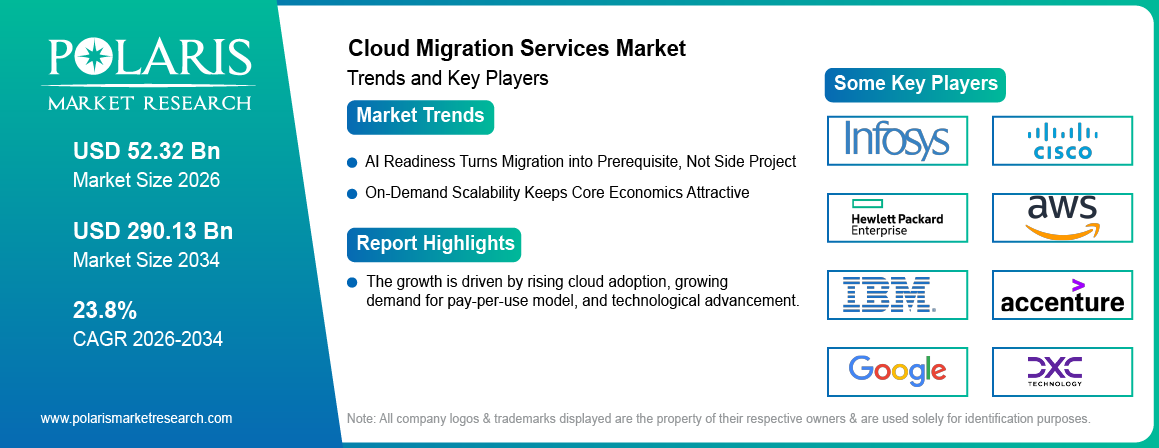
Driver: AI Readiness Turns Migration into Prerequisite, Not Side Project
Companies that are adopting generative AI and advanced analytics are discovering they need to migrate or modernize their legacy systems to support these new workloads. Migration and modernization are being rolled into AI enablement projects. Providers are presenting a clean, well-architected cloud environment as the foundation for their AI initiatives, not as a separate initiative. That means companies' budgets for migrations that might have been deferred are being pulled into the current fiscal year.
Driver: On-Demand Scalability Keeps Core Economics Attractive
The pay-per-use model of the cloud allows companies to scale up or down as needed. There is no need to provision resources in advance for peak seasons or times of high demand. This makes the cloud particularly attractive for seasonal traffic surges, development and test environments, and scaling up during growth periods. Due to which small and medium-sized businesses choose the cloud. Moreover, it reduces the need for data center power, real estate, and cooling, thus facilitating more consolidation in the cloud.
Restraint: Vendor Lock-In Remains Sharpest Brake on Migration Decisions
Choosing one vendor increases the risk of loss. Switching to another vendor involves significant costs and risks. In addition, organizational and financial problems at the vendor can affect the customer in the long run. However, the transition is more problematic when data must be converted from one standard to another, as is often required when moving data between clouds. To mitigate single-vendor risk, many companies are moving toward a multi-cloud and hybrid strategy. Nevertheless, this approach has challenges, creating a need for migration services, though it also requires more complex decision-making.
Opportunity: Multi-Cloud and Hybrid Architectures to Open Durable Services Layer
As more companies spread their workloads over different providers to manage risk and costs, they require ongoing services to design, connect, and manage those environments. It's no longer a one-time project. Providers that can operate across AWS, Azure and Google Cloud, rather than focusing on a single one, are better positioned to handle this ongoing multi-year work. Recent moves by the big clouds to eliminate exit fees for customers switching providers only further enhance the appeal of a multi-cloud strategy.
Opportunity: Data Sovereignty and Regulatory Pressure to Reshape Where Migrations Happen
Data residency rules, industry-specific compliance requirements, and growing government focus on sovereign cloud infrastructure are pushing organizations to consider where their data is stored, not just how it is designed. This is creating new projects focused on regional data centers, in-country hosting, and compliance-based migration planning. This is especially common in Europe, the Middle East, and parts of Asia Pacific. It also gives migration providers with strong regional and regulatory knowledge a clear advantage.
Segment Analysis
By Service Type — Managed Cloud & Migration Services
The managed cloud services segment dominated with the largest share of 34.6% in 2025. Data migration and management prove to be a rapidly growing area. This highlights the importance of organizing, cleaning, and transferring data properly to ensure a successful migration. In turn, managed cloud services involve ongoing infrastructure management, security monitoring, and optimization. These are now often provided within the migration project scope, serving as an additional source of revenues for the cloud migration service providers.
| Service type | Key benefits |
| Data Migration & Management | Enables secure transfer of structured and unstructured data, databases, files, metadata, and permissions; preserves data integrity through validation, reconciliation, and checksums; supports real-time or phased replication to minimize downtime; improves data classification, backup, retention, and disaster-recovery readiness. |
| Assessment & Planning Services | Provides a clear migration roadmap by identifying workloads, applications, dependencies, technical debt, and cloud-readiness gaps; supports business-case development, cost modeling, provider selection, workload prioritization, risk assessment, and selection of the right migration approach such as rehost, replatform, refactor, repurchase, retain, or retire. |
| Migration & Deployment Services | Executes workload, application, database, infrastructure, and network migration with minimal disruption; reduces migration risk through pilot testing, controlled migration waves, rollback planning, and cutover validation; accelerates time-to-value and enables faster deployment of cloud-based applications and services. |
| Integration & Customization Services | Connects migrated applications with APIs, databases, identity systems, third-party tools, ERP/CRM platforms, and legacy systems; customizes cloud architecture to business requirements; enables hybrid and multi-cloud interoperability; reduces workflow disruption and supports end-to-end process automation. |
| Training and Support Services | Improves user adoption and operational readiness through role-based training, documentation, change management, and stakeholder communication; reduces post-migration errors and resistance to new workflows; provides helpdesk, troubleshooting, and handover support for internal IT teams. |
| Managed Cloud Services | Delivers ongoing monitoring, patching, backup, incident management, performance tuning, capacity management, and cost optimization; reduces internal IT workload and total cost of ownership; improves uptime, scalability, resilience, and continuous post-migration improvement. |
| Security and Compliance Services | Strengthens cloud security through IAM, multi-factor authentication, zero-trust access, encryption, vulnerability management, logging, and threat detection; supports compliance with frameworks such as GDPR, HIPAA, PCI DSS, SOC 2, ISO 27001, and FedRAMP; reduces audit risk and protects sensitive workloads during and after migration. |
| Other Service Type | Covers specialized offerings such as cloud-native modernization, containerization, DevOps enablement, FinOps, disaster-recovery design, data-center exit, AI/ML enablement, and sustainability consulting; helps enterprises address unique technical, regulatory, or transformation requirements beyond standard migration activities. |
Source: Polaris Market Research Analysis
By Vertical — Media & Entertainment
Media and entertainment held market share of 18.9% in 2025. Firms operating in this sector are adopting cloud migration to enhance their content distribution and management capabilities. Cloud migration enables media firms to scale up and down their content delivery resources as per demand without having to overprepare their infrastructure for peak seasons. This trend is particularly pertinent in light of the rising demand for on-demand content, virtual production, and the growing need for augmented and virtual reality, which require highly fluid and adaptable infrastructures. BFSI and healthcare & life sciences follow, driven primarily by regulatory compliance and the need to renew core systems rather than content distribution needs.
By Migration Type — Data Migration
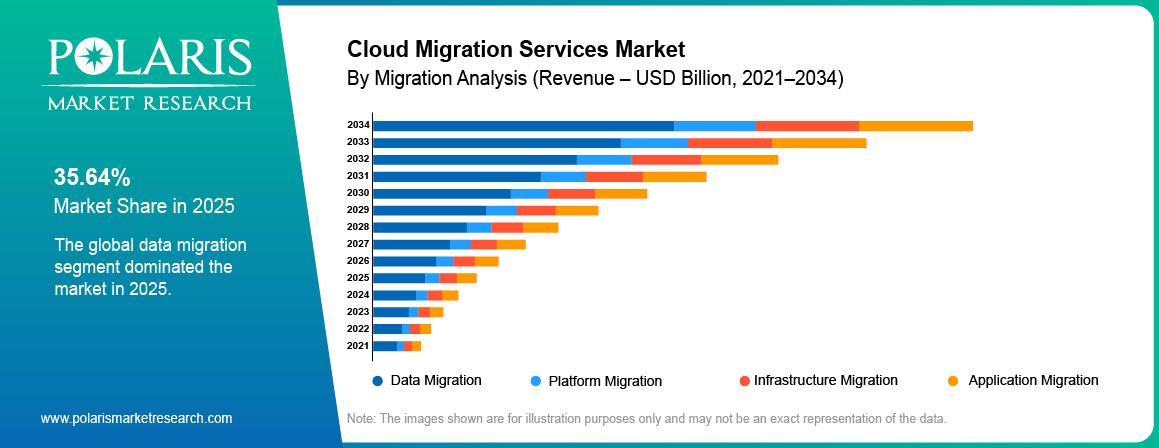
The data migration segment dominated the market with 35.64% share in 2025. The leading share is driven by the growing need to move large volumes of business data from legacy systems to cloud platforms. Companies are adopting cloud storage to improve data accessibility, scalability, and cost efficiency. The rising use of big data, artificial intelligence, and analytics is also increasing demand for secure and flexible data environments. In addition, businesses are modernizing outdated IT infrastructure and seeking better disaster recovery, backup, and data management capabilities, further supporting the growth of data migration services.
Emerging Technology Trends in Cloud Migration Services
| Technology trend | Description | Impact on cloud migration services |
| AI-assisted migration | AI/ML tools automate application discovery, dependency mapping, code analysis, risk scoring, and migration-runbook generation. | Shortens assessment cycles, reduces manual errors, and supports faster large-scale migrations. |
| Automation and orchestration | Automated provisioning, workload conversion, data transfer, testing, and rollback workflows are embedded in migration platforms. | Reduces downtime, lowers execution cost, and enables repeatable “migration factory” delivery. |
| Hybrid and multi-cloud migration | Enterprises distribute workloads across public cloud, private cloud, on-premises systems, and multiple providers. | Increases demand for interoperability, workload portability, unified governance, and cross-platform observability. |
| Cloud-native modernization | Lift-and-shift remains common, but refactoring/re-architecting into containers, microservices, serverless, and managed services is growing. | Shifts migration projects from infrastructure relocation to application modernization and platform engineering. |
| DevOps and platform engineering | CI/CD, infrastructure-as-code, Kubernetes, GitOps, and automated testing are integrated into migration programs. | Enables continuous deployment after migration and accelerates cloud-native transformation. |
| Security-by-design migration | IAM, zero-trust access, encryption, key management, logging, and compliance controls are built into landing zones before migration. | Reduces post-migration security gaps and supports regulated-industry adoption. |
| FinOps and cost optimization | Migration services include rightsizing, reserved-capacity planning, egress-cost management, and cloud-spend governance. | Converts one-time migration projects into recurring optimization and managed-service revenue. |
| Edge-to-cloud integration | IoT, 5G, manufacturing, retail, and healthcare workloads require processing closer to data sources while retaining cloud analytics. | Creates demand for distributed migration architectures and hybrid edge-cloud management. |
| Sovereign and compliant cloud | Regionally hosted infrastructure, auditable controls, and data-portability assurances are becoming procurement requirements. | Drives specialized migration services for government, BFSI, healthcare, and defense customers. |
Source: Polaris Market Research Analysis
Regional Insights
North America Cloud Migration Services Market Trends
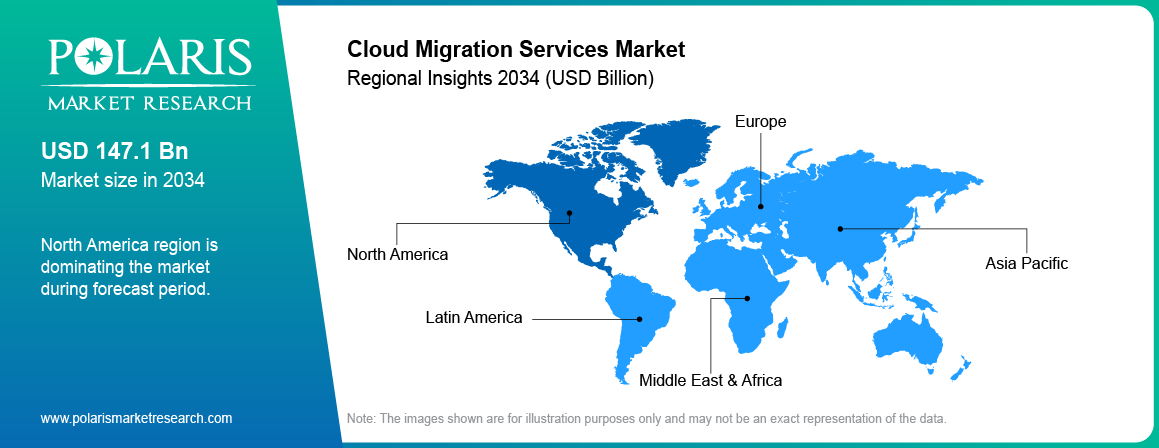
North America held the largest market share of 39.8% in 2025. North American cloud migration companies are seeing a surge in demand for cloud transformation as organizations adopt the technology to renovate their IT systems. At the same time, cloud providers are bolstering their security capabilities as companies are becoming more concerned about data-centric security. The combination of these two trends is set to drive the market growth.
Asia Pacific Cloud Migration Services Market Trends
The Asia Pacific market is expected to witness the highest CAGR of 26.1% during the forecast period due to aggressive digital transformation investments and the adoption of public cloud to support business intelligence, analytics, risk management, and other business processes. The regional shift toward cloud-based software and services is further expected to propel market growth by enabling organizations to migrate their legacy systems to the cloud. The presence of countries such as Japan and South Korea and emerging markets such as India and Indonesia make this region ideal for cloud migration providers.
Europe Cloud Migration Services Market Trends
Europe is expected to grow at a CAGR of 22.7% during the forecast period, driven by regulatory and technological forces. Regional data protection regulations are forcing organizations to be more careful and deliberate in how they store and protect their data. This trend is driving demand for cloud migration companies that offer regional and local cloud data storage solutions. Additionally, financial institutions and government agencies are adopting cloud migration due to their critical need for technology solutions that are inherently compliant from the ground up. As a result, large technology and consulting companies with a strong regional footprint are benefiting from this trend.
Middle East & Africa Cloud Migration Services Market Trends
The Middle East & Africa is expected to grow at a CAGR of 20.4% during the forecast period due to increased demand for cloud migration companies. Government led digital transformation initiatives are driving the need for cloud migration services. Major cloud providers are investing in the region in terms of building local data centers, further propelling the market growth. Sovereign governments and large conglomerates in the Gulf region are adopting cloud computing to meet their economic growth agenda. They are prioritizing the local knowledge and compliance during the selection process. This trend is a significant driver for the cloud migration companies with expertise in the local regulations and data compliance.
Key Regulations in Cloud Migration Services By Region
| Region | Key regulations / frameworks | Main migration implication |
| North America — U.S. | HIPAA, CCPA, FedRAMP, Cloud Smart, NIST cloud-security guidance | Healthcare, government, and financial workloads require strong access controls, encryption, auditability, and authorized cloud environments. |
| North America — Canada | Financial-sector cloud-outsourcing guidelines; privacy and data-protection requirements | Banks and insurers face enhanced vendor-risk, resilience, and data-governance requirements when using cloud services. |
| Europe — EU | GDPR, EU Data Act, Cloud and AI Development Act (CADA), GAIA-X | Data residency, portability, interoperability, and sovereign-cloud assurance shape public-cloud and hybrid migration design. |
| Europe — Germany | GDPR plus industrial-data and sovereignty expectations | Manufacturing and enterprise customers favor private/hybrid architectures with strong control over sensitive operational data. |
| Europe — UK | UK GDPR, financial-services operational-resilience and outsourcing rules | Financial institutions prioritize secure migration, continuity planning, and demonstrable third-party oversight. |
| Asia-Pacific — India | Digital Personal Data Protection (DPDP) Act; government digital-cloud initiatives | Data localization and compliance mapping influence region selection, especially for BFSI, government, and healthcare workloads. |
| Asia-Pacific — China | Data-localization and cross-border data-transfer rules; domestic cloud-provider requirements | Multinational firms often need separate China cloud footprints, favoring local providers and hybrid/sovereign designs. |
| Asia-Pacific — Japan | ISMAP for government cloud procurement; Society 5.0 digital initiatives | Public-sector migration requires certified security controls; manufacturing and enterprise modernization support hybrid adoption. |
| Middle East — GCC | National cloud strategies, data-residency requirements, Vision 2030-style digitization programs | Government cloud-first mandates create demand for sovereign, compliant migration and managed-cloud services. |
| Latin America | Growing data-protection regimes and SME digitalization incentives | Cloud adoption is rising, but cross-border data rules and cost sensitivity encourage phased, hybrid migration approaches. |
Source: Polaris Market Research Analysis
Competitive Landscape
The competitive field is fragmented and spans three distinct types of players: hyperscalers offering native migration tooling alongside their cloud platforms (AWS, Microsoft, Google, Oracle, IBM), global systems integrators that run large-scale migration programs as part of broader digital-transformation engagements (Accenture, Infosys, NTT Data, DXC), and specialist migration-platform vendors focused narrowly on the migration workflow itself (RiverMeadow). Competitive activity centers on partnership and platform-integration announcements rather than price competition — most providers are racing to deepen relationships with the hyperscalers, expand vertical-specific delivery capability, and, increasingly, bundle migration work with generative-AI enablement rather than compete purely on migration cost or speed.
Key Companies
- Accenture
- AWS
- Cisco
- DXC
- HPE
- IBM
- Infosys
- Microsoft
- NTT Data
- Oracle
- RiverMeadow
- SAP
- Veritis
- VMware
- TCS
- Wipro
Recent Industry Developments
- September 2026 — Accenture Edge partnered with AWS to help mid-market companies accelerate AI adoption and technology transformation. The collaboration launched six AWS Marketplace offerings focused on cloud migration, customer experience, cost optimization, AI security, data modernization and secure cloud foundations. (Source: newsroom.accenture.com)
- September 2026 — Spinnaker Support launched PostgreSQL support and migration services to help organisations modernise Oracle database environments. The company partnered with HexaCluster to assess workloads, automate migration tasks and support controlled cutovers, while expanding its services across on-premises, virtualized, containerized and cloud environments. (Source: itbrief.co.uk)
- July 2026 — CloudifyOps launched MIXIMO, an AI-powered platform that streamlined cloud migration and modernization planning. The platform supported AWS, Microsoft Azure and Google Cloud, offering workload discovery, dependency mapping, migration recommendations and infrastructure blueprints to help organizations reduce risks and optimize cloud transformation. (Source: datacentrenews.in)
- September 2026 — Accenture and AWS launched AI and cloud offerings for mid-sized companies through Accenture Edge. The solutions supported cloud migration, security, data management, AI risk testing, customer service, and cloud cost optimization, helping organizations modernize technology and manage workloads more efficiently. (Source: seekingalpha.com)
Future Outlook
The cloud migration services market is expected to expand as organizations accelerate digital transformation, modernize legacy infrastructure, and adopt hybrid and multi-cloud environments. Demand will increasingly focus on automation, AI-driven migration planning, cybersecurity, data modernization, and cost optimization. Service providers are likely to strengthen capabilities around workload assessment, application refactoring, compliance, and managed cloud operations. As enterprises seek faster migrations with lower risks, cloud migration services will remain a critical component of technology modernization strategies across industries and regions over the coming years.
Cloud Migration Services Market Report Segmentation
By Service Type Outlook (Revenue, USD Billion, 2021–2034)
-
Data Migration & Management
-
Large-Scale Data Migration
-
Data Mapping and Cleansing
-
Data Lifecycle Management
-
-
Assessment & Planning Services
-
Migration Roadmap
-
Dependency Mapping
-
Readiness Assessment
-
-
Migration & Deployment Services
-
Lift-and-Shift Migration
-
DevOps Integration
-
-
Integration & Customization Services
-
System Interoperability
-
Application Integration
-
Customization and Configuration
-
-
Training and Support Services
-
Ongoing Support
-
User Training and Adoption
-
Knowledge Transfer
-
-
Managed Cloud Services
-
Cloud Infrastructure Management
-
Security Management
-
Performance Optimization
-
-
Security and Compliance Services
-
Security Assessment and Remediation
-
Identity and Access Management (IAM)
-
Compliance Adherence
-
-
Other Service Type
By Deployment Outlook (Revenue, USD Billion, 2021–2034)
-
Public Cloud
-
Private Cloud
-
Hybrid Cloud
By Vertical Outlook (Revenue, USD Billion, 2021–2034)
-
Media and Entertainment
-
BFSI
-
Healthcare & Life Sciences
-
Retail & Consumer Goods
-
Telecom
-
Government & Public Sector
-
Manufacturing
-
Transportation & Automotive
-
Others
By Migration Type Outlook (Revenue, USD Billion, 2021–2034)
-
Platform Migration
-
Data Migration
-
Infrastructure Migration
-
Application Migration
By Application Outlook (Revenue, USD Billion, 2021–2034)
-
Business Intelligence & Analytics
-
Data Warehouse Management
-
Supply Chain Management
-
Project Management
-
Content Management
-
Others
By Regional Outlook (Revenue, USD Billion, 2021–2034)
- North America
- U.S.
- Canada
- Europe
- Germany
- France
- UK
- Italy
- Spain
- Netherlands
- Russia
- Rest of Europe
- Asia Pacific
- China
- Japan
- India
- Malaysia
- South Korea
- Indonesia
- Australia
- Vietnam
- Rest of Asia Pacific
- Middle East & Africa
- Saudi Arabia
- UAE
- Israel
- South Africa
- Rest of Middle East & Africa
- Latin America
- Mexico
- Brazil
- Argentina
- Rest of Latin America
Cloud Migration Services Market Report Scope
| Report Attributes | Details |
| Market size in 2025 | USD 42.39 billion |
| Market size in 2026 | USD 52.32 billion |
| Revenue Forecast in 2034 | USD 290.13 billion |
| CAGR | 23.8% from 2026 – 2034 |
| Base year | 2025 |
| Historical data | 2021 – 2024 |
| Forecast period | 2026 – 2034 |
| Quantitative units | Revenue in USD billion and CAGR from 2026 to 2034 |
| Segments covered |
|
| Regional scope |
|
| Customization | Report customization as per your requirements with respect to countries, region and segmentation. |
Source: Polaris Market Research Analysis
Cloud Migration Services Market FAQ's
Cloud migration services size was worth $ 42.39 billion in 2025 and is expected to reach USD 290.13 billion by 2034.
The global cloud migration services market is expected to grow at a CAGR of 23.8% during the forecast period.
Cloud migration services are the consulting, technical, and managed offerings. Organizations use these services to move applications, data, and infrastructure from on-premises systems or one cloud platform to another.
Two forces are driving demand most directly: the push to build AI-ready infrastructure, which is pulling migration and modernization work into the same engagement as AI enablement, and the ongoing appeal of on-demand, pay-as-you-go cloud economics over the cost and rigidity of maintaining on-premises infrastructure.
Vendor lock-in is the leading restraint. Dependency on a single cloud provider raises the cost and complexity of switching later, exposes businesses to a vendor's own operational or financial risk, and is pushing many enterprises toward multi-cloud and hybrid strategies that add their own integration complexity in return for reduced dependency.
North America holds the largest share, supported by sustained enterprise investment in digital transformation and continued security-capability improvements from regional cloud providers.
Media and entertainment holds the largest vertical share of 18.9% in 2025, as companies in the space use cloud migration to scale content-delivery infrastructure dynamically for on-demand consumption, virtual production, and immersive content formats.
The competitive field blends hyperscalers with native migration tooling (AWS, Microsoft, Google, Oracle, IBM), global systems integrators running large-scale migration programs (Accenture, TCS, Infosys, Wipro, NTT Data, DXC), and specialist migration-platform vendors (RiverMeadow).
Generative AI is turning migration from a standalone infrastructure project into a prerequisite for AI adoption. Enterprises and their migration partners increasingly treat a clean, modernized cloud environment as the foundation AI initiatives are built on, which is pulling migration budgets and planning timelines forward.
Download Sample Report of Cloud Migration Services Market
Please fill out the form to request a customized copy of the research report.


