
Exoskeleton Market Size, Share & Trends Analysis Report, 2026-2034
REPORT DETAILS
Exoskeleton Market Summary
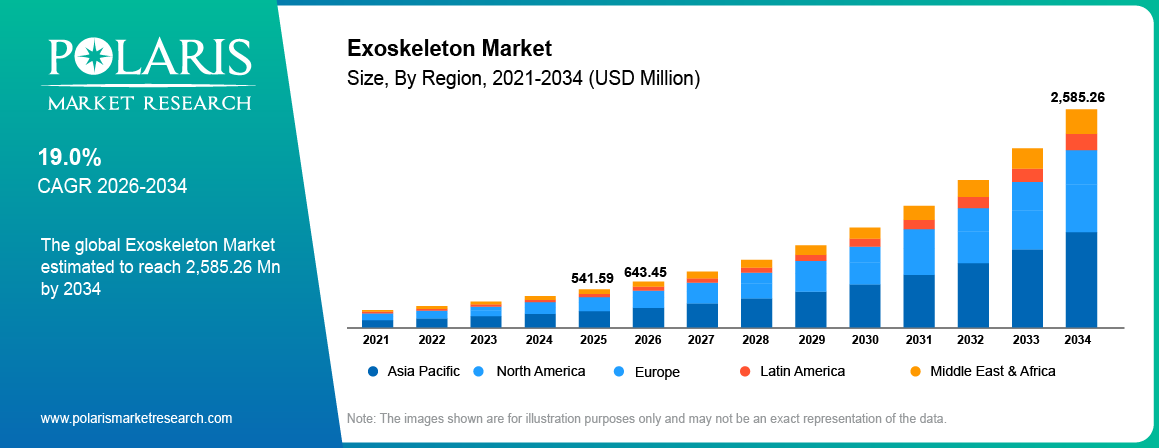
The global exoskeleton market size was valued at USD 541.59 million in 2025 and is expected to register a CAGR of 19.0% from 2026 to 2034. The market expansion is fueled by growing need for workplace safety measures and rising investment in assistive devices. The growing investment in rehab robotics, automation in the workplace, and wearable medical devices is helping to fuel the market growth. The rapidly growing adoption of powered exoskeletons in healthcare, manufacturing, defense, and logistics is boosting the market growth.
Market Statistics
Key Takeaways
- North America dominated the exoskeletons market with a 40.50% share in 2025, owing to increasing adoption of robotic rehabilitation technologies and favorable reimbursement initiatives.
- The market in Asia Pacific is anticipated to experience a 21.5% CAGR during the forecast period on account of robotics innovation, healthcare spending, intelligent manufacturing, and aging population trends.
- The powered exoskeletons category is expected to witness growth at 19.8% CAGR during the forecast period, based on the growing preference for robotic gait training, individual mobility, and lifting and carrying.
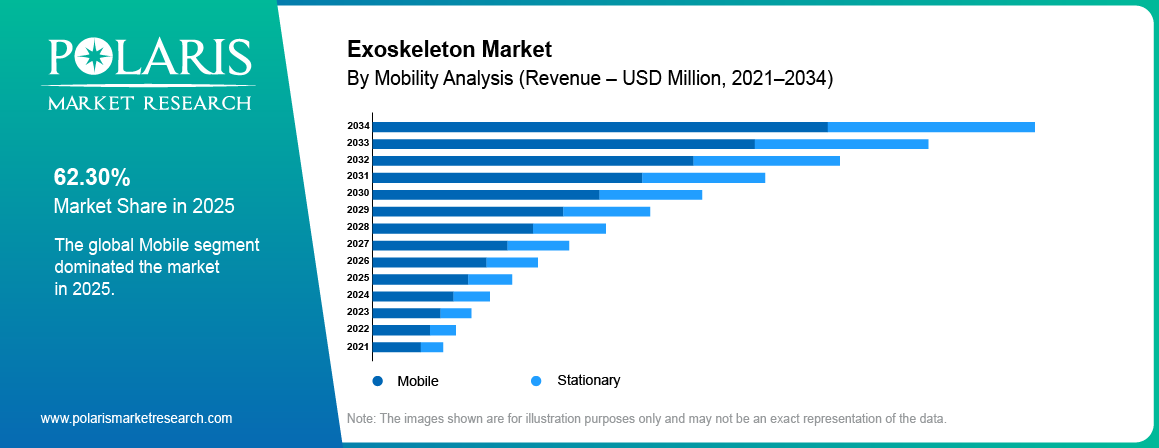
- Mobile exoskeletons dominated the market with 62.30% share in 2025, attributed to the widespread use of mobile exoskeletons in healthcare and industries.
- Rehabilitation was the leading application segment with a share of 45.80% in 2025 owing to the increasing need for neurological and orthopedic recovery solutions.
- Manufacturing is expected to record a CAGR of 17.90% during the forecast period owing to increasing industrial automation and rising workplace safety investments.
- The healthcare segment accounted for 38.6% share of the market in 2025, because of the growing adoption of rehabilitation robots and mobility solutions.
Note: Figures and projections outlined in this report are the result of Polaris Market Research’s proprietary analytical processes, grounded in the latest available datasets and market observations.
What is an Exoskeleton?
An exoskeleton is a mechanical device that improves and assists human movement. This machine comprises of sensors, actuators, control systems, and structural elements that increase human physical strength, mobility, and endurance. Exoskeletons find applications in rehabilitation, industrial activities, military, and human mobility.
The value chain comprises component providers, actuator and sensor producers, software providers, exoskeleton producers, system integration firms, distributors, healthcare organizations, industries, and end consumers. The manufacturers continue to enhance their products by using lightweight components, intelligent control systems, and ergonomically designed products.
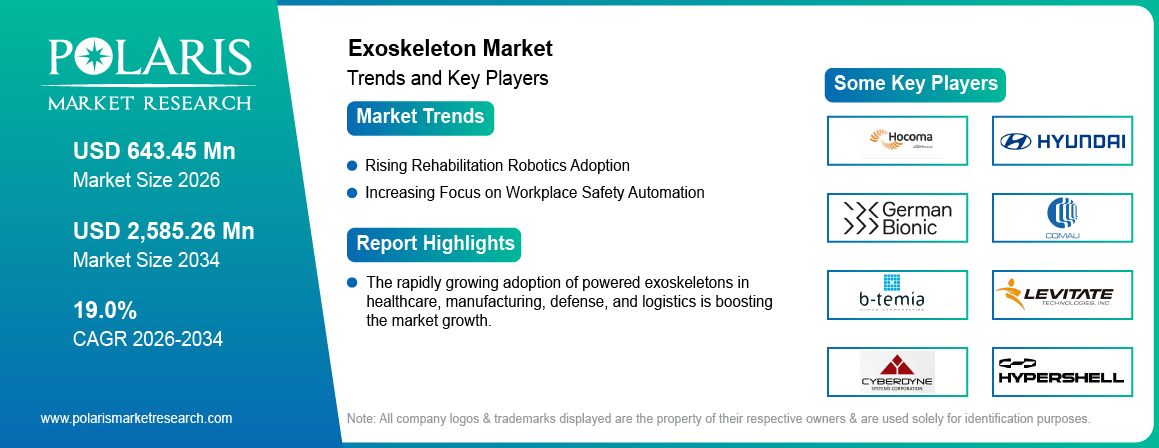
The growing demand for rehabilitation devices, the introduction of workplace safety programs, and increasing funding in robotics is expected to propel market expansion. The continuous innovation in products, positive regulatory approvals, and development of the healthcare sector are likely to generate growth opportunities in the forecast period.
How Does an Exoskeleton Work?
Exoskeletons work by integrating mechanical frameworks with sensors, actuators, and control systems that align with the user’s body. Sensors are used to detect movement intentions or muscle signals. Actuators provide powered assistance to joints, such as knees, hips, or arms. The structure redistributes weight and enhances force. It reduces strain on muscles and improves efficiency. Some exoskeletons are passive, using springs and supports. However, advanced powered exoskeletons rely on batteries and motors. Applications range from rehabilitation and mobility support to industrial load handling and military performance enhancement.
Market Dynamics
Exoskeleton Market Driver and Opportunity Impact Analysis
| Market Driver / Opportunity | Est. CAGR Impact | Geographic Relevance | Impact Timeline |
| Rising rehabilitation robotics adoption | +2.6% | North America, Europe | Medium to Long Term |
| Increasing focus on workplace safety automation | +2.2% | North America, Europe, Asia Pacific | Short to Medium Term |
| Rising technological advancements in exoskeleton | +3.0% (Opportunity) | Global | Medium to Long Term |
Source: Polaris Market Research Analysis
Driver: Rising Rehabilitation Robotics Adoption
The growing adoption of robotic rehabilitation equipment systems is increasing demand for medical exoskeleton market across healthcare facilities. The hospitals and rehabilitation centers are making use of these devices to enhance mobility of patients and increase recovery. In July 2025, Hermina Hospitals launched a robotic rehabilitation center in Jakarta, Indonesia, for stroke rehabilitation and post-surgical rehabilitation. Increasing investments in rehabilitation infrastructure and robotic assisted therapy is driving the exoskeleton market growth. Medical exoskeletons help clinicians deliver structured movement training and monitor patient progress. The increasing capability of rehabilitation robotics assists patients with walking and neuro-rehabilitation purposes. It has increased the demand for better exoskeletons (Source: RehaCare Asia).
Driver: Increasing Focus on Workplace Safety Automation
Exoskeletons have been increasingly used in industry to address issues related to fatigue among workers as well as for increasing efficiency of operations. In June 2026, the US National Safety Council listed exoskeletons, artificial intelligence (AI), and sensor-based ergonomic technology as innovations. It helps decrease workplace injuries and musculoskeletal disorders. The wearable devices are expected to help reduce workplace accidents during difficult and repetitive work activities. Their use may reduce strain during lifting, overhead work, and material handling. Exoskeletons have been evaluated by industries such as manufacturing, automotive, construction, and logistics for use within their workplaces. It helps improve ergonomic conditions and reduce discomfort. Increased emphasis on worker safety would lead to testing exoskeletons within these industrial environments (Source: www.nsc.org).
Restraint: High Cost of Exoskeleton
The exoskeleton market continues to be hampered by high product costs. Manufacturing costs are increased by advanced actuators, sensors, control software, batteries, and specialized materials. Training, maintenance, repairs, and equipment upgrades are other costs buyers must consider. Such costs can be a barrier to smaller businesses and health care facilities that have more limited budgets. Other barriers to the purchase of medical exoskeletons may include lack of reimbursement or criteria for eligibility that limit coverage. In emerging markets, slower adoption may be related to affordability and access to trained professionals. Lower cost designs, reliable post sales service, and clearer routes to reimbursement could help reduce these barriers and increase access.
Opportunity: Rising Technological Advancements in Exoskeleton
Technological improvements in artificial intelligence, light-weight materials, and batteries are paving new paths for exoskeleton makers. In April 2026, Vastnaut presented the Vastnaut One 4×4 AI-powered exoskeleton system, aiming to reduce strain on the wearer while increasing endurance as they venture outdoors. Firms are developing better exoskeleton systems that make them easier to use in healthcare and industrial sectors. Growth potential is expected to continue due to rising demands for mobility aid robots. These improvements are expected to expand the use of wearable robotics across new applications. The need for comfortable and efficient exoskeleton systems is likely to spur growth in the market (Source: New Atlas).
Challenge: Concerns Regarding Exoskeleton Fit, Comfort, and Battery Runtime
Comfort, fit, and battery runtime are key challenges in the exoskeleton market. Exoskeletons that do not fit properly can limit movement and be uncomfortable to wear for a long period of time. Heavy designs may cause more fatigue for users and reduce acceptance in healthcare and industrial applications. Battery-powered exoskeletons also need to provide sufficient runtime to support rehabilitation sessions and long work shifts. Regular charging can disrupt operations and reduce productivity. To address these concerns, manufacturers are developing lightweight materials, ergonomic designs, adjustable support systems and higher capacity batteries. The improved comfort, mobility and battery performance are expected to further boost user acceptance and allow wider adoption of powered exoskeletons.
How Is Physical AI Changing Exoskeletons?
Physical AI is advancing exoskeletons by enabling wearable systems to respond to human motion and real-world conditions. These systems combine artificial intelligence (AI), sensors, actuators, and control software to support mobility and adaptive assistance. AI-enabled exoskeletons in healthcare can help manage robotic gait training by adjusting to movement patterns and therapy needs. In industrial environments, physical artificial intelligence can help exoskeletons adjust support when lifting, repetitive handling, and overhead work. The functions may improve usability and task performance when validated under real operating conditions. AI vision systems are also being integrated into exoskeletons. They help interpret visual cues from the environment. It enables real-time adjustments in support and navigation for safer and more intuitive user interaction.
Further developments in motion sensing and adaptive control have enabled the development of powered exoskeletons. Sensors detect motion information, which is processed by the control system to provide assistance. Developers are working on lighter construction materials, better batteries, and man-machine interface developments to make these devices more comfortable and easier to move with. But how well they work is dependent on the sensors’ effectiveness, the software’s efficiency, and the appropriateness and safety testing for the user. Their implementation may be hampered by expensive research and validation. Developments in physical AI exoskeletons could widen the scope of exoskeleton applications.
Tariff and Trade Impact on Exoskeleton Supply Chains
Tariffs and trade rules could affect the cost of building the exoskeletons, getting components, and pricing the products. Exoskeleton devices consist of sensors, actuators, batteries, electrical controls and some specific materials. Tariffs could drive up the costs of the components that the manufacturers are sourcing. This could translate into increased production costs and pricing for powered exoskeletons.
Trade barriers and disruptions within the supply chain might also lead to late arrival of the components. The organization can reduce the risk of such delays through supplier diversification, assessment of the supply chain, and development of manufacturing capabilities in the region. Import tariffs, shipping times, maintenance fees, and spare part availability should be considered prior to purchasing an exoskeleton system. Changes in tariff policies may influence market access and pricing, but their effect on the exoskeleton market forecast through 2034 depends on future trade conditions and sourcing strategies.
Exoskeleton Market Segmentation Analysis
The exoskeleton market is assessed across type, body part, operation, mobility, application, end-use industry, and region. These segments describe different product and demand characteristics. Application refers to the task performed, such as rehabilitation or industrial assistance. End-use industry identifies the buyer environment, such as healthcare, manufacturing, logistics, construction, defense or consumer outdoor use. Keeping these dimensions separate reduces double counting.
Type Insights
The powered exoskeleton segment is expected to grow at a CAGR of 19.8% during the forecast period. Actuators, sensors, batteries, and control software in these systems help to assist human movement. Demand comes from robotic gait training, personal mobility assistance, industrial lifting, and load carriage. Improvements in the field of artificial intelligence, motion detection, and lightweight materials could increase the efficiency of the product and its comfortability. However, its high price and power consumption could hinder its implementation. Application areas of the powered exoskeleton include healthcare, manufacturing, logistics, and military operations.
The segment of passive exoskeleton accounted for 38.6% of total revenue in 2025. These systems use springs, elastic elements, counterweights, and mechanical linkages to reduce the amount of physical effort needed, and do not use powered actuators. They are used to help with overhead work, postural support, lifting, and repetitive industrial work. They are simpler so less charging is required, and might mean less operating complexity. Passive exoskeletons are suitable for specific workplace activities and can be used by companies in manufacturing, automotive, construction, and logistics. Adoption is a function of fit, comfort, movement flexibility, and task suitability.
The hybrid exoskeleton segment accounted for 18.4% of the total exoskeleton market revenue in 2025. These systems provide passive mechanical support and powered assistance at selected joints. They can give basic support during everyday activities and additional support during difficult movements. Potential applications include industrial lifting, rehabilitation and personal mobility assistance. Sensors and control systems can adjust assistance according to user movement. But product costs, battery run-time, maintenance, and device weight can impact adoption. Manufacturers are developing hybrid systems to help balance assistance and operating requirements.
Comparison Matrix By Type
| Attribute | Powered (active) | Passive | Hybrid |
| Power source | Battery-driven electric, pneumatic or hydraulic actuators | None; springs, elastic bands, counterweights | Passive structure with small powered assist at key joints |
| Control | Sensors + embedded/AI motion control | Mechanical, user-driven | Sensor-triggered assist on top of passive support |
| Typical weight | Heavier (frame, motors, battery) | Lightest | Intermediate |
| Primary uses | Gait rehabilitation, SCI personal mobility, heavy lifting, defense | Overhead work, repetitive lifting, posture support | Logistics, construction, long-shift industrial tasks |
| Regulatory path | Medical versions need FDA / EU MDR clearance | Mostly non-medical occupational equipment | Depends on claims |
| Price band | USD 15,000–200,000+ | USD 3,000–10,000 | Between passive and powered |
Source: Polaris Market Research analysis
Body Part Insights
The lower body exoskeleton segment captured 56.8% of the total exoskeleton market share in 2025. These systems assist the hip, knee, ankle, or several leg joints. They provide robotic gait training, rehabilitation, and personal mobility assistance. Medical exoskeletons enable eligible users to practice walking in a supervised setting. Demand is determined by the clinical need, safety of the device, eligibility of the user, and availability of suitably trained staff. The choice of the product depends on balance control, fit, and walking environment. Lower-body systems make up one large category of external industry benchmarks.
The upper-body exoskeleton segment is expected to register a CAGR of 18.6% during the forecast period. These systems provide support to shoulders, arms, or back when working overhead, lifting, and making repetitive motions. Shoulder exoskeletons are used in manufacturing and automotive facilities for assembly and maintenance tasks. Back support exoskeletons assist with selected bending and lifting activities. Adoption depends on comfort, freedom of movement, and compatibility with workplace equipment. Employers evaluate worker fatigue, ergonomic outcomes and task performance during the trials. Adjustable designs and the use of lightweight materials could improve user acceptance.
The full-body exoskeletons segment generated a 24.7% share in 2025. They provide both upper and lower limb exoskeleton support. The exoskeletons are used for specific industrial, defense (military exoskeleton), and mobility applications. Possible applications are load carriage, assistance in movement, and physically demanding tasks. Product selection is based on system weight, joint mobility, power requirements, safety and compatibility with other equipment. Battery capacity and maintenance also affect operating performance. While full-body exoskeletons could provide more comprehensive support than devices designed for specific body parts, their greater complexity may also increase costs and training demands.
Operation Insights
In 2025, the manual exoskeleton segment accounted for a revenue share of 22.5%. The systems rely on mechanical structures and user movement to provide assistance. They help redistribute forces without powered actuators, springs, elastic elements, and linkages. Manual exoskeletons assist with posture, lifting, and repetitive industrial tasks. Their simple design reduces charging requirements and operating complexity. The systems may be adopted by manufacturing, automotive, and logistics companies based on worker comfort, task applicability, fit, and ergonomic performance.
The semi-automatic exoskeleton segment is expected to record a CAGR of 18.8% during the forecast period. They use sensors and a set control to initiate or change assistance. With motion sensors devices can respond to certain activities by measuring joint positions and user movements. Applications are in rehabilitation exercises and repetitive industrial work. Adoption depends on accuracy, comfort, reliability, and training needs. These systems are assessed by healthcare providers and industrial buyers in terms of user needs and operating conditions.
In 2025, the automatic exoskeleton segment contributed to about 46.2% of the total exoskeleton market revenue share. These systems incorporate advanced controls, motion sensors, and embedded software to adjust assistance with limited user input. Applications are in robotic gait training, mobility assistance, and selected industrial tasks. Performance depends on sensor accuracy, software reliability, safety testing, and proper fit. High cost of development and technical complexity may limit adoption. Advances in artificial intelligence (AI) and physical AI may expand their applications.
Mobility Insights
The mobile segment dominated the market with a 62.30% share in 2025. It is attributed to its broad use across rehabilitation, industrial, and defense applications. The mobile exoskeleton segment offers increased flexibility and allows patients to conduct their everyday activities with better mobility and decreased physical exertion. Continued improvements in battery technology and lighter materials will support the segment's growth.
The stationary segment is expected to witness the highest CAGR of 20.3% during 2026–2034. Stationary exoskeletons are increasingly used by healthcare professionals to perform rehabilitation exercises where controlled movements are needed. Growing investments in advanced rehabilitation equipment is anticipated to fuel segment expansion.
Application Insights
In 2025, the rehabilitation segment accounted for 45.80% share. Medical exoskeletons enable robotic gait training and supervised mobility exercises for qualifying patients. Hospitals and rehabilitation centers use these systems to provide structured therapy and monitor movement. Demand is related to neurological rehabilitation, mobility limitations, and investment in rehabilitation robotics. Adoption depends on clinical evidence, patient eligibility, staff training, equipment budgets, and reimbursement conditions. Additional investments in rehabilitation technology could help support market demand through 2034.
The industrial assistance segment is expected to register a 19.6% CAGR during the forecast period owing to the rising demand for workplace ergonomics and industrial automation. Exoskeletons help workers with lifting, overhead assembly and repetitive handling in manufacturing, automotive, construction, and logistics. Employers are evaluating these devices to reduce physical strain and improve comfort. The adoption criteria are the fit, movement flexibility, safety, battery runtime and compatibility with the equipment. Workplace trials can test fatigue, task execution, and operational value before full deployment across industrial facilities.
Exoskeleton Market by End-Use Industry
The healthcare segment accounted for the largest share of the exoskeleton market by end user in 2025, contributing to 38.6% of the total revenue. Exoskeletons are used in hospitals, rehabilitation centers, and home-care settings for robotic gait training, rehabilitation and mobility assistance. Demand is linked to neurological rehabilitation, mobility restrictions, and spending on sophisticated healthcare equipment. The way it is put into practice depends on clinical evidence, the eligibility of patients, training for the staff, budgets for equipment, and reimbursement policies. Advances in powered exoskeletons could expand their use in rehabilitation and personal exoskeleton for home use applications.
The manufacturing segment is expected to register a CAGR of 17.9 % during the forecast period. This is owing to the demand for workplace ergonomics and industrial automation using collaborative robots. Industrial exoskeletons help workers with repetitive handling, overhead assembly, and selected lifting tasks. Car manufacturers and factories are using these devices to evaluate ergonomic risks and decrease physical strain. Adoption will be based on comfort, fit, battery life, worker acceptance. and testing in the workplace. Employers also look at maintenance, training, and equipment compatibility.
End-Use Industry Comparison
| End-use industry | Typical device | Primary job | Named example | Buying driver |
| Healthcare: Hospitals & Rehab Centers | Powered lower-body, stationary gait trainers | Gait training after stroke, SCI, MS | Atalante X (Wandercraft), EksoNR, Lokomat (DIH/Hocoma) | Clinical outcomes, therapist time |
| Healthcare: Home / Personal | Powered personal lower-body | Daily standing and walking | Eve (Wandercraft), ReWalk Personal (Lifeward) | FDA clearance, Medicare coverage |
| Manufacturing & Automotive | Passive shoulder/back | Overhead assembly, repetitive lifts | Ford with Ekso EksoVest; MAN Truck & Bus with suitX | MSD injury reduction |
| Logistics & Warehousing | Powered back support | Parcel and pallet handling | FIEGE with German Bionic | Lift frequency, shift length |
| Construction | Passive shoulder/arm | Overhead drilling, tunneling | Granite Construction with Levitate | Fatigue, safety compliance |
| Defense | Powered lower-body / load carriage | Load carriage, endurance | Lockheed Martin ONYX | Soldier endurance programs |
| Consumer/Outdoor | Lightweight powered hip | Hiking, field work | Hypershell X Series; Vastnaut One | Price, weight, battery |
Source: Polaris Market Research Analysis
Exoskeleton Use Cases: Deployments in Healthcare, Industry and Defense
- Healthcare: Exoskeletons assist in robotic gait training, rehabilitation, and mobility assistance for qualified patients.
- Manufacturing and Automotive: Industrial exoskeletons assist with lifting, overhead assembly, and repetitive operations.
- Logistics and Warehousing: An exoskeleton for warehouse/logistics workers helps with package handling, order fulfillment, and repetitive lifting.
- Construction: A construction exoskeleton assists workers with material handling and overhead tasks.
- Defense: Military exoskeletons offer load-bearing, mobility assistance, and support for challenging field operations.
- Technology and Adoption: Improvements in AI, lighter materials, and sensors are increasing exoskeleton use in various fields.
Exoskeleton Market Regional Insights
North America Exoskeleton Market Trends
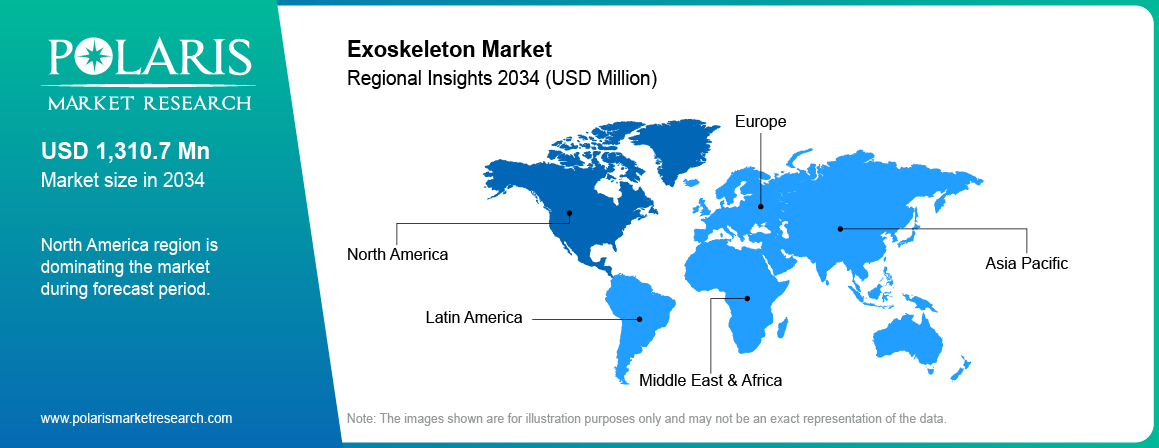
North America dominated the exoskeleton market in 2025, accounting for 40.50% of global revenue. Regional demand is stimulated by investments made in the areas of rehabilitation robots, health care infrastructure, occupational safety, and defense upgradations. Both the U.S. and Canada are using exoskeletons in healthcare applications such as hospital and rehabilitation center settings to facilitate robotic gait training and movement assistance. In June 2026, Northwestern University created an exoskeleton robotic therapy system. Industrial applications also create demand for wearable robotics that support lifting and repetitive tasks. Medical-device approvals, clinical adoption, and investment in occupational ergonomics are expected to influence regional market growth (Source: Northwestern University).
Asia Pacific Exoskeleton Market Trends
The market in Asia Pacific is projected to record the fastest CAGR of 21.5% during the forecast period. China, Japan, South Korea, and India are investing in robotics, healthcare infrastructure, and smart manufacturing. As the population of Japan is aging, rehabilitation systems and mobility assistance devices are becoming more and more relevant. China and South Korea have opportunities in industrial automation and development of wearable robotics. In June 2026, Severance Hospital, South Korea launched a government-sponsored program to develop brain-controlled wearable exoskeletons for quadriplegics. Regional growth is expected to be supported by rising healthcare investment and demand for industrial assistance. Adoption will depend on affordability, product approvals, clinical access, and availability of services (Source: MobiHealthNews).
Europe Exoskeleton Market Trends
In 2025, Europe comprised 27.6% of the exoskeleton market share. Rehabilitation technology, industrial automation, and workplace ergonomics support demand. Germany’s strong manufacturing and automotive base presents opportunities for industrial exoskeleton market in assembly, overhead work and repetitive handling. Investment in healthcare and industrial modernization from France, Italy, and the UK. Also opportunities for the Nordic countries and Poland arise in healthcare, manufacturing, and workplace safety applications. In February 2026, Comau launched the MATE-XT GO exoskeleton to reduce physical strain during repetitive and overhead industrial activities. Its extent depends on product performance, workplace trials, investments in healthcare, and its acceptance (Source: Comau).
Latin America Exoskeleton Market Trends
Latin America accounted for 8.4% of the exoskeleton market revenue share in 2025. Regional demand is linked to health care infrastructure build-out, rehab programs, industrial modernization, and workplace safety programs. Medical exoskeleton opportunities exist in hospitals and rehabilitation centers in Brazil, Mexico, and Argentina. Manufacturing and automotive plants could look into wearable robots to help with lifting and repetitive work. But adoption depends on equipment affordability, healthcare budgets, trained professionals, and access to maintenance services. Investment in rehabilitation technology and industrial automation can expand the regional customer base. Future market growth will depend on infrastructure spending, purchasing decisions and manufacturers’ ability to provide suitable products at affordable prices.
Middle East & Africa Exoskeleton Market Trends
The Middle East & Africa exoskeleton market accounted for approximately 5.2% of the global revenue in 2025. Healthcare modernization and rehabilitation programs, industrial development, and workplace safety initiatives are driving regional demand. Saudi Arabia and the UAE are investing in advanced healthcare services, while South Africa and Israel offer opportunities across healthcare and industrial applications. In December 2025, Verita Neuro partnered with Lifeward to launch the ReWalk Personal Robotic Exoskeleton into a UAE rehabilitation program for those with spinal cord injury. The project demonstrates the potential of personal mobility assistance and rehabilitation robotics. Investment in healthcare will be key for future growth, as will availability of products, affordability, trained clinical staff, and access to maintenance services (Source: Verita Neuro).
Regulatory Requirements and Safety Considerations
| Region / country | Framework or signal | Market implication |
| U.S. | FDA medical-device regulations; veterans' rehabilitation programs; Medicare policy | Supports commercialization for devices cleared for specific indications |
| Canada | Medical device licensing framework | Defines entry and compliance requirements |
| Germany / EU | EU Medical Device Regulation (MDR) | Applies to medical devices and relevant conformity requirements |
| UK | UK medical-device regulations | Defines market access and post-market obligations |
| China | National robotics and intelligent manufacturing initiatives | May support innovation and domestic production |
| Japan | Society 5.0 and robotics programs | Supports interest in rehabilitation robotics |
| South Korea | Intelligent Robot Development Strategy | Provides policy context for wearable robotics |
| India | National Medical Device Policy and Make in India | Creates context for local manufacturing and medical-device development |
| International / occupational | ISO 13482 and ASTM F48 standards work | Can inform safety design and risk assessment for personal-care or industrial systems |
Source: Polaris Market Research Analysis
Exoskeleton Market Competitive Landscape
Advances in wearable robotics, AI-enabled movement control, lightweight materials, and battery technology have made the exoskeleton market competitive. Manufacturers are developing powered, passive, and hybrid exoskeletons for use in healthcare, industrial assistance, logistics, construction, and defense applications. Key players are competing on product innovation, better mobility aid, ergonomic performance, user comfort and system reliability. Competitive positioning will be affected by product customization, geographic expansion, and strategic alliances with healthcare providers, industrial companies, and research institutions during the forecast period.
Exoskeleton Technology & Innovation Landscape
Exoskeleton technology combines mechanical structures, actuators, sensors, control software, and power systems to assist human movement. Innovation aims at better mobility assistance, load transfer, ergonomic performance, user comfort, and movement control across healthcare, manufacturing, logistics, construction, and defense. AI control systems read the user’s movement and adjust the level of assistance. Advances in compact actuators, battery systems, and lightweight materials also increase device usability.
Rigid exoskeletons provide mechanical support and better force transmission through well-defined frames. Flexible exoskeletons or soft exosuits consist of flexible textiles, cables, and compliant materials, making them more flexible and comfortable. Hybrid designs combine stiff support elements with flexible interfaces. The choice of material is dictated by the weight, strength, durability, movement requirements, and device cost.
| Technology element | Key components or materials | Market relevance |
| Actuation and power | Electric motors, actuators, batteries, cable-driven systems | Controls assistance force and operating time |
| Sensors and software | Motion sensors, force sensors, AI control, feedback systems | Improves movement detection and assistance |
| Rigid exoskeletons | Aluminum, steel, titanium, composite frames | Provides structural support and load transfer |
| Soft exoskeletons | Technical textiles, polymers, elastomers, flexible cables | Improves flexibility and wearability |
| Hybrid designs | Rigid frames, soft interfaces, powered joints | Balances strength, comfort, and movement |
| Human-machine interface | Straps, joints, ergonomic fittings, control interfaces | Affects fit, safety, and user acceptance |
Source: Polaris Market Research Analysis
Exoskeleton Buying Checklist: How to Choose an Exoskeleton
Exoskeleton selection involves aligning the device’s abilities to match the task, the users’ requirements, and the surrounding environment. Medical exoskeletons must align with the healthcare providers’ goals for rehabilitation, movement, and safety. Industrial buyers want wearable systems that decrease strain on the body during lifting, assembly, overhead work and repetitive tasks. Industrial buyers need wearable systems that reduce physical strain during lifting, assembly, overhead work, and repetitive tasks. Defense and logistics users may prioritize load support, mobility, durability, and operating time.
Before purchasing, buyers should assess the following factors:
| Check | What to verify | Applies to |
| Task fit | Match support zone (shoulder, back, legs) to the task's dominant strain, from ergonomic assessment data | Industrial |
| Type and operation | Passive for overhead or posture tasks; powered or AI-adaptive for heavy lifts, gait or SCI use | All |
| Regulatory status | FDA clearance / EU MDR CE mark and the cleared indications (stroke, SCI level, MS) for medical use; ISO 13482 / ASTM F48 conformity for occupational use | Medical / industrial |
| Fit and adjustability | Size range, donning/doffing time, comfort over a full shift or session | All |
| Weight and range of motion | Device mass, joint freedom, interference with PPE or tools | Industrial / defense |
| Battery and runtime | Hours per charge, hot-swap batteries, charging infrastructure | Powered |
| Evidence | Published clinical outcomes or pilot data on injury or fatigue reduction | All |
| Total cost of ownership | Purchase or lease price, training, maintenance, software subscriptions | All |
| Reimbursement | Medicare/insurer coverage, prescription and eligibility steps | Medical personal |
| Data and connectivity | Usage analytics, data security, integration with EHR or EHS systems | Powered / connected |
| Vendor viability and service | Post-2026 ownership changes, local service network, spare parts | All |
Source: Polaris Market Research Analysis
Exoskeleton Cost Benchmarking
| Product | Est. Price Range | Key Cost Driver | Complexity Tier |
| Passive Exoskeleton | USD 3,000–10,000 | Structural materials | Low |
| Industrial Powered Exoskeleton | USD 15,000–50,000 | Actuators and sensors | Medium |
| Rehabilitation Exoskeleton | USD 40,000–120,000 | Medical-grade robotics | High |
| Military Exoskeleton | USD 80,000–200,000 | Advanced electronics and mobility systems | Premium |
Source: Polaris Market Research Analysis
Who Buys Exoskeleton Market Research and Why?
The exoskeletons market research report provides information on growth prospects, technology adoption, competitive positioning, and investment potential of the various regions. The report can be useful for making strategic decisions for expanding into markets, developing products, and investing.
| Buyer / Investor Type | Primary Use Case | Key Insight Sought | Decision Horizon |
| Corporate Strategy Teams | Market expansion | Regional demand and growth opportunities | 2–5 Years |
| Healthcare Providers | Equipment procurement | Clinical performance and patient outcomes | 1–3 Years |
| Manufacturing Companies | Worker safety planning | Productivity improvement and injury reduction | 1–3 Years |
| Private Equity Firms | Investment evaluation | Market potential and competitive landscape | 3–7 Years |
| Government Agencies | Healthcare and workforce planning | Rehabilitation and industrial automation trends | 3–7 Years |
Source: Polaris Market Research Analysis
Barriers to Entering the Exoskeleton Market
- High investment required for product development and commercialization.
- Complex regulatory approval procedures across major countries.
- High manufacturing cost of advanced robotic components.
- Limited reimbursement coverage in several healthcare systems.
- Requirement for continuous product testing and clinical validation.
- Strong competition from established wearable robotics companies.
Key Players
Some of the major exoskeleton companies include:
- B-Temia Inc.
- Comau S.p.A.
- CYBERDYNE Inc.
- DIH Medical (Hocoma AG; parent DIH Holding US, Inc.)
- German Bionic Systems GmbH
- Hypershell
- Hyundai Motor Company / Kia Corporation (Robotics LAB)
- Laevo B.V. (activities under Boers & Co Precision Products)
- Levitate Technologies, Inc.
- Lifeward Ltd. (formerly ReWalk Robotics)
- Lockheed Martin Corporation
- Myomo, Inc.
- Ottobock SE & Co. KGaA (incl. suitX)
- RoboCT
- Wandercraft SAS (incl. Ekso Bionics, Inc.)
- Wearable Robotics Srl
Exoskeleton Market Vendor Positioning
| Company (legal name) | HQ | Flagship products | Segment focus |
| B-Temia Inc. | Canada | Keeogo; ONYX (licensed to Lockheed Martin) | Medical / defense mobility |
| Comau S.p.A. | Italy | MATE-XT, MATE-XB, MATE-XT GO | Industrial (passive) |
| CYBERDYNE Inc. | Japan (Tsukuba) | HAL (Hybrid Assistive Limb) | Medical rehab; work support |
| DIH Medical (Hocoma AG; parent DIH Holding US, Inc.) | Switzerland (Hocoma); US (parent) | Lokomat, Andago | Stationary rehab |
| German Bionic Systems GmbH | Germany (Augsburg) | Apogee (AI-connected), Cray X | Industrial / logistics (powered) |
| Hypershell | China | Hypershell X Series | Consumer outdoor |
| Hyundai Motor Company / Kia Corporation (Robotics LAB) | South Korea | X-ble Shoulder, X-ble MEX | Industrial + medical |
| Laevo B.V. (activities under Boers & Co Precision Products) | Netherlands | Laevo Flex | Industrial (passive back support) |
| Levitate Technologies, Inc. | US (San Diego) | AIRFRAME | Industrial (passive shoulder) |
| Lifeward Ltd. (formerly ReWalk Robotics) | Israel / US | ReWalk 7 Personal, ReStore | Medical personal |
| Lockheed Martin Corporation | US | ONYX | Defense |
| Myomo, Inc. | US (Burlington, MA) | MyoPro | Upper-limb powered orthosis |
| Ottobock SE & Co. KGaA (incl. suitX) | Germany | Ottobock Shoulder/Paexo, suitX range | Industrial + orthopedic |
| RoboCT | China | GoGo series; UGO, KidGo | Rehab + consumer |
| Wandercraft SAS (incl. Ekso Bionics, Inc.) | France (Paris) / US (New York) | Atalante X, Eve, EksoNR, Indego Personal | Medical rehab + personal |
Source: Polaris Market Research Analysis
Recent Developments
- October 2026: LyondellBasell (LYB) partnered with exoIQ to develop advanced material solutions for its B900 active back exoskeleton, combining reinforced polyamide and polypropylene to improve strength, durability, and lightweight design for industrial workers. (Source: Robotics Tomorrow)
- October 2026: Wandercraft acquired Ekso Bionics to bringing the Atalante X and Eve exoskeletons together with EksoNR and Indego Personal under one company portfolio. (Source: exoskeletonindex.com)
- September 2026: Wandercraft commercially launched Eve in the US on September 17, following the Wandercraft Eve FDA clearance for eligible wheelchair users. (Source: Wandercraft)
- August 2026: Wandercraft received approval from the US FDA-cleared exoskeleton ‘Eve.’ It is eligible for people with spinal cord injuries, marking a regulatory milestone for personal mobility assistance. (Source: yahoo.com)
- August 2026: Lifeward and Ottobock Care launched a US pilot to expand access to the ReWalk Personal exoskeleton through Ottobock’s care network. (Source: Lifeward)
- May 2026: Hypershell announced its new X Series consumer exoskeletons, equipped with HyperIntuition, an AI-based motion-control system. (Source: PR Newswire)
- January 2026: RoboCT revealed their GoGo series of exoskeletons at CES 2026, with the use of wearable devices for movement and rehabilitation support. (Source: RoboCT)
- June 2025: Wandercraft secured USD 75 million in Series D funding and financing to accelerate its AI-powered robotics development and global expansion across rehabilitation, personal mobility, and industrial robotics. (Source: GlobeNewswire)
Exoskeleton Market Future Outlook, 2026–2034
The global exoskeleton market is projected to grow from USD 643.45 million in 2026 to USD 2,585.26 million by 2034, registering a CAGR of 19.0% during 2026–2034, according to Polaris Market Research. Growth is driven by rising demand for robotic rehabilitation, personal mobility assistance, and workplace ergonomics across healthcare and industrial sectors.
Progress in AI-based movement control, sensors, lightweight materials, actuators, and battery systems is expected to enhance the performance of the devices and comfort for the user. There are growth opportunities in healthcare, manufacturing, automotive, logistics, and construction through rehabilitation and industrial assistance applications. However, the high cost of acquisition, alignment, maintenance, and user acceptance remain great challenges. Companies that ensure lower costs, longer durability, and task-oriented performance will enhance adoption by 2034.
Research Methodology
The exoskeleton market study combines secondary research, primary interviews, market sizing, and cross-validation to develop estimates for the 2025 base year and the 2026–2034 forecast period.
Secondary research: Review exoskeleton manufacturers' annual reports, investor presentations, product specifications, clinical studies, regulatory announcements, product launches, and strategic partnerships. Research should include powered and passive and hybrid exoskeletons, rigid and soft designs, AI-enabled movement control, actuators, sensors, battery systems and lightweight materials. Sources of interest: medical device regulators, workplace safety agencies, research institutions, industry associations.
Primary research: Interview exoskeleton manufacturers, component vendors, healthcare providers, rehabilitation specialists, industrial users, distributors and industry experts. Topics should include product pricing, production capacity, clinical adoption, industrial deployment, purchase criteria, maintenance costs, technology developments and demand in health care, manufacturing, automotive, logistics, construction and defense applications.
Market sizing and validation: Use a bottom-up approach driven by product sales, volumes shipped, average selling prices, and demand by application and region. Crosscheck estimate against company revenue disclosures, product deployments, investment announcements, and a top-down assessment of the wearable robotics market. Reconcile regional and segment estimates, document assumptions and assess the impact of high acquisition costs, user acceptance, regulatory requirements, technological improvements and adoption rates on the forecast for the exoskeleton market.
Exoskeleton Market Segmentation
By Type Outlook (Revenue, USD Million, 2021–2034)
- Powered
- Passive
- Hybrid
By Body Part Outlook (Revenue, USD Million, 2021–2034)
- Upper
- Lower
- Full Body
By Operation Outlook (Revenue, USD Million, 2021–2034)
- Manual
- Semi-automatic
- Automatic
By Mobility Outlook (Revenue, USD Million, 2021–2034)
- Mobile
- Stationary
By Application Outlook (Revenue, USD Million, 2021–2034)
- Rehabilitation
- Industrial assistance
- Military
- Personal mobility
- Outdoor/Consumer
By End-Use Industry Outlook (Revenue, USD Million, 2021–2034)
- Healthcare
- Hospitals
- Rehab Centres
- Home Care
- Manufacturing & Automotive
- Logistics & Warehousing
- Construction
- Defense
- Others
By Regional Outlook (Revenue, USD Million, 2021-2034)
- North America
- U.S.
- Canada
- Europe
- Germany
- France
- UK
- Italy
- Spain
- Netherlands
- Russia
- Rest of Europe
- Asia Pacific
- China
- Japan
- India
- Malaysia
- South Korea
- Indonesia
- Australia
- Vietnam
- Rest of Asia Pacific
- Middle East & Africa
- Saudi Arabia
- UAE
- Israel
- South Africa
- Rest of Middle East & Africa
- Latin America
- Mexico
- Brazil
- Argentina
- Rest of Latin America
Exoskeleton Market Report Scope
| Report Attributes | Details |
| Market Size in 2025 | USD 541.59 Million |
| Market Size in 2026 | USD 643.45 Million |
| Revenue Forecast by 2034 | USD 2,585.26 Million |
| CAGR | 19.0% from 2026 to 2034 |
| Base Year | 2025 |
| Historical Data | 2021–2024 |
| Forecast Period | 2026–2034 |
| Quantitative Units | Revenue in USD Million and CAGR from 2026 to 2034 |
| Report Coverage | Revenue Forecast, Competitive Landscape, Growth Factors, and Industry Trends |
| Segments Covered |
|
| Regional Scope |
|
| Competitive Landscape |
|
| Report Format |
|
| Customization | Report customization as per your requirements with respect to countries, regions, and segmentation. |
Source: Polaris Market Research Analysis
Exoskeleton Market FAQ's
The global exoskeleton market is projected to reach USD 643.45 million by the end of 2026, due to its rising demand across industries.
The market is expected to record a CAGR of 19.0% from 2026 to 2034, fueled by demand for robotic rehabilitation, mobility assistance, and workplace ergonomics.
An exoskeleton is a wearable device designed to assist human motion, augment mobility, and reduce physical fatigue.
Passive exoskeletons typically cost USD 3,000–10,000, industrial powered models USD 15,000–50,000, rehabilitation systems USD 40,000–120,000, and military systems USD 80,000–200,000.
A few of the major players are Wandercraft, Ottobock, Lifeward, CYBERDYNE, DIH Medical, German Bionic, Comau, Hyundai Motor Group Robotics LAB, and Myomo.
North America dominated the market with 40.50% share in 2025, due to the presence of key market players and increasing investments in physical AI technologies.
The passive exoskeleton segment accounted for the largest share of 38.6% in 2025.
Its major applications are rehabilitation, industrial assistance, personal mobility, and other special applications.
Consider the intended use, level of assistance, body coverage, comfort, battery life, safety needs, maintenance, and overall cost.
Key growth drivers are robotic rehabilitation, demand for personal mobility assistance, workplace ergonomics, and advances in wearable robotics.
Download Sample Report of Exoskeleton Market
Please fill out the form to request a customized copy of the research report.


