
Hand Sanitizer Market Perspective, Growth Drivers, 2026-2034
REPORT DETAILS
Hand Sanitizer Market Summary
The hand sanitizer market size was valued at USD 7.88 billion in 2025. The market is projected to grow from USD 8.35 billion in 2026 to USD 13.33 billion by 2034, exhibiting a CAGR of 6.0% during 2026–2034. The market is rapidly growing due to increased hygiene awareness and COVID-19 impact. Key drivers include rising demand in healthcare, easy availability of alcohol-based products, and consumer preference for convenient, on-the-go sanitation solutions, boosting global sales significantly.
Market Statistics
Key Takeaways
- North America holds the largest market share accounting for 40.5% in 2025, driven by high personal hygiene awareness, strict health and safety regulations, and widespread sanitizer adoption across healthcare, education, corporate, and public sectors.
- Europe’s hand sanitizer market grows steadily with a CAGR of 5.5%, during the forecast period, supported by rigorous hygiene regulations, increasing consumer consciousness about hand cleanliness, and government initiatives promoting preventive health measures amid rising infectious disease concerns.
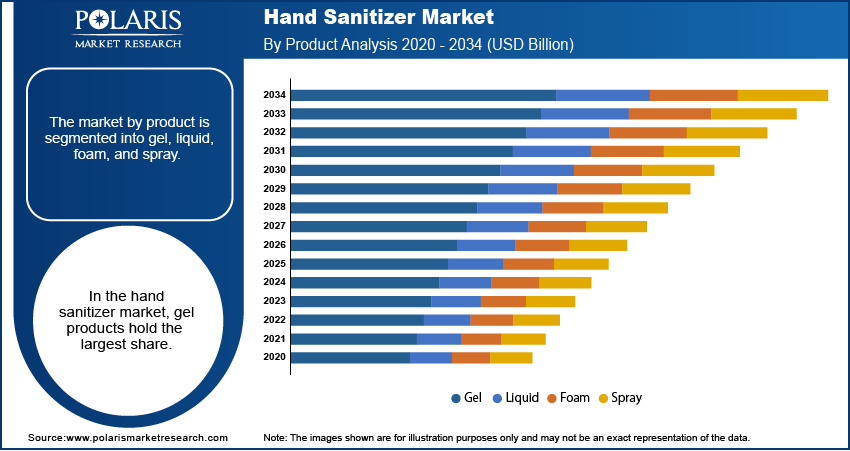
- The gel segment dominated the market with 47.0% share in 2025, owing to its easy application, effective germ protection, and consumer preference for non-liquid sanitizers that offer convenience and longer-lasting effects.
- In 2025, retail suppliers and supermarkets accounted for 27.0% market share, due to extensive consumer access, robust distribution channels, and increasing daily hygiene routines driving steady demand for sanitizing products.
- The online distribution channel shows the fastest growth at a CAGR of 7.9%, propelled by rising consumer preference for e-commerce platforms offering convenience, bulk buying options, competitive prices, and contactless shopping, boosting overall market expansion.
*Note: Figures and projections outlined in this report are the result of Polaris Market Research’s proprietary analytical processes, grounded in the latest available datasets and market observations.
Industry Dynamics
- Rising demand for hand sanitizers is driven by increased hygiene awareness, pandemic impact, and the need for convenient, effective infection control in healthcare, public, and domestic settings.
- Expanding use in retail, offices, schools, and public transport fuels growth, supported by consumer preference for easy-to-use, quick-drying sanitizers that enhance daily personal hygiene practices.
- Challenges such as fluctuating raw material costs, regulatory compliance, and consumer skepticism toward chemical ingredients may slow market growth, highlighting the need for safer, natural formulations and clear labeling.
- Innovations in formulation, packaging, and distribution channels—including, e-commerce are accelerating market adoption, improving product accessibility, user experience, and supporting global hygiene standards across diverse regions.
Source: Polaris Market Research Analysis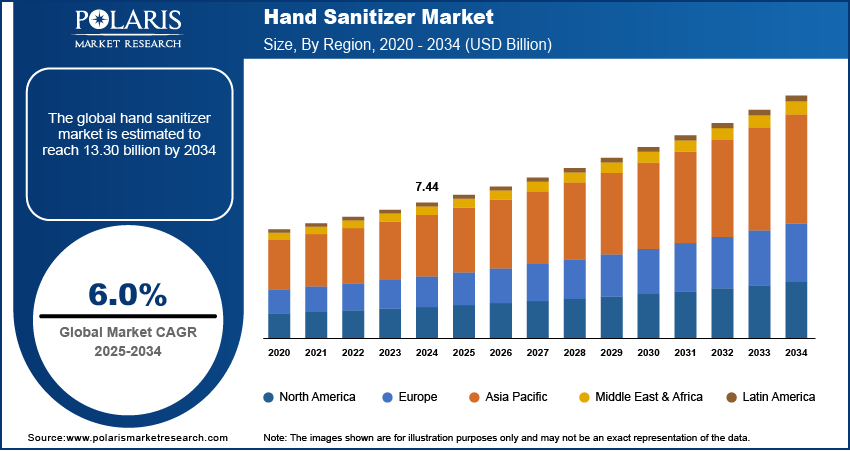
What is Hand Sanitizer?
Hand sanitizer is an antiseptic solution, usually alcohol-based, used to reduce microorganisms on hands when soap and water are not available. It supports maintain hygiene and prevent infection spread. Widely used in healthcare settings, households, workplaces, and public places for quick hand cleaning.
The hand sanitizer market comprises products designed for hand hygiene, primarily alcohol-based and non-alcohol-based formulations used to reduce microbial presence. Market growth is driven by increasing awareness of hand hygiene, rising concerns over infectious diseases, and regulatory emphasis on sanitation in healthcare and public spaces. The COVID-19 pandemic significantly accelerated hand sanitizer market demand, leading to product innovations such as skin-friendly formulations and eco-friendly packaging. Trends in the market include the growing preference for natural and organic ingredients, the expansion of private-label brands, and the integration of moisturizing agents to prevent skin dryness. The expansion of e-commerce and retail distribution channels further supports market growth.
Market Dynamics
Heightened Health Awareness
The increasing emphasis on personal hygiene has significantly propelled the market expansion. Public health campaigns and educational initiatives have underscored the importance of hand hygiene in preventing disease transmission. For instance, the Centers for Disease Control and Prevention, recommends using hand sanitizers with at least 60% alcohol when soap and water are unavailable. This guidance has led to a substantial rise in consumer adoption of hand sanitizers as a preventive health measure.
Urbanization and Lifestyle Changes
Rapid urbanization has altered daily routines, leading to increased interactions in public spaces such as offices, malls, and public transportation. In these environments, access to traditional handwashing facilities may be limited, making hand sanitizers a convenient alternative. The portability and ease of use of hand sanitizers have made them essential for individuals seeking to maintain hand hygiene amidst busy schedules.
Expansion of Healthcare Sector
The growth of healthcare facilities, including hospitals, clinics, and nursing homes, has boosted the market demand. Healthcare-associated infections (HAIs) remain a concern, prompting stringent hygiene protocols. Hand sanitizers are integral to infection control practices, aiding in reducing pathogen transmission among patients and staff. The healthcare sector's commitment to maintaining high hygiene standards continues to drive the utilization of hand sanitizers.
Source: Polaris Market Research Analysis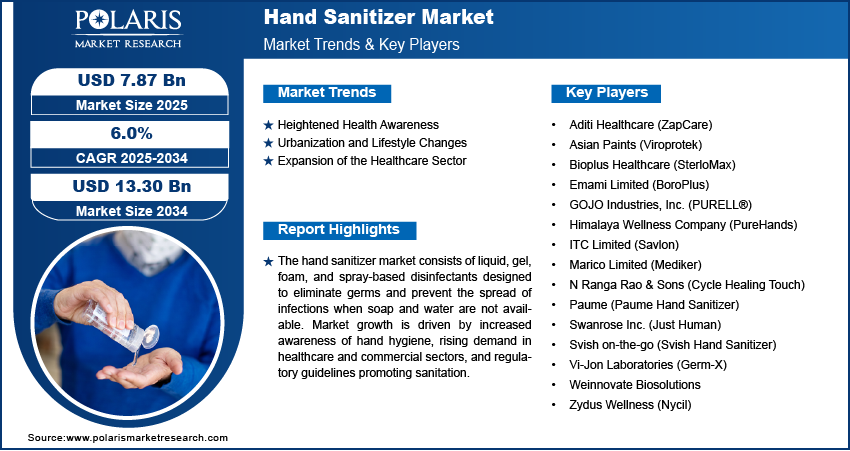
Segment Insights
By Product Outlook
The hand sanitizer market segmentation, based on product, includes gel, liquid, foam, and spray. The gel segment holds the largest market share accounting for 40.5% in 2025. Their light, watery formulation allows for high spreadability, enabling effective skin penetration to eliminate bacteria. The widespread availability and accessibility of gel sanitizers have fueled their demand, especially during the COVID-19 pandemic.
Foam-based hand sanitizers are expected to witness the highest hand sanitizer market CAGR of 7.9% over the forecast period. These products penetrate the skin easily and remain effective for extended periods. Their ease of application offers time-saving convenience, contributing to their rising popularity. The increased demand for foam-based sanitizers is attributed to their higher effectiveness against microbial germs.
| Product Type | Key Characteristics | Usage/Application | Market Insight |
| Gel | Thick consistency, easy control | Personal and household use | Dominant segment due to convenience and longer-lasting effect |
| Liquid | High spreadability, fast absorption | Hospitals and institutions | Widely used in healthcare for effective coverage |
| Foam | Light texture, uniform coverage | Commercial and public spaces | Fastest growing due to ease of use and efficiency |
| Spray | Fine mist, quick application | Travel and on-the-go use | Gaining traction for portability and surface-friendly use |
Source: Polaris Market Research Analysis
By Distribution Channel Outlook
The hand sanitizer market is segmented by distribution channel into hospital pharmacies, retail suppliers, supermarket, online and others. In 2025, the retail suppliers and supermarkets segment accounted for 27.0% share, due to widespread consumer accessibility, strong distribution networks, and increasing demand for hygiene products in daily routines. Supermarkets and retail chains offer convenient access to a variety of hand sanitizers, including branded and private-label options, providing to different price points and consumer preferences. Bulk purchasing options, frequent promotional discounts, and strategic product placement further drove sales. Additionally, rising consumer awareness about hand hygiene and the preference for in-store purchases contributed to sustained demand, reinforcing the dominance of this segment in the market.
The online distribution channel is experiencing the fastest growth with a CAGR of 7.9% over the forecast period due to rising consumer preference for e-commerce platforms, driven by convenience, bulk purchasing options, and competitive pricing, is accelerating the growth of the online distribution channel in the market. Expanding digital payment systems, doorstep delivery services, and direct-to-consumer brand strategies further boost adoption. Increased awareness of hygiene and ongoing demand from healthcare, corporate, and personal users contribute to sustained online sales growth, supported by subscription models and targeted digital marketing.
| Distribution Channel | Key Characteristics | Usage/Application | Market Insight |
| Retail (Supermarkets & Stores) | Wide availability, strong networks | Daily consumer purchase | Dominant channel due to accessibility and visibility |
| Online | E-commerce platforms, doorstep delivery | Bulk and convenience buying | Fastest growing due to digital adoption and pricing benefits |
| Healthcare (Hospitals & Pharmacies) | Regulated supply, bulk demand | Infection control and medical use | Consistent demand driven by hygiene protocols |
| Others | Includes institutional and specialty stores | Offices, schools, public places | Supports market expansion across multiple end-use sectors
|
Source: Polaris Market Research Analysis
Source: Polaris Market Research Analysis
Regional Insights
By region, the study covers North America, Europe, Asia Pacific, Latin America, and the Middle East & Africa. In 2025, North America accounted for the largest hand sanitizer market share valued at 40.5%, driven by high awareness of personal hygiene, stringent health regulations, and widespread adoption in various sectors such as healthcare, education, and corporate workplaces. The presence of established manufacturers, along with strong retail and e-commerce distribution networks, further contributes to regional dominance.
The hand sanitizer market in Europe is driven by strict hygiene regulations and growing consumer awareness of hand hygiene practices. Government policies promoting the use of sanitizers in public spaces, hospitals, and workplaces have contributed to steady demand. Countries such as Germany, the UK, and France have well-established healthcare infrastructures, which further support the widespread adoption of hand sanitizers. The market also benefits from the presence of multiple domestic and international manufacturers offering a variety of formulations, including alcohol-based, herbal, and skin-friendly options. Additionally, the rising preference for eco-friendly and sustainable packaging solutions is influencing product innovation in the region.
The hand sanitizer market in Asia Pacific is expanding at a CAGR of 7.5% due to increasing urbanization, rising disposable income, and growing public awareness of hygiene practices. Countries such as China, India, and Japan are seeing higher demand for hand sanitizers due to improved healthcare access and frequent government-led hygiene awareness campaigns. The expansion of retail and e-commerce channels has also made hand sanitizers more accessible to consumers, driving overall market growth. Additionally, the presence of regional players offering cost-effective products tailored to local preferences has strengthened market competition. The demand for herbal and natural ingredient-based sanitizers is also gaining traction, particularly in countries with strong consumer preferences for traditional and organic products.
Source: Polaris Market Research Analysis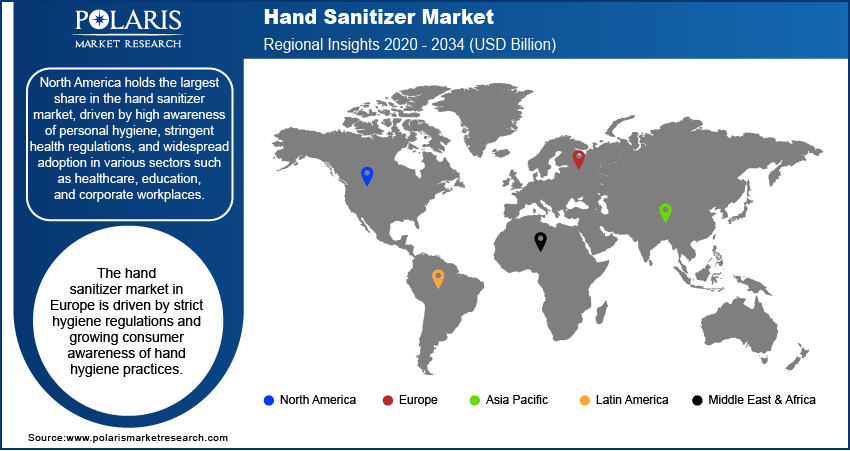
Key Players and Competitive Insights
The market is highly competitive, with numerous global and regional players focusing on innovation, branding, and strategic distribution. Companies are investing in advanced formulations, including alcohol-free and moisturizing variants, to provide evolving consumer preferences. The market is also witnessing significant competition in packaging innovations, such as travel-friendly sachets, sprays, and eco-friendly dispensers. E-commerce expansion and direct-to-consumer sales have intensified rivalry, with brands leveraging digital marketing and subscription models to strengthen customer loyalty.
Regulatory compliance and certifications play a crucial role in market positioning, especially in healthcare and institutional sectors. Additionally, private-label brands are increasing competition by offering cost-effective alternatives. Marico Limited, an Indian consumer goods company, offers hand sanitizers under its Mediker brand, leveraging its extensive distribution network. ITC Limited, another Indian conglomerate, markets Savlon hand sanitizers, emphasizing their antiseptic properties. Himalaya Wellness Company provides PureHands sanitizers, focusing on herbal formulations. Emami Limited has introduced BoroPlus hand sanitizers, aligning with its skincare product range. Asian Paints, primarily known for paints, ventured into the hygiene segment with Viroprotek sanitizers. N Ranga Rao & Sons, under the Cycle brand, offers Healing Touch sanitizers, combining traditional practices with modern hygiene. Bioplus Healthcare has launched SterloMax hand sanitizers, targeting both personal and institutional users. Swanrose Inc.
The hand sanitizer market is characterized by a mix of established corporations and emerging startups, each bringing unique products to consumers. Companies such as GOJO Industries and Vi-Jon Laboratories have leveraged their longstanding market presence to maintain consumer trust and loyalty. In contrast, firms such as Swanrose Inc. and Paume have introduced innovative formulations and eco-conscious packaging to appeal to environmentally aware consumers. The diversity in product offerings, ranging from alcohol-based to herbal and alcohol-free formulations, reflects the industry's responsiveness to varied consumer preferences and health considerations.
GOJO Industries, Inc., established in 1946 and headquartered in Ohio, US is a manufacturer of hand hygiene and skin care products. The company is best known for its PURELL® brand of hand sanitizers, which has become a trusted name in both consumer and professional markets. GOJO Industries offers a range of products, including hand sanitizers in various forms, such as gels, foams, sprays, and wipes, catering to diverse user preferences.
Vi-Jon Laboratories, founded in 1908 and based in St. Louis, Missouri, is a longstanding producer of personal care products. The company manufactures both private label and branded items, with its Germ-X line of hand sanitizers being particularly well-known. Vi-Jon operates multiple manufacturing and distribution centers across Missouri and Tennessee, supplying products to major retailers nationwide.
List of Key Companies
- Aditi Healthcare (ZapCare)
- Asian Paints (Viroprotek)
- Bioplus Healthcare (SterloMax)
- Emami Limited (BoroPlus)
- GOJO Industries, Inc. (PURELL®)
- Himalaya Wellness Company (PureHands)
- ITC Limited (Savlon)
- Marico Limited (Mediker)
- N Ranga Rao & Sons (Cycle Healing Touch)
- Paume (Paume Hand Sanitizer)
- Swanrose Inc. (Just Human)
- Svish on-the-go (Svish Hand Sanitizer)
- Vi-Jon Laboratories (Germ-X)
- Weinnovate Biosolutions (Silver Nanoparticle Hand Sanitizer)
- Zydus Wellness (Nycil)
Market Developments
-
May 2025: Church & Dwight acquired Touchland. The step shows increasing demand for premium branded hand mists with strong year-on-year sales. (Source: churchdwight.com)
-
April 2025: Bath & Body Works re-launched full-size hand sanitizers, including gels and sprays. Demand remains high in both in-store and online channels. (Source: bestlifeonline.com)
- January 2024: Vi-Jon Holding announced a strategic reorganization to establish clear focus and expectations, empower its employee-owners, and position the company for continued success and expansion. As part of this reorganization, the company formed Vivos Holdings, consumer-packaged goods holding company focused on providing household and personal care products. (Source: vivosholdings.com)
Market Segmentation
By Product Outlook (Revenue-USD Billion, 2021–2034)
- Gel
- Liquid
- Foam
- Spray
By Distribution Channel Outlook (Revenue-USD Billion, 2021–2034)
- Hospital Pharmacies
- Retail Suppliers
- Supermarket
- Online
- Others
By Regional Outlook (Revenue-USD Billion, 2021–2034)
- North America
- US
- Canada
- Europe
- Germany
- France
- UK
- Italy
- Spain
- Netherlands
- Russia
- Rest of Europe
- Asia Pacific
- China
- Japan
- India
- Malaysia
- South Korea
- Indonesia
- Australia
- Vietnam
- Rest of Asia Pacific
- Middle East & Africa
- Saudi Arabia
- UAE
- Israel
- South Africa
- Rest of Middle East & Africa
- Latin America
- Mexico
- Brazil
- Argentina
- Rest of Latin America
Future of Hand Sanitizer Market
Growth in skin-friendly and non-irritating formulations is increasing because of rising demand for safer products. Eco-friendly packaging and sustainable ingredients are gaining importance. Expansion in emerging markets is helping growth. Long-term focus on infection prevention continues to sustain demand. The future of the hand sanitizer market shows constant demand backed by continued hygiene awareness in daily life and healthcare.
Report Scope
| Report Attributes | Details |
| Market Size Value in 2025 | USD 7.88 billion |
| Market Size Value in 2026 | USD 8.35 billion |
| Revenue Forecast by 2034 | USD 13.33 billion |
| CAGR | 6.0% from 2026 to 2034 |
| Base Year | 2025 |
| Historical Data | 2021–2024 |
| Forecast Period | 2026–2034 |
| Quantitative Units | Revenue in USD billion and CAGR from 2026 to 2034 |
| Report Coverage | Revenue Forecast, Market Competitive Landscape, Growth Factors, and Industry Trends |
| Segments Covered |
|
| Regional Scope |
|
| Competitive Landscape |
|
| Report Format |
|
| Customization | Report customization as per your requirements with respect to countries, regions, and segmentation. |
Source: Polaris Market Research Analysis
Hand Sanitizer Market FAQ's
The hand sanitizer market size was valued at USD 7.88 billion in 2025 and is projected to grow to USD 13.33 billion by 2034.
The market is projected to register a CAGR of 6.0% during the forecast period, 2026-2034.
North America had the largest share of the market driven by high awareness of personal hygiene, stringent health regulations, and widespread adoption in various sectors such as healthcare, education, and corporate workplaces.
Aditi Healthcare (ZapCare), Asian Paints (Viroprotek), Bioplus Healthcare (SterloMax), Emami Limited (BoroPlus), GOJO Industries, Inc. (PURELL®), Himalaya Wellness Company (PureHands), ITC Limited (Savlon), Marico Limited (Mediker), N Ranga Rao & Sons (Cycle Healing Touch), Paume (Paume Hand Sanitizer), Swanrose Inc. (Just Human), Svish on-the-go (Svish Hand Sanitizer), Vi-Jon Laboratories (Germ-X), Weinnovate Biosolutions (Silver Nanoparticle Hand Sanitizer), and Zydus Wellness (Nycil).
The gel segment accounted for the larger share of the market in 2025 due to their light, watery formulation allows for high spreadability, enabling effective skin penetration to eliminate bacteria.
The retail suppliers and supermarkets segment accounted for the larger share of the market in 2025 due to the widespread presence of these retail outlets and their extensive distribution networks have made hand sanitizers readily accessible to a broad consumer base.
Hand sanitizer is a liquid, gel, or foam-based disinfectant used to reduce or eliminate germs, bacteria, and viruses on the hands. It is typically formulated with alcohol, such as ethanol or isopropyl alcohol, which acts as the primary antimicrobial agent. Some non-alcohol-based variants use antimicrobial compounds like benzalkonium chloride. Hand sanitizers are widely used in healthcare settings, public spaces, workplaces, and households to maintain hand hygiene, especially in situations where soap and water are not readily available. They play a crucial role in preventing the spread of infections and maintaining personal hygiene.
Download Sample Report of Hand Sanitizer Market
Please fill out the form to request a customized copy of the research report.


