
Operational Technology Market Size, Share, Trends and Forecast, 2026–2034
REPORT DETAILS
Operational Technology Market Summary
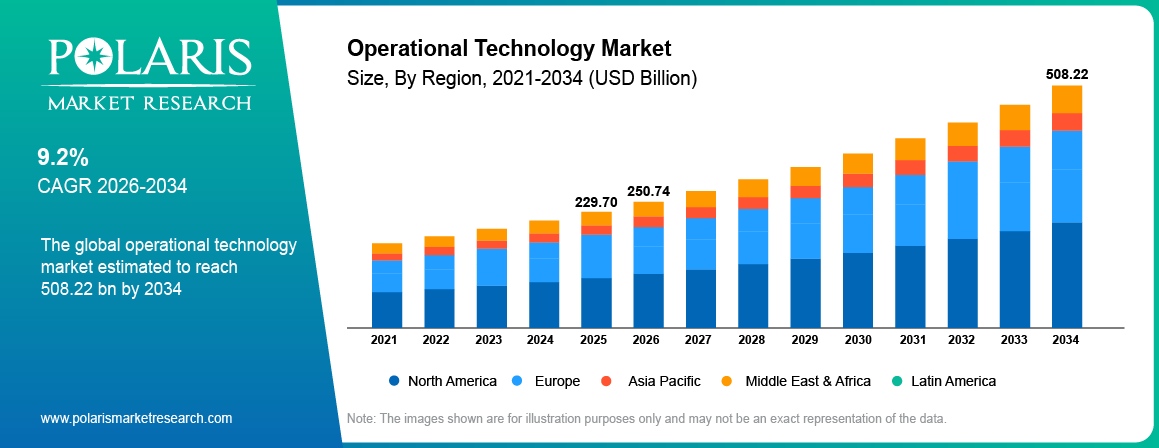
The global operational technology market was valued at USD 229.70 billion in 2025 and is projected to grow at a CAGR of 9.2% during 2026–2034. Growth is driven by rising Industry 4.0 investments, industrial automation, digitalization, and increasing cybersecurity needs. Additionally, the expansion of renewable energy projects and smart grid infrastructure is boosting demand for advanced OT solutions.
Market Statistics
Key Takeaways
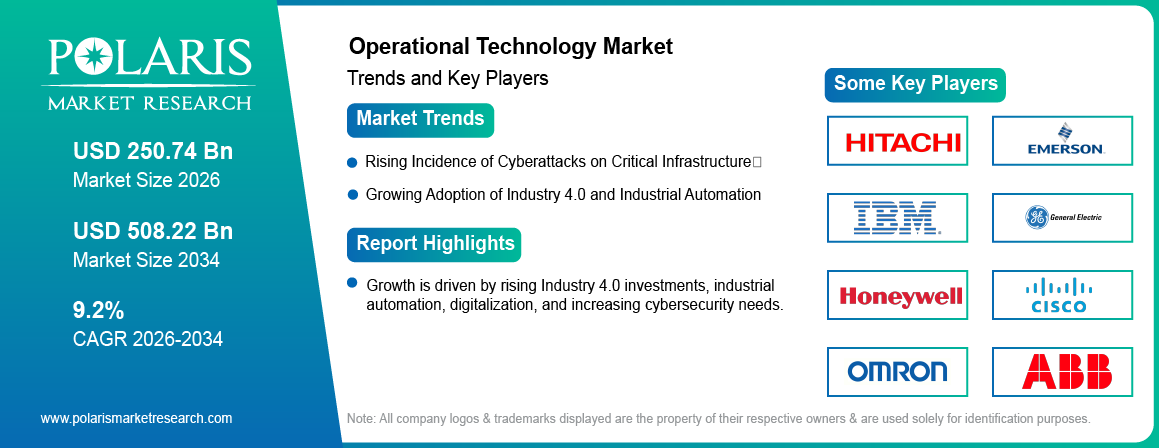
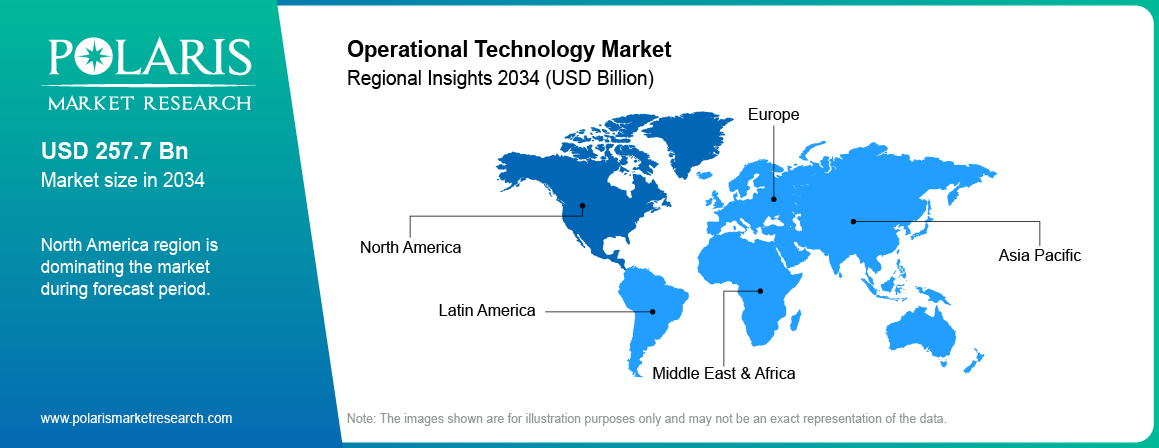
- North America held the largest revenue share of 37.38% in the operational technology market in 2025. Rapid industrialization, smart manufacturing investments, and infrastructure development support its dominance.
- Asia Pacific is projected to grow at a CAGR of 10.99% during the forecast period. Increasing investments in industrial automation, digital transformation, and OT cybersecurity will drive regional growth.
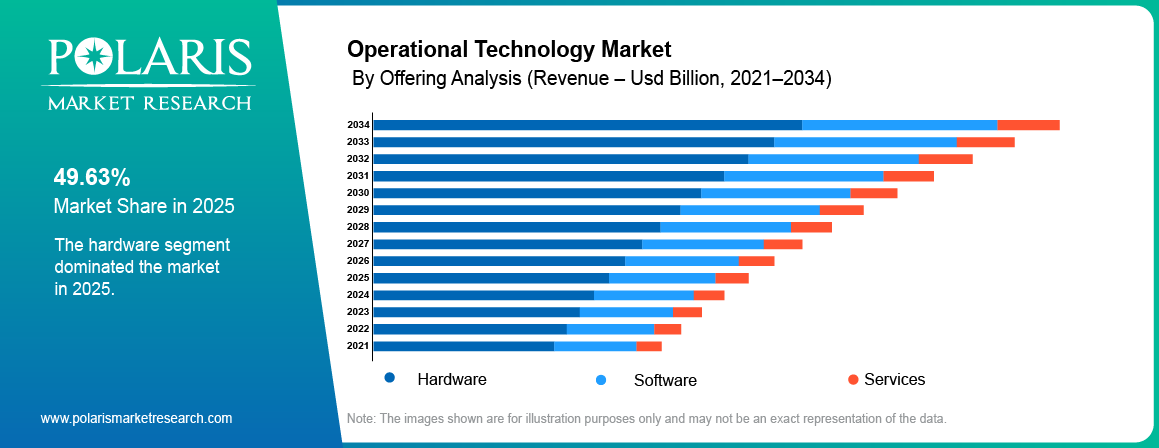
- The hardware segment held the largest market share of 49.63% in 2025. Rising investments in industrial automation, sensors, PLCs, and control systems support its dominance.
- The software segment is projected to grow at a CAGR of 10.83% during 2026–2034. Growing adoption of predictive maintenance, real-time analytics, and AI-powered platforms will support segment growth.
- The wired connectivity segment held the largest market share of 68.24% in 2025. Its reliability, low latency, and stable data transmission support its widespread industrial adoption.
- The wireless connectivity segment is projected to grow at a CAGR of 11.75% during the forecast period. Increasing demand for flexible connectivity, remote monitoring, and smart factory solutions will drive growth.
Note: Figures and projections outlined in this report are the result of Polaris Market Research’s proprietary analytical processes, grounded in the latest available datasets and market observations.
What Is Operational Technology (OT)?
Operational technology (OT) refers to the hardware and software systems used to monitor, control, and manage physical devices, processes, and industrial operations. It includes industrial control systems (ICS), supervisory control and data acquisition (SCADA), distributed control systems (DCS), and programmable logic controllers (PLCs). These systems work with equipment such as IoT sensors, pumps, motors, and machines to collect real-time data and control industrial processes.
In simple terms, OT helps industries operate machines and manage physical processes safely and efficiently. It is widely used in manufacturing, energy, utilities, transportation, and healthcare. For example, manufacturing plants use OT systems to automate production lines, while power companies use them to monitor electricity grids and manage energy distribution. Water treatment facilities also rely on OT to control pumps, monitor water levels, and maintain treatment processes.
The growing adoption of Industry 4.0 is increasing demand for operational technology solutions. Manufacturers are investing in smart factories, industrial robotics, connected devices, and real-time data monitoring to improve productivity. These developments require reliable OT systems that can connect physical equipment with digital platforms. The integration of artificial intelligence and machine learning is also helping industries improve process control, identify equipment faults, and support predictive maintenance.
Furthermore, the growing connection between operational technology and information technology (IT) is creating new opportunities for industrial digitalization. Cloud computing, edge computing, and industrial IoT are enabling faster data processing and remote monitoring. However, increased connectivity also creates cybersecurity risks. As a result, businesses are investing in secure and scalable OT infrastructure to protect critical operations, reduce downtime, and maintain operational efficiency.
How Does Operational Technology Work?
Operational technology works by connecting physical equipment with control systems to monitor and manage industrial processes in real time. The process begins with sensors that collect data such as temperature, pressure, speed, and equipment performance. Controllers, such as programmable logic controllers (PLCs), process this information and send commands to machines or other equipment. Industrial networks enable communication between connected devices and control systems.
The collected data is then displayed through systems such as SCADA and human-machine interfaces (HMIs), allowing operators to monitor activities and make adjustments when required. For example, in a manufacturing plant, IoT sensors can detect changes in machine temperature and send data to a controller. The controller can then adjust machine operations to prevent overheating and reduce downtime.
Advanced OT systems also use data analytics and artificial intelligence to identify equipment issues, improve process efficiency, and support predictive maintenance. This helps industries maintain smooth operations, improve productivity, and reduce operational risks.
IT-OT Convergence and Industrial Data Integration
IT-OT convergence refers to the integration of information technology (IT) with operational technology (OT) to improve industrial operations. IT systems manage business data, while OT systems monitor and control physical equipment and industrial processes. Connecting these systems allows businesses to share real-time operational data, improve decision-making, and manage equipment more efficiently.
The growing adoption of Industrial Internet of Things (IIoT), cloud computing, and edge computing is accelerating IT-OT convergence. For example, manufacturing companies can combine machine data with production analytics to monitor equipment performance, identify faults, and support predictive maintenance. This integration also enables remote monitoring and better coordination across industrial facilities.
However, increased connectivity can expose OT networks to cybersecurity threats. Businesses must focus on secure data exchange, network segmentation, and access controls to protect critical systems while maintaining operational efficiency.
OT Cybersecurity and Critical Infrastructure Risk
OT cybersecurity is becoming increasingly important as industrial systems become more connected to enterprise networks and the internet. Operational technology environments control critical processes in manufacturing, energy, transportation, and utilities. A cyberattack on these systems can disrupt production, damage equipment, affect worker safety, and interrupt essential services.
The growing use of IIoT devices, remote monitoring, and cloud-based platforms has increased the number of connected entry points in industrial networks. To address these risks, businesses are investing in OT cybersecurity solutions such as network segmentation, continuous asset monitoring, anomaly detection, and controlled remote access. Maintaining an updated inventory of connected devices also helps organizations identify vulnerabilities and manage security risks.
In 2025 and 2026, the growing focus on industrial digitalization and critical infrastructure protection has further highlighted the need for stronger OT security. Businesses are increasingly adopting AI-based threat monitoring and zero-trust security approaches to detect unusual activities and respond to potential threats. These measures help protect industrial assets, maintain operational continuity, and improve infrastructure resilience.
OT Technology Comparison: PLC, SCADA, DCS, HMI and Sensors
Operational technology uses different hardware and software components to monitor and control industrial processes. Each component performs a specific function, from collecting machine data to managing complex operations. Programmable logic controllers (PLCs), supervisory control and data acquisition (SCADA), distributed control systems (DCS), human-machine interfaces (HMIs), and IoT sensors are commonly used in industrial environments.
| Technology | Primary Function | Common Applications |
| Sensors and Field Instruments | Measure temperature, pressure, flow, vibration, and other operating conditions. | Machine monitoring, tank-level measurement, and grid monitoring. |
| PLC (Programmable Logic Controller) | Processes inputs and controls machines and industrial processes through programmed instructions. | Assembly lines, packaging systems, pumps, and motors. |
| SCADA (Supervisory Control and Data Acquisition) | Collects real-time data, monitors equipment, and supports remote control of operations. | Oil and gas pipelines, power grids, and water treatment networks. |
| DCS (Distributed Control System) | Manages and coordinates complex industrial processes across multiple control units. | Chemical plants, oil refineries, and power generation facilities. |
| HMI (Human-Machine Interface) | Displays equipment status, alerts, and operating information to help workers control machines. | Manufacturing plants, machine control panels, and industrial control rooms. |
| Industrial Networks and Gateways | Enable communication and data exchange between connected devices, control systems, and enterprise networks. | Industrial Ethernet, fieldbus networks, wireless sensor networks, and secure gateways. |
Source: Polaris Market Research Analysis
Market Dynamics
Market Driver- Rising Incidence of Cyberattacks on Critical Infrastructure
The rising number of cyberattacks is increasing demand for operational technology (OT) cybersecurity solutions. Attacks on industrial systems can disrupt production, damage equipment, and affect essential services. Businesses are investing in network monitoring, intrusion detection, and secure access solutions to protect critical operation. According to a 2025 report by the Center for Strategic and International Studies (CSIS), cyberattacks on Ukraine increased by nearly 70% in 2024, reaching 4,315 incidents. Many of these attacks targeted critical infrastructure, including the energy sector and government services. This growing threat is encouraging industries to strengthen OT security and protect connected industrial assets (Source: csis.org).
Market Driver- Growing Adoption of Industry 4.0 and Industrial Automation
The growing adoption of Industry 4.0 is driving demand for advanced operational technology solutions. Manufacturers are investing in industrial robotics, connected devices, sensors, and automated control systems to improve production efficiency. These technologies depend on OT infrastructure for real-time monitoring, data collection, and process control. The integration of artificial intelligence (AI), machine learning, and industrial IoT is also helping businesses improve equipment performance and reduce downtime. As more companies move toward smart manufacturing, the need for reliable and scalable OT systems is increasing across industrial sectors.
Market Opportunity- Increasing Investment in Renewable Energy Infrastructure
The expansion of renewable energy projects is creating opportunities for the operational technology market. Solar and wind facilities require advanced monitoring, automated controls, and grid management systems to maintain stable operations. OT solutions also support energy storage, smart inverters, and distributed energy resources. According to the India Brand Equity Foundation (IBEF), India is expected to invest over USD 360 billion in renewable energy and infrastructure by 2030. These investments are likely to increase demand for OT systems used in power generation, transmission, and grid modernization (Source: ibef.org).
Market Opportunity- Growing Adoption of Private 5G and Industrial IoT
The adoption of private 5G and Industrial IoT is creating new opportunities for OT providers. These technologies support faster communication between machines, sensors, and control systems. In September 2025, GlobalLogic and Ericsson deployed a private 5G network at Hitachi Rail's 307,000-square-foot manufacturing facility in the US. The network supports factory automation, worker safety, and connected industrial operations. Such projects highlight the growing role of advanced connectivity in modern OT environments (Source: hitachi.com).
Market Restraint- High Costs of OT Modernization and System Integration
High modernization costs remain a challenge for the operational technology market. Many industries still use legacy equipment that requires upgrades or replacement to support modern OT solutions. Integrating new systems with existing infrastructure can increase deployment costs and create compatibility issues. Businesses also need skilled professionals to manage connected devices, maintain system reliability, and address cybersecurity risks. These challenges can delay OT adoption, particularly among small and medium-sized enterprises.
Segment Analysis
Market Assessment by Offering
Based on offering, the operational technology market is segmented into hardware, software, and services. In 2025, the hardware segment held the largest market share of 49.63%. Its dominance is supported by the widespread use of sensors, programmable logic controllers (PLCs), human-machine interfaces (HMIs), and industrial control systems across manufacturing, energy, and utility industries. These components help monitor equipment, collect real-time data, and control industrial processes. The growing adoption of smart factories and industrial automation is further supporting hardware demand.
The software segment is projected to be the fastest-growing segment, registering a CAGR of 10.83% during 2026–2034. Increasing adoption of Industry 4.0, industrial IoT, and artificial intelligence is driving demand for software solutions. SCADA, industrial analytics, and asset management platforms help businesses monitor equipment, improve process control, and support predictive maintenance. Growing cybersecurity needs are also encouraging investments in OT software.
The services segment includes system integration, installation, consulting, maintenance, and technical support. Rising demand for OT modernization and the integration of advanced technologies with existing infrastructure is supporting this segment.
Market Assessment by Connectivity
Based on connectivity, the operational technology market is segmented into wired and wireless. In 2025, the wired connectivity segment held the largest market share of 68.24%, supported by its reliability, low latency, and stable data transmission in industrial environments. Industries such as oil and gas, manufacturing, and utilities rely on wired networks to maintain secure communication between equipment and control systems. Their ability to perform consistently in demanding operating conditions continues to support adoption across critical industrial applications.
The wireless connectivity segment is projected to be the fastest-growing segment, registering a CAGR of 11.75% during the forecast period. Its growth is driven by increasing demand for flexible and scalable communication solutions across industrial facilities. Wireless networks support remote monitoring, predictive maintenance, and communication between connected devices. Advancements in wireless security and integration with edge computing are further supporting adoption. Additionally, the growing use of smart factories, Industrial Internet of Things (IIoT), and automated systems is increasing demand for wireless connectivity in industrial operations.
Market Assessment by Deployment Type
Based on deployment type, the operational technology market is segmented into cloud and on-premises. The on-premises segment held the largest market share of 52.37% in 2025, driven by the need for greater control over industrial systems, data security, and network reliability. Industries such as manufacturing, energy, and utilities often prefer on-premises deployment to manage critical operations within their own infrastructure. It also allows businesses to maintain direct control over sensitive operational data, system access, and security settings.
The cloud segment is projected to be the fastest-growing segment, registering a CAGR of 11.64% during the forecast period. Growing adoption of industrial IoT, remote monitoring, and digital transformation is increasing demand for cloud-based OT solutions. Cloud deployment allows businesses to access operational data across multiple facilities, improve scalability, and reduce the need for extensive on-site IT infrastructure. Additionally, integration with artificial intelligence (AI), machine learning, and advanced analytics is supporting cloud adoption. These capabilities help industries improve equipment monitoring, support predictive maintenance, and make faster operational decisions.
Market Assessment by Enterprise Size
Based on enterprise size, the operational technology market is segmented into small and medium-sized enterprises (SMEs) and large enterprises. The large enterprises segment held the largest market share of 67.36% in 2025, supported by higher investments in industrial automation, digital infrastructure, and advanced control systems. Large organizations often operate complex industrial facilities that require reliable monitoring, process control, and cybersecurity solutions. Their greater financial resources also allow them to invest in modern OT infrastructure, system integration, and regular technology upgrades.
The SMEs segment is projected to be the fastest-growing segment, registering a CAGR of 11.37% during the forecast period. Growing awareness of industrial automation and the need to improve operational efficiency are encouraging SMEs to adopt OT solutions. Affordable sensors, cloud-based platforms, and scalable automation systems are making these technologies more accessible to smaller businesses. Additionally, increasing demand for real-time monitoring, predictive maintenance, and improved production processes is supporting adoption among SMEs. As digital transformation expands across industries, SMEs are expected to increase their investments in operational technology.
Operational Technology Use Cases Across Industries
Operational technology supports the monitoring, control, and automation of physical processes across several industries. Its applications help businesses improve efficiency, maintain safety, and reduce operational downtime.
| Industry | OT Technologies Used | Key Applications |
| Manufacturing | Sensors, PLCs, robotics, and industrial control systems | Automating production lines, monitoring machine performance, maintaining product quality, and supporting predictive maintenance. |
| Energy | SCADA, smart sensors, and control systems | Monitoring power generation, managing electricity grids, controlling substations, and improving energy distribution. |
| Oil and Gas | SCADA, industrial sensors, and remote monitoring systems | Monitoring pipelines, regulating pressure, detecting leaks, and controlling drilling and refining operations. |
| Water and Wastewater | PLCs, SCADA, and flow sensors | Monitoring water quality, controlling pumping stations, and managing water treatment and distribution networks. |
| Transportation | Signaling systems, sensors, and automated control systems | Managing railway signals, monitoring traffic, and controlling transport infrastructure. |
| Buildings | Building management systems, sensors, and automated controllers | Controlling heating, ventilation, air conditioning, lighting, elevators, and security systems to improve energy efficiency. |
Source: Polaris Market Research Analysis
Regional Analysis
The operational technology market is analyzed across North America, Europe, Asia Pacific, Latin America, and the Middle East & Africa. Regional demand is driven by industrial automation, smart manufacturing, infrastructure development, and increasing investments in industrial cybersecurity.
Asia Pacific
Asia Pacific is projected to grow at a CAGR of 10.99% during the forecast period, driven by rapid industrialization, infrastructure development, and rising investments in smart manufacturing. The growing adoption of Industry 4.0 and Industrial Internet of Things (IIoT) technologies is encouraging businesses to upgrade their industrial systems. Increasing demand for robotics, automated control systems, and real-time monitoring solutions is further supporting regional growth. Strong manufacturing activities across China, Japan, and India are creating opportunities for OT providers. Additionally, government initiatives focused on digital infrastructure and industrial modernization are encouraging industries to adopt advanced operational technology solutions to improve productivity and operational efficiency.
China
China's focus on smart manufacturing, factory automation, and digital infrastructure is driving demand for OT solutions. Investments in industrial robotics, control systems, and IIoT technologies are supporting the modernization of manufacturing facilities and industrial operations.
Japan
Japan's advanced manufacturing sector and growing use of industrial robotics are supporting OT adoption. Investments in automated production systems, connected equipment, and smart factories are helping industries improve productivity and operational efficiency.
India
India's expanding manufacturing sector and infrastructure development are creating opportunities for OT solutions. Government initiatives supporting industrial modernization and smart manufacturing are encouraging the adoption of automation, monitoring, and control systems.
North America
North America accounted for the largest market share of 37.38% in 2025. Regional growth is supported by advanced industrial infrastructure, investments in smart manufacturing, and the presence of major companies such as Rockwell Automation and Honeywell. Industries across the region are increasingly adopting automation, connected devices, and digital control systems to improve operational efficiency. Growing investments in industrial cybersecurity and critical infrastructure protection are also supporting demand. The expansion of digital transformation initiatives across manufacturing, oil and gas, and utilities is further encouraging businesses to upgrade their OT infrastructure.
US
The US leads regional adoption, with manufacturing, oil and gas, and utility companies investing in automation and digital technologies. Industrial modernization and increasing attention to cybersecurity are supporting demand for advanced OT systems.
Canada
Canada's investments in energy infrastructure, manufacturing modernization, and industrial automation are supporting OT adoption. The growing use of connected industrial systems is increasing demand for reliable monitoring and control technologies.
Europe
Europe's operational technology market is supported by the growing adoption of Industry 4.0, industrial automation, and energy-efficient manufacturing technologies. Businesses are investing in connected production systems, robotics, and advanced control solutions to improve productivity. Germany, France, and the UK are contributing to regional demand through industrial digitalization initiatives and infrastructure modernization. Additionally, increasing attention to industrial cybersecurity and operational resilience is encouraging companies to upgrade legacy systems. The expansion of smart manufacturing and the integration of digital technologies across industrial facilities are expected to create further opportunities for OT providers across the region.
Germany
Germany's strong manufacturing base and Industry 4.0 initiatives are driving demand for industrial automation, robotics, and advanced control systems. Investments in smart factories are further supporting OT adoption.
France
Investments in smart manufacturing, energy infrastructure, and industrial digitalization are supporting the adoption of OT solutions across French industries. Automation is helping businesses improve process efficiency and equipment monitoring.
UK
The UK's focus on industrial modernization, critical infrastructure protection, and digital transformation is creating demand for advanced OT systems across manufacturing, energy, and utility sectors.
Middle East & Africa
The Middle East & Africa operational technology market is gaining momentum as countries invest in energy infrastructure, industrial diversification, and smart city projects. The oil and gas industry remains an important source of demand for industrial monitoring and control systems. Investments in utilities, manufacturing, and transportation are also increasing the need for automation solutions. Additionally, digital transformation initiatives and the growing focus on critical infrastructure protection are encouraging businesses to modernize industrial operations. These developments are creating opportunities for OT providers across the region.
Latin America
Latin America's operational technology market is gaining traction as industries modernize manufacturing facilities, energy infrastructure, and transportation networks. Growing investments in industrial automation and connected systems are encouraging businesses to improve productivity and operational efficiency. The expansion of mining, oil and gas, and utility operations is also supporting demand for monitoring and control technologies. Additionally, increasing awareness of industrial cybersecurity and the need to upgrade legacy infrastructure are creating opportunities for OT solutions across the region.
Competitive Insights
The operational technology market is evolving through strategic mergers and acquisitions, partnerships, collaborations, and product development. Major companies are focusing on expanding their technological capabilities and strengthening their market presence. Companies such as Siemens AG and ABB Ltd. are advancing their industrial automation and smart infrastructure offerings through technology development and strategic initiatives. Partnerships and collaborations are also helping companies develop integrated solutions for industries such as manufacturing, energy, and utilities.
Additionally, expanding product portfolios are supporting market competition. Companies such as Rockwell Automation, Inc. and Schneider Electric SE are introducing advanced solutions for predictive maintenance, industrial automation, and OT cybersecurity. These developments are helping businesses improve operational efficiency, strengthen system security, and address the growing requirements of connected industrial environments.
Rockwell Automation, Inc. is a global company in industrial automation and operational technology, supporting smart manufacturing and digital transformation. Its approach emphasizes the integration of information technology (IT) and operational technology (OT) systems, enabling manufacturers to optimize processes, improve productivity, and support sustainability goals. The company uses technologies such as the Industrial Internet of Things (IIoT), digital twins, and edge computing to improve manufacturing operations. Its IIoT solutions support real-time data collection and analysis, predictive maintenance, process optimization, and asset utilization. Digital twin technology allows organizations to simulate and optimize operations in virtual environments, helping reduce downtime and operational risks. Edge computing also enables faster data processing for applications such as automated quality inspections.
IBM Corporation plays an important role in advancing cybersecurity solutions for operational technology and critical infrastructure industries. Its cybersecurity capabilities address risks associated with interconnected devices, legacy architectures, and vulnerabilities in industrial networks. IBM focuses on threat detection, continuous monitoring, and incident response supported by artificial intelligence and machine learning technologies. Its approach to OT security considers industrial network structures and operational requirements, helping organizations protect connected systems while maintaining operational efficiency and business continuity.
Key Players
- ABB Ltd.
- Cisco Systems, Inc.
- Emerson Electric Co.
- General Electric Company
- Hitachi, Ltd.
- Honeywell International Inc.
- IBM Corporation
- OMRON Corporation
- Rockwell Automation, Inc.
- Schneider Electric SE
- Siemens AG
- Yokogawa Electric Corporation
Vendor Positioning Table
| Company | Headquarters | Key OT Technologies | Industry Applications |
| ABB Ltd. | Zurich, Switzerland | Electrification, industrial automation, robotics, and process control systems. | Manufacturing, energy, utilities, and infrastructure. |
| Cisco Systems, Inc. | San Jose, California, USA | Industrial networking, secure connectivity, and network visibility solutions. | Manufacturing, energy, transportation, and critical infrastructure. |
| Emerson Electric Co. | St. Louis, Missouri, USA | Process automation, measurement, control, and industrial reliability solutions. | Oil and gas, chemicals, power, and manufacturing. |
| General Electric Company | Boston, Massachusetts, USA | Power generation, grid technologies, and industrial solutions. | Energy, power generation, and utilities. |
| Honeywell International Inc. | Charlotte, North Carolina, USA | Process automation, industrial control, safety systems, and industrial software. | Manufacturing, energy, oil and gas, and buildings. |
| IBM Corporation | Armonk, New York, USA | Industrial data analytics, asset management, and enterprise integration solutions. | Manufacturing, energy, transportation, and critical infrastructure. |
| Rockwell Automation, Inc. | Milwaukee, Wisconsin, USA | Factory automation, industrial control platforms, and industrial software. | Manufacturing, automotive, food and beverage, and life sciences. |
| Schneider Electric SE | Rueil-Malmaison, France | Industrial automation, energy management, and connected infrastructure solutions. | Manufacturing, energy, buildings, and utilities. |
| Siemens AG | Munich, Germany | Industrial automation, control systems, and digitalization solutions. | Manufacturing, energy, transportation, and infrastructure. |
| Yokogawa Electric Corporation | Musashino, Tokyo, Japan | Process automation, measurement, and industrial control systems. | Oil and gas, chemicals, power, and pharmaceuticals. |
Source: Polaris Market Research Analysis
Operational Technology Industry Developments
- October 2026: Mitsubishi Electric developed an OT security solution using Nozomi Networks technology to improve industrial equipment protection and network visibility. (Source: mitsubishielectric.com)
- June 2026: Honeywell expanded its OT Cybersecurity Suite to strengthen industrial security and protect critical infrastructure. (Source: industrialcyber.co)
- August 2026: Cognizant and CrowdStrike expanded their partnership to provide cybersecurity services for connected industrial assets and OT environments. (Source: crowdstrike.com)
- April 2025: Rockwell Automation introduced its Security Monitoring and Response service to provide real-time threat monitoring and improve OT cybersecurity.(Source: rockwellautomation.com)
- March 2025: Fortinet rolled out major updates to its OT Security Platform, boosting protection for critical infrastructure against new cyber threats. Announced at the Gartner Digital Workplace Summit in Singapore, the updates provide enhanced visibility, segmentation, and secure connectivity for industries including transportation, energy, and manufacturing. (Source: fortinet.com)
- March 2025: TXOne Networks launched Version 3.2 of its Stellar solution, significantly expanding capabilities in operational technology environments. The update upgrades Stellar from endpoint protection to full detection and response, enabling more efficient threat hunting and incident detection. (Source: txone.com)
- March 2025: Armis, a specialist in cyber exposure management, acquired OTORIO, an OT and Cyber-Physical Systems (CPS) security expert. This strategic move strengthens Armis’ OT and CPS security offerings by integrating OTORIO’s Titan platform into Armis’ Centrix cloud-based cyber exposure management system. (Source: armis.com)
Operational Technology Market Future Outlook
The operational technology market is expected to grow as industries increase investments in automation, digitalization, and connected infrastructure. The integration of artificial intelligence (AI) and machine learning will support predictive maintenance, real-time monitoring, and faster decision-making. Edge computing will enable quicker data processing near industrial equipment, improving system performance and reducing delays. The adoption of private 5G, Industrial Internet of Things (IIoT), and wireless connectivity will further support smart manufacturing and remote operations. Additionally, rising cybersecurity concerns will increase demand for secure and resilient OT systems. These developments are expected to strengthen industrial efficiency, improve operational reliability, and create new growth opportunities.
Research Methodology
Polaris Market Research follows a structured research methodology to provide reliable and comprehensive insights into the operational technology market. The study combines primary and secondary research to collect, validate, and analyze market information.
Primary research involves gathering information through interviews and discussions with industry experts, company executives, technology providers, suppliers, and other market participants. These interactions help understand market trends, technology developments, business strategies, challenges, and growth opportunities.
Secondary research involves reviewing publicly available information from company annual reports, investor presentations, industry publications, government databases, trade journals, and other relevant sources. This research helps assess industry developments, competitive activities, market segmentation, and regional trends.
The collected information is evaluated through data validation and analysis to maintain consistency and accuracy. Market estimation and forecasting consider factors such as historical trends, industry demand, technological advancements, investments, and economic conditions. Data triangulation is used to compare findings from different sources and improve the reliability of market estimates.
This approach helps Polaris Market Research present a detailed assessment of the operational technology market, including its size, growth trends, competitive landscape, and future opportunities.
Operational Technology Market Segmentation
By Offering Outlook (Revenue, USD Billion, 2021–2034)
- Hardware
- Software
- Services
By Connectivity Outlook (Revenue, USD Billion, 2021–2034)
- Wired
- Wireless
By Deployment Type Outlook (Revenue, USD Billion, 2021–2034)
- Cloud
- On-Premises
By Enterprise Size Outlook (Revenue, USD Billion, 2021–2034)
- SMEs
- Large Enterprises
By Regional Outlook (Revenue, USD Billion, 2021–2034)
- North America
- US
- Canada
- Europe
- Germany
- France
- UK
- Italy
- Spain
- Netherlands
- Russia
- Rest of Europe
- Asia Pacific
- China
- Japan
- India
- Malaysia
- South Korea
- Indonesia
- Australia
- Vietnam
- Rest of Asia Pacific
- Middle East & Africa
- Saudi Arabia
- UAE
- Israel
- South Africa
- Rest of Middle East & Africa
- Latin America
- Mexico
- Brazil
- Argentina
- Rest of Latin America
Report Scope
| Report Attributes | Details |
| Market Size in 2025 | USD 229.70 billion |
| Market Siz in 2026 | USD 250.74 billion |
| Revenue Forecast in 2034 | USD 508.22 billion |
| CAGR | 9.2% from 2026 to 2034 |
| Base Year | 2025 |
| Historical Data | 2021–2024 |
| Forecast Period | 2026–2034 |
| Quantitative Units | Revenue in USD billion and CAGR from 2026 to 2034 |
| Report Coverage | Revenue Forecast, Market Competitive Landscape, Growth Factors, and Trends |
| Segments Covered |
|
| Regional Scope |
|
| Competitive Landscape |
|
| Report Format |
|
| Customization | Report customization as per your requirements with respect to countries, regions, and segmentation. |
Source: Polaris Market Research Analysis
Operational Technology Market FAQ's
The global operational technology market was valued at USD 229.70 billion in 2025. The market is estimated to reach USD 250.74 billion in 2026, supported by growing industrial automation and digital transformation.
The global operational technology market is projected to reach USD 508.22 billion by 2034, driven by increasing investments in smart manufacturing, connected infrastructure, and industrial control systems.
The market is expected to register a CAGR of 9.2% during 2026–2034. Growing adoption of Industry 4.0, industrial IoT, and advanced cybersecurity solutions is supporting this growth.
Key growth drivers include increasing industrial automation, rising cybersecurity concerns, growing adoption of Industrial Internet of Things (IIoT), and investments in smart manufacturing and digital infrastructure.
The hardware segment held the largest market share in 2025. Its growth is supported by the widespread use of sensors, programmable logic controllers (PLCs), industrial controllers, and other automation equipment.
The wireless connectivity segment is expected to grow at the fastest rate during the forecast period. Its flexibility, scalability, and support for remote monitoring are encouraging adoption across industrial facilities.
Asia Pacific accounted for the largest market share in 2025. Rapid industrialization, smart manufacturing investments, and infrastructure development across China, Japan, and India support regional growth.
Major companies include ABB Ltd., Cisco Systems, Inc., Emerson Electric Co., General Electric Company, Hitachi, Ltd., Honeywell International Inc., IBM Corporation, OMRON Corporation, Rockwell Automation, Inc., Schneider Electric SE, Siemens AG, and Yokogawa Electric Corporation.

Download Sample Report of Operational Technology Market
Please fill out the form to request a customized copy of the research report.


