
Rare Earth Permanent Magnets Market Size, Share, and Forecast 2026 to 2034
REPORT DETAILS
Rare Earth Permanent Magnets Market Summary
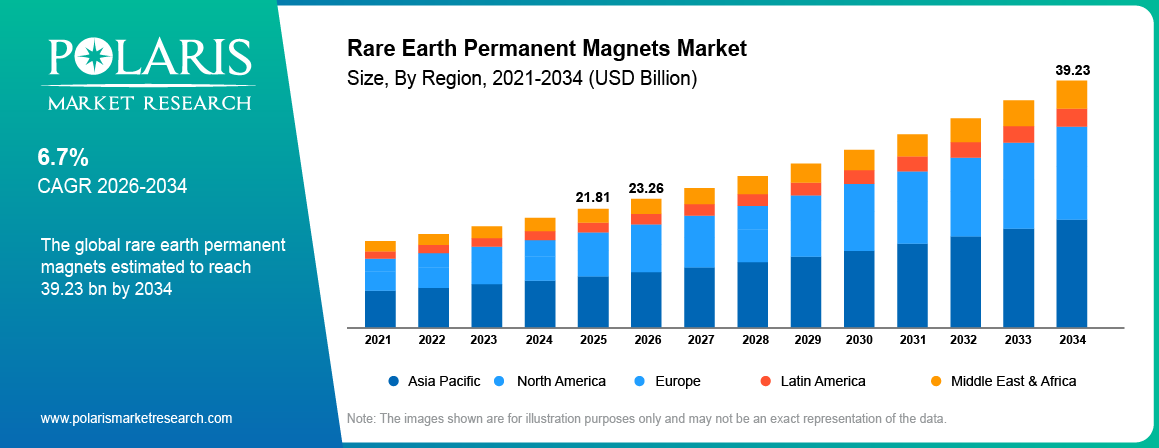
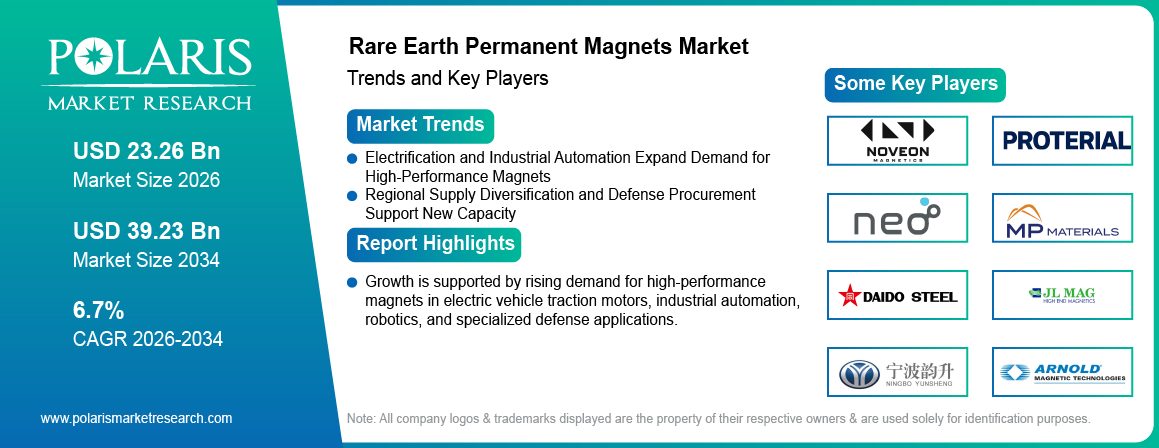
The Rare Earth Permanent Magnets Market size was valued at USD 21.81 Billion in 2025. The market is expected to grow at a CAGR of 6.7% from 2026 to 2034. Growth is supported by rising demand for high-performance magnets in electric vehicle traction motors, industrial automation, robotics, and specialized defense applications.
Market Statistics
Key Takeaways
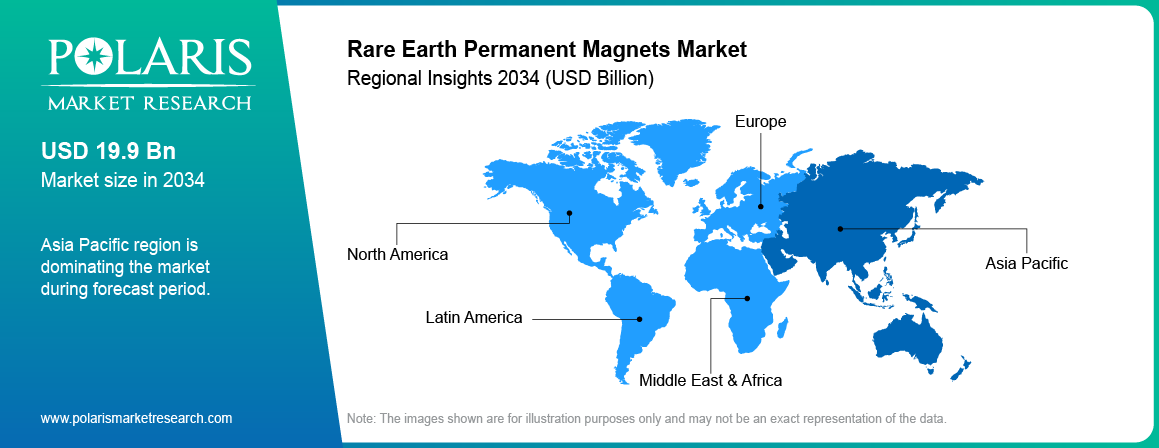
- Asia Pacific accounted for 46.63% of the global Rare Earth Permanent Magnets Market in 2025, supported by China’s established magnet manufacturing base, integrated supply chains, and export activity.
- North America is expected to witness a 7.08% CAGR in the forecast period owing to investments in domestic magnet manufacturing, strategic procurement initiatives, and supply chain diversification.
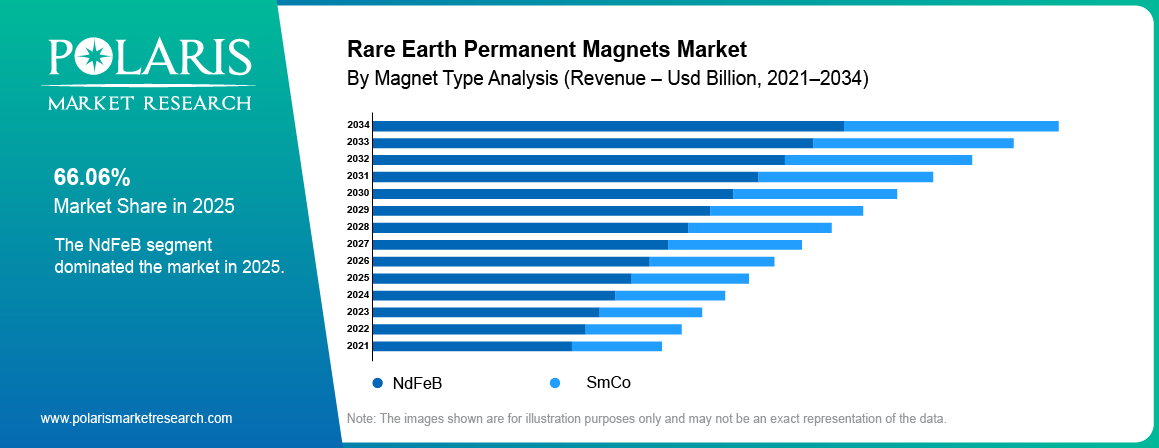
- NdFeB magnets accounted for 66.06% of the market in 2025, due to their application in electric vehicle traction motors, industrial servo systems, consumer electronics and other applications requiring high magnetic performance.
- Heavy Rare Earth Free and Reduced Grades are expected to grow at a 9.22% CAGR, fueled by efforts to reduce reliance on dysprosium and terbium while maintaining application-specific magnetic performance.
- The automotive sector accounted for 39.52% of the market in 2025, due to the demand for rare earth permanent magnets used in electric vehicle drive systems and other automotive components.
- Industrial and Robotics is forecast to see 6.72% CAGR growth, driven by demand from servo motors, precision-motion systems, industrial automation and new robotic applications.
Note: Figures and projections outlined in this report are the result of Polaris Market Research’s proprietary analytical processes, grounded in the latest available datasets and market observations.
What Is the Rare Earth Permanent Magnets Market?
The rare earth permanent magnets market covers materials that retain their magnetism after an external magnetic field is removed. This report concentrates on two families of materials, neodymium iron boron (NdFeB) and samarium cobalt (SmCo). With their high magnetic performance, they allow for compact designs in applications where space, weight, efficiency or operating conditions prevent the use of conventional materials. Within the wider permanent magnets market, the scope includes sintered, bonded, and hot-deformed variants supplied as blocks, shaped parts, and finished magnets. Ferrite, alnico, rare earth free magnets such as iron nitride (Source: Niron Magnetics), upstream oxides and metals, and finished motors are excluded.
In the NdFeB magnets market, magnets are widely used in applications that require strong magnetic output in a relatively compact volume. Their performance can be tuned by composition and processing techniques, including techniques that minimize the need for dysprosium and terbium. SmCo magnets use samarium and cobalt and are selected for applications where thermal stability and performance under demanding conditions are important.
The industry sits at the intersection of materials science, precision manufacturing, and end-market engineering. Magnet makers supply components directly to motor manufacturers or work through industrial customers and specialized distributors. Some companies also participate in upstream alloy or rare earth processing, making the revenue boundary important when assessing the magnet market alone. The analysis distinguishes magnet production from upstream rare earth metals activity and from finished products such as traction motors. It also separates rare-earth permanent magnets from rare-earth-free substitutes, even where those alternatives compete for similar applications. A product is in scope if it is a finished or semi finished magnet containing rare earth elements; metal, alloy and motor revenue is not.
Value Chain Snapshot
| Stage | Activity | Representative Companies | Report Scope |
| Oxides and metals | Separation, refining, metal making | Neo Performance Materials; MP Materials | Excluded |
| Alloys | Magnet alloy production | USA Rare Earth (Less Common Metals) | Boundary case |
| Magnet production | Sintered, bonded, hot deformed NdFeB and SmCo | JL MAG; VACUUMSCHMELZE; Proterial | Included |
| Finished magnets | Blocks, shaped parts, coated magnets | Arnold Magnetic Technologies; TDK | Included |
| Motors and assemblies | Traction, servo, generator motors | Motor makers and OEMs | Excluded |
| Recycling | Scrap and end of life recovery | MP Materials | Feeds supply |
Source: Polaris Market Research Analysis; company disclosures cited in this report.
Market Dynamics
Driver and Opportunity Impact Analysis
| Driver or Opportunity | Overall Impact | 2026 to 2028 | 2029 to 2031 | 2032 to 2034 |
| Driver: Electrification and industrial automation | High | High | High | High |
| Driver: Regional supply diversification and defense procurement | High | High | High | Medium |
| Opportunity: Heavy rare earth free and reduced grades | Medium | Medium | Medium | High |
| Opportunity: Recycled magnets and non China supply | Medium | Medium | Medium | High |
Source: Polaris Market Research Analysis. Ratings cover the drivers and opportunities discussed in this section and are qualitative analyst assessments.
Driver: Electrification and Industrial Automation Expand Demand for High-Performance Magnets
Electric vehicles, industrial servo systems, and robotics rely on permanent magnet motors that strike a balance between torque, efficiency, and size. This link between motor design and magnet supply defines demand in the rare earth permanent magnets market. Rare earth permanent magnets enable engineers to satisfy these needs, especially for applications where a compact motor design is desirable. Industrial automation, robotic systems, and other precision-motion applications also create opportunities for magnet suppliers, although the amount and grade of magnet material used varies by design.
JL MAG Rare Earth’s first-half 2026 update reported revenue growth of approximately 30% for new-energy vehicle and auto-parts activities and approximately 90% for robot and servo-motor activities. These are company-reported revenue trends, not market-wide growth rates, but they illustrate the different demand channels influencing manufacturers. The company also referred to traction-motor and industrial applications in its outlook. The broader implication is that magnet demand is becoming more closely tied to electrification and automation investment, while individual suppliers remain exposed to customer programs, product mix, and capacity utilization (Source: Investing.com, JL Mag first half 2026 forecast).
Demand from robotics adds a further layer to the market’s development. Humanoid robots and other advanced robotic systems require compact actuators, motors, and precision components, but magnet consumption varies with architecture and the number and type of motors deployed. For suppliers, the commercial opportunity lies in qualifying materials for customer designs and delivering consistent performance at scale.
Driver: Regional Supply Diversification and Defense Procurement Support New Capacity
Governments and industrial buyers are increasingly stressing secure access to key magnet materials. The commercial importance of how and where magnets are made, and where their inputs come from, has grown with export licensing, strategic sourcing and domestic manufacturing programs. In the US, the Department of Defense’s agreement with MP Materials includes a price floor of USD 110 per kilogram for NdPr and a 10-year offtake arrangement for the company’s 10X magnet production. The arrangement also includes Department of Defense financing support. These terms provide a defined demand and pricing framework for a U.S.-based supply initiative (Source: MP Materials, public-private partnership with the Department of Defense).
Other projects reflect the same strategic direction, although their timelines and commercial structures differ. VACUUMSCHMELZE opened its Sumter, South Carolina, plant in July 2026, and the company disclosed an agreement to supply NdFeB magnet blocks to the Defense Logistics Agency. USA Rare Earth announced a proposed South Carolina facility for magnet and metal production, while Vulcan Elements disclosed a large U.S. supply partnership. These developments offer potential options for buyers. New facilities can deliver reliable supply once qualification, commissioning, material availability and customer approvals are achieved.
Restraint: Concentrated Production and Qualification Requirements Limit Rapid Substitution
China’s established magnet industry benefits from manufacturing scale, supplier networks, and experience serving a wide range of customers. New plants elsewhere face a different starting point, as they must establish processes, build skilled teams, qualify products, secure inputs, and demonstrate consistent performance.
Export licensing adds uncertainty to procurement schedules. China began licensing exports of seven heavy rare earth elements and magnets containing them in April 2025. Separate measures introduced in October 2025 were later suspended until November 2026, according to the policy timeline reviewed for this report. The licensing framework for the earlier group of materials remained in force. Companies using dysprosium and terbium in high-performance magnet grades must therefore consider material availability, licensing lead times, and the possibility of changes to trade conditions (Source: China Briefing, China’s rare earth export controls; Mainrich International, China rare earth export controls and MOFCOM licensing).
Opportunity: Heavy Rare Earth Free and Reduced-Content Grades
Reducing dependence on heavy rare earth elements is an important product-development opportunity. Dysprosium and terbium can help preserve coercivity at elevated temperatures, but their availability and price can affect production economics. Manufacturers are therefore developing compositions and processing methods that limit heavy rare earth use while retaining the required magnetic properties. Such products are particularly relevant for traction motors and other applications with demanding thermal requirements.
Proterial has introduced heavy-rare-earth-free NdFeB grades, including NMX F1SH HF and NMX G1NH HF, for evaluation in electric-vehicle drive-motor applications. The company’s published material describes a remanence rating of 1.40 tesla for the NMX F1SH HF grade. This is a product-level specification, not a market-wide performance benchmark. The commercial value of these grades will depend on customer qualification, production economics, and whether they meet application-specific requirements across temperature ranges and operating cycles (Source: Proterial, heavy rare earth free neodymium sintered magnet release, July 2025).
Manufacturing methods also support lower heavy rare earth use. Grain boundary diffusion, for example, is intended to concentrate selected elements in regions where they can improve coercivity, rather than distributing them uniformly through the magnet. MP Materials has identified grain boundary diffusion as part of its planned 10X manufacturing approach (Source: Dallas Innovates, MP Materials 10X campus announcement, February 2026).
Opportunity: Recycled Magnets and Rule-Backed Non-China Supply
Rare earth recycling provides a potential route to recover rare earth materials from manufacturing scrap and end-of-life products. MP Materials and Apple announced a USD 500 million partnership for recycled rare earth magnets in July 2025, ahead of the 10X campus plan announced in February 2026. The partnership signals commercial interest in incorporating recycled material into a domestic magnet supply chain, although the broader economics will depend on collection, separation, material quality, and processing costs (Source: MP Materials Form 10-Q, Apple agreement and Department of Defense terms, 2025).
European policy proposals also place circularity on the agenda. The European Union has considered measures involving permanent-magnet waste exports and proposals for recycled-content disclosure and minimum recycled content in magnets from 2031. These proposals are part of a developing regulatory framework, and their final requirements and implementation timetable may change. For suppliers, the opportunity is to build traceable material flows and recycling capabilities that can serve customers seeking lower exposure to primary inputs (Source: IEA, RESourceEU Action Plan; ERP, proposed circularity rules for magnets).
Market Segmentation Analysis
The Rare Earth Permanent Magnets Market analysis is segmented by magnet type, manufacturing process, heavy rare earth content, end use industry, and supply-chain origin. These dimensions distinguish the magnetic material selected by the customer, manufacturing route used to produce it, the grade’s dependence on heavy rare earth elements, industry purchasing the magnet, and geographic origin of supply.
Magnet Type Insights
The NdFeB segment accounted for 66.06% of the market in 2025, driven by demand for high-performance magnets in compact motor and electromechanical designs. Neodymium-iron-boron magnets are relevant to electric vehicle drive systems, consumer electronics, industrial automation, and robotics, where magnetic performance and component size influence equipment design. Manufacturers are also increasing production capacity to meet demand from customers looking for qualified magnet supply away from existing Chinese manufacturing bases. VACUUMSCHMELZE's Sumter plant, which opened in July 2026, provides dedicated NdFeB magnet-block capacity for the North American supply base. The development reflects the commercial importance of NdFeB products to regional manufacturing strategies. (Source:
The SmCo segment, or samarium cobalt magnets market, is expected to grow at a 6.39% CAGR over the forecast period due to the growing demand for rare-earth magnets in applications requiring thermal stability and consistent magnetic performance under demanding operating conditions. Samarium-cobalt magnets are used in special applications where the operating environment and reliability specifications are considered in the selection of the material. Their position in the market also reflects procurement requirements in aerospace and defense applications where buyers look at material characteristics along with traceability and supply-chain compliance. In March 2026, Arnold Magnetic Technologies and USA Rare Earth signed a mutual sales and distribution agreement covering finished SmCo and NdFeB magnets (Source: Arnold Magnetic Technologies, March 2026). Specific NdFeB and SmCo magnets within covered weapons systems are identified by U.S. defense procurement restrictions that are set to go into effect in January 2027. As a result, origin and production-stage compliance are important considerations when making purchases (Source: TechTimes, U.S. defense procurement restrictions).
Manufacturing Process Insights
The Sintered segment held 70.14% of the market share in 2025, due to its application in the manufacturing of high-performance rare-earth magnets for applications that require demanding magnetic properties. Sintered NdFeB products are particularly relevant to electric mobility and industrial motor applications, where magnetic properties must meet the requirements of the finished system. Investment announcements across several regions indicate that sintered NdFeB production is a key focus of current capacity development. Proterial’s announced investment in Andhra Pradesh, India, is designed to establish production capacity for sintered NdFeB magnets and broaden the geographic base of manufacturing (Source: New Projects Tracker, Proterial India magnet plant).
The Bonded segment is expected to grow at a 7.13% CAGR during the forecast period, supported by applications in which component geometry, dimensional flexibility, and integration into the finished product influence the manufacturing decision. Bonded magnets combine magnetic powder with a binder, allowing manufacturers to produce shapes that may be difficult or less economical to achieve through other processing routes. Their suitability depends on the required magnetic performance, mechanical properties, production volume, and operating conditions.
The Hot-Deformed segment is projected to record a V CAGR during the forecast period, reflecting demand for specialized magnet structures and performance characteristics. In the rare-earth permanent magnet industry, hot deformation is a unique manufacturing method with different production considerations than traditional sintering and powder-binder processes. The commercial suitability of this method depends on the magnet’s intended application, the properties required by the customer, and the manufacturer’s process capabilities. Daido Steel started a 1.5 billion yen production line for heavy rare earth free hot deformed magnets for hybrid vehicle traction motors in April 2026 (Source: Daido Steel, FY2026 business briefing, June 2026).
Heavy Rare Earth Content Insights
Standard Grades held 72.65% of the market in 2025, reflecting demand for magnets specified to meet the performance requirements of the intended application. Depending on the grade and operating conditions, heavy rare earth elements may be used to support coercivity and performance at elevated temperatures. Buyers assess these properties against motor design, operating temperature, reliability requirements, and qualification criteria. Standard grades remain a distinct commercial category as the amount and type of heavy rare earth content vary by formulation and application.
The Heavy Rare Earth Free and Reduced Grades segment is expected to register a 9.22% CAGR during the forecast period as magnet producers work to reduce dependence on heavy rare earth inputs while meeting application-specific performance requirements. Proterial’s NMX F1SH HF product is an example of a heavy-rare-earth-free NdFeB grade developed for electric vehicle drive motors. Such products illustrate how magnet formulation can support efforts to manage material exposure without changing the application’s underlying need for permanent-magnet performance (Source: Magnetics Magazine, Proterial heavy rare earth free magnet, August 2025).
End Use Industry Insights
The Automotive segment accounted for 39.52% of the market in 2025, supported by demand for permanent magnets in electric vehicle traction motors and other vehicle systems. Automotive customers evaluate magnetic performance alongside thermal behaviour, reliability, production consistency, and the requirements of the motor design. The market also includes suppliers developing magnet products for changing vehicle-platform needs. New-energy vehicle and automotive-parts activities drove revenue growth for JL MAG Rare Earth in the first half of 2026, highlighting the commercial importance of this customer segment (Source: GMT Eight, JL Mag first half 2026 forecast).
The Consumer Electronics segment is expected to grow at a 5.74% CAGR during the forecast period, due to demand for compact components requiring controlled magnetic performance. Permanent magnets are used in miniature motors, speakers and other electronic assemblies where size, weight and product design influence the component selection. Demand varies by device category and product architecture, so not every electronic product uses rare-earth magnets. MP Materials and Apple announced a USD 500 million partnership in July 2025 to supply recycled rare earth magnets from Fort Worth, Texas for Apple devices (Source: MP Materials, Apple partnership, July 2025).
The Industrial and Robotics segment is expected to witness a 6.72% CAGR over the forecast period propelled by the rising demand from servo motors, industrial automation equipment, precision-motion systems and robotic applications. These systems require magnets tailored to specific torque, size, operating temperature and control requirements. Demand is also growing outside of traditional industrial machinery as manufacturers create products for emerging robotic platforms. Ningbo Yunsheng has identified humanoid robotics and electric vertical take-off and landing aircraft as areas of development, indicating that magnet suppliers are seeking more applications (Source: SMM, Ningbo Yunsheng intelligent manufacturing project update).
The Aerospace and Defense segment registered 9.25% in 2025. Magnets used in equipment have specific needs in the aerospace and defense industry and reliability, traceability and procurement compliance can be material purchasing considerations. Applications are platform/subsystem dependent and magnet specifications are driven by engineering and qualification requirements versus simply the end use label. Buyers also need to establish the origin of the magnet and relevant production stages to demonstrate compliance with applicable procurement rules.
The Wind and Renewable Energy segment is projected to record a 7.61% CAGR during the forecast period, reflecting the potential use of permanent magnets in selected generator and energy-system designs. Demand depends on equipment architecture, generator configuration, operating conditions, and the choice between permanent-magnet and alternative technologies.
Supply-Chain Origin Insights
The China-Linked segment accounted for a market share of 81.65% in 2025 owing to production networks in China for the production and supply of rare-earth permanent magnets. China-connected supply can be magnets made in China, or products with upstream parts that rely on Chinese production. Buyers assess this exposure alongside price, availability, technical specifications, and delivery reliability. Supply-chain origin is therefore a commercial and regulatory classification.
The Non-China segment is projected to grow at a 10.85% CAGR during the forecast period as manufacturers and buyers seek additional production options and greater supply-chain resilience. Investment in rare earth magnet supply outside China includes both operating facilities and projects that remain under development, so announced capacity should not be treated as current output. MP Materials’ planned 10X campus in Northlake, Texas, is one example of investment intended to expand U.S. rare-earth magnet production. The project also illustrates the importance of assessing commissioning schedules, customer commitments, and input sourcing when evaluating the commercial contribution of non-China capacity (Source: AllianceTexas, MP Materials 10X campus).
Regional Insights
The rare earth permanent magnets market regional analysis covers North America, Europe, Asia Pacific, Latin America, and the Middle East & Africa. Regional demand and supply conditions vary according to magnet manufacturing capacity, access to rare earth materials, automotive and industrial demand, trade flows, government procurement policies, and investment in alternative supply chains.
North America Rare Earth Permanent Magnets Market Trends
In 2025, North America held 21.48% of the global rare earth permanent magnets market. Regional activity is supported by efforts to develop domestic magnet manufacturing, strengthen defense supply chains, and reduce dependence on established overseas production networks. MP Materials has revealed its 10X magnet manufacturing campus in Northlake, Texas, investing more than USD 1.25 billion, with a commissioning timeline expected to start in 2028. The project uses grain boundary diffusion technology and is part of the company’s wider strategy to expand U.S. rare earth magnet production (Source: Fort Worth Report, MP Materials 10X campus). VACUUMSCHMELZE and eVAC Magnetics opened their Sumter, South Carolina plant on July 15, 2026, described as the first large scale U.S. producer of these magnets in more than 25 years (Source: SC Economic Developers’ Association, Sumter opening, July 2026).
Europe Rare Earth Permanent Magnets Market Trends
In 2025, Europe accounted for 22.16% of the global rare earth permanent magnets market, fueled by initiatives to establish regional magnet production and diversify access to critical materials. Neo Performance Materials announced its magnet manufacturing plant in Narva, Estonia, opened in September 2025 with an initial annual capacity of about 2,000 tons. The site provides a regional manufacturing base for rare earth magnets and strengthens Europe’s efforts to reduce its dependence on imports of finished products. However, domestic magnet manufacturing still requires reliable access to upstream materials and qualified inputs. European market development will therefore depend on the integration of magnet production, raw-material sourcing, recycling, and customer qualification (Source: Neo Performance Materials, Q2 2026 results). The EU supported the factory with EUR 14.5 million from the Just Transition Fund (Source: European Commission, September 2025).
Asia Pacific Rare Earth Permanent Magnets Market Trends
Asia Pacific is expected to register a 7.24% CAGR during the forecast period, supported by its established magnet manufacturing base and investment in additional production capacity across regional markets. India is emerging as a location for new manufacturing investment, with Proterial announcing plans to invest INR 22.5 billion in an Andhra Pradesh facility designed to produce 1,200 tonnes of sintered NdFeB magnets annually. South Korea is also seeking to expand its position through a memorandum of understanding between Noveon Magnetics and Kangwon Energy for a planned facility with annual capacity of 2,000 tonnes. These projects indicate growing interest in regional supply alternatives, although announced capacity is distinguished from operational production (Sources: Rare Earth Exchanges, Proterial India magnet plant; Noveon Magnetics, Korean facility MOU).
Latin America Rare Earth Permanent Magnets Market Trends
Latin America accounted for 5.22% of the global rare earth permanent magnets market in 2025. Regional demand is associated with automotive production, industrial equipment, electronics, renewable-energy systems, and other applications that use permanent magnets. However, published data on finished rare earth permanent magnet manufacturing or country level consumption across the region remains limited. Mining activity and the availability of rare earth resources should not be treated as evidence of an established finished-magnet manufacturing industry.
Middle East & Africa Rare Earth Permanent Magnets Market Trends
The Middle East & Africa region held 4.51% of the global rare earth permanent magnets market in 2025. Regional market development depends on access to qualified magnet suppliers, import channels, industrial demand, and the use of permanent magnets in selected mobility, energy, manufacturing, and defense applications. Published data on magnet manufacturing developments and regional demand remains limited.
Export and Import Data Analysis
The trade reporting used in this analysis shows that in July 2026, China exported 5,375.1 tonnes of rare earth permanent magnets. The reported volume was down 3.6% year over year and 4.9% from June. The same source implied an average export price of approximately USD 60.4 per kilogram, equivalent to about USD 324.6 million in value when applied to the reported volume (Source: Bloominglobal.com).
Export Analysis: China Rare Earth Magnet Exports by Period
| Period | Exports (tonnes) | Change and Basis |
| Full year 2025 | 57,392 | Down 1.3% year over year |
| Dec 2025 | 5,952 | Down 3.2% from November |
| May 2026 | 4,730 | Lowest of the months shown |
| Jun 2026 | 5,652.05 | Up approximately 19.49% from May |
| Jul 2026 | 5,375.10 | Down 4.90% month over month and 3.60% year over year |
Destination Analysis: China Rare Earth Magnet Exports by Importing Region
| Importing Region | Period | Volume (tonnes) | Change and Basis |
| European Union | Jul-26 | 2,141.90 | Up 0.10% year over year and 0.70% month over month |
| European Union | Jan–Feb 2026 | 4,775.00 | Up 28.40% year over year |
| European Union | Jan–Jul 2026 | 15,165.00 | Up approximately 17.00% versus Jan–Jul 2024 |
| United States | Full year 2025 | 5,933.00 | Down 20.30% year over year |
| United States | Jan–Jul 2026 | 3,521.00 | Down approximately 16.00% versus Jan–Jul 2024 |
| United States | Jul-26 | 647.3 | Up 32.60% month over month and 4.50% year over year |
| United States | Aug-26 | 512 | Down approximately 21.00% from July and 13.00% year over year |
| South Korea | Jul-26 | 606.5 | Down 26.50% month over month but up 19.30% year over year |
| Japan | Jul-26 | 111.4 | Down 13.60% month over month and 52.10% year over year |
| World, rare earth permanent magnets | Sep-26 | 6,165.12 | Up 23.00% month over month and 6.70% year over year |
| World, rare earth elements | Sep-26 | 4,269.80 | Up 6.70% year over year; Jan–Sep volume down 9.60% |
Note: Figures cover rare earth magnets exported from China, as reported by Chinese customs. Comparable customs data for other exporting countries was not identified. The data is redacted intentionally.
Sources: Polaris Market Research Analysis.
China’s magnet exports to the European Union reached 4,775 tonnes in January and February 2026, representing 44.4% of China’s reported rare earth magnet exports during the period. U.S. imports of magnets from China dropped to 512 tonnes in August 2026, a 21% month-on-month decline. These trade flows underscore the significance of destination-specific demand and export licensing in the rare earth magnet supply chain (Sources: Transparency Now, SCMP report; The Oregon Group, U.S. magnet exports).
China's total rare earth exports across all product types totaled 4,269.8 tonnes in September 2026, an increase of 6.7% year over year. This figure covers rare earth products broadly, not permanent magnets alone. The suspension of China’s October 2025 export-control measures is due to end on November 10, 2026, although the related China and U.S. trade arrangement was extended to January 10, 2027 on September 28, 2026, making subsequent licensing conditions and destination-specific shipments of NdFeB magnets important indicators for the NdFeB magnets market (Sources: Reuters via Yahoo Finance; NAMI Trade Services, November 2026 suspension scenarios)
Competitive Landscape
The rare earth permanent magnets market competitive landscape includes established Chinese producers, Japanese integrated materials companies, and Western manufacturers building additional capacity. Competition is shaped by production scale, access to rare earth inputs, magnet-grade expertise, customer qualification, and the ability to meet origin and traceability requirements. Some companies operate across several stages of the value chain, while others focus on magnet production or specific regional supply relationships. The company list below follows the scope defined for this report.
Vendor Landscape Snapshot
| Company | Market Position | HQ Region | Core Focus | Scale or Differentiator |
| JL MAG Rare-Earth Co., Ltd. | Leader | China | Sintered NdFeB at scale | About 40,000 tonnes capacity, end 2025 |
| Proterial, Ltd. | Leader | Japan | NdFeB, heavy rare earth free grades | Heavy rare earth free grades, 600+ patents |
| Shin-Etsu Chemical Co., Ltd. | Leader | Japan | Integrated materials and magnets | Integrated refining and magnets |
| VACUUMSCHMELZE GmbH & Co. KG | Challenger | Germany, U.S. | NdFeB and SmCo | Sumter plant, about 2,000 tonnes |
| MP Materials Corp. | Challenger | U.S. | Mine to magnet | 10X campus, 10,000 tonne target |
| Ningbo Yunsheng Co., Ltd. | Challenger | China | Sintered NdFeB | Sintered NdFeB for NEV and servo motors |
| Beijing Zhong Ke San Huan High-Tech Co., Ltd. | Challenger | China | NdFeB magnets | Grain boundary diffusion, lower heavy rare earth use |
| Yantai Zhenghai Magnetic Material Co., Ltd. | Challenger | China | Low heavy rare earth grades | Low and no heavy rare earth technology |
| TDK Corporation | Niche Player | Japan | NEOREC neodymium magnets | NEOREC series, catalog evidence only |
| Daido Steel Co., Ltd. (Daido Electronics Co., Ltd.) | Niche Player | Japan | Hot deformed, bonded magnets | Heavy rare earth free hot deformed grades |
| Arnold Magnetic Technologies Corporation | Niche Player | U.S. | SmCo and NdFeB, defense | SmCo and NdFeB, USA Rare Earth distribution partner |
| Neo Performance Materials Inc. | Emerging Player | Estonia, Canada | Sintered NdFeB for Europe | Narva plant, 2,000 tonnes initial |
| Noveon Magnetics Inc. | Emerging Player | U.S. | Sintered and recycled magnets | U.S. sintered plant, recycling technology |
| USA Rare Earth, Inc. | Emerging Player | U.S. | Metals and magnets | Planned 6,400 tonne plant, 2028 start |
| Vulcan Elements Inc. | Emerging Player | U.S. | NdFeB with federal backing | 10,000 tonne target, USD 620 million federal loan |
Market positions are Polaris analyst classifications based on scale and differentiators, not ranked market shares. Sources: Polaris Market Research Analysis
Chinese rare earth magnet manufacturers like JL MAG Rare Earth, Ningbo Yunsheng, Yantai Zhenghai Magnetic Material and Zhong Ke San Huan benefit from established production networks, customer relationships and manufacturing experience. Their activities span automotive, industrial, and other magnet-consuming markets. Differences in product mix, capacity, and customer exposure shape competition.
Outside China, investment is expanding the range of potential suppliers. MP Materials is developing its U.S. magnet manufacturing operations, VACUUMSCHMELZE has opened its Sumter facility, and Neo Performance Materials operates a magnet plant in Estonia. USA Rare Earth, Vulcan Elements, and Noveon Magnetics are pursuing additional supply-chain initiatives. Their competitive contribution will depend on commissioning, qualified output, material access, and customer contracts. Energy Fuels agreed in June 2026 to acquire VACUUMSCHMELZE for about USD 1.9 billion, so the ownership of a named player may change (Source: The Globe and Mail, Energy Fuels press release, June 2026).
Japanese manufacturers contribute through magnet technology and materials expertise. Proterial is developing heavy-rare-earth-free grades and an Indian manufacturing facility, while Shin-Etsu Chemical’s planned refinery investment highlights the connection between upstream material access and finished magnet production.
Competition depends on product consistency, magnetic performance, delivery reliability, technical support, and origin documentation. New facilities must demonstrate consistent commercial output and meet customer qualification requirements before they can compete directly with established suppliers. No source ranks suppliers by rare earth permanent magnets market share, so the order of companies here reflects evidence of scale, not a ranked share. Evidence of an active rare earth magnet program is thinner for TDK Corporation than for the other listed companies.
Technology and Innovation Landscape
The innovations of the rare earth permanent magnets market are aimed at improving magnetic performance, reducing the dependency on heavy rare earths, improving manufacturing processes and recovering material from scrap. Sintered NdFeB remains important for high-performance applications, while bonded and hot-deformed magnets serve different requirements for geometry, processing, and magnetic properties.
Grain Boundary Diffusion and Reduced Heavy Rare Earth Use
Grain boundary diffusion can improve selected magnetic properties by introducing elements into targeted regions of a magnet’s microstructure. Depending on the grade and process, this technique can reduce the amount of heavy rare earth material needed to achieve a specified coercivity. MP Materials has identified the technology as part of its planned 10X magnet manufacturing strategy (Source: MP Materials, 10X campus announcement, February 2026).
Proterial’s heavy-rare-earth-free NdFeB grades illustrate a different approach to reducing dependence on constrained inputs. Suitability depends on operating temperature, geometry, and the required balance between remanence and coercivity. Buyers must assess the finished magnet against the technical requirements of the intended application.
Process Selection: Sintered, Bonded, and Hot-Deformed Magnets
Sintered NdFeB magnets are produced by powder processing and consolidation and are used in applications requiring high magnetic performance. Bonded magnets are a composite material which is made by mixing magnetic powder with a binder, which allows for various forming techniques and intricate shapes. Hot-deformed magnets are developed by controlled deformation to achieve certain microstructures and magnetic properties. The appropriate process depends on the component specification, performance requirements, and production economics.
Recycling and Alternative Materials
Magnet recycling can recover rare earth materials from manufacturing scrap and end-of-life components. Commercial viability depends on feedstock availability, recovery yield, processing costs, and the quality of recovered material. MP Materials’ partnership with Apple links recycled magnet material with its broader domestic manufacturing strategy.
Technology and Innovation Landscape Snapshot
| Technology | Role | Representative Company | Stage |
| Sintered NdFeB | High performance mainstream route | VACUUMSCHMELZE; JL MAG | Commercial |
| Bonded magnets | Complex shapes using a binder | Daido Electronics | Commercial |
| Hot deformed magnets | Fine grain, low heavy rare earth | Daido Steel | Commercial |
| Grain boundary diffusion | Cuts heavy rare earth use | Proterial; MP Materials | Commercial and planned |
| Heavy rare earth free grades | Removes dysprosium and terbium | Proterial | Sample stage |
| Recycled magnet feedstock | Recovers rare earths from scrap | MP Materials | Expanding |
| Iron nitride magnets | Rare earth free substitute | Niron Magnetics | Plant planned, 2027 |
Sources: Polaris Market Research Analysis.
Use Case Analysis
Rare earth permanent magnets are selected according to the magnetic performance, size, weight, and operating conditions required by the finished system. Automotive, industrial automation, aerospace and defense, and selected renewable-energy applications have different technical and procurement requirements.
Automotive: NdFeB Magnets in Traction Motors
Electric vehicle traction motors are an important application for high-performance neodymium magnets. Selection depends on torque, efficiency, thermal performance, packaging, and cost. Motor architecture, cooling, power electronics, and control systems also influence overall vehicle performance.
JL MAG Rare Earth’s reported growth in revenue from new-energy vehicle and automotive-parts activities highlights the commercial importance of this customer group. Magnet requirements nevertheless vary across vehicle platforms (Source: Remio, JL MAG first half 2026 results).
Industrial and Robotics: Precision Motion and Servo Systems
Industrial automation uses permanent magnets in servo motors, actuators, and precision-motion equipment. Robotics extends these applications into compact drive systems where torque, weight, and available space affect component selection. JL MAG’s reported increase in robot and servo-related revenue demonstrates growing commercial activity in this customer category.
Humanoid robotics presents an additional potential application area, although magnet quantity and grade depend on actuator configuration and robot design. Estimating magnet demand per robot requires product-level specifications rather than a single industry-wide assumption.
Aerospace and Defense: Reliability and Origin Requirements
Aerospace and defense applications require magnets that meet demanding reliability and operating-temperature specifications. SmCo is used where thermal stability is important, whereas NdFeB is leveraged for applications requiring high magnetic performance within the relevant operating limits. Procurement also includes traceability and compliance with restrictions on origin.
U.S. defense procurement restrictions scheduled for January 2027 identify specified NdFeB and SmCo magnets for covered weapons systems. Suppliers serving these programs will need to meet applicable origin, production-stage, and contract requirements (Source: Metal Powder Report, defense procurement restrictions).
Wind and Renewable Energy: Magnet Selection by Generator Design
Permanent magnets are used in selected wind-generator and renewable-energy system designs. Demand depends on generator architecture, power rating, operating environment, and service requirements.
Premium Insights and Forward Outlook
November 2026 Export-Control Milestone
The suspension of China’s October 2025 export-control measures is due to end on November 10, 2026 under MOFCOM Announcement No. 70, according to the policy timeline reviewed for this report. Separately, the licensing framework introduced in April 2025 for seven heavy rare earth elements and magnets containing them remains relevant. Buyers should distinguish the scope and status of each measure when assessing procurement and delivery risks (Sources: China Countermeasures, rare earth export control tracker; Technology.org, China’s rare earth export pause, October 2026). MOFCOM said on September 28, 2026 that the Kuala Lumpur joint arrangement was extended to January 10, 2027, but no announcement amending the suspension had been published as of October 22, 2026, so the legal expiry date remains November 10, 2026. The January 1, 2027 U.S. defense procurement rule for Chinese origin magnets is set by U.S. law and applies regardless of the outcome (Sources: Rare Earth Investing, October 2026; Environment and Energy Leader, defense contractor rules).
For manufacturers and buyers in the neodymium magnet market, the key considerations are licensing requirements, shipment timing, and the availability of qualified alternatives. Regional capacity expansion may improve sourcing options, while its impact depends on commercial output, grade suitability, and competitive pricing. Together, these factors determine the rare earth permanent magnets industry forecast, which treats announced capacity separately from commissioned output.
Heavy Rare Earth Reduction and Magnet Economics
Reducing heavy rare earth content can lower exposure to constrained inputs, although the benefits vary by grade and application. Proterial’s heavy-rare-earth-free products and MP Materials’ planned use of grain boundary diffusion illustrate approaches to improving material efficiency. Their commercial value depends on whether the resulting magnets meet required operating conditions, production yields, and customer qualification standards.
Non-China Capacity and Commercial Readiness
New magnet projects in the US, Europe, India, and South Korea are expanding potential supply options. Their contribution must be assessed by project status, commissioning progress, qualified output, input sourcing, and customer commitments.
Recycling and alternative magnet grades may also help address selected supply constraints, but their market impact depends on the volume of usable material and the applications they can serve.
Cost and Pricing Benchmarking Analysis
Rare earth permanent magnet prices vary by material, grade, dimensions, manufacturing process, order volume, and contract structure. Customs-derived averages provide a trade reference but can combine products with different specifications.
Cost and Pricing Benchmarks
| Item | Reference | Basis | Price or Value |
| Rare-earth permanent magnet exports | China, July 2026 | Average derived from reported magnet trade value and volume | USD 60.40/kg |
| NdPr material under U.S. Department of Defense agreement | MP Materials partnership | Contractual price floor for NdPr material | USD 110.00/kg |
| Heavy-rare-earth-free NdFeB grades | Proterial | Indicative high-performance grade benchmark; not a published Proterial list price | USD 90.00–160.00/kg |
| Sintered NdFeB magnet blocks | VACUUMSCHMELZE | Indicative N35–N52 commercial range; not a published VAC list price | USD 60.00–120.00/kg |
| Bonded rare-earth magnets | Multiple suppliers | Indicative finished-magnet range based on process, geometry and volume | USD 50.00–100.00/kg |
| Hot-deformed rare-earth magnets | Multiple suppliers | Indicative specialty-grade range reflecting hot pressing and deformation processing | USD 80.00–150.00/kg |
Sources: Polaris Market Research Analysis based on China customs data cited in the Export and Import section; CNBC, MP Materials agreement with the Department of Defense.
The USD 110/kg price floor applies to NdPr material, not finished magnets. Buyers should compare quotations using the same grade, dimensions, tolerances, order quantity, delivery terms, and origin requirements.
Key Players in the Rare Earth Permanent Magnets Market
- Arnold Magnetic Technologies
- Daido Electronics (Daido Steel group)
- JL MAG Rare-Earth
- MP Materials
- Neo Performance Materials
- Ningbo Yunsheng
- Noveon Magnetics
- Proterial
- Shin-Etsu Chemical
- TDK Corporation
- USA Rare Earth
- VACUUMSCHMELZE
- Vulcan Elements
- Yantai Zhenghai Magnetic Material
- Zhong Ke San Huan
Industry Developments
- July 2026: VACUUMSCHMELZE GmbH & Co. KG and eVAC Magnetics opened the Sumter, South Carolina rare earth magnet plant on July 15, 2026, described as the first large scale U.S. producer of these magnets in more than 25 years. (Source: eVAC Magnetics)
- June 2026: Energy Fuels Inc. signed a definitive agreement to acquire VACUUMSCHMELZE GmbH & Co. KG for about USD 1.9 billion in cash and stock, with closing expected in early 2027. (Source: Energy Fuels)
- May 2026: Daido Steel Co., Ltd. announced a traction motor rotor using heavy rare earth free hot deformed magnets, developed jointly with NHK Spring Co., Ltd. (Source: Monoscope)
- March 2026: Arnold Magnetic Technologies Corporation and USA Rare Earth, Inc. signed a mutual, non exclusive sales and distribution agreement covering finished SmCo and NdFeB magnets and processed NdFeB feedstock. (Source: Manufacturing Dive)
- February 2026: MP Materials Corp. selected Northlake, Texas as the site of its 10X magnet campus, with more than USD 1.25 billion of planned investment and commissioning set to begin in 2028. (Source: Community Impact)
- April 2026: Neo Performance Materials commissioned a small scale heavy rare earth separation production line at its Silmet facility in Estonia, producing terbium and dysprosium materials used in high-performance permanent magnets. (Source: Neo Performance Materials)
- November 2025: India approved a USD 815 million (INR 7,280 crore) programme to establish domestic rare earth permanent magnet manufacturing capacity of 6,000 tonnes a year. The initiative aims to reduce import dependence and strengthen local supply chains for electric vehicles, renewable energy systems, and advanced industrial applications. (Source: Business Standard)
- September 2025: The European Union supported the opening of a rare earth permanent magnet factory in Narva, Estonia, with EUR 14.5 million from the Just Transition Fund. The facility expands European magnet manufacturing capacity for electric vehicles, wind turbines, and microelectronics while reducing dependence on imported magnets. (Source: Il Sole 24 Ore)
- July 2025: Proterial, Ltd. developed heavy rare earth free neodymium sintered magnets NMX F1SH HF and NMX G1NH HF for electric vehicle drive motors. (Source: SMM)
- July 2025: MP Materials Corp. and Apple Inc. announced a USD 500 million partnership to supply recycled rare earth magnets made in Fort Worth, Texas. (Source: Apple Newsroom)
Market Segmentation
By Magnet Type (Revenue, USD Billion, 2021–2034)
- NdFeB
- SmCo
By Manufacturing Process (Revenue, USD Billion, 2021–2034)
- Sintered
- Bonded
- Hot Deformed
By Heavy Rare Earth Content (Revenue, USD Billion, 2021–2034)
- Standard Grades
- Heavy Rare Earth Free and Reduced Grades
By End Use Industry (Revenue, USD Billion, 2021–2034)
- Automotive
- Consumer Electronics
- Industrial and Robotics
- Aerospace and Defense
- Wind and Renewable Energy
- Others
By Supply Chain Origin (Revenue, USD Billion, 2021–2034)
- China Linked
- Non China
By Regional Outlook (Revenue, USD Billion, 2021–2034)
- North America
- US
- Canada
- Europe
- Germany
- France
- UK
- Italy
- Spain
- Netherlands
- Rest of Europe
- Asia Pacific
- China
- Japan
- India
- South Korea
- Taiwan
- Australia
- Rest of Asia Pacific
- Latin America
- Brazil
- Mexico
- Argentina
- Rest of Latin America
- Middle East & Africa
- Saudi Arabia
- UAE
- South Africa
- Rest of Middle East & Africa
Rare Earth Permanent Magnets Market Report Scope
| Report Attributes | Details |
| Market Size in 2025 | USD 21.81 Billion |
| Market Size in 2026 | USD 23.26 Billion |
| Revenue Forecast by 2034 | USD 39.23 Billion |
| CAGR | 6.7% from 2026-2034 |
| Base Year | 2025 |
| Historical Data | 2021–2024 |
| Forecast Period | 2026–2034 |
| Quantitative Units | Revenue in USD Billion and CAGR |
| Report Coverage | Revenue Forecast, Growth Factors, Competitive Landscape, Industry Trends, and Strategic Analysis |
| Segments Covered | By Magnet Type, Manufacturing Process, Heavy Rare Earth Content, End Use Industry, Supply Chain Origin, and Region |
| Regional Scope | North America, Europe, Asia Pacific, Latin America, Middle East & Africa |
| Competitive Landscape | Company Profiling, Product Benchmarking, Financial Analysis, Market Developments, and Strategic Initiatives |
| Report Format | PDF + Excel |
| Customization | Available by Country, Region, and Segment |
Source: Polaris Market Research Analysis
Why Choose Polaris Market Research?
Polaris Market Research & Consulting, Inc. combines market analysis with company-level evidence, technology assessment, trade analysis, and competitive benchmarking. This rare earth permanent magnets market report distinguishes rare earth permanent magnets from ferrite and alnico products, upstream rare earth materials, and finished motors. That separation helps buyers and industry participants evaluate the rare earth magnets market without conflating it with adjacent value chains.
The analysis also considers how production capacity, material availability, origin requirements, and manufacturing processes affect supplier positioning. Company announcements are presented in context, with planned facilities distinguished from operating plants and reported company performance distinguished from market-wide growth. This approach gives readers a clearer basis for evaluating the commercial significance of capacity additions and emerging technology.
Clients can request additional analysis by region, magnet type, manufacturing process, end-use industry, or supply-chain origin. A customized study can also examine the commercial implications of heavy rare earth reduction, recycling, supplier qualification, and changes in export controls. If you need this scope cut by supply chain origin or by heavy rare earth content, Polaris Market Research & Consulting, Inc. will build a custom study around it. The report details above list the scope and purchase options for the full report.
Research Methodology
This study uses a structured research approach that combines market scoping, secondary evidence collection, market estimation, validation, and analyst review. Secondary research prioritizes company disclosures, trade reporting, policy summaries, and industry publications. The analysis separates magnet production from upstream rare earth materials and finished motors, maintaining a consistent boundary for the rare earth permanent magnets market.
Primary research for rare earth magnets market can include discussions with magnet manufacturers, material suppliers, industrial buyers, procurement specialists, and technology experts. These discussions can help assess grade selection, customer qualification, sourcing constraints, manufacturing costs, and the practical effect of export licensing. The research distinguishes reported company data, third-party trade information, derived calculations, and proprietary Polaris estimates.
Five-Phase Research Methodology
| Phase | Activity | Evidence Used in This Report |
| 1. Scoping | Define the market boundary and distinguish rare earth magnets from ferrite, alnico, rare-earth-free alternatives, upstream materials, and finished motors | Market definition and scope exclusions |
| 2. Secondary Research | Review company releases, industry reporting, trade data, and policy summaries | Company announcements, export data, and policy sources cited in the report |
| 3. Estimation | Develop revenue estimates and forecasts on a consistent market basis | Polaris internal data |
| 4. Validation | Assess capacity announcements, policy timelines, product claims, and price references | Competitive landscape, trade analysis, and cost benchmarks |
| 5. Quality Review | Review scope consistency, source attribution, terminology, figures, and publication quality | Analyst review and quality checklist |
Source: Polaris Market Research Analysis.
The research process distinguishes operating capacity from planned projects and reported figures from derived estimates. Market size, revenue share, and CAGR values reflect Polaris analysis.
Rare Earth Permanent Magnets Market FAQ's
The market was valued at USD 21.81 billion in 2025 and is projected to reach USD 39.23 billion by 2034.
Asia Pacific is the leading region, supported by China’s established magnet manufacturing and export base. The region accounted for 46.63% of the global market in 2025.
NdFeB magnets lead by magnet type, supported by demand from electric vehicles, industrial motors, and robotics. The segment accounted for 66.06% of the market in 2025.
The market is projected to grow at a CAGR of 6.7% during the 2026–2034 forecast period, driven by electrification, automation, and supply-chain diversification.
Key trends include regional manufacturing investments, heavy rare earth reduction, magnet recycling, and increased attention to export licensing and supply-chain traceability.
NdFeB magnets offer high magnetic performance in compact designs, while SmCo magnets are valued for thermal stability in demanding applications. Selection depends on operating conditions and technical requirements.
Export licensing can affect material availability and shipment schedules, encouraging buyers to diversify suppliers and assess supply-chain origin.
Rare earth permanent magnets are neodymium iron boron and samarium cobalt magnets that keep their magnetism without an external field, allowing compact and high performance motor designs.
Six export control measures announced in October 2025 return after November 10, 2026 unless China formally extends or replaces the suspension. MOFCOM said on September 28, 2026 that the related trade arrangement was extended to January 10, 2027, but no amending announcement had been published as of October 22, 2026. The April 2025 licensing of seven heavy rare earths stays in force.
Outside China, rare earth magnets are made in Japan, in Germany, Finland and Slovakia by VACUUMSCHMELZE, in the U.S. at its Sumter plant and in Estonia at the Neo Performance Materials Narva plant. India and South Korea have planned plants.
Key companies covered include JL MAG Rare-Earth, Ningbo Yunsheng, Yantai Zhenghai Magnetic Material, Zhong Ke San Huan, Proterial, Shin-Etsu Chemical, TDK Corporation, VACUUMSCHMELZE, Daido Electronics, Arnold Magnetic Technologies, MP Materials, Neo Performance Materials, Noveon Magnetics, USA Rare Earth, and Vulcan Elements.
Humanoid robots may create additional demand for compact, high-performance magnets in motors and actuators. Actual demand depends on robot design, actuator configuration, and magnet specifications.
Prices depend on magnet composition, grade, dimensions, manufacturing process, order volume, and delivery terms. Trade-derived averages are not equivalent to supplier quotations for specific finished magnets.
U.S. procurement restrictions scheduled for January 1, 2027, cover specified NdFeB and SmCo magnets of restricted origin in covered weapons systems, subject to applicable exceptions and contract requirements.
Polaris Market Research & Consulting, Inc. offers market research reports and customized studies covering regional demand, magnet types, manufacturing processes, heavy rare earth content, and supply-chain origin.
Download Sample Report of Rare Earth Permanent Magnets Market
Please fill out the form to request a customized copy of the research report.


